
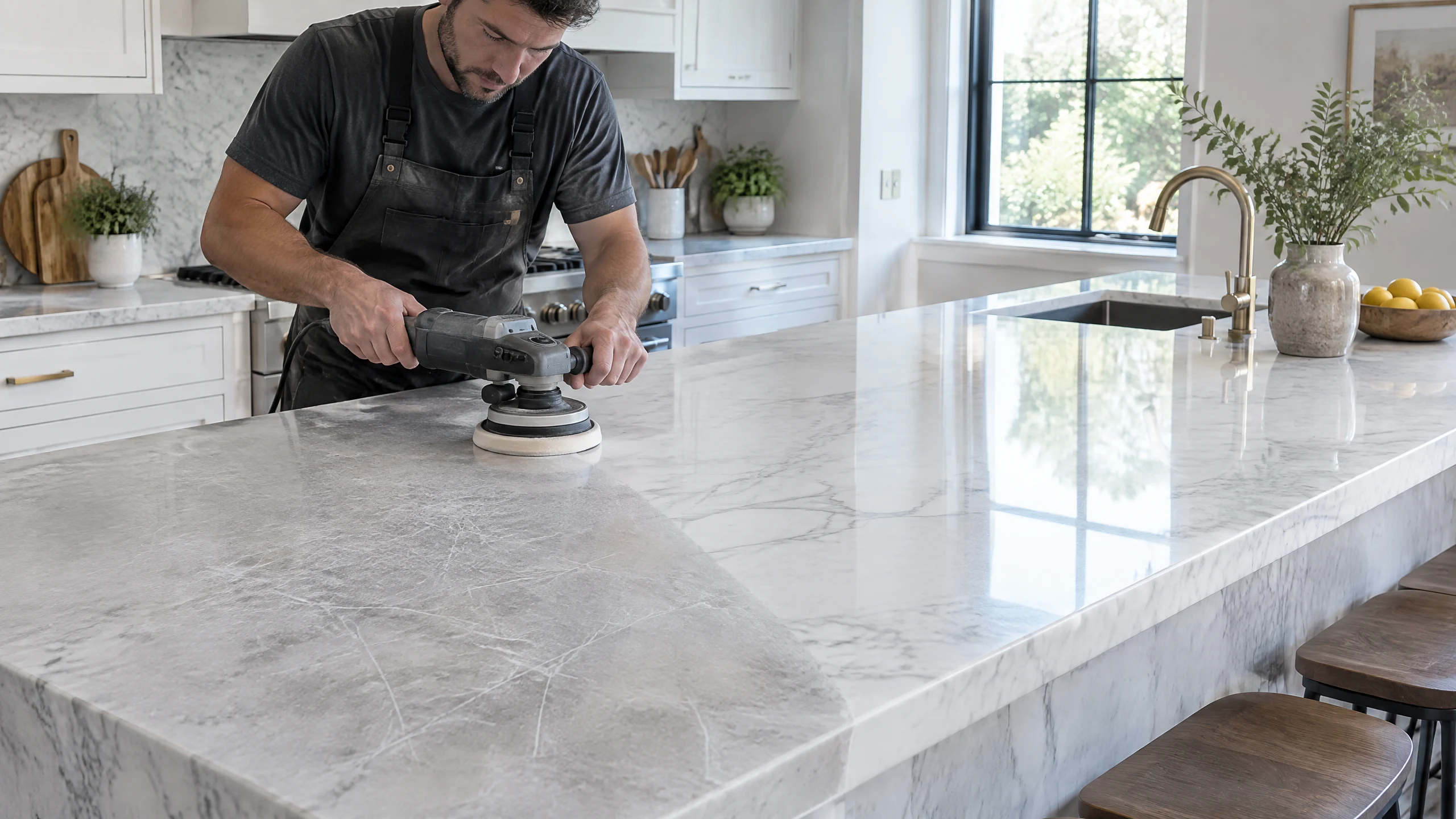
J. Perry & Sons restores stone and quartz countertops in homes, condos, restaurants and offices across Broward and Palm Beach counties: etch removal and re-polishing on marble, chip and edge repair on granite and quartzite, seam repair, stain treatment and sealing. It is the countertop side of our stone restoration service and the fix most owners do not know exists; a marble island that has gone dull and ringed does not need to be replaced. Read marble polishing vs honing for what each process does, then send photos of the damage.
Countertop Restoration Cost in South Florida: $8–$15 per sq ft to re-polish marble, $150–$400 per chip repair
| Scope | Typical size | Installed range |
|---|---|---|
| Etch removal and re-polish, marble or limestone | 40–80 sq ft kitchen | $8–$15 per sq ft |
| Hone to a matte finish, marble or travertine | 40–80 sq ft | $7–$12 per sq ft |
| Chip or edge repair, color-matched resin or epoxy | per chip, up to 1 in | $150–$400 per chip |
| Crack or fissure fill and polish | per linear ft | $60–$150 per ft |
| Seam repair: remove failed adhesive, re-glue, color match, level | per seam | $200–$500 per seam |
| Stain removal with poultice | per stain, 1–3 visits | $150–$450 per stain |
| Impregnating sealer, natural stone | 40–80 sq ft | $3–$6 per sq ft |
| Quartz scorch, scratch or chip repair | per spot | $200–$500 per spot |
| Minimum service visit | any | $350–$600 |
Ranges cover labor, abrasives, repair compounds and sealer. Quartz cannot be re-polished the way stone can, so quartz work is limited to spot repair and the result is good but not invisible; we say that before we start. Commercial bar tops and reception counters are priced by the square foot with after-hours scheduling when needed.
Free Estimate
Free estimate — call (561) 556-7509 or email jperrysonsgc@gmail.com with project photos, the city, approximate dimensions, and material selections.
What can be restored and what cannot
Marble, limestone and travertine. The most restorable surfaces. Etching from lemon, wine and vinegar, water rings, dull traffic zones and light scratches all come out with diamond abrasives and a polishing compound. A honed finish hides daily wear better than polished and is what we recommend for a working kitchen.
Granite. Rarely etches but chips at the sink and edge, loses its factory shine at the faucet from hard-water buildup, and develops failed seams. Chips are filled with color-matched resin, seams re-glued and leveled, and the surface cleaned of mineral deposits before resealing.
Quartzite. Hard, but soft veins and fissures open up and some quartzites etch. We fill fissures, re-polish and seal. True quartzite polishes well; a stone sold as quartzite that is really a dolomitic marble polishes like marble, and we test before quoting.
Quartz (engineered). Resin-bound, so heat scorches it and sunlight yellows it near windows. We repair chips and small scorch marks with color-matched compound and can blend light scratches. Deep heat damage and widespread yellowing are replacement, not restoration, and we say so.
Sealing. An impregnating sealer slows absorption of oil and water in natural stone. It does not stop etching, which is a chemical reaction with the stone surface. Marble will etch again; a honed finish and a sealer make it less visible and easier to maintain. See sealing natural stone in Florida humidity.
Free estimate — call (561) 556-7509 or email jperrysonsgc@gmail.com. Send a photo of the counter and the damaged spots and we'll return a range the same day.
How we restore a countertop
- Inspection. We identify the stone, test an inconspicuous spot for etching and absorption, photograph every chip, seam and stain, and check the overhang supports and sink mounting while we are there.
- Protection. Cabinets, backsplash, floors and appliances are masked. Wet polishing is controlled with a slurry ring so water does not run into the cabinets.
- Repairs first. Chips are cleaned, filled with color-matched polyester or epoxy, cured and shaved flush. Failed seams are opened, the old adhesive removed, the slabs pulled tight, re-glued and leveled. Fissures are filled.
- Stain treatment. Oil, rust and organic stains get a poultice matched to the stain, left 24–48 hours, sometimes repeated. We tell you up front which stains are likely to lift and which have gone too deep.
- Honing. Diamond pads from 200 to 800 grit remove etching, scratches and the damaged surface layer. Flat areas are machine-honed; edges, around faucets and backsplash lines are done by hand.
- Polishing. For a polished finish, pads continue to 3,000 grit and a polishing powder brings back the reflective surface. For a honed finish we stop at the grit that matches the look you want and buff.
- Clean and seal. The surface is neutralized, dried and sealed with an impregnating sealer. Two coats on marble and limestone. Sealer cures before the counter is used.
- Care sheet. We leave a one-page note on cleaners, cutting boards and what will etch, so the finish lasts.
Countertops in South Florida: humidity, salt and busy kitchens
Humidity. Natural stone in a South Florida kitchen takes on moisture from the air year-round, which slows sealer cure and makes porous stones like limestone and travertine more prone to stains. We schedule sealing with the AC running and allow extra cure time.
Coastal homes. Salt air and hard water leave mineral haze around faucets and on outdoor kitchen counters. Granite and quartzite outdoors need cleaning and resealing more often, and quartz should not be used outdoors at all because UV breaks down the resin.
Condos and rentals. Marble counters in condo kitchens and baths are often etched by tenants or guests within a season. Re-polishing between tenants costs a fraction of replacement, needs no permit and takes one day.
Commercial counters. Restaurant bar tops, hotel reception desks, office break rooms and retail cash wraps in marble, granite and quartz get re-polished and resealed after hours. We carry insurance naming the property owner and schedule around operating hours.
No permit. Countertop restoration is a finish service with no plumbing or electrical, so no permit is involved in Broward or Palm Beach.
Related stone and countertop services
- Stone restoration: marble, travertine and terrazzo floors honed, polished and sealed.
- Stone slab installation: new quartz, quartzite, marble and porcelain slab counters when restoration is not enough.
- Kitchen renovation: counters, backsplash and cabinets in one contract.
- Tile repair and regrout: backsplash and tile counter repair.
- Commercial renovation: restaurant, hotel and office finish work on a schedule.
What a countertop restoration estimate includes
- Stone or surface type, confirmed by test
- Square footage of surface to be honed or polished and the target finish
- Count and location of chips, fissures and failed seams
- Stains by type and the likely result of poultice treatment
- Edge work, faucet and backsplash detail by hand
- Sealer product and number of coats
- Protection, slurry control and cleanup
- Schedule, cure time before use, and after-hours work if commercial
- A note on what cannot be restored, if anything
Countertop restoration by city
Stone slab installation in Fort Lauderdale · Stone slab installation in Miami · Stone slab installation in Boca Raton · Stone slab installation in West Palm Beach · Stone slab installation in Weston · Stone slab installation in Delray Beach · Stone slab installation in Parkland · Stone slab installation in Wellington
Planning guides: Marble and travertine floor restoration cost · Marble polishing vs honing · Sealing natural stone in Florida humidity · Quartzite countertop cost · Stone slab installation
Countertop restoration & polishing — FAQ
How much does it cost to re-polish a marble countertop? $8–$15 per square foot for etch removal and re-polishing, or $7–$12 to hone to a matte finish. A typical kitchen with an island runs $600–$1,500 including sealer, with a $350–$600 minimum for small jobs.
Can etch marks on marble be removed? Yes. Etching is surface damage, not a stain, and it comes out with diamond honing and re-polishing. A honed finish afterward makes future etches far less visible.
Can quartz countertops be polished? Not the way stone can. The resin in quartz does not respond to stone polishing compounds. We repair chips, scorch spots and light scratches with color-matched compound; heavy heat damage and yellowing are replacement.
Can a chipped granite edge be fixed? Yes. The chip is cleaned, filled with a color-matched resin, cured and shaved flush, then polished to blend. At the sink edge or a corner the repair is usually invisible from standing height.
How often should stone counters be sealed? Marble, limestone and travertine every one to two years in South Florida; granite and quartzite every two to three. A drop of water that darkens the stone within a few minutes means it is time. Quartz is not sealed.
How do I get an exact price? Call (561) 556-7509 or email jperrysonsgc@gmail.com with photos and rough dimensions. A written estimate is typically ready within 24–48 hours after a site review and scope confirmation.
Free estimate — call (561) 556-7509 or email jperrysonsgc@gmail.com. Licensed Florida general contractor CGC1540699. Serving Broward and Palm Beach counties.
Free Estimate
Free estimate — call (561) 556-7509 or email jperrysonsgc@gmail.com with project photos, the city, approximate dimensions, and material selections.