
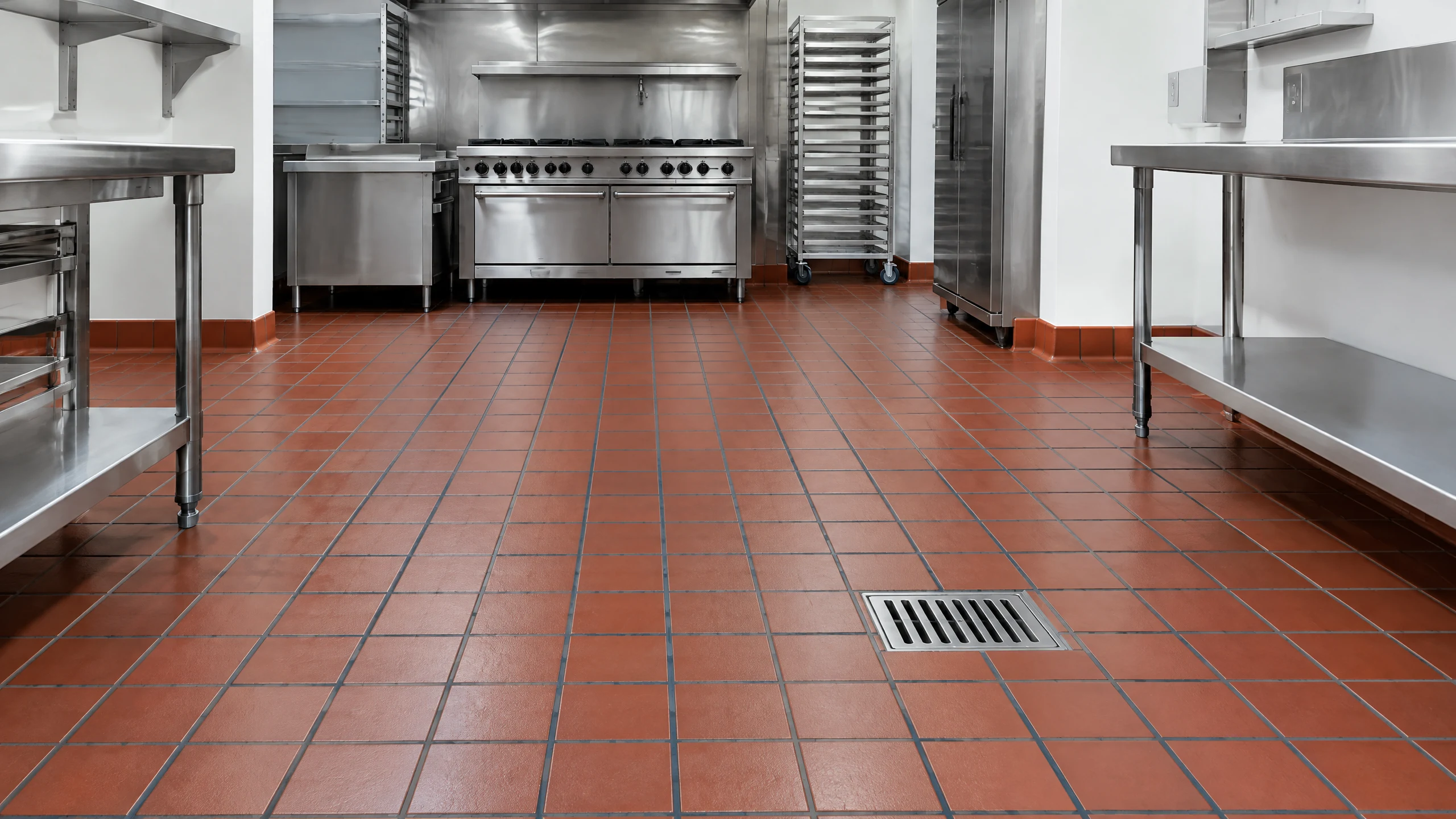
J. Perry & Sons installs kitchen and dining-room tile for restaurants, bars, cafes, hotel kitchens, school and hospital kitchens, and grocery prep areas across Broward and Palm Beach counties. A commercial kitchen floor has one job: hold up to grease, hot water, carts and nightly degreaser without ever letting water sit, and pass the health inspector. That means quarry tile or slip-rated porcelain, epoxy grout, a 6-inch coved base with a sanitary radius and a floor that slopes to the drain. We build it for restaurant owners, franchise groups and general contractors as a licensed commercial renovation contractor. The full spec is in restaurant kitchen floors: quarry tile, epoxy grout, coved base, drains.
Restaurant Kitchen Tile Cost in South Florida: $14–$22 per sq ft installed
| Item | Spec | Installed range (labor + setting materials) |
|---|---|---|
| Quarry tile floor, 6x6, epoxy grout | kitchen, dish pit, prep | $14–$22 per sq ft |
| Porcelain alternative, DCOF 0.42+ wet, 12x12 or 12x24 | kitchen or service line | $14–$20 per sq ft |
| 6" quarry cove base with sanitary radius | per linear ft | $16–$26 per lf |
| Slope-to-drain mud bed, 1/4" per ft | per sq ft of sloped area | $4–$8 per sq ft |
| Floor drain or trench drain set in tile | each, plumbing by others | $350–$900 |
| Waterproofing membrane under tile (dish pit, walk-in, upper floor) | per sq ft | $3–$6 per sq ft |
| Wall tile or tile wainscot to FRP transition | per sq ft | $16–$26 per sq ft |
| Dining room porcelain floor, 12x24 or 24x24 | 800–4,000 sq ft | $9–$16 per sq ft |
| Demo of old quarry tile or VCT, haul-away | per sq ft | $3–$6 per sq ft |
Ranges are labor and setting materials with tile supplied by the owner or GC. A 1,200 sq ft kitchen with new quarry tile, cove base, two drains and a sloped dish pit typically lands between $22,000 and $38,000 before demo. Night and weekend work in an operating restaurant adds 15–30 percent to labor.
Free Estimate
Free estimate — call (561) 556-7509 or email jperrysonsgc@gmail.com with project photos, the city, approximate dimensions, and material selections.
Materials for restaurant and kitchen floors
Quarry tile, 6x6, unglazed. Fired dense clay with an abrasive surface that stays slip-resistant when greasy, in 1/2-inch thickness that takes dropped stockpots and cart wheels. Red, gray or tan; abrasive-grain versions for the dish pit and cook line.
Slip-rated porcelain. For a lighter look in an open kitchen or service line, a porcelain with a wet DCOF of 0.42 or higher in 12x12 or 12x24. It cleans the same and costs about the same installed.
100 percent solids epoxy grout. Grease, food acids and nightly degreaser destroy cement grout within a year in a kitchen. Epoxy does not absorb, stain or need sealing. It is in every kitchen floor we price.
Sanitary cove base. A 6-inch quarry cove with a formed inside radius at the floor, formed corner pieces and a bullnose cap where it meets FRP or wall tile.
Membranes and drains. A bonded waterproofing membrane under the dish pit, walk-in floor and any kitchen above another tenant, with clamping-ring drains tied to it.
Free estimate — call (561) 556-7509 or email jperrysonsgc@gmail.com. Send the kitchen plan with drain locations and we'll return a range the same day.
How we install a commercial kitchen floor
- Kitchen plan and drain locations. We price from the kitchen designer's equipment plan, which sets drain positions, slope zones, cove base runs and where equipment curbs land.
- Demolition. Old quarry tile, VCT or failed epoxy comes out with dust-shrouded tools, usually overnight, with the old mortar bed ground to sound concrete. Asbestos check on older VCT and mastic first.
- Drain and plumbing coordination. The plumber sets drain bodies to our finished floor elevation. We confirm each drain is 1/4 inch per foot below the surrounding floor before any bed goes down.
- Slope-to-drain bed. A mortar bed screeded to the drains at 1/4 inch per foot in dish pits, behind the cook line and anywhere water is thrown. Flat areas are leveled where needed at $3–$6 per sq ft.
- Waterproofing. Membrane over the bed in wet zones, turned up the wall behind the cove, clamped into each drain and flood-tested.
- Layout. Quarry tile laid with 1/4- to 3/8-inch joints so the epoxy grout has enough body. Cuts fall under equipment and at the cove, not in the aisle.
- Setting. Latex-modified mortar, back-buttered quarry tile, cove base set after the floor with the radius piece resting on the floor tile, corners formed.
- Epoxy grouting. Mixed in small batches, forced into the full joint depth, cleaned in two passes. Movement joints at the perimeter and at equipment curbs, sealed with a chemical-resistant sealant.
- Cure and turnover. Epoxy is left to reach full cure before equipment rolls back, then the floor is washed and released with the health department documentation the owner needs.
Restaurant tile in Broward and Palm Beach: health inspections, grease and slabs
Health department and plan review. Florida restaurant plan review and the local health inspection both check the kitchen floor: smooth, durable, cleanable, coved at the wall, no open joints. Quarry or porcelain with epoxy grout and a formed cove base passes.
Permits. A kitchen floor replaced in kind is often exempt, but any change to drains, the hood or the layout requires a building permit in Broward and Palm Beach, and the GC pulls it. See commercial renovation permits in Broward County and Palm Beach County.
Slab moisture and old grease. Years of grease soak into a concrete slab. We grind to clean concrete and degrease before any mortar; a bond failure over a greasy slab shows up as hollow tile within months.
Humidity and cure. Epoxy grout and mortar cure on temperature and humidity, so the kitchen stays conditioned during the work. Most kitchen floors here are replaced over a two- to five-day closure or in overnight zones, with equipment moved and reset by the owner's kitchen contractor.
How we work with GCs and property managers
- Certificate of insurance naming the owner, the landlord and the GC, issued before mobilization, with license copy.
- Bids from drawings in 48 hours from the kitchen equipment plan and finish schedule, with unit prices per sq ft, per linear foot of cove and per drain.
- Night and closure work sequenced with the plumber, hood contractor and kitchen equipment installer so the floor cures before equipment rolls back.
- Per-sq-ft and per-lf unit pricing so a revised equipment plan or an added walk-in prices out without renegotiation.
- Closeout documents: flood-test records, product data for tile, grout and membrane, DCOF reports, attic stock and workmanship warranty terms.
Related commercial renovation services
- Commercial tile contractor: tile and stone for GCs across all building types.
- Hotel and hospitality tile: hotel restaurants, bars and banquet kitchens.
- Commercial bathroom and restroom renovation: customer and employee restrooms.
- Office and retail tile and flooring: dining rooms, cafes and food-hall tenant spaces.
- Epoxy flooring: seamless resinous floors for walk-ins, storage and back of house.
What a restaurant kitchen tile estimate includes
- Kitchen floor area by zone, drain count and slope zones from the equipment plan
- Demolition, slab grinding, degreasing and leveling, with the closure or overnight schedule
- Slope-to-drain mortar bed, waterproofing and flood test in wet zones
- Quarry or porcelain tile with mortar and epoxy grout; cove base by linear foot
- Wall tile, dining-room and restroom tile where in scope
- Plumber and equipment-installer coordination, COI, closeout and workmanship warranty terms
Restaurant tile by city
Commercial renovation in Fort Lauderdale · Commercial renovation in Miami · Commercial renovation in Boca Raton · Commercial renovation in West Palm Beach · Commercial renovation in Weston · Commercial renovation in Delray Beach · Commercial renovation in Parkland · Commercial renovation in Wellington
Planning guides: Restaurant kitchen floors: quarry tile, epoxy grout, coved base, drains · Commercial tile cost per sq ft · Commercial bathroom renovation cost · Retail tile installation after hours · Commercial renovation permits in Broward
Restaurant and commercial kitchen tile — FAQ
How much does a quarry tile kitchen floor cost? $14–$22 per sq ft installed with epoxy grout, labor and setting materials with the tile supplied. Cove base adds $16–$26 per linear foot, and sloped areas add $4–$8 per sq ft for the mortar bed.
Quarry tile or porcelain for a commercial kitchen? Quarry tile is the proven choice: thick, abrasive and forgiving. A porcelain with a wet DCOF of 0.42 or higher works where the owner wants a lighter color in an open kitchen. Both get epoxy grout and a cove base.
Why does the floor need to slope? Health codes and the kitchen designer require water to reach the drain rather than pool. We screed a mortar bed at 1/4 inch per foot to each drain in the dish pit and wet zones so the floor dries after wash-down.
How long is the kitchen closed? A full kitchen floor typically takes two to five days of closure, or it runs in overnight zones over a longer period. Epoxy grout needs its cure time before equipment rolls back; we set that date in the schedule.
Who sets the floor drains? The plumber sets the drain bodies to the finished floor elevation we provide; we build the slope to them and clamp the membrane into them. Plumbing is priced separately.
How do I get an exact price? Call (561) 556-7509 or email jperrysonsgc@gmail.com with the kitchen equipment plan and drain locations. A written estimate is typically ready within 24–48 hours after a site review and scope confirmation.
Free estimate — call (561) 556-7509 or email jperrysonsgc@gmail.com. Licensed Florida general contractor CGC1540699. Serving Broward and Palm Beach counties.
Free Estimate
Free estimate — call (561) 556-7509 or email jperrysonsgc@gmail.com with project photos, the city, approximate dimensions, and material selections.