
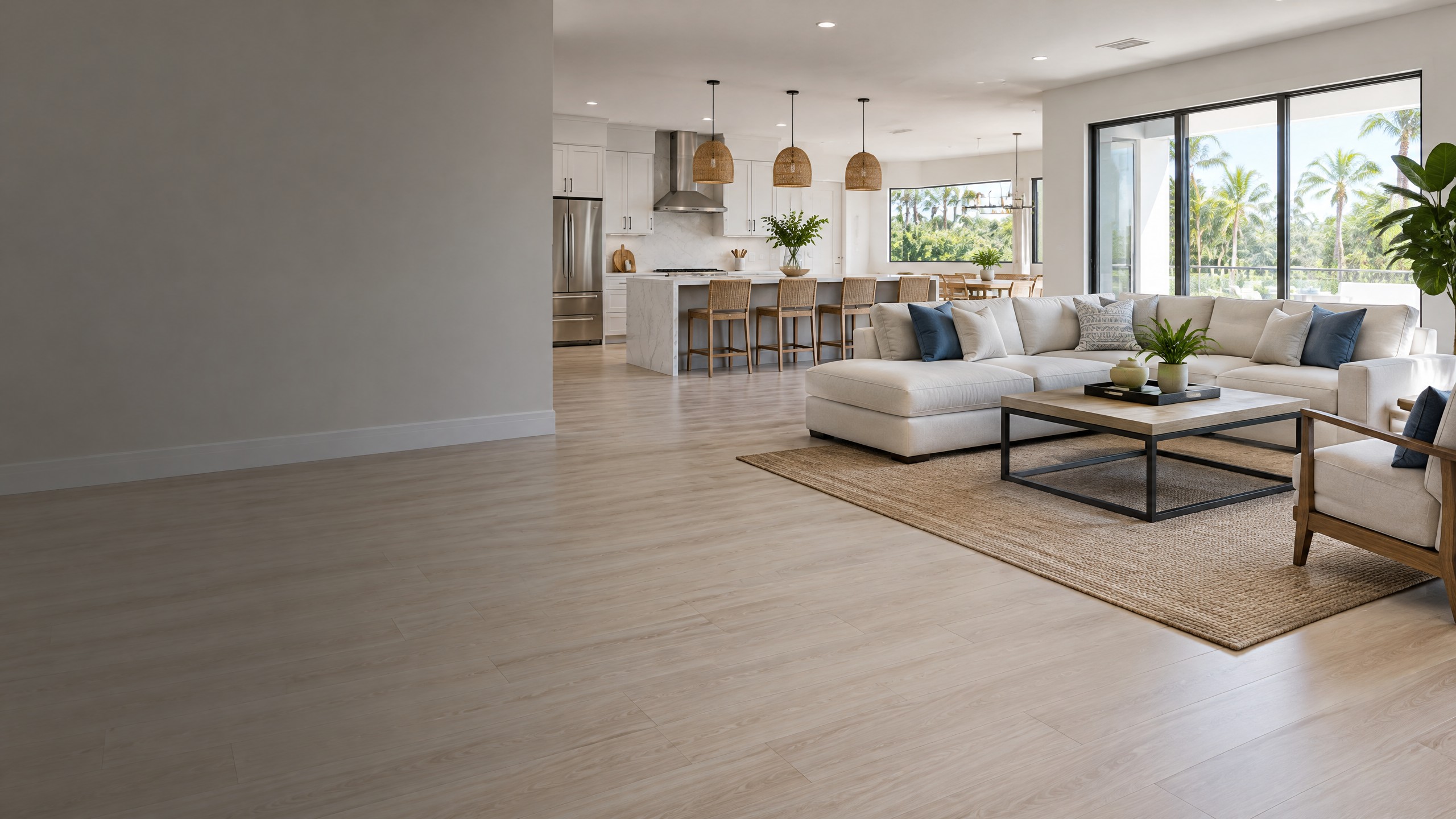
Replacing the floors is the biggest disruption most families take on short of a kitchen remodel, because it touches every room. This page covers residential flooring from the homeowner's side: which floor for which room, whether to do the whole house at once, what your condo board will ask for, and how to live through it. The products and installation method are explained on our main flooring installation page. Offices, stores and clinics are covered on our commercial flooring page. J. Perry & Sons is a licensed Florida general contractor serving Broward, Palm Beach and Miami-Dade.
Residential Flooring Cost by Home Situation
The table groups our standard rates by the situations homeowners actually face. Material is supplied by you unless we quote it.
| Your situation | Typical floor choice | Installed range |
|---|---|---|
| Single-family home, old tile out, new tile through the house | Standard porcelain, plus demo | $14–$18 per sq ft, demo $4–$6 |
| Family with pets and kids, wants a wood look | Wood-look porcelain plank | $17–$23 per sq ft |
| Open living area, primary suite, resale focus | Large-format porcelain, 24x48 and up | $25–$34 per sq ft |
| Bedrooms or a rental, budget-conscious | Luxury vinyl plank | $6–$9 per sq ft, plank only, subfloor prep extra |
| Wants real wood on a slab | Engineered hardwood, glued down | $14–$21 per sq ft |
| Older home with a wavy slab | Self-leveling underlayment where needed | $4–$6 per sq ft |
Baseboards, stairs, door undercuts and moving heavy furniture are separate lines, so you can see what each one adds.
Free estimate — call (561) 556-7509 or email jperrysonsgc@gmail.com. Send a floor plan or a phone video walking through the rooms and we'll reply with a range the same day.
Choosing a Floor for Each Room in Your Home
Whole house in one material. One floor running from the front door to the back slider makes a home feel larger and avoids transition strips. Porcelain is the usual choice because it handles the kitchen, baths and the pool door equally well.
Wood-look tile vs LVP. Both give you a plank look. Porcelain is harder, cooler underfoot, waterproof and lasts the life of the house; LVP is quieter, softer, faster to install and costs less, but sun from a west window can move it and a heavy fridge can dent it. Families with big dogs and a pool usually pick tile; a bedroom wing or a rental often gets LVP.
Engineered hardwood. For owners who want real wood in bedrooms or a study. It needs a moisture test and a moisture-barrier adhesive on a slab, and it doesn't belong in a bathroom or laundry room.
The kitchen question. Decide early whether the new floor goes under the cabinets or butts into them. If you plan new cabinets in a few years, run the tile under where they will sit now.
Condo Board Approval, HOA Rules and Permits
Condo associations treat a new hard floor as an alteration. Expect an application signed by you, our license and certificate of insurance naming the association, the underlayment data sheet showing it meets the building's sound rating, and a scheduled start. Some boards also want a deposit for elevator padding and hallway protection. We prepare the contractor side of the package and adjust the start date to the approval.
Single-family HOAs rarely care about interior floors, but most limit dumpster placement and work hours. Like-for-like flooring in a house generally doesn't need a city permit; when the scope includes anything that does, we pull it and handle the inspections.
Living in Your Home During New Floors
For a whole-house job, there are two ways to live through it. Many families stay two or three nights elsewhere during demolition, which is the loudest and dustiest part. Others stay put and we phase the house: bedrooms first while you live in the main rooms, then the main rooms while you use the bedrooms. Phasing adds a few days but saves the hotel.
Either way, we seal HVAC returns, run dust extraction on demo tools and leave a clean path to the kitchen and one bathroom each evening. You'll need to empty closets that get new floor and move small items, fragile things and anything in cabinets that might rattle. We move the large furniture if it's in the estimate.
Week-by-Week Timeline for Whole-House Flooring Installation
- Before week 1: estimate visit and moisture test, floor chosen and ordered, condo approval or permit if required. LVP and engineered wood delivered early to acclimate 48–72 hours.
- Week 1: furniture moved, demolition of old flooring and thinset, slab grinding and leveling where needed.
- Week 2: installation in the first half of the house, transitions planned at doorways.
- Week 3: second half installed, grout or finishing, baseboards reinstalled and caulked, door undercuts, final clean and walkthrough.
About 1,500–2,000 sq ft of tile in an occupied house usually takes three weeks. LVP in the same space can finish in under two.
Five Flooring Mistakes We See in Florida Homes
- Leaving the leveling out of the comparison. A quote without slab prep on an older home is not cheaper; it moves the cost to cracked tile or bouncing planks.
- Ordering without overage. Buy 10% extra for straight lay and 15% for plank and diagonal patterns, all from one lot.
- Choosing thin LVP for a sunny room. Low-cost planks with a thin wear layer telegraph slab flaws and move in direct sun.
- Forgetting door clearances. Thicker floors can stop doors from opening. Undercutting jambs and doors belongs in the estimate.
- Starting a condo job before the approval letter arrives. Associations can stop work and fine the owner.
What to Prepare and What the Estimate Visit Covers
Gather the condo's renovation rules if you have them, a sample or product name for the floor you like, and a list of rooms included and excluded. Think about which rooms you can live without for a week.
At the visit we measure every room, run a straightedge and a moisture reading on the slab, check for old adhesives and cracks, look at door heights and transitions to stairs and patios, and talk through phasing. Your estimate lists demo, haul-away, leveling by area, underlayment, installation, trim and furniture moving separately. Workmanship warranty on every job; materials carry the manufacturer's warranty. Terms are in your written contract.
Residential Flooring by City
- Flooring installation in Boca Raton
- Flooring installation in Weston
- Flooring installation in Aventura
- Flooring installation in Miami Beach
- Flooring installation in Hollywood
- Flooring installation in Palm Beach Gardens
- Flooring installation in Boynton Beach
Planning guides: Wood-look tile vs LVP in Florida · Condo flooring rules and sound ratings · Floor leveling before new flooring
For product details and installation steps, return to the main flooring installation page; for offices and retail, see commercial flooring.
Residential Flooring — FAQ
Should I replace the flooring in the whole house at once? If you can, yes. One material and one installation avoid mismatched transitions and a second round of demo dust. Phasing is possible when budget or schedule requires it.
Do we have to move out for new floors? No. Many families stay elsewhere for two or three nights during demolition; others stay home while we phase the house.
Is LVP or tile better for a family with dogs? Porcelain resists scratches and water better. LVP is quieter and softer but can scratch and dent.
How long does a condo flooring approval take? It depends on the association. Some approve in days and others wait for a monthly meeting, so we schedule the start around the letter.
Can new flooring go under my existing kitchen cabinets? Usually it butts into them. If new cabinets are coming later, we can run the tile under their future footprint now.
How do I get an exact price? Call (561) 556-7509 or email jperrysonsgc@gmail.com with a floor plan or room photos. After a visit to measure and test the slab, we send a written estimate, typically within 24–48 hours.
Free estimate — call (561) 556-7509 or email jperrysonsgc@gmail.com. Licensed Florida general contractor CGC1540699. Serving Broward, Palm Beach and Miami-Dade counties.