
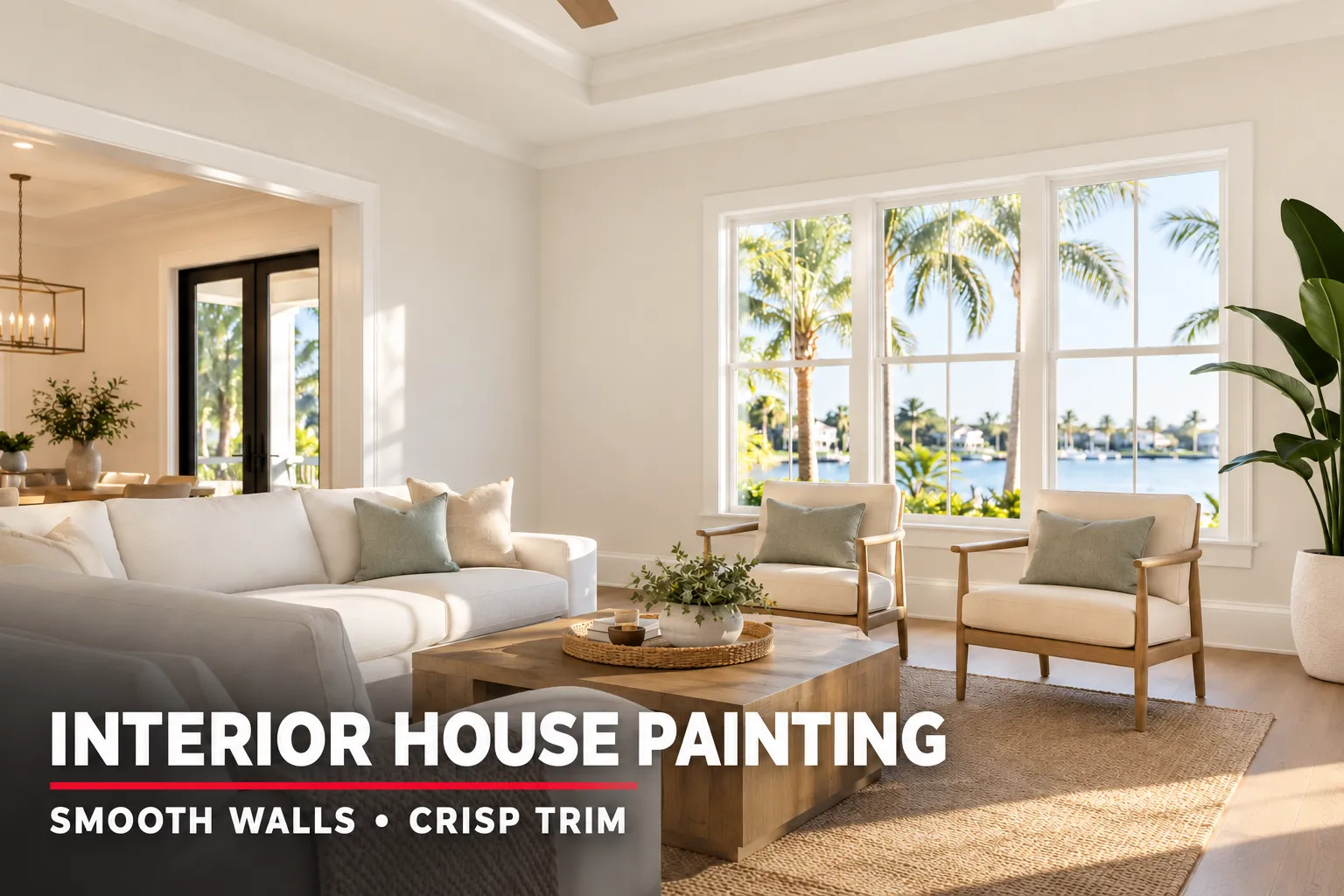
J. Perry & Sons is a licensed Florida general contractor (CGC1540699) and a painting contractor for homes, condo buildings, HOA communities and commercial properties in Broward, Palm Beach and Miami-Dade. Painting is one of the trades listed under our services, and exterior painting of buildings is the one we staff most heavily: our own crews, our own scaffolding and spray rigs, with boom lifts rented for each phase. We also pressure clean buildings, so the wash, the repairs, the sealants and the paint are one crew and one schedule.
Repainting your house inside or out: residential painting. Repainting a building or community: commercial painting.
Residential or commercial? If you're a homeowner hiring house painters for a repaint, a color change or cabinets, start with residential painting. Property managers, boards and general contractors comparing painting companies for a building should go to commercial painting. This page explains the systems behind both: what goes on the wall, in what order, and why.
What a painting contractor in South Florida costs
Trying to set a budget before you call anyone? These are our published 2026 ranges. Every number includes washing, masking, normal crack treatment, primer where the surface needs it and two finish coats.
| Scope | Unit | Range |
|---|---|---|
| Interior painting, walls, ceilings, trim and doors, two coats | per sq ft of floor area, home | $4–$6 |
| Exterior painting, single-story CBS home of about 1,800 sq ft | per house | $7,750–$11,000 |
| Exterior painting, larger or two-story home | per house | $12,000–$21,000 |
| Exterior painting, homes measured by wall | per sq ft of wall | $4.50–$7 |
| Commercial interior, walls, ceilings, doors, two coats | per sq ft of floor area | $3–$4.50 |
| Commercial exterior, stucco buildings | per sq ft of wall | $3.50–$6 |
| Condo exterior, three to six stories, lift or swing stage | per sq ft of wall | $4–$6 |
| Elastomeric in place of acrylic, commercial wall | per sq ft of wall, added | $1–$1.50 |
| Building pressure cleaning | per sq ft of wall | $0.45–$0.90, $650 minimum |
| Premium paint line on a home | per sq ft, added | $0.50–$1 |
| Stucco cracks on a house | per lin ft | $8–$14 |
| Stucco cracks routed and sealed, commercial | per lin ft | $10–$17 |
About these prices. These ranges are starting points based on typical South Florida projects. Your final price depends on the condition of the property, access, the materials or system specified and the full scope of work. We confirm every number after we review your project in person or from the drawings, and the price in your signed proposal is the one that applies.
The full breakdowns by room, house size and building type are on the residential and commercial pages.
Free estimate: call (561) 556-7509 or send us your project. Photos of each side of the house, or the building elevations, get you a range the same day.
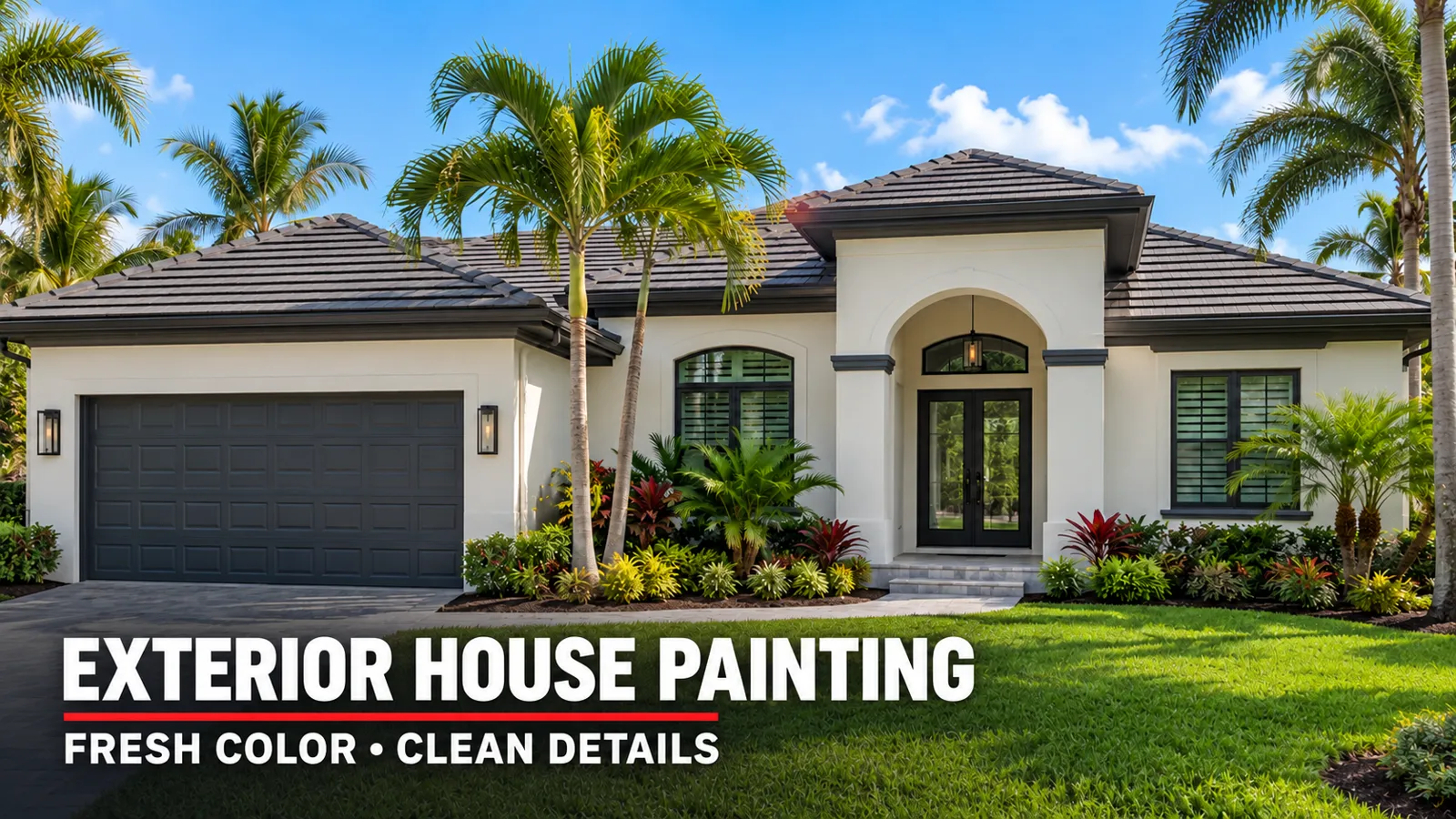
Exterior painting and interior painting are two different systems
Why can't the same paint go inside and out? Interior painting is about a smooth, washable film on drywall, trim and doors in a room that stays near 75 degrees. Exterior painting is about protecting masonry and stucco from UV, wind-driven rain, salt and constant humidity. The prep, the primer, the paint chemistry and the application method are all different.
Exterior system on stucco and CBS block. Clean the wall, repair cracks and failed sealant, prime anything bare, patched or chalky with an alkali-resistant masonry primer, then two coats of 100% acrylic exterior paint, sprayed and back-rolled so the paint fills every pore of the texture. On cracked, weather-beaten walls, the finish coats become an elastomeric system instead.
Interior system on drywall and trim. Patch, sand, spot-prime the patches, caulk trim joints, cut in by brush at ceilings and corners, then roll two coats on walls. Ceilings get a flat. Doors and trim get a harder enamel, sprayed or brushed depending on whether the house is furnished.
Metal, wood and doors. Railings, gates and steel get a rust-inhibitive primer and a direct-to-metal or enamel finish. Wood fascia and trim get any rot cut out and replaced, then a bonding or exterior wood primer and the same topcoat as the trim.
Sheens and where each one goes
| Sheen | Where we use it | Why |
|---|---|---|
| Flat | Ceilings, low-traffic walls with imperfect drywall | Hides surface flaws; least washable |
| Matte | Living rooms, bedrooms, exterior stucco body on many homes | Low reflection with better scrubbing than flat |
| Eggshell | Hallways, family rooms, offices, commercial corridors | Washable, still forgiving on drywall |
| Satin | Kitchens, bathrooms, kids' rooms, exterior body on coastal homes | Sheds moisture and dirt, cleans easily |
| Semi-gloss | Trim, interior doors, cabinets, exterior doors and fascia | Hard film that takes handling and wiping |
| Gloss | Front doors, railings, accent metal | Maximum hardness and color depth |
About these prices. These ranges are starting points based on typical South Florida projects. Your final price depends on the condition of the property, access, the materials or system specified and the full scope of work. We confirm every number after we review your project in person or from the drawings, and the price in your signed proposal is the one that applies.
Sheen exaggerates whatever is underneath your paint. A semi-gloss on a wall with patch marks shows every one in raking light from a window, which is why we keep walls at eggshell or below unless the drywall is finished to a high level.
Can't decide between eggshell and satin for a room? Call (561) 556-7509 and we'll tell you what holds up best there.
Primers: matching the primer to the surface
Is the paint on your walls peeling, blotchy or chalky after only a couple of years? Most paint failures we're called to fix trace back to a primer that was skipped or wrong for the surface.
- Masonry and alkali-resistant primer. Fresh stucco and stucco patches are highly alkaline, and that alkalinity burns standard paint, leaving blotchy color and weak adhesion. Sherwin-Williams Loxon Concrete and Masonry Primer is our default on bare or patched stucco.
- Masonry conditioner. Old, chalky paint that leaves white powder on your hand will not hold a new coat. After washing, we seal it with a conditioner such as Sherwin-Williams Loxon Conditioner to lock the chalk down.
- Bonding primer. Glossy enamel, laminate, tile, PVC and previously oil-painted trim need a bonding primer before latex will stick. We use primers such as Sherwin-Williams Extreme Bond or Benjamin Moore Insl-X Stix.
- Stain-blocking primer. Water stains, smoke, marker and tannin bleed come back through latex paint. They get a stain-blocking primer first, oil-based or shellac-based for the stubborn ones.
- Rust-inhibitive primer. Any bare or rusting metal within reach of salt air gets it before the topcoat, every time.
Elastomeric vs acrylic on stucco
Heard that elastomeric is the best paint for Florida? Not always. Standard 100% acrylic is a thin, breathable film. It is the right finish on most CBS homes and on stucco with occasional hairline cracks that we seal before painting. Elastomeric is a thick, rubbery coating that stretches across hairline cracks and keeps wind-driven rain out of the wall.
We spec elastomeric on stucco with widespread map cracking, on tall walls that take horizontal rain, and on buildings where the engineer or the specification calls for it. We do not put it on a wall that is already wet behind the stucco, because the thick film slows drying and traps water, and it blisters. Elastomeric also has a slightly softer surface that holds dirt more than acrylic, so color choice and a cleaning schedule matter. Full detail, including how we apply the system, is on our elastomeric coatings page.
Wondering which one your stucco needs? Send photos of the cracks through our project form and we'll give you our recommendation.
Mil thickness: what one coat actually is
Paint is measured in mils, or thousandths of an inch. A coat of exterior acrylic goes on at roughly 4 mils wet and dries to well under half that. An elastomeric system is built to roughly 10–20 mils dry across its coats. That difference is the whole reason elastomeric bridges cracks and acrylic does not.
On commercial work the spec states the target thickness, and we prove it: crews carry a wet film gauge and check readings as they spray, and spread rate is tracked against the gallons used per elevation. On homes, the same rule shows up as two full coats, not one heavy coat. One thick coat on a hot wall skins over before it cures, and it cracks or wrinkles.
Products we use: Sherwin-Williams and Benjamin Moore
We build our systems on Sherwin-Williams and Benjamin Moore, or the manufacturer-approved equivalent the job specifies.
- Sherwin-Williams exterior: Duration and Emerald Exterior for long-life finishes on homes, SuperPaint Exterior as the dependable mid-tier line, Loxon primers and conditioner on masonry, SherLastic Elastomeric where the wall needs crack-bridging.
- Sherwin-Williams interior and metal: Emerald Interior for high-wear rooms, Pro Industrial primers and enamels on steel and railings.
- Benjamin Moore residential: Aura for deep colors and fast recoat, Regal Select for interiors that need to wash well.
- Benjamin Moore commercial: Ultra Spec interior and exterior lines for offices, common areas and repaint cycles on large buildings.
We pick the line for your surface and exposure, not by habit. A south-facing, dark-colored wall a mile from the beach gets a better line than a shaded north wall in Wellington.
Prep: pressure cleaning, mildew wash, cracks and sealants
What happens before the first coat matters more than the paint itself.
Pressure cleaning. Every exterior starts with a wash: a low-pressure application of a mildewcide solution from the bottom up, dwell time, then a rinse from the top down. High pressure blasted at stucco and window joints drives water into the wall and tears out sealant. Walls dry 24–48 hours before primer. We also clean buildings as a standalone service between repaints; see pressure washing buildings.
Mildew. In South Florida, mildew grows on north walls, under eaves and behind landscaping within a season. Painting over it without killing it means black spots coming back through the new paint. The wash kills it; a mildew-resistant finish slows the return.
Cracks. Hairline cracks get an elastomeric patching compound or brush-grade sealant worked into the crack. Wider cracks are routed open and filled, then primed. Hollow or delaminated stucco is cut out and rebuilt before paint, and that larger work is handled by our stucco crew.
Sealants. Failed caulk at windows, doors, control joints and penetrations is cut out and replaced, not caulked over. Paint does not seal a moving joint; the sealant does.
Color approvals
Does your HOA have to approve your colors? Most South Florida communities require architectural approval for exterior colors, often even when the color stays the same, and commercial buildings answer to an owner, a board or a brand standard. We prepare the color schedule (body, trim, accent, doors, metal) with manufacturer, product and color codes, paint sample areas on the actual wall, and supply product data for the submission. On commercial jobs, a color mockup on a full panel is signed off before the first elevation is sprayed. More on the process: HOA exterior paint approval and paint color consultation for HOA colors.

Florida sun, salt and humidity
- UV. South and west walls fade and chalk first, and deep colors fade fastest. We put the better paint line where the sun is worst.
- Salt. Within a mile or two of the coast, salt film on walls prevents adhesion and salt on steel starts rust. The wash removes it; rust-inhibitive primer and stainless fasteners stop the orange streaks.
- Humidity and dew. Paint applied when the wall will drop to the dew point before the film skins over loses sheen and adhesion. In summer we start early and finish shaded walls by mid-afternoon.
- Rain season. June through October, we coat walls that dried overnight and stop before afternoon storms. Interiors run on any schedule.
A well-prepped acrylic system on stucco lasts about 7–10 years here, shorter on the coast and on dark colors.
Close to the water and seeing rust streaks or fading? Call (561) 556-7509 and we'll set up a visit to look at your walls.
Comparing painters: what to ask before you sign
Got three quotes from painters and the numbers are thousands apart? The gap is almost always in the prep and the paint line, not the hourly rate. Ask every company the same questions:
- What is the wash and crack plan? Good exterior painters list the pressure cleaning, the crack treatment and the sealant work as their own lines. A quote that only says "paint house" skips them.
- Which product, by name? "Two coats of Sherwin-Williams Duration" can be compared. "Premium paint" cannot.
- Who is on the wall? Some painting companies sell the job and send a different crew. Ours are our own crews, with our own scaffolding and spray rigs.
- Is the license real? Home painting contractors should give you a license number you can look up and a certificate of insurance before they start. Ours is CGC1540699.
Interior painting companies get compared the same way: how furniture and floors are protected, how many coats on walls, ceilings and trim, and whether drywall patching is included. When you line our painting services up against another quote this way, the difference in price usually explains itself.
Want a second look at a quote you already have? Send it through our project form and we'll walk you through what it includes.
Painting services
- Exterior house painting: CBS and stucco homes, house-size pricing.
- Interior painting: rooms, ceilings, trim and doors in occupied homes.
- Cabinet painting: sprayed enamel on kitchen and bath cabinets.
- Building exterior painting: mid-rise and high-rise exteriors, scaffolding, swing stages and lifts.
- Condo and HOA repainting: board approval, reserve timing and phasing.
- Multifamily painting: apartment exteriors and unit turns.
- Elastomeric coatings: the crack-bridging system for stucco buildings.
- Pressure washing buildings: wash-only service and prep before paint.
Guides: exterior painting cost · interior painting cost · commercial painting cost · best exterior paint for Florida stucco · elastomeric paint on Florida stucco
Painting by city
Painting in Fort Lauderdale · Painting in Boca Raton · Painting in West Palm Beach · Painting in Miami · Painting in Delray Beach · Painting in Weston · Painting in Hollywood · Painting in Palm Beach Gardens
Residential or commercial?
For a house, a townhome you own or a condo unit interior, go to residential painting: pricing by room and by house, paint lines, HOA color approval and timelines. For buildings, associations and GC scopes, go to commercial painting: unit pricing, access plans, elastomeric specs, sealants and closeout. Workmanship warranty on every job; materials carry the manufacturer's warranty. Terms are in your written contract.
Prefer to send photos or plans? Send us your project
Painting FAQ
How much does a painting contractor charge in South Florida? Interiors run $4–$6 per square foot of floor area for walls, ceilings, trim and doors. Exterior house painting runs $7,750–$11,000 for a one-story CBS home and $12,000–$21,000 for larger and two-story homes. Commercial exteriors run $3.50–$6 per square foot of wall. Final pricing is confirmed after we review your project.
Which paint brands do you use? Sherwin-Williams and Benjamin Moore: Duration, Emerald, SuperPaint and Loxon primers from Sherwin-Williams; Aura, Regal Select and Ultra Spec from Benjamin Moore. On spec jobs we use the product the specification names.
Should my stucco get elastomeric or regular acrylic paint? Acrylic for most homes with sound stucco. Elastomeric when the stucco shows widespread hairline cracking and takes wind-driven rain, and only after we confirm the wall is dry behind the surface.
Do you do the pressure cleaning and crack repair yourselves? Yes. Our crews wash, repair cracks, replace failed sealant and prime before the finish coats. Larger stucco rebuilds go to our stucco crew under the same contract.
What is the quickest way to an exact number? Send photos of each side of the house or the building elevations, plus approximate square footage, through our project form or call (561) 556-7509. We walk the job, measure and send a written estimate, typically within 24–48 hours.
Free estimate — call (561) 556-7509 or send us your project. Licensed Florida general contractor CGC1540699. Serving Broward, Palm Beach and Miami-Dade counties.