
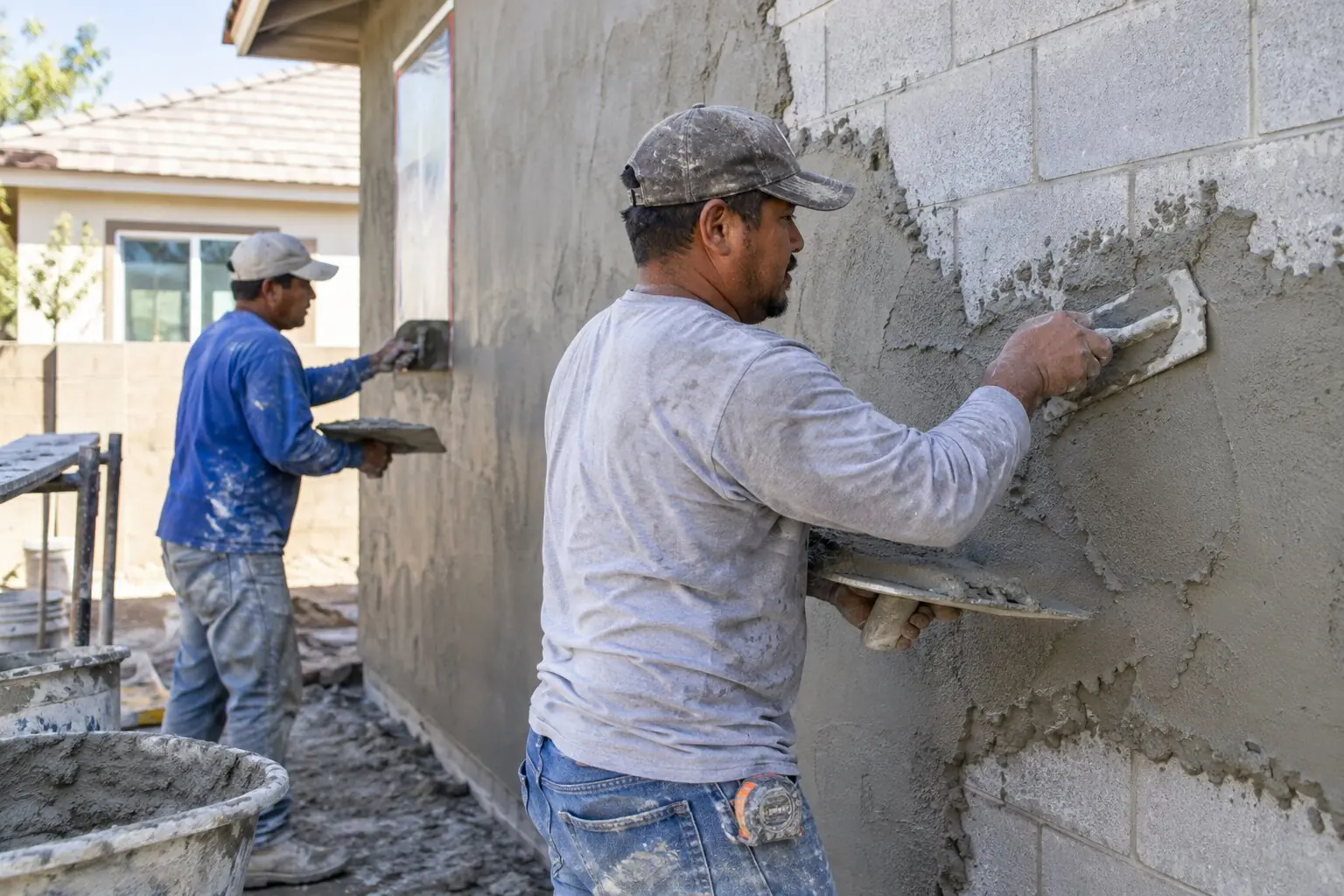
Cracks, stains or a hollow-sounding wall? J. Perry & Sons is a licensed Florida general contractor and stucco contractor. We apply, repair and refinish exterior stucco on block and frame buildings. This page covers what stucco is, the four systems used here, the seven finishes and what the work costs. It is part of our renovation services. The page you need next depends on who is buying.
Residential or commercial? If you own a house or townhome, go to residential stucco. If you are a general contractor, property manager or association board, go to commercial stucco.
What stucco is and why South Florida uses it
Stucco is a cement-based coating, troweled or sprayed onto a wall in layers. Here it goes on concrete block (CBS construction, short for concrete block and stucco) or on lath, a metal mesh, over wood or metal framing. It sheds rain, stands up to fire and salt air, and takes paint well, which is why it covers most buildings from Jupiter to Homestead.
What it is not is waterproof. Water that gets behind it at a window head, a roof-to-wall joint or a cracked sill has to drain out. If it can't, it pushes the coating off the wall. So every stucco job we do starts with the water path.
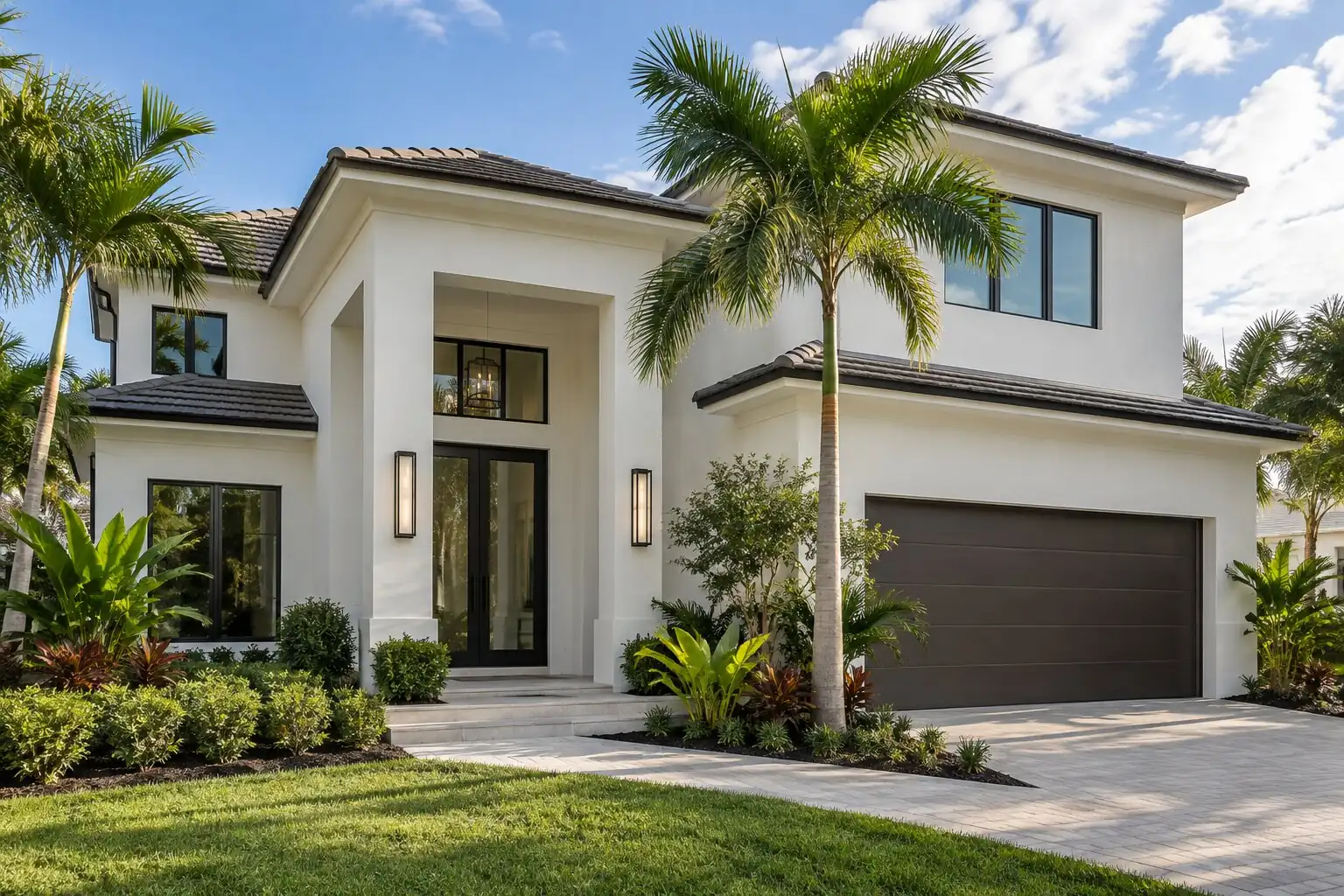
Types of stucco
Four systems are in use. They look alike from the street and fail very differently.
| System | How it is built | Where it fits |
|---|---|---|
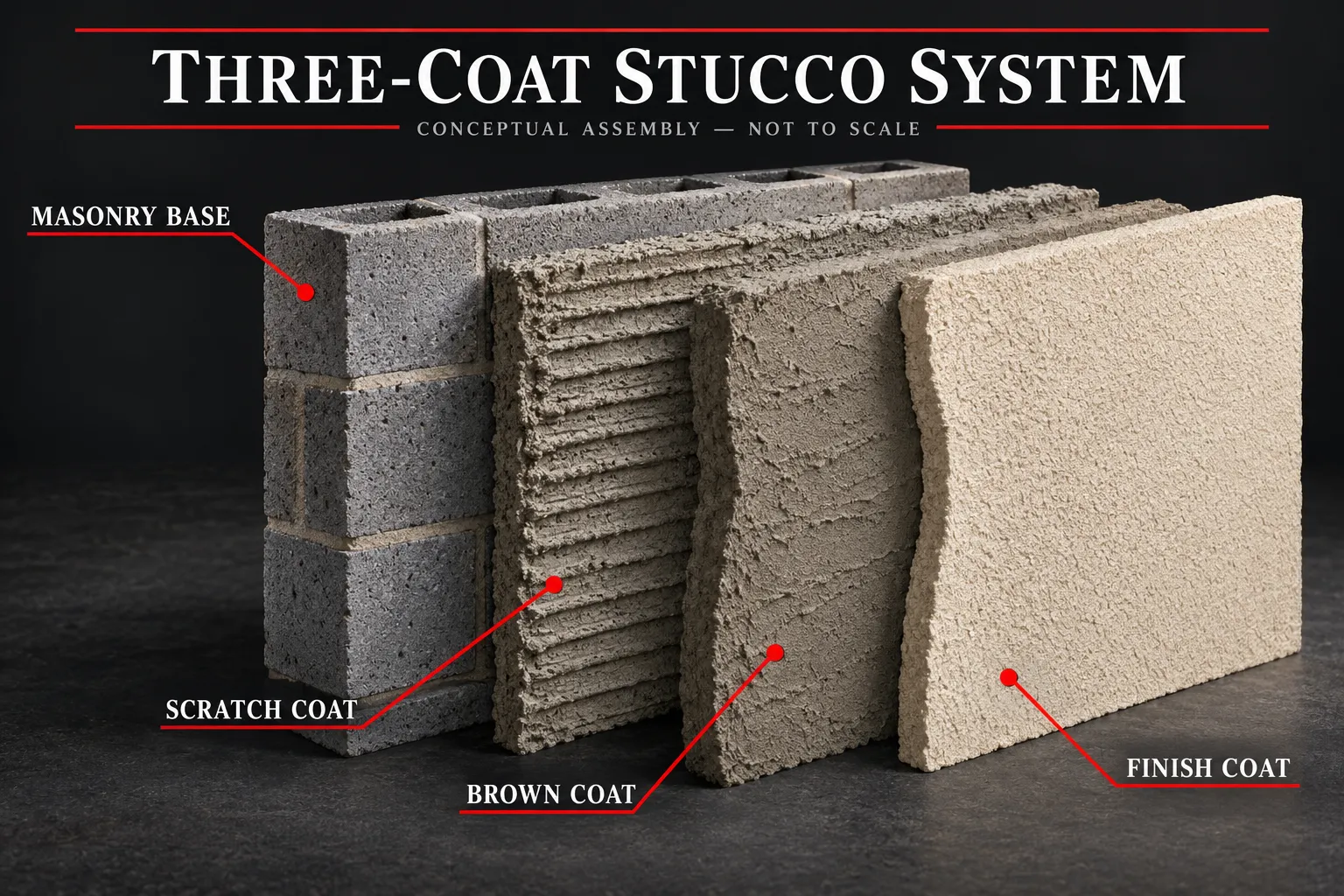
| Traditional three-coat cement (Portland) | Scratch coat, brown coat, finish coat of Portland cement, sand and lime, over block or lath | Homes and most buildings; the system we recommend for houses |
| One-coat | A single thicker, fiber-reinforced coat over lath or a bonded substrate | Production new construction where speed matters |
| EIFS (Dryvit) | Foam board glued or fastened to the wall, a reinforcing mesh layer, then a flexible acrylic finish | Commercial facades, reveals, cornices and high-build shapes |
| Synthetic acrylic | A thin acrylic-based finish troweled over a prepared base | Smooth modern looks and color-through finishes |
Traditional three-coat cement. This is hard-coat stucco. Each coat cures before the next one goes on. The result is a dense, paintable shell that bonds to block. Details are on our Portland cement stucco page.
One-coat. Faster, with one pass, but less thickness to hide a wavy wall and less room to correct it. We use it only where the substrate and the specification call for it.
EIFS and Dryvit. EIFS (exterior insulation and finish system) is built on foam, and foam is soft. A hard impact dents it, and water that gets behind the finish has no easy way out. You'll see it on commercial work and on older condo and retail buildings. We compare it with hard-coat in EIFS (Dryvit) repair vs hard-coat stucco, and the commercial scope is on EIFS and high-build stucco.
Synthetic acrylic. A finish layer, not a full wall build. It can be colored all the way through, which cuts repainting, and it is the usual choice for a very smooth surface. See smooth stucco finish.
Not sure which system is on your walls? Send a few photos through our project form and we'll tell you.
Types of stucco finishes
The finish is the last coat and the only part you see. South Florida walls carry one of seven.
| Finish | Look | How it is made |
|---|---|---|
| Smooth | Flat, even, almost no texture | Steel-troweled or fine-floated finish coat |
| Sand float | Fine, uniform grain | Sand-bearing finish floated in circles |
| Dash | Rough, splattered peaks | Finish flicked on with a brush or hopper and left as it lands |
| Skip trowel | Irregular flat patches with low valleys | Finish dragged on with a trowel in random passes |
| Knockdown | Flattened peaks with smooth plateaus | Finish sprayed, then flattened with a knife as it sets |
| Lace | Heavy, raised, almost sculpted pattern | Thick finish worked into a deep relief |
| Orange peel | Small, even bumps like citrus skin | Fine spray, left unflattened |
Why it matters to you. Texture hides or exposes a wavy base. Smooth shows every wave and every hairline crack, so it needs the straightest brown coat (the second, leveling coat) and usually an elastomeric or integral-color finish. Knockdown and sand hide a lot. Dash and lace are the hardest to match on a repair, because the pattern comes from the hand that threw it. Our guide to stucco textures in South Florida shows each one.
Stucco cost in South Florida
| Scope | Installed range |
|---|---|
| Crack and patch repair (cracks, hollow areas, holes), texture matched | $13–$21 per sq ft |
| Spalling repair (chip to steel, treat rebar, rebuild) | $22–$34 per sq ft |
| Re-stucco (scratch, brown and finish coat) | $14–$23 per sq ft |
| Smooth skim coat over existing texture | $7–$10 per sq ft |
| Heavy knockdown or lace ground down and skimmed | $9–$13 per sq ft |
| Whole single-story house re-stucco | $25,000–$40,000 |
| Column repair, wrap or rebuild with shoring | $1,250–$8,500 per column |
| New construction, three coats on block / over lath | $7–$10 / $9–$13 per sq ft of wall |
| Full building re-stucco, multi-story, access included | $15–$24 per sq ft of wall |
| EIFS conversion to hard-coat stucco | $16–$24 per sq ft of wall |
| Service-call minimum | $550–$750 |
About these prices. These ranges are starting points based on typical South Florida projects. Your final price depends on the condition of the property, access, the materials or system specified and the full scope of work. We confirm every number after we review your project in person or from the drawings, and the price in your signed proposal is the one that applies.
Small patches cost more per square foot because setup, three coats and texture matching take the same time on 10 feet as on 40. Spalling (concrete breaking off over rusting steel) costs more because we chip back to the steel and treat the rebar before rebuilding. One-coat and synthetic systems are priced per job after a site visit. For the repair breakdown, see stucco repair cost per square foot.
Want a real number for your walls instead of a range? Call (561) 556-7509 and we'll set up a free site visit.
Stucco water damage repair
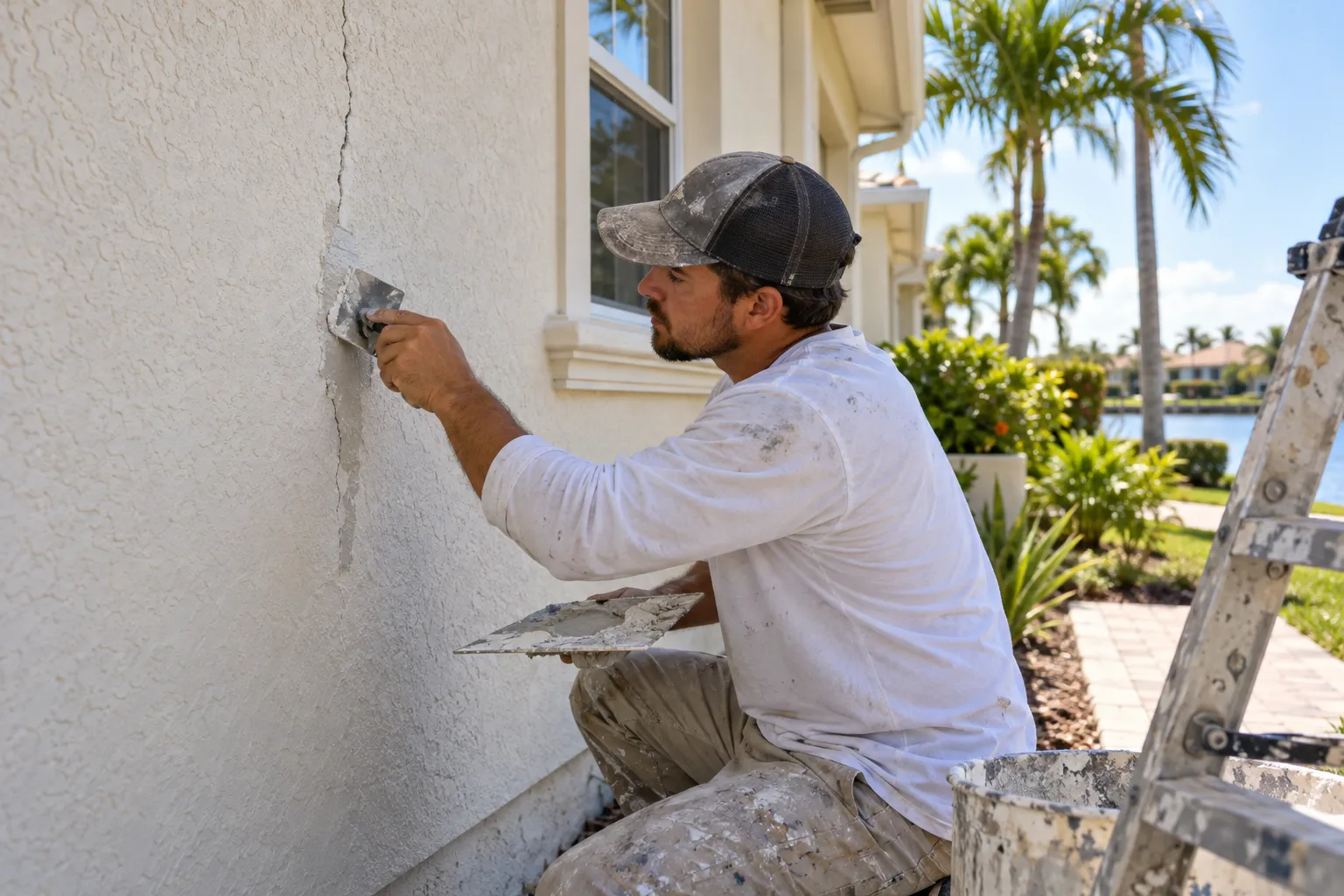
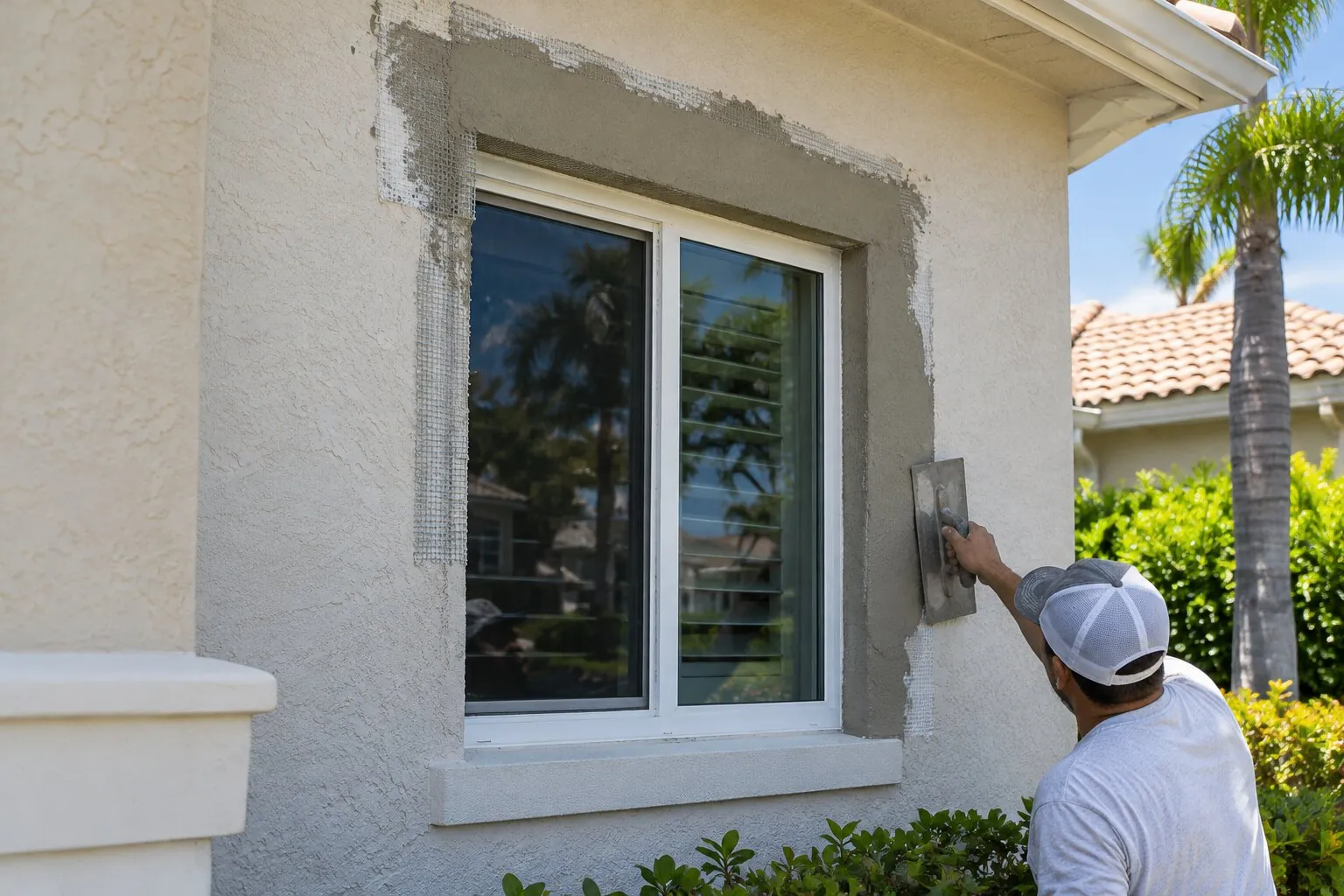
Seeing bubbling paint, brown streaks under a window, or a spot that crumbles when you press it? That is water behind the stucco, and a surface patch will not stop it. Stucco water damage repair starts with finding where the water gets in: a window head with no flashing, failed sealant at a sill, a missing weep screed at the base of the wall, or a roof-to-wall joint. If the leak is in the roof itself, that goes to a roofer; we do not do roofs.
Once the entry point is sealed, we cut the stucco back to sound material and check what is behind it. On block, we let the wall dry and treat any rusted steel. On frame walls, rusted lath and wet backing are replaced. Then the wall is rebuilt in three coats with the texture matched. When the damage runs across most of an elevation, stucco replacement on that whole side costs less than chasing patches and leaves one uniform wall to paint.
EIFS repair and Dryvit repair follow a different method, because the foam board and mesh have to be cut out and rebuilt, or the wall converted to hard-coat. The EIFS links above cover both.
Stains under a window and no idea why? Send a close-up photo through our project form and we'll tell you where the water is most likely getting in.
What we do as a stucco contractor
- Stucco repair: stucco crack repair, spalling, hollow areas and water damage.
- Full-house stucco: whole-house re-stucco and new stucco.
- Stucco column repair: entry, porch and garage columns.
- Squaring off arched openings: arch to square, with the wall rebuilt around it.
- Smooth stucco finish: skim coats over knockdown, lace and sand.
- Full-building stucco and new-construction stucco: commercial scopes.
- Commercial column repair: columns on commercial buildings.
Permits, HOA approval and engineering
Do you need a permit? For patching and refinishing stucco on the same footprint, generally no. Re-stucco over lath, new stucco on an addition and any change to an opening do need one. J. Perry & Sons pulls those permits itself and follows every city and county requirement.
Changing a texture or a color counts as an architectural change in most communities. We prepare samples for your approval request. We do not do engineering; we build to the engineer's drawings and bring in a licensed engineer when needed.
Have an HOA review coming up? Call (561) 556-7509 or send us your project and we'll get your texture and color samples ready for the board.
Stucco and the South Florida climate
CBS and moisture. Block holds water, and stucco over it traps whatever gets in. We fix flashing, sealant and weep screed (the metal strip at the base of the wall that lets water out) before we close a wall.
Salt air. Near the coast, steel lath, corner bead and fasteners rust and stain the finish. On coastal jobs we use galvanized or PVC accessories and coated fasteners.
Humidity and cure. Coats cure slower in summer. We stage them a day apart and let cement stucco cure before primer.
Hurricane season. Window replacement peaks before storm season, and every new window needs a sealed stucco return. We schedule within days of the install.
Residential or commercial?
If it is your house, start with residential stucco. If it is a building with a bid package, a board or tenants, start with commercial stucco. Both are backed by the same crews and the same licence, which is the first thing to check when you compare stucco contractors.
Stucco by area
Boca Raton · Fort Lauderdale · West Palm Beach · Palm Beach Gardens · Miami · Weston · Delray Beach · Pompano Beach
If you are searching for stucco companies near me in any of these cities, your city page lists the local permit and HOA notes.
Planning guides: how to choose a stucco contractor · hairline cracks and when to worry · smooth stucco whole-house cost
Prefer to send photos or plans? Send us your project
Stucco FAQ
What is the difference between stucco and EIFS? Stucco is a hard cement coating on block or lath. EIFS is foam insulation board with a mesh layer and a flexible acrylic finish. EIFS is lighter and easier to shape. Stucco is harder and handles impact and moisture better, which is why we recommend it for houses. EIFS repair follows its own method, covered on the EIFS and high-build stucco page.
Which stucco finish is easiest to repair? Sand float and knockdown, because the uniform pattern blends past the patch edge. Dash and lace are the hardest, and smooth shows any mismatch when the sun hits the wall at a low angle.
How much does stucco cost in South Florida? Repairs, re-stucco, smooth skim coats, spalling repair and whole-house jobs each have their own starting range in the cost table above. One-coat and synthetic systems are priced per job after a site visit. Final pricing is confirmed after we review your project.
Do I need a permit or HOA approval for stucco work? Cosmetic patching usually needs neither. Re-stucco over lath and opening changes need a permit, which we pull, and texture or color changes need HOA approval. Workmanship warranty on every job; materials carry the manufacturer's warranty. Terms are in your written contract.
How do I get an exact price? Send photos of each elevation with a rough wall height, or book a site visit. We tap the walls, check the water path and give you a written line-item estimate you can compare. Call (561) 556-7509 or send us your project.
Free estimate — call (561) 556-7509 or send us your project. Licensed Florida general contractor CGC1540699. Serving Broward, Palm Beach and Miami-Dade counties.