
J. Perry & Sons is a tile contractor and licensed Florida general contractor (CGC1540699) setting floor, wall, shower and exterior tile across Broward, Palm Beach and Miami-Dade. This page is the trade manual behind every job we price, one of all of our services. Homeowners planning a bathroom, kitchen or whole-house floor go next to residential tile installation. General contractors, property managers and building owners go to our commercial tile contractor page for bids from drawings, unit pricing and closeout. We pull every permit the work needs and follow each city and county's requirements on our jobs.
Building or remodeling your own home? Start with residential tile. General contractors, property managers and associations bidding a building should go to our commercial tile contractor page.
Have you seen tile crack, pop loose or show raised edges a year after it went in? Tile fails for three reasons: a substrate (the floor or wall under the tile) that is not flat, mortar that does not fully cover the back of the tile, and grout or sealant in the wrong joint. Everything below is how our tile installers control those three things on each size and type of tile.
Tile Sizes and What Changes With Each One
Picked a big tile for your floor? The size of the tile decides the flatness the floor needs, the trowel, the crew and the price. Most porcelain is made in metric and sold under a rounded inch name, so a "24x24" is a 60x60 cm tile and a "24x48" is 60x120 cm. The real face is slightly under the inch name, which matters when we lay out a niche or a doorway.
3x6, 4x4 and other small format. Subway tile, mosaics and small squares go on walls, backsplashes and shower floors. Small tile follows the plane of the wall, so the wall has to be straight, and more joints per foot mean more labor per square foot.
12x24. The everyday porcelain floor. Rectified 12x24 is long enough to show bow in the center, so we hold the offset to one-third, not half. Standard floor flatness applies: no more than 1/4" in 10 ft and 1/16" in 12".
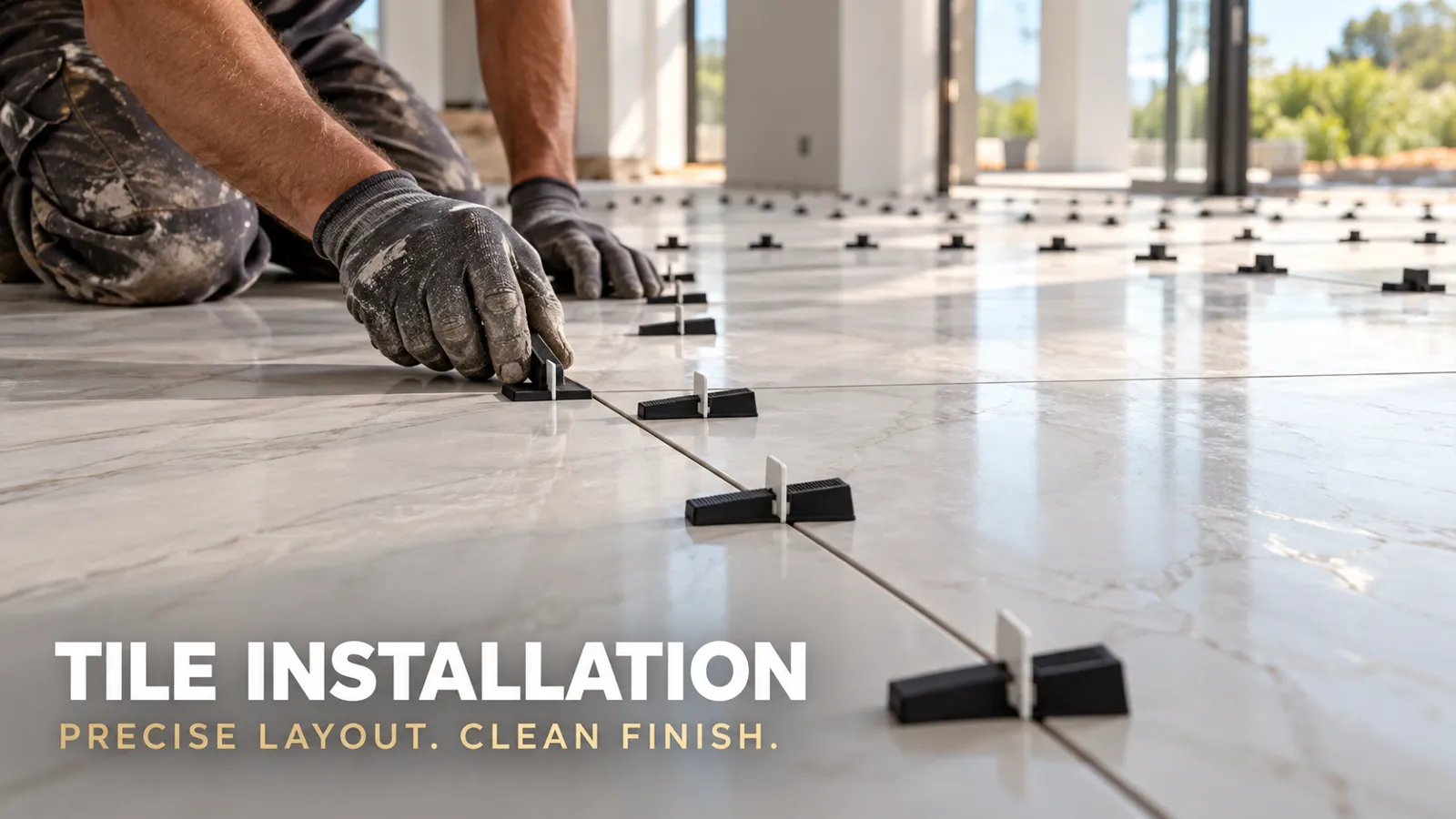
24x24 (60x60 cm). Once any edge reaches 15" or more, the floor has to be flatter: 1/8" in 10 ft and 1/16" in 24". This is where we start back-buttering every piece and using leveling clips.
24x48 (60x120 cm). The most requested large format tile in South Florida homes and lobbies. It needs the flat floor above, full-coverage mortar, clips at every edge and two people handling each piece. Long planks in this size never go on a half offset. See our 24x48 tile installation guide for the step-by-step.
32x32, 48x48 and 60x60 cm-plus squares. Heavy, stiff pieces where one high spot under the center will crack the tile under load. We grind and pour self-leveler before setting, and each tile is placed by two setters with suction cups.
48x96 and gauged porcelain slabs. Thin porcelain panels in 6 mm and up are set with mortars made for them, carried on frames and placed by a crew of three. They are a different installation from tile and are priced per job. For stone and porcelain slab countertops and walls, see stone and slab installation.
Lippage, flatness and leveling clips
Lippage is the edge of one tile sitting higher than its neighbor. On large format tile, especially with a raking light from a sliding glass door, 1/32" shows. Leveling clips pull edges into the same plane while the mortar cures, but they do not fix a floor that is out of flat; they only hold tile on a floor that is already within tolerance. We check every slab with a 10 ft straightedge before we quote and list grinding or self-leveler as its own line.
Fell in love with a 24x48 or bigger? Call (561) 556-7509 and we'll check whether your floor is flat enough before you buy it.
Floor Tile, Wall Tile and Exterior Tile Are Different Products
That pretty tile at the showroom may not be made for where you want it.
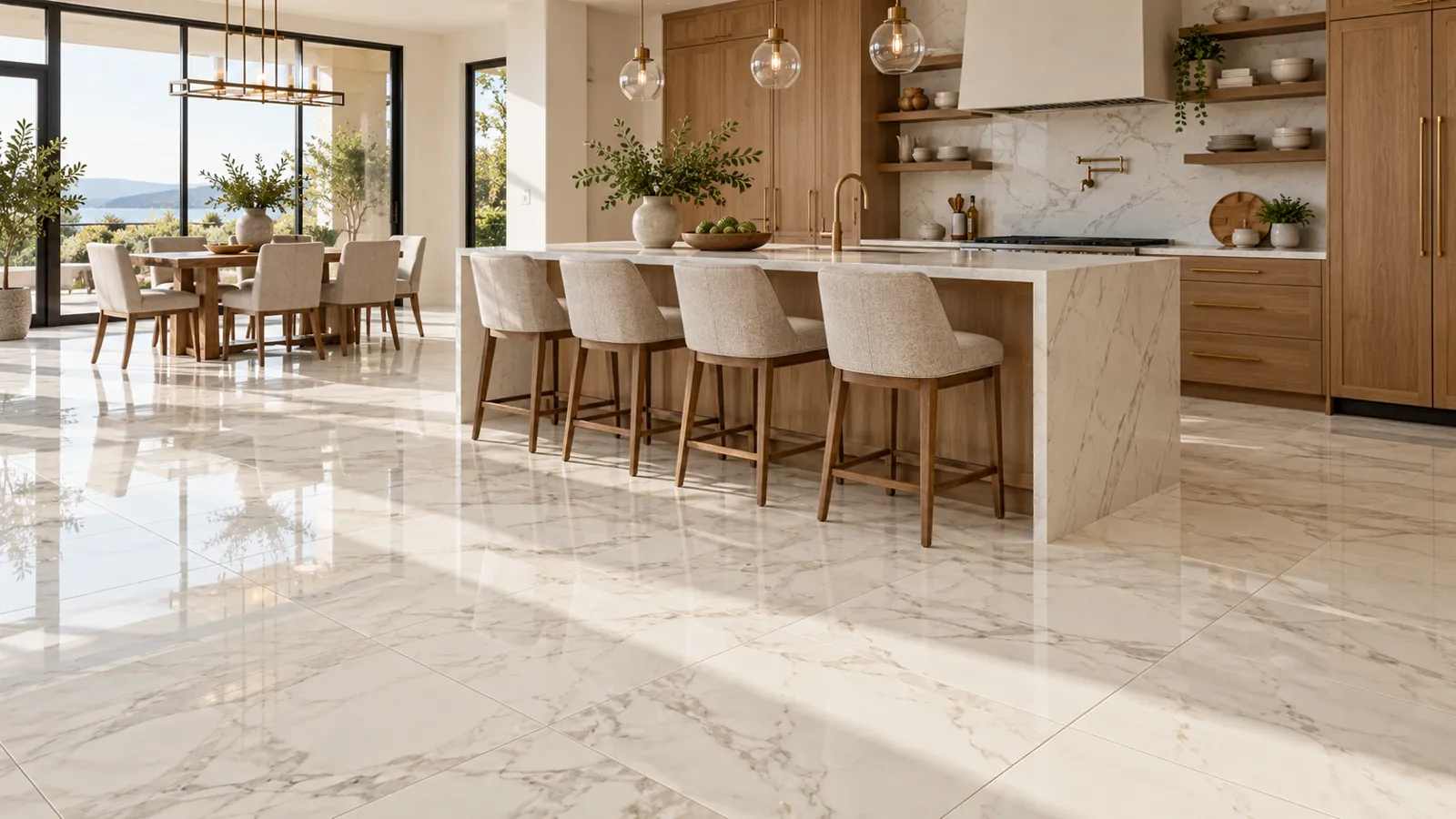
Floor tile is porcelain or a floor-rated stone or ceramic. Porcelain absorbs 0.5% of its weight in water or less; that dense body is why it handles mopping, spills and Florida humidity without problems.
Wall tile is often a soft-bodied ceramic that absorbs far more water. It is light, cuts easily and is made for walls and backsplashes. It doesn't go on a floor, a shower floor or outdoors, because it will crack and stain. Many glass tiles are wall-only as well. We check the manufacturer's rating on every product before it goes down.
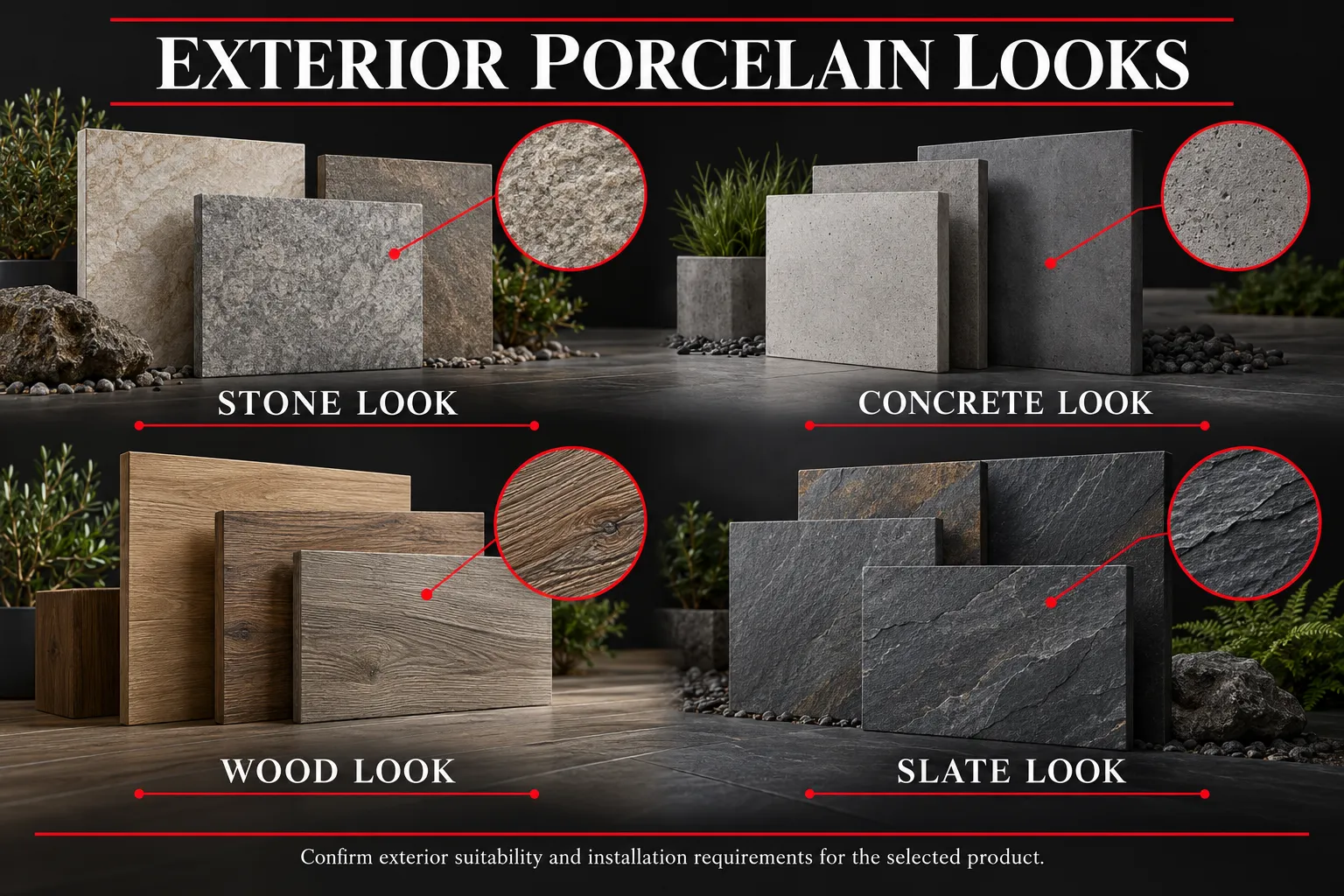
Exterior and wet-area tile must be porcelain or a stone rated for the use, with a textured or matte finish. For level floors that get walked on wet, we look for a wet DCOF (a slip-resistance rating) of 0.42 or higher on the product data. Polished porcelain does not go on a pool deck, a balcony or a shower floor. Outdoors every tile is back-buttered and movement joints sit closer together. For balconies, see balcony waterproofing and tile.
Natural stone. Marble, travertine and limestone need a white mortar so they do not stain through, full mortar coverage, and sealing. Marble on a shower floor stays matte or honed.
Mosaics. Sheets on mesh, set with a V-notch trowel so mortar does not squeeze up into the joints. On shower floors the small pieces follow the slope to the drain.
Wood-look plank. 6x36, 8x48 and 9x59 planks give the look of hardwood with the durability of porcelain. Long planks have a slight crown in the middle, so we lay them at no more than a one-third offset, or 20% where the manufacturer asks for it. A random half offset on a long plank is where most lippage complaints start. Compare plank tile and vinyl in our wood-look tile vs LVP article.
Grout Joint Spacing: 1/32" to 3/16" and Why
Want the thinnest grout line possible? The grout joint is set by the tile, not by taste. Every tile is made within a size tolerance, called its caliber, and the joint has to be wide enough to absorb the difference between pieces and any variation in the floor.
| Tile | Joint we set | Why |
|---|---|---|
| Rectified porcelain, wall, dry area | 1/32" to 1/16" | Ground edges; tight only when the batch measures true |
| Rectified porcelain, floor | 1/16" minimum, often 1/8" on long planks | Floor variation and plank crown need room |
| Pressed-edge (non-rectified) porcelain and ceramic | 1/8" | Edges vary piece to piece |
| Handmade, zellige, calibrated stone, terracotta | 3/16" and wider | Sizes vary; a tight joint would stack errors across the room |
| Quarry tile | 1/4" | Pressed body, wide tolerance |
About these prices. These ranges are starting points based on typical South Florida projects. Your final price depends on the condition of the property, access, the materials or system specified and the full scope of work. We confirm every number after we review your project in person or from the drawings, and the price in your signed proposal is the one that applies.
We go to 1/32" only on rectified wall tile, in a dry area, after we measure a sample of the batch. Floors and showers stay at 1/16" or wider. A joint narrower than the tile's caliber allows will wander off the line within a few rows, and a joint on an out-of-flat floor turns into lippage.
Movement joints are sealant, not grout
Tile and concrete move with heat and moisture. At every perimeter, at every change of plane (floor to wall, wall to wall in a shower, tub to wall, countertop to backsplash) and across large floors, we leave the joint open and fill it with color-matched silicone or urethane sealant, not grout. Large interior floors get movement joints at roughly 20 to 25 ft in each direction, and closer where the floor sees direct sun. Grout in a corner of a shower cracks within months, while sealant moves and stays tight.
Seeing cracked grout in your shower corners? Send a photo through our project form and we'll tell you whether it needs sealant or more.
Setting Materials: Wall Mortar vs Floor Mortar
Mortar is the part of the job you never see, and the part that decides whether tile stays put.
Wall thinset is a non-sag mortar. It holds tile on a vertical surface without sliding, so we do not have to tape or wedge every row. Large and heavy tile on walls gets a mortar rated for that weight.
Floor thinset for large format is a large-and-heavy-tile (LHT) mortar. It can be troweled thick, up to about 3/4" under the tile, without shrinking, so it fills small variations and holds big tile without slumping at the edges.
Coverage. Interior dry floors require at least 80% mortar contact; showers, exteriors and natural stone require 95%. We get there by back-buttering large tile, combing the mortar in straight lines, and lifting a tile now and then to check the back.
Trowels in general. A 3/16" V-notch for mosaics, 1/4" square notch for small wall tile, 1/4" x 3/8" or 1/2" x 1/2" for 12x24 and up, and larger notches or specialty trowels for 48x48 and slab. The trowel is matched to the tile and the floor, not picked out of habit.
Cure times. Modified mortar usually takes 24 hours before grout and before foot traffic on the floor; in a cold or very humid room, longer. Epoxy grout and self-levelers follow their own data sheet times.
Products we use
J. Perry & Sons prefers MAPEI systems and uses LATICRETE as the alternative, or the manufacturer-approved equivalent the job specifies. Examples:
- Large-format floor mortar: Mapei Ultraflex LFT, Laticrete 4-XLT.
- Liquid waterproofing membranes: Mapei Mapelastic AquaDefense, Laticrete Hydro Ban.
- Shower board and foam systems: Schluter-Kerdi and Wedi panels, pans and drains.
- Epoxy grout: Mapei Kerapoxy, Laticrete SpectraLock.
- Self-levelers: Mapei Ultraplan, Laticrete NXT.
- Leveling clip systems on every large format floor.
We use a system from one manufacturer under a tile assembly where we can, so mortar, membrane and grout are designed to work together.
Tile Installation Cost in South Florida
What is the cost to lay tile in your home? Our tile installation cost per square foot covers labor and setting materials, with tile supplied by you. That covers tile floor installation, walls, showers and large format tile installation. Where your job lands depends on the size of the tile, the pattern, the room and the floor under it. Bigger tile, a herringbone layout or a floor that needs leveling moves you up the table.
| Scope | Installed range |
|---|---|
| Standard porcelain floor, 12x24 or 18x18 | $14–$18 per sq ft |
| Wood-look plank, 8x48 | $17–$23 per sq ft |
| Herringbone or chevron floor | $22–$30 per sq ft |
| 24x48 and larger floor | $25–$34 per sq ft |
| Shower wall tile | $22–$30 per sq ft |
| Mosaic shower floor | $32–$46 per sq ft |
| Remove existing tile and haul away | $4–$6 per sq ft |
| Self-leveler where the floor is out of flat | $4.50–$7 per sq ft |
| Small-job minimum | $750–$1,000 |
About these prices. These ranges are starting points based on typical South Florida projects. Your final price depends on the condition of the property, access, the materials or system specified and the full scope of work. We confirm every number after we review your project in person or from the drawings, and the price in your signed proposal is the one that applies.
Labor runs about the same across Broward and Palm Beach; see tile installation cost by city. Commercial unit pricing is on the commercial tile contractor page.
Showers, Tub Surrounds, Niches and Backsplashes
Most calls we get are not for a whole floor. They're for one wet wall, one shower or one backsplash, and those small areas take the most care per square foot.
Shower tile installation starts behind the tile: the pan, the membrane and a 24-hour flood test before any tile goes on. Details are on our shower tile page.
Tub surround installation is the three walls around a tub you're keeping. The tile goes over cement board or foam board with a membrane, the bottom row sits just above the tub flange, and the joint where tile meets tub gets sealant, never grout.
Installing a shower niche is planned with the wall layout so the niche lands on the tile courses, waterproofed with the rest of the shower.
Backsplash installation is a smaller job with its own details: outlet extenders, a sealant joint at the countertop and clean edges at the end of the run. See kitchen backsplash.
Regrouting. If your shower tile is still bonded and the grout is just stained or cracking, regrouting may be enough. Our tile repair and regrout page explains when it works and when it doesn't.
Not sure if your shower needs regrouting or a rebuild? Call (561) 556-7509 or send us your project with a few photos, and our tile setters will tell you what they see.
Residential or Commercial?
Remodeling your home? Start with residential tile, which covers shower systems, waterproofing, niches, curbs, self-leveler and condo underlayment. GCs and owners of buildings, restaurants, clinics and offices: start with commercial tile, which covers epoxy grout, quarry tile, cove base, submittals and night work.
Tile services by room and repair
- Shower tile
- Kitchen backsplash
- Stair tile and marble stairs
- Tile repair and regrout
- Balcony waterproofing and tile
How a Tile Job Runs With Us
- Site visit. We measure, run a straightedge over the floor, check moisture on slabs that will get large format or epoxy, and look at door heights and transitions.
- Written estimate. Demo, prep, leveling, waterproofing, setting, grout and trim are separate lines, so you see what the floor needs before the tile.
- Permit and material. We pull the permit when the scope needs one. Tile arrives and is checked against the order: same lot, same shade, same caliber, with enough overage.
- Prep. Demolition, grinding, self-leveler, membranes and flood tests.
- Layout and setting. Centerlines and starting rows chosen so cut pieces fall at walls and under cabinets, not at the front door.
- Grout, sealant and trim. Movement joints sealed, transitions and edge profiles set.
- Walkthrough and cleanup. Workmanship warranty on every job; materials carry the manufacturer's warranty. Terms are in your written contract.
Structural questions, such as a slab that is cracked through or a balcony that needs repair under the tile, go to a licensed engineer. We don't do engineering; we build to the engineer's drawings and coordinate a licensed engineer when the work needs one.
Ready to get your tile job on the calendar? Call (561) 556-7509 to book a free site visit.
Tile Installers by City
Looking for tile installers in Palm Beach County, Broward or Miami-Dade? The same crews of tile setters work all three counties, with the same methods and the same written estimate.
- Tile installation in Boca Raton
- Tile installation in Fort Lauderdale
- Tile installation in West Palm Beach
- Tile installation in Jupiter
- Tile installation in Delray Beach
- Tile installation in Weston
- Tile installation in Parkland
- Tile installation in Coral Gables
For your own home, continue to residential tile installation. For a building, tenant space or bid package, go to our commercial tile contractor page.
Prefer to send photos or plans? Send us your project
Tile Installation FAQ
How much does tile installation cost per square foot? Standard porcelain floors run $14–$18 per sq ft and 24x48 and larger $25–$34, with tile supplied by you. Showers, mosaics and patterns sit higher because of the cuts, and demo or self-leveler is added where the floor needs it. Final pricing is confirmed after we review your project.
What grout joint size should I use with rectified porcelain? 1/16" on floors and 1/8" on long planks. We set 1/32" only on rectified wall tile in dry areas after measuring the batch. Handmade and calibrated tile needs 3/16" or more.
Can wall tile go on a floor? No. Soft-bodied ceramic wall tile absorbs too much water and is not made to carry foot traffic. Floors, shower floors and exteriors get porcelain or rated stone.
Why does large format tile cost more to install? The floor has to be within 1/8" in 10 ft, every piece is back-buttered for full coverage, leveling clips go on every edge, and two people handle each tile. Most of the difference is prep and handling, not setting time.
Do you regrout showers, or only install new tile? Both. Regrouting a shower makes sense when the tiles are solid and the leak or stain is in the grout. If tiles are loose or the wall behind them is soft, new grout won't hold, and we'll tell you before you spend money on it.
How do I get a firm price for my tile job? Call (561) 556-7509 or send us your project with photos, rough room sizes and the tile you picked. We visit, check the floor with a straightedge and send a written estimate with every prep item listed.
Free estimate — call (561) 556-7509 or send us your project. Licensed Florida general contractor CGC1540699. Serving Broward, Palm Beach and Miami-Dade counties.