
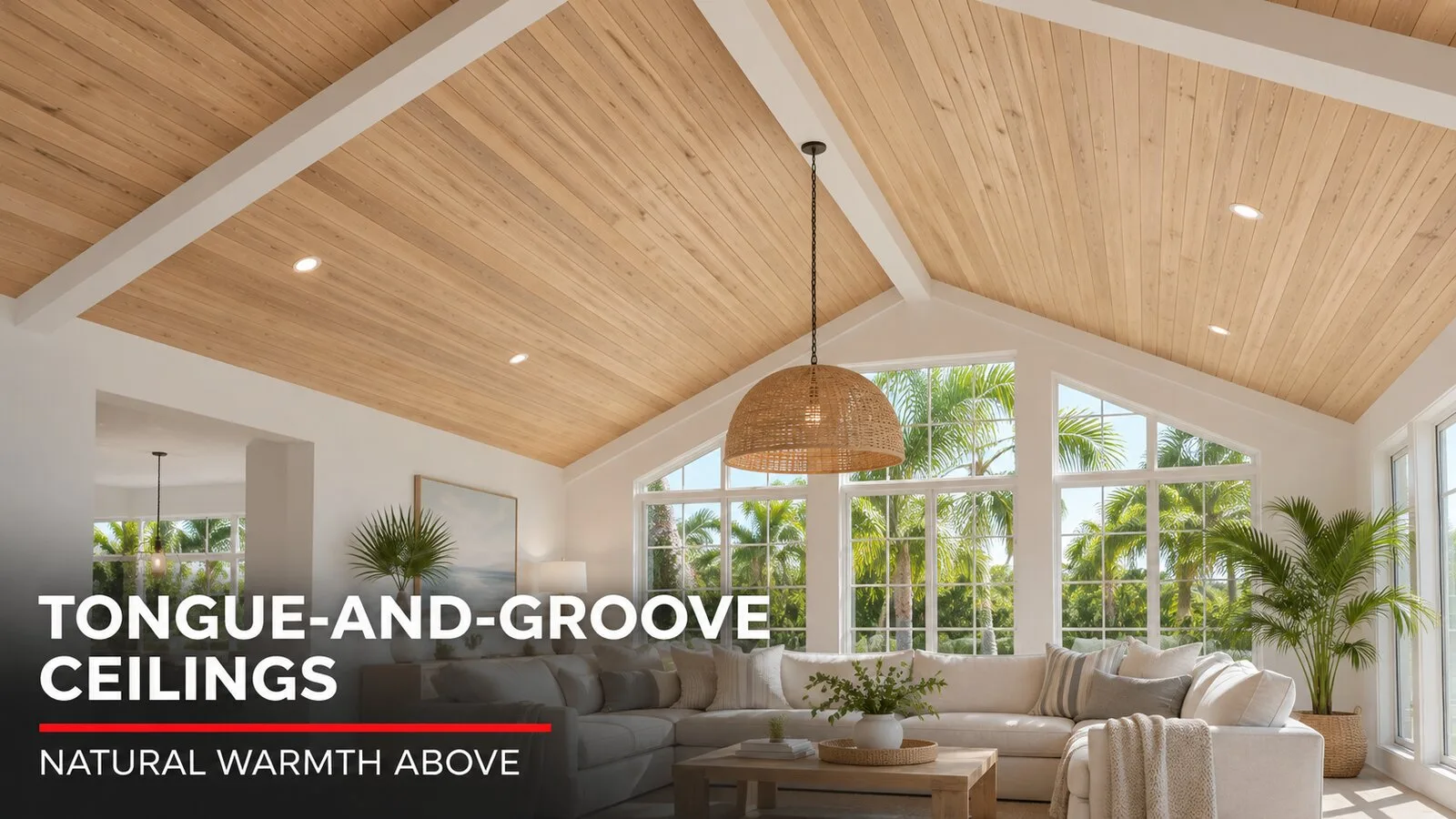
Is a flat white ceiling the last plain surface in a room you've otherwise finished? A tongue and groove ceiling changes the whole space. Boards lock edge to edge, one into the next, and run the length of the room in long lines that draw the eye up. J. Perry & Sons handles wood ceiling installation in South Florida homes and commercial spaces: interior ceilings in living rooms, kitchens and primary bedrooms, vaulted and tray ceilings, and porch, lanai and covered patio ceilings outside. This page covers starting prices, the materials that work here, how Florida humidity changes the way boards are installed, fire and code points, and how we handle lights and fans in a wood ceiling.
Tongue and groove ceiling cost
| Ceiling | Unit | Starting price |
|---|---|---|
| Interior tongue-and-groove wood ceiling | per sq ft | $14–$22 |
| Porch, lanai and exterior ceiling | per sq ft | $18–$30 |
| Removing an existing ceiling finish first | per job | priced per job after we see it |
| Beams, trim or a coffered layout added to the ceiling | per job | priced per job after we see it |
About these prices. These ranges are starting points based on typical South Florida projects. Your final price depends on the condition of the property, access, the materials or system specified and the full scope of work. We confirm every number after we review your project in person or from the drawings, and the price in your signed proposal is the one that applies.
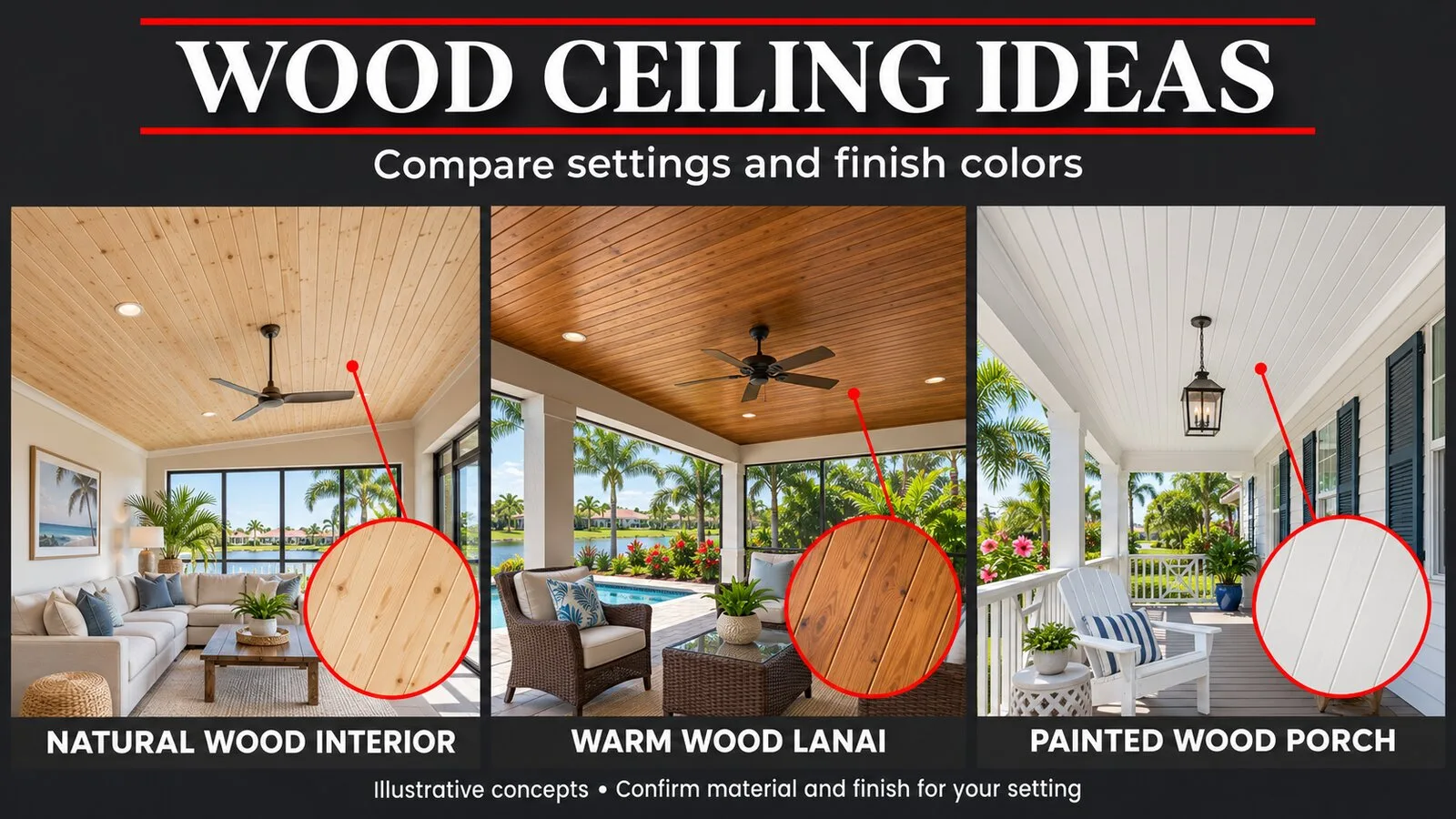
Within each range, the price moves with the species and grade of the board, the height of the ceiling and whether it needs scaffolding, the number of angles on a vaulted or tray ceiling, and how many cut-outs there are for lights, fans and vents. Exterior ceilings cost more because the boards are sealed on all sides and fastened for wind.
Wondering what your ceiling would run? Call (561) 556-7509 with the room size and ceiling height and we'll give you a starting number on the phone.
Interior wood ceilings
Inside the house, a wood ceiling does three things: it warms up a room full of tile and white walls, it defines a space in an open floor plan, and it hides an uneven or patched drywall ceiling without the mess of a full skim coat.
Where it works best. Great rooms with high or vaulted ceilings, kitchens where a band of wood over the island sets the space apart, primary bedrooms and dens, and tray ceilings where only the recessed center gets wood.
Direction of the boards. Running the boards along the long dimension of a room makes it feel longer. Running them across makes a narrow room feel wider. On a vaulted ceiling, boards usually run along the ridge so the lines lead to the peak.
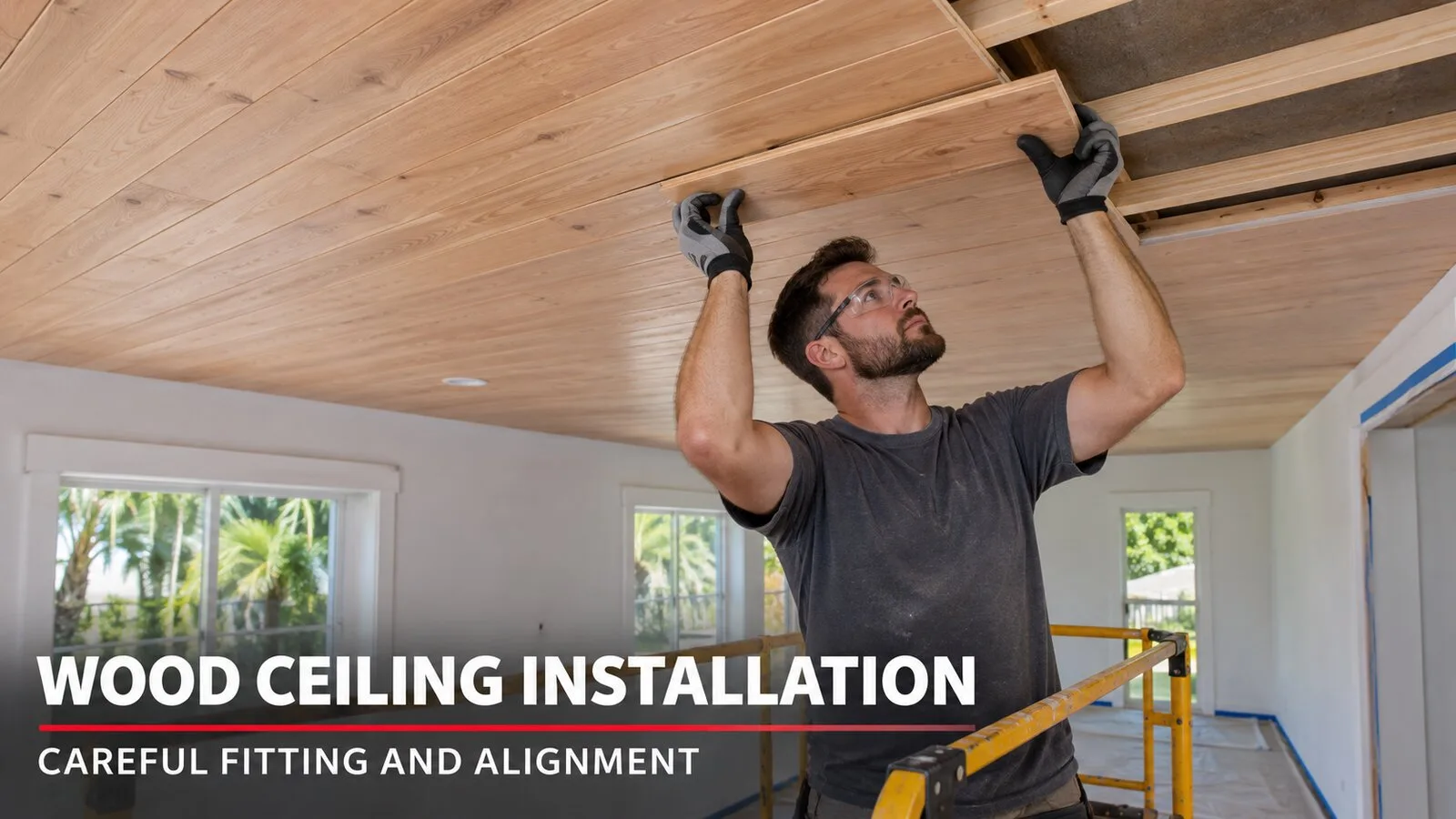
How it attaches. Boards are blind-nailed through the tongue, so no nail heads show. They go over the existing drywall into the framing, or onto furring strips where the framing isn't spaced right for the board direction. A small gap is left at the walls and covered by crown molding or a simple trim, so the boards can move with the seasons.
Stain, clear or paint. Natural wood with a clear coat is the most requested finish. Light stains and whitewash suit coastal homes. Painted tongue and groove in white or a soft color gives texture without the wood tone. We bring board and finish samples to your home, and we can prepare a rendering, in house or with our designer, so you see the room before the first board goes up.
Porch and lanai ceilings
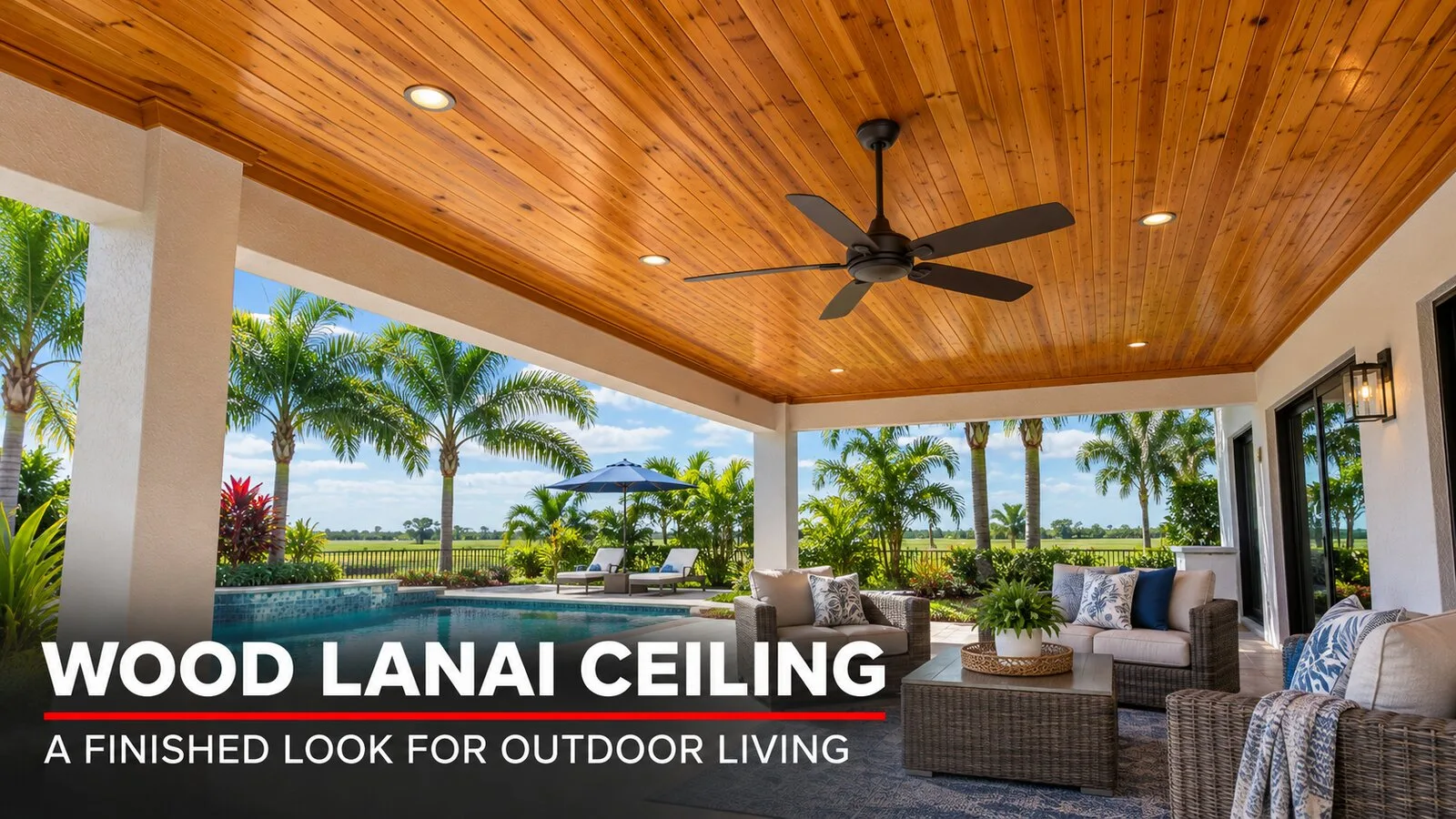
What usually ruins an outdoor ceiling in Florida? Water. Afternoon storms blow rain sideways under the roof, humidity sits in the air for months, and in older houses the existing lanai ceiling is often stained plywood or sagging vinyl soffit.
A good porch or lanai ceiling here needs:
- Boards sealed on all six sides. Front, back, edges and cut ends get primer or sealer before installation, so moisture can't soak into the back of the board where you can't see it. This step is called back-priming.
- Stainless or coated fasteners. Plain steel nails bleed rust stains through the finish within a year or two near the coast.
- Ventilation where the roof needs it. If the ceiling closes off a vented area, vents are cut in so the space above it can dry.
- Fastening for wind. In a storm, wind pushes up under a lanai roof. Boards are fastened more closely than indoors, and soffit and ceiling products on exposed areas in Broward and Miami-Dade must meet the High-Velocity Hurricane Zone rules.
For pool cages and lanais on the water, PVC tongue and groove is often the smarter choice. It looks like painted wood from the ground and doesn't rot, swell or feed mold.
Is your lanai ceiling stained or sagging? Send us your project with photos and we'll tell you whether to repair it or replace it with wood or PVC.
Materials: pine, cypress, cedar, white oak and PVC
Pine. The most affordable wood and the classic look of a beach cottage ceiling. Knotty pine has a rustic feel; clear or select grades are calmer. It must be sealed well in humid spaces.
Cypress. A Southern wood with natural resistance to rot and insects, long used in Florida porch ceilings. It takes stain well and has a soft gold color.
Cedar. Western red cedar resists decay and has a reddish tone and a light aroma. It is a strong choice for porches and covered outdoor kitchens.
White oak. A hardwood ceiling, usually for interiors, often chosen to match white oak floors or stairs in the same room. It costs more and is heavier, so fastening is planned with the framing.
PVC. Cellular PVC tongue and groove for exteriors, pool areas and anywhere water or salt air is a constant. It comes white and can be painted, and some products have a printed wood grain.
Humidity and acclimation in Florida
Why do some wood ceilings show gaps in winter and buckle in summer? Because the boards were installed before they adjusted to the house.
Wood takes on and gives off moisture until it matches the air around it. A bundle of boards from a warehouse can be at a very different moisture level than your air-conditioned living room. If it goes up right away, it shrinks or swells after installation, and the ceiling shows gaps or ridges.
Our acclimation steps:
- Deliver early. Boards are opened and stacked with spacers in the room where they'll be installed, with the A/C running at normal settings.
- Wait and measure. Typically several days, until a moisture meter shows the wood is close to what the room's air calls for.
- Seal before installing. Back-priming or sealing all sides slows how fast the board reacts to humidity later.
- Leave expansion room. The gap at the walls, hidden under trim, lets the ceiling move without pushing.
Exterior boards are acclimated outdoors under cover, since that is the air they'll live in.
Fire and code points
Is a wood ceiling allowed? In a single-family home, yes in almost every case. The Florida Building Code limits how fast an interior finish can spread flame, and ordinary softwood and hardwood boards meet the residential limit when installed over the ceiling as a finish.
Other situations need more care:
- Commercial spaces, restaurants and multifamily common areas have stricter interior finish ratings that depend on the occupancy and whether the building has sprinklers. These jobs may need fire-retardant-treated boards or a specific listed product.
- Condominium units can be subject to association rules, and some buildings require board approval for ceiling work.
- Garage ceilings below living space have fire separation requirements, so wood goes over the required drywall, never in place of it.
When a permit is required, J. Perry & Sons pulls its own permits and follows every city and county requirement. See permits and compliance.
Planning wood ceilings in a restaurant or office? Call (561) 556-7509 and we'll check the finish rating your space requires before you pick a board.
Lighting, fans and cut-outs
Every light, fan, speaker and A/C vent in a wood ceiling needs a clean cut-out, and most homeowners want to add lights while the ceiling is open. Here is how we handle it:
- Layout first. We mark the board layout and every fixture location before installing, so cut-outs land in sensible spots and not on a joint.
- Electrical by a licensed electrician. New fixtures, boxes and wiring are done by a licensed electrician under an electrical permit. Fixtures used in a ceiling with insulation above need to be rated for that.
- Fans need proper support. A ceiling fan hangs from a fan-rated box fastened to the framing, not from the wood boards.
- Trim rings and vent covers. Covers are sized to hide the cut edge and sit flat on the board face.
Related services
- Stairs: a white oak stair under a matching white oak ceiling in a two-story foyer.
- Engineered wood flooring: wood floors to pair with the ceiling.
- Drywall and painting: repairs to the walls and trim around a new ceiling.
- Decks: outdoor living spaces beneath a covered porch ceiling.
We serve Broward County, Palm Beach County and Miami-Dade County.
Prefer to send photos or plans? Send us your project
Tongue and groove ceiling FAQ
How much does a tongue and groove ceiling cost?
An interior tongue-and-groove wood ceiling starts at $14–$22 per square foot installed, and porch and exterior ceilings at $18–$30 per square foot. Final pricing is confirmed after we review your project.
Can you install a wood ceiling over my existing drywall ceiling?
Yes, in most homes. The boards are fastened through the drywall into the framing, or onto furring strips. We check the ceiling's framing first.
What is the best wood ceiling material for a Florida lanai?
Cypress and cedar resist rot and do well under a covered porch. On lanais that get wet or sit near salt water, PVC tongue and groove holds up best.
How long does wood ceiling installation take?
After the boards acclimate, a typical room goes up in a few days. Ceiling height, angles and the number of fixture cut-outs add time.
Will a tongue and groove ceiling move or crack in Florida humidity?
Wood always moves a little. Acclimating, sealing the boards and leaving hidden gaps at the walls keep that movement out of sight.
How do I get an exact price for a wood ceiling?
Call (561) 556-7509 or send us your project with the room dimensions, ceiling height, photos and the wood or finish you like. We visit, measure and send a written proposal.
Free estimate: call (561) 556-7509 or send us your project. Licensed Florida general contractor CGC1540699. Serving Broward, Palm Beach and Miami-Dade counties.