
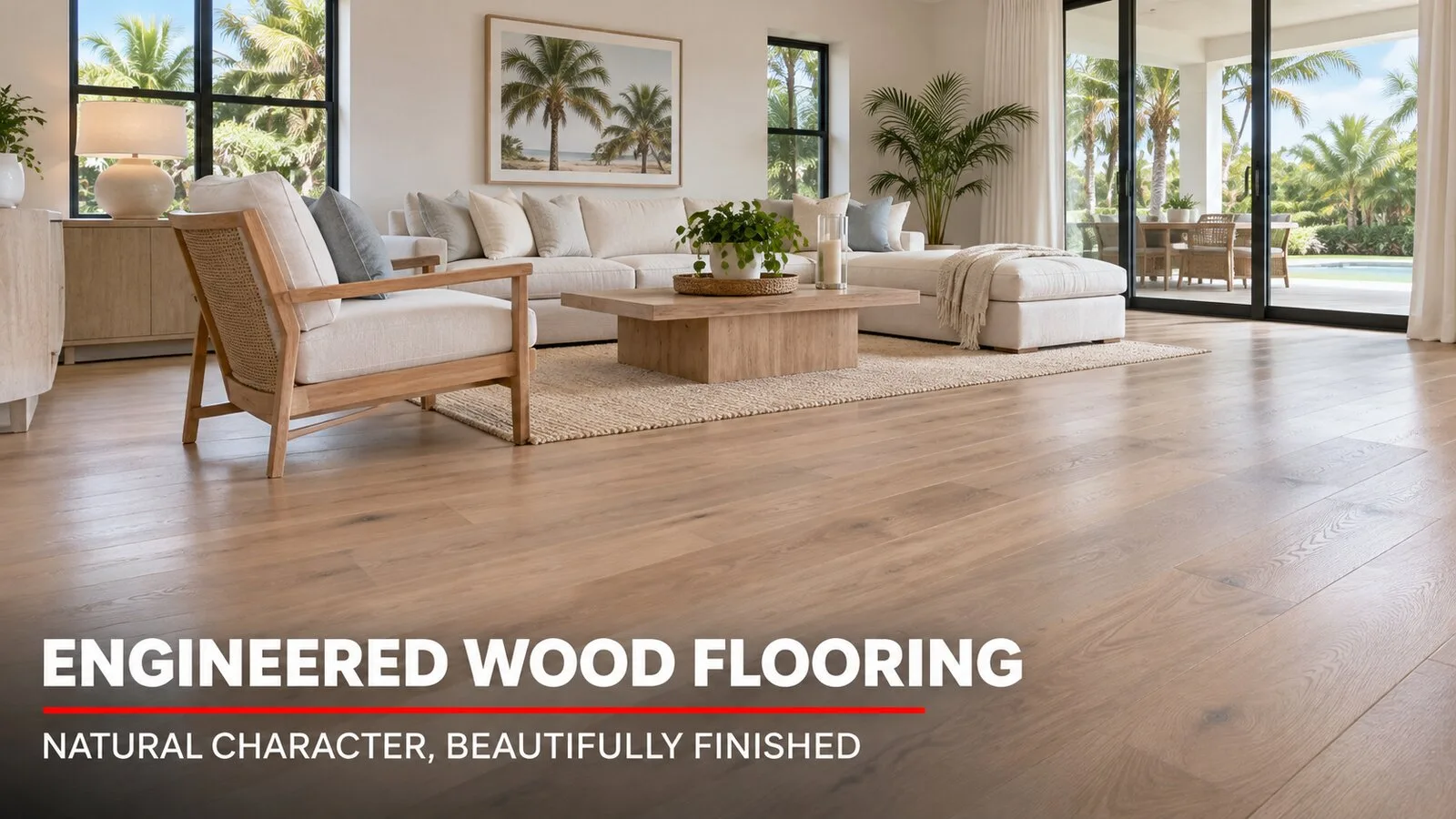
Want real wood floors but worried a Florida slab will ruin them? Engineered wood flooring is how you get them. Each plank has a real hardwood top layer bonded to a cross-layered core, so it stays flat where solid boards would cup. Almost every home and condo here sits on concrete, and engineered hardwood flooring installation over that concrete is what this page is about: glue-down versus floating, the moisture testing that comes first, condo sound underlayment rules, wide-plank white oak, and matching your stairs. It is part of our flooring installation work.
Engineered wood flooring cost
| Floor | Unit | Starting price |
|---|---|---|
| Engineered wood, glued down over a concrete slab | per sq ft | $14–$21 |
| Premium wide-plank white oak, glued down | per sq ft | $21–$28 |
| Removing existing tile, carpet or vinyl | per job | priced per job after we see it |
| Leveling the slab where needed | per job | priced per job after we see it |
| Moisture barrier or condo sound underlayment | per job | priced per job after we see it |
| Baseboards and transitions | per job | priced per job after we see it |
About these prices. These ranges are starting points based on typical South Florida projects. Your final price depends on the condition of the property, access, the materials or system specified and the full scope of work. We confirm every number after we review your project in person or from the drawings, and the price in your signed proposal is the one that applies.
Removal, leveling and underlayment depend on what is on your floor today and what your slab and your association require, so we price them after we test and measure.
Comparing wood quotes? Call (561) 556-7509 and we'll walk you through which lines belong in a complete wood floor bid.
What engineered wood is, and why it suits a slab
An engineered plank has two parts. The top layer, called the wear layer, is real hardwood, usually between 2 and 6 millimeters thick. Under it is a core of cross-laid plywood layers or a dense fiberboard. Because the core layers run in different directions, the plank resists swelling and shrinking across its width.
Solid hardwood is milled from one piece of wood and is meant to be nailed into a wood subfloor. On a concrete slab there is no wood to nail into, and solid boards react to slab moisture by cupping. That is why engineered wood is the standard choice for real wood floors in South Florida.
Things to compare between products:
- Wear layer thickness. A thicker wear layer can be sanded and refinished more times over the life of the floor.
- Core type. Multi-ply plywood cores are the most stable on slabs. Fiberboard cores are flatter and cheaper but less forgiving of water.
- Finish. Factory finishes are hard and ready to walk on right away. Some floors are sold unfinished and finished on site.
Glue-down vs floating installation
There are two ways to put engineered wood over concrete, and the choice affects feel, sound and how the floor lasts.
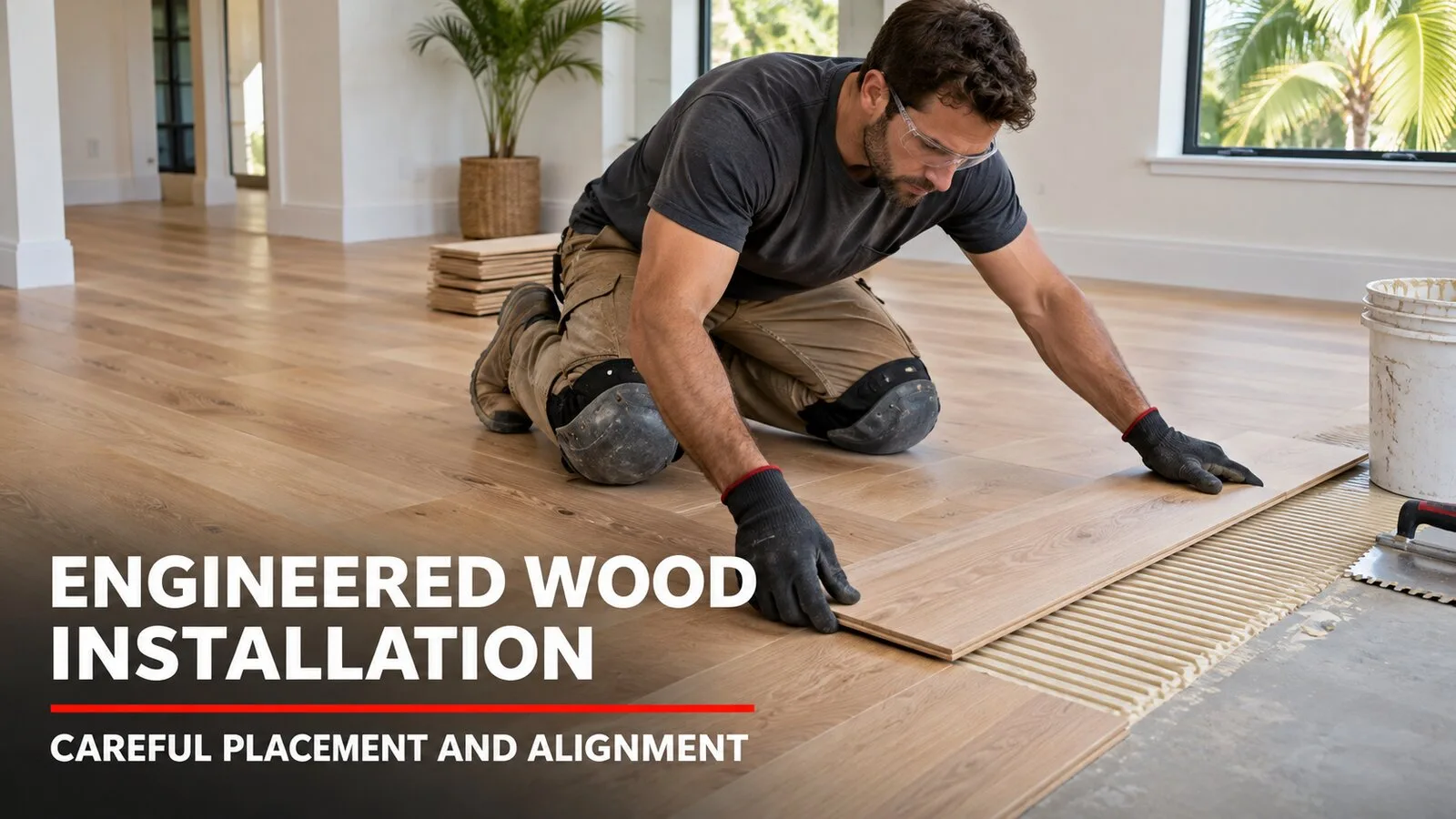
Glue-down. Each plank is bonded to the slab with a urethane flooring adhesive troweled across the floor. Many of these adhesives include a built-in moisture barrier, so one product bonds the floor and slows moisture from the concrete. A glued floor feels solid underfoot, sounds like real wood when you walk on it, and doesn't shift. It is our standard method and the one our prices above are based on.
Floating. Planks lock or glue to each other, not to the slab, and rest on a foam or cork underlayment with a plastic vapor retarder underneath. Floating floors go in faster and can work over some existing hard floors. They can feel and sound hollow, and long or wide planks are more likely to move. Many manufacturers limit floating installs for wide planks, and many condo associations don't allow them.
Not sure which method your building allows? Send us your project with your association's flooring rules and we'll tell you which one fits.
Moisture testing comes first
Does the slab under your floor look dry? It can still be pushing moisture up. South Florida's water table sits a few feet below most homes, and concrete passes moisture through it constantly. That moisture is the main cause of cupped boards and failed adhesive.
Before we quote wood, we test:
- Relative humidity probes. Small holes are drilled in the slab and sensors left in place to read the humidity inside the concrete, following the ASTM F2170 method most wood and adhesive makers reference.
- Calcium chloride tests. A dish of salt under a sealed dome measures how much moisture leaves the slab surface over a set time, following ASTM F1869.
- Meter readings on the wood. We check the planks and the slab are within the range the flooring maker allows.
If the slab reads high, the fix is a moisture barrier: either the adhesive's own barrier, or a separate liquid barrier coat rolled on before the glue. We follow the specific limits the flooring and adhesive manufacturers publish, because their warranty depends on it.
Already have cupped wood floors? Call (561) 556-7509 and we'll test the slab and tell you whether moisture is the cause.
Condo sound underlayment rules
Live in a condo with neighbors below? The association almost certainly has rules for hard floors. Most require a sound-reducing underlayment under any wood or tile, rated by IIC (impact insulation class, which measures footstep noise heard below) and sometimes STC (sound transmission class, for airborne sound). Many associations also require the board's approval before work starts.
How we handle condo wood floors:
- Read the rules first. We ask for your association's flooring rules and the minimum ratings they set.
- Pick a tested assembly. The underlayment maker publishes test results for specific assemblies; we choose one that meets the rule with an engineered wood floor glued over it.
- Prepare the submittal. Product data sheets and test reports go to the board or the building manager for approval.
- Isolate the perimeter. A small gap or isolation strip keeps the floor from touching the walls, so footstep noise doesn't travel through the drywall.
- Follow building hours. Work, deliveries and debris removal stay inside the times the building sets.
Wide-plank white oak
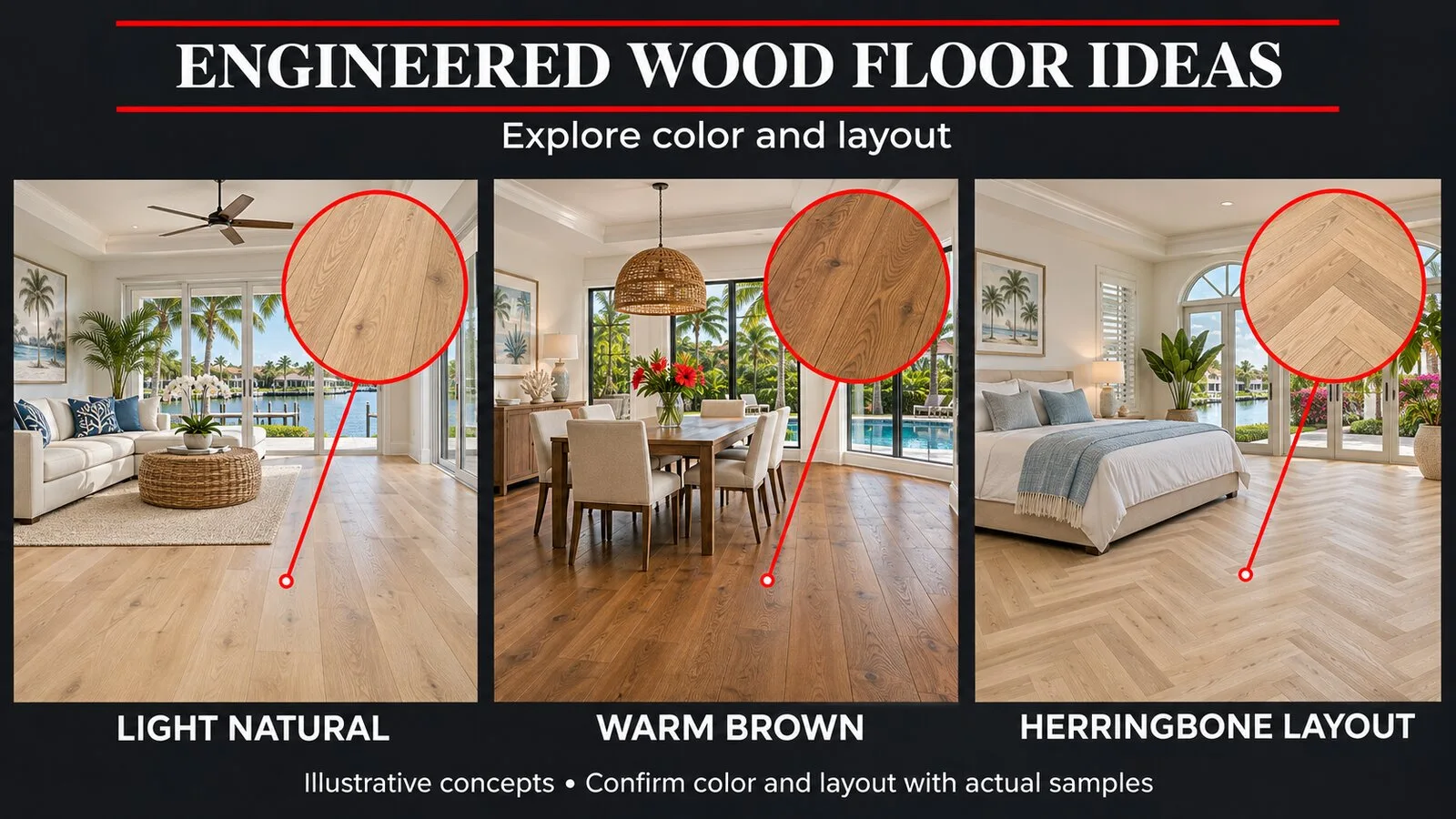
Wide-plank white oak is what most of our clients ask for right now: planks around 7 to 10 inches wide or more, in long lengths, in natural, light or gray-brown tones. Wide planks show more of the wood's grain and make a room look calmer, with fewer seams.
They also ask more of the installation:
- Flatness. A wide plank bridges over dips in the slab instead of following them, so slab flatness matters more. We check with a straightedge and level low spots before gluing.
- Moisture. A wide board has more wood to swell. Glue-down with a moisture-barrier adhesive is the method we use for wide planks on slabs.
- Layout. Long planks need planning so end joints are spread out and no short pieces end up at doorways.
We bring wide-plank samples in several tones to your home, so you see them in your own light. Upon request, we can also show you a rendering of the room, in house or through our designer, before you order.
Matching floors and stairs
Two-story home? The stair is usually the first thing you see from the front door, and a new wood floor next to a carpeted or tiled stair looks unfinished. We plan floors and stairs as one project. The floor can be matched with stair parts from the flooring maker, or with solid white oak treads finished on site to match your floor. See our white oak stairs page for the stair side.
To complete the room, a tongue-and-groove ceiling in the same oak is another option clients pair with a new floor. For other floor types in the house, see residential flooring, and for offices and stores, commercial flooring.
Prefer to send photos or plans? Send us your project
Engineered wood flooring FAQ
How much does engineered wood flooring cost to install?
Engineered wood glued down over a concrete slab starts at $14–$21 per square foot, and premium wide-plank white oak at $21–$28 per square foot. Removal, leveling and underlayment are priced after we test and measure. Final pricing is confirmed after we review your project.
Can engineered hardwood go over a concrete slab in Florida?
Yes. It is the right kind of wood for a slab. We test the concrete for moisture first, then glue it down with a moisture-barrier adhesive or a separate barrier coat.
Is glue-down better than floating for engineered wood?
On a slab, glue-down usually is. It feels and sounds like solid wood and doesn't shift. Floating floors can work, but many condos don't allow them and many wide planks aren't approved for floating.
Can I put engineered wood in my condo?
Usually yes, with the sound underlayment your association requires and the board's approval. We prepare the product data for the submittal.
Can engineered wood be refinished?
Yes, if the wear layer is thick enough. A floor with a thicker wear layer can be sanded and refinished more than once.
How do I get an exact price for engineered wood floors?
Call (561) 556-7509 or send us your project with the rooms, what is on the floor now, and whether it is a house or a condo. We visit, test the slab, measure and send a written proposal.
Free estimate: call (561) 556-7509 or send us your project. Licensed Florida general contractor CGC1540699. Serving Broward, Palm Beach and Miami-Dade counties.