
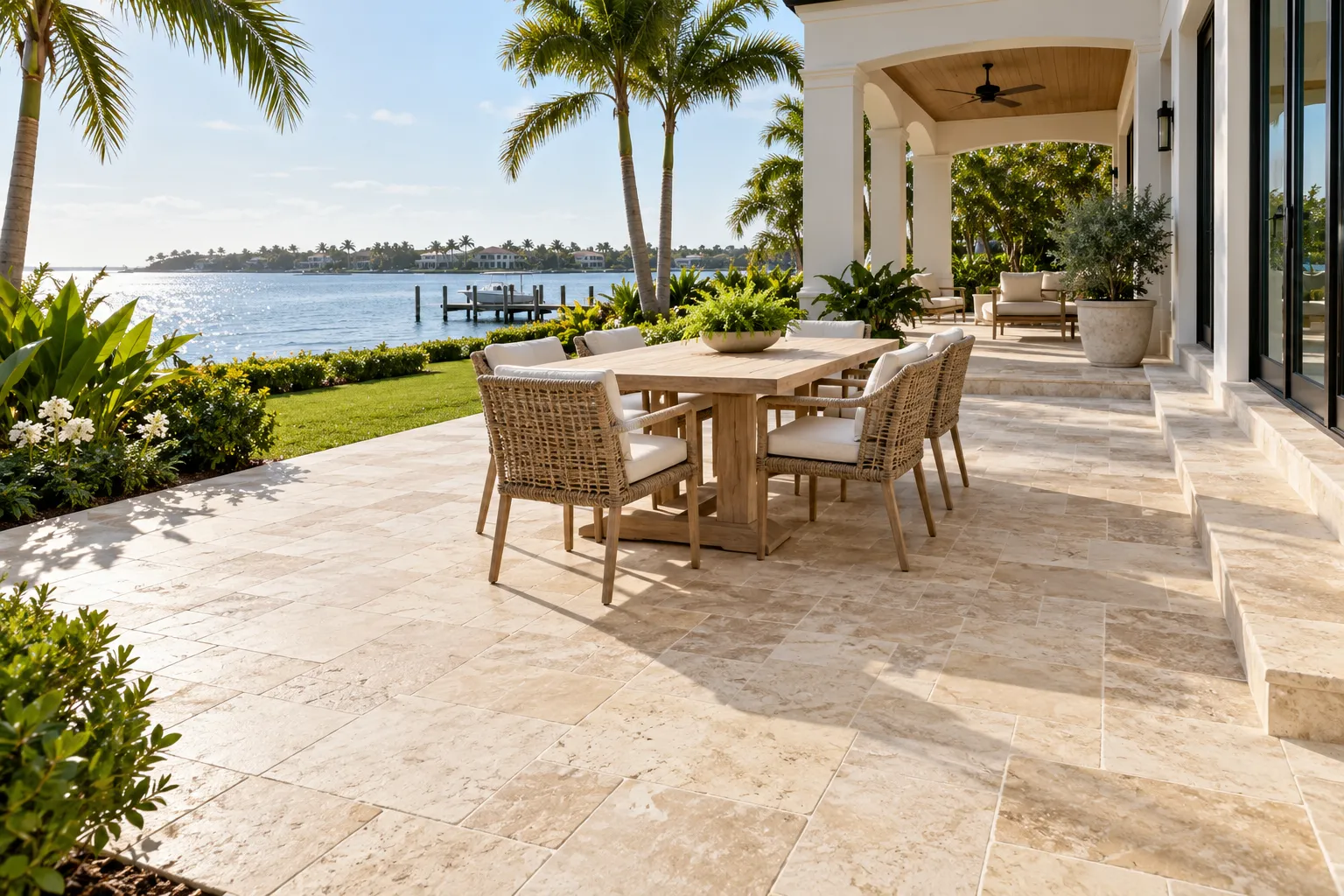
J. Perry & Sons handles paver installation from tear-out to sealing across Broward, Palm Beach and Miami-Dade, as one of all of our services. We are licensed paver contractors working under a Florida general contractor license (CGC1540699), so the base, the drainage, the coping and the permit sit with one company. If you're planning a driveway, patio or pool deck at home, go next to residential pavers. HOAs, condo boards, property managers and general contractors go to commercial pavers and HOA pool decks for unit pricing, phasing and closeout. We pull every permit the work needs and follow each city and county's requirements on our jobs.
Homeowners planning a driveway, patio or pool deck will find options and timelines on residential pavers. Associations, property managers and GCs pricing common areas and pool decks should see commercial pavers for HOAs and pool decks.
This page is the trade manual behind every paver job we price: which paver goes where, how thick, in what pattern, on how much base. Ever seen a paver driveway rut, sink or grow weeds in the joints after a few years? Pavers fail for four reasons: a thin or poorly compacted base, no edge restraint, water running the wrong way, and joint sand that washed out. Everything below is how we control those four things.
Paver Installation Cost in South Florida
| Scope | What goes in | Installed range |
|---|---|---|
| Paver driveway, all materials | Tear-out, limerock base, sand bed, pavers, edge restraint, joint sand | $19–$39 per sq ft |
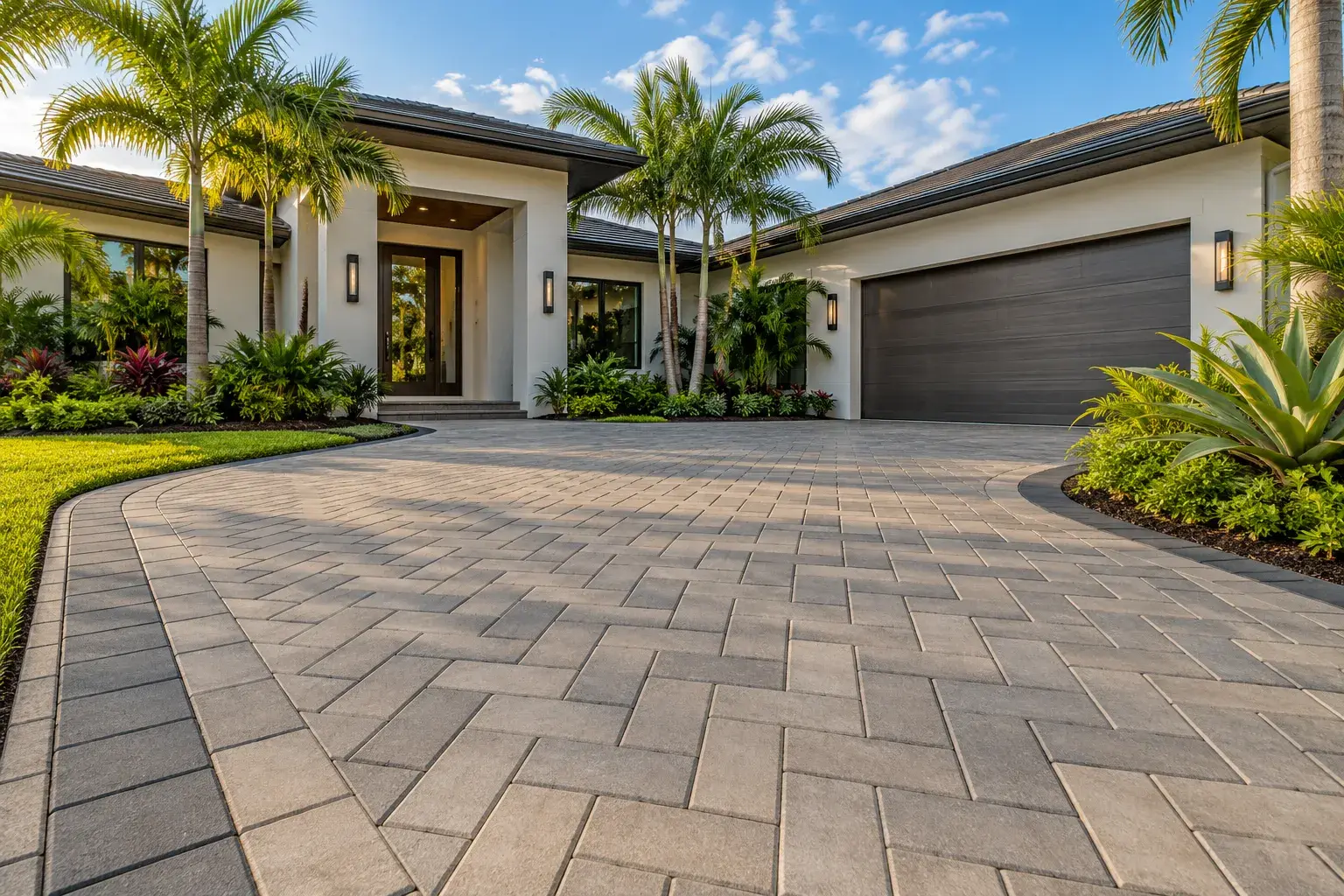
| Concrete paver driveway, 80 mm | Belgard, Tremron or Pavestone, herringbone field, border | $19–$28 per sq ft |
| Travertine driveway or motor court | 1¼ in driveway-grade travertine, heavier base | $24–$32 per sq ft |
| Concrete paver patio or walkway, 60 mm | New base, soldier border | $19–$25 per sq ft |
| Travertine pool deck | 3 cm tumbled or brushed, on a new base | $24–$34 per sq ft |
| Porcelain paver deck, 2 cm | Textured outdoor porcelain, no sealing needed | $29–$39 per sq ft |
| Pavers over existing concrete | Sound slab kept, leveling extra | $17–$32 per sq ft |
| Pool coping | Precast, concrete, porcelain, marble or travertine | $50–$100 per linear ft |
| Travertine pool coping | 12x24 or 16x24, bullnose or rebated | $70–$100 per linear ft |
| Paver sealing | Cleaning, re-sanding with polymeric sand, sealer | $2–$3 per sq ft |
| Releveling sunken pavers | Lift, rebuild base, relay the same pavers | $12–$18 per sq ft |
About these prices. These ranges are starting points based on typical South Florida projects. Your final price depends on the condition of the property, access, the materials or system specified and the full scope of work. We confirm every number after we review your project in person or from the drawings, and the price in your signed proposal is the one that applies.
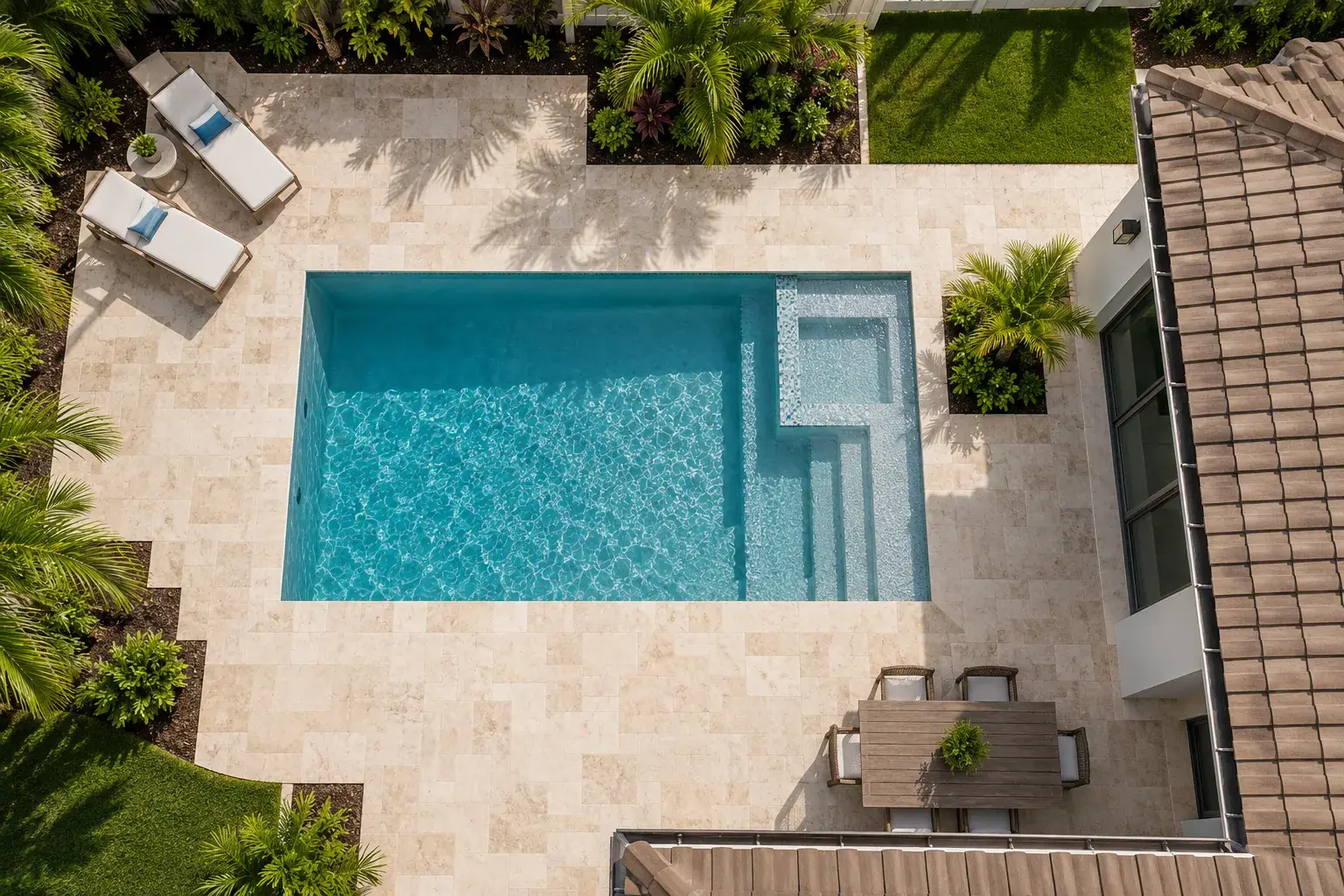
Ranges include demolition and haul-away where noted, compacted base, bedding sand, edge restraint and polymeric sand. Permit fees, including the city fee for a driveway apron, drainage additions and pool fence or gate corrections are listed as their own lines. Small areas carry a higher per-foot price, because mobilization, the compactor and the cutting station cost the same on 150 sq ft as on 600.
Free estimate — call (561) 556-7509 or send us your project. Send photos of the area and a rough length and width for a first range.
Paver Types We Install
Not sure which paver suits your house? Each one has a job it does best.
Concrete pavers. Most of the driveways and walkways we build, and what most South Florida homeowners mean by a brick driveway or brick pavers. They are made in molds at high compression, so they carry vehicle loads, come in dozens of colors and blends, and a single broken piece lifts out and gets replaced years later. We install Belgard pavers first, with Tremron and Pavestone as the alternatives, because all three are stocked by South Florida suppliers and can be reordered for repairs.
Clay brick pavers. Fired clay keeps its color for life and fits older and Key West style homes. Brick is less forgiving of a soft base and costs more to cut, so we use it on walks, borders and courtyards more than full driveways.
Travertine. The South Florida pool deck standard. Tumbled or brushed travertine stays cooler underfoot than concrete, grips when wet, and matches travertine coping piece for piece. It is porous and gets a penetrating sealer. Full detail on travertine installation is on the travertine pavers page.
Porcelain pavers (2 cm). Outdoor porcelain 20 mm thick, usually 24x24 or 24x48. It absorbs almost no water, so it does not stain, fade, grow mold in the pores or need sealing. It needs a perfectly prepared bed and slow wet cutting, which is why it sits at the top of the price table.
Flagstone, shellstone and marble. Flagstone pavers in irregular natural shapes for garden paths and courtyards; shellstone (cut coral stone) for its warm color and cool surface; tumbled marble pavers for a formal, light-colored deck. All three are softer than travertine, need sealing near salt water, and belong on decks, patios and walks rather than daily-driver driveways.
Torn between travertine and porcelain for your pool deck? Call (561) 556-7509 and we'll bring samples so you can feel both underfoot.
Thickness: 60 mm, 80 mm and Thin Overlay Pavers
60 mm (2⅜ in). The standard concrete paver for patios, walkways, pool decks and side yards. Foot traffic and the occasional lawn mower.
80 mm (3⅛ in). Driveways, motor courts, anything a car turns on, and every commercial drive aisle. The extra thickness resists rocking and rotating under turning tires. We do not install 60 mm pavers on a driveway.
Thin overlay pavers. Roughly half the thickness of a standard paver, made to go over a sound concrete slab where the height at the doors cannot rise much. Belgard, Tremron and Pavestone all make overlay pavers in colors that match their full-depth lines, so a front walk overlay can match a new driveway.
Stone and porcelain. Travertine for decks on sand is 3 cm (about 1¼ in); 2 cm stone and 2 cm porcelain go on a bonded mortar bed over concrete, not loose sand, because thin pieces crack under a point load on sand. Driveway travertine is 1¼ in at minimum on a heavier base.
Patterns and Borders
Which pattern should you pick? It depends on what drives or walks over it.
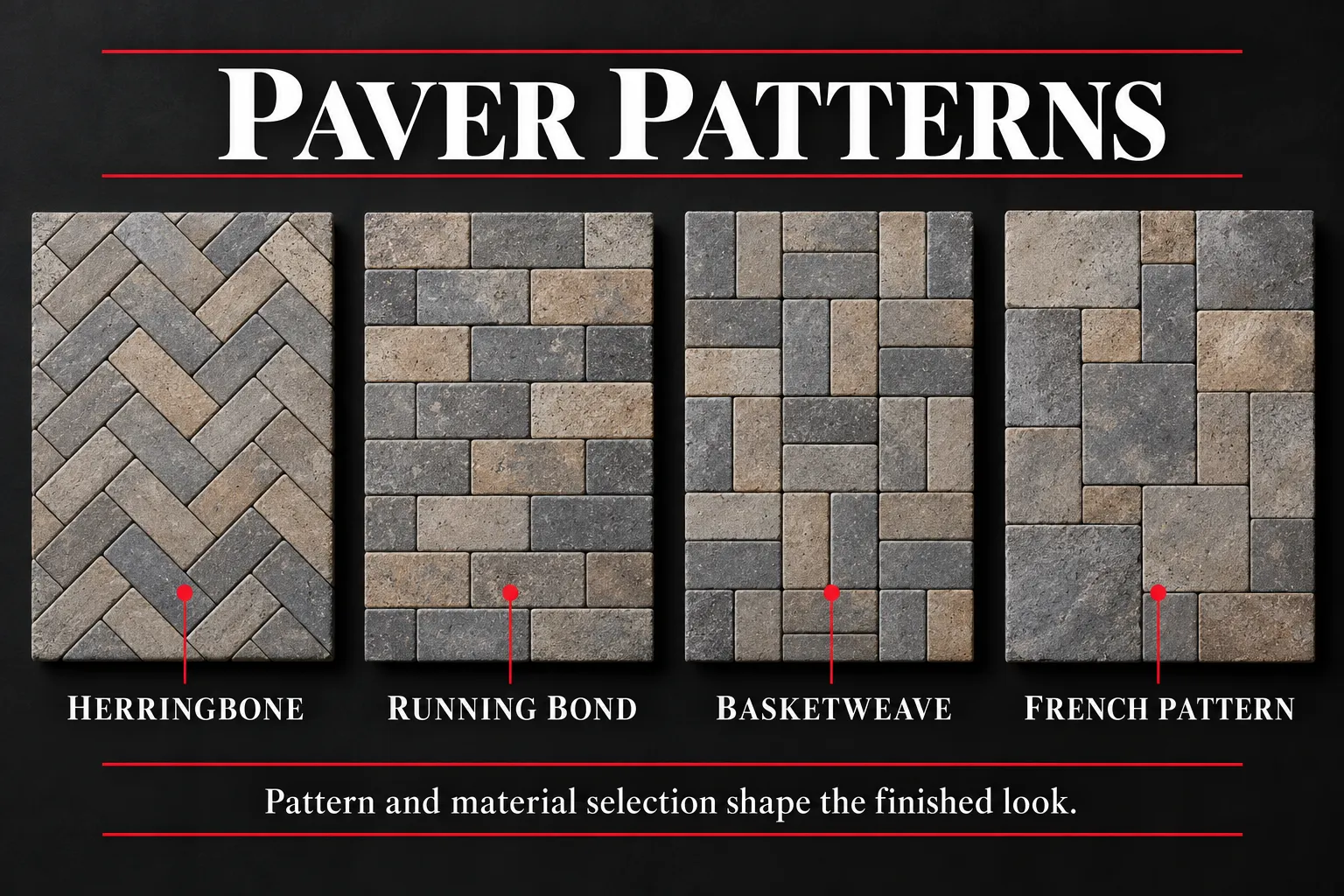
Herringbone, 45 or 90 degrees. The interlocking pattern for driveways. Each paver is locked by four neighbors in two directions, so turning tires cannot push the field into waves. Our herringbone paver driveway guide shows both angles.
Running bond. Long rectangles in offset rows. Clean and modern on walks and patios, laid with the long side across the direction of travel on a walkway so it does not creep.
Basket weave. Pairs of pavers turned 90 degrees to each other. A traditional look for patios and courtyards; not for heavy turning traffic.
French pattern (Versailles). Four sizes of travertine or marble in a repeating set. The common pool deck pattern; it hides small color variation.
Soldier course border. A row of pavers set on end around the field, usually in a contrasting color. It frames the field and gives the edge restraint a straight line to hold. On driveways we set the border in concrete where it meets lawn.
The Base: Where Paver Jobs Last or Fail
Why do some paver jobs stay flat while others sink in two years? It's almost always the base. South Florida ground is sand and limerock over a high water table. It drains well, but uncompacted fill settles fast after a tropical storm drops several inches in an afternoon. Most failed paver jobs we are called to fix had a thin base, so we put the paver base depth in writing on every estimate.
| Area | Compacted limerock base |
|---|---|
| Patios, walkways, pool decks | 4–6 in |
| Residential driveways | 6–8 in |
| Boat, RV or trailer parking | 10–12 in |
| Commercial drives and parking courts | To the civil engineer's drawing |
About these prices. These ranges are starting points based on typical South Florida projects. Your final price depends on the condition of the property, access, the materials or system specified and the full scope of work. We confirm every number after we review your project in person or from the drawings, and the price in your signed proposal is the one that applies.
Subgrade. We excavate to depth, pull roots, organic soil and muck pockets, and compact the exposed soil. Soft spots are dug out and backfilled, never bridged.
Geotextile. A woven fabric separates the base from sandy fill on driveways and wherever the subgrade is soft, so the limerock does not migrate down into the sand.
Lifts. Crushed limerock goes in lifts no thicker than 4 in, wetted and compacted with a plate compactor or roller before the next lift. Dumping 8 in and compacting once leaves the bottom loose.
Bedding sand. One inch of washed coarse concrete sand, screeded flat with rails and a straightedge and left uncompacted until the pavers are on it. Too much sand is the second most common cause of ruts.
Edge restraint. Every open edge gets restraint, also called paver edging (a hard stop that keeps pavers from spreading): spiked heavy plastic edging with spikes about every 12 in on patios and walks, or a concrete toe or curb on driveways and commercial work. Without it, borders drift and joints open within a season.
Comparing paver quotes? send them through our project form and we'll point out where the base depth is missing.
Polymeric Sand Done Right
Joints are filled with polymeric sand, a graded sand with a binder that hardens when activated with water. It resists washout from storms and pressure washers, and it slows weeds and ants. We use Techniseal or Alliance Gator polymeric sand, matched to the joint width of the paver.
The steps matter more than the brand. The pavers must be completely dry. Sand is swept into the joints, the field is compacted with a pad on the plate compactor to vibrate the sand down, and the joints are topped off to just below the paver's chamfer. Every grain is blown off before the field is misted in sections, not flooded. Leftover sand on the face turns into a hard haze that only a chemical cleaner removes. We do not activate polymeric sand with rain in the forecast inside the window the bag calls for.
Drainage and Slope
Where will the water go when it rains on your new pavers? We set slope at about 1/4 in per foot away from the house on patios and pool decks, and toward the street or a swale on driveways, never toward the garage. Before we finish grades we check where the roof gutters discharge, because a downspout dumping onto a new patio will wash a joint in one summer.
At sliding doors, the finished pavers stay below the interior floor with room for the threshold. On pool decks, the surface falls away from the pool and the house at once, toward deck drains or the lawn.
Is your lot close to its limit for hard surface, or does a side yard hold water? Permeable pavers are built differently: wider joints filled with clean crushed stone over an open-graded stone base, so rain soaks down instead of running off. We'll tell you on the site visit whether a permeable driveway or patio makes sense on your lot, and price it as its own line.
Pavers Over Existing Concrete
Hoping to skip the tear-out? When an existing slab is flat, uncracked and not settling, pavers can go over it and the demolition line disappears. We check three things first: offset cracks (the slab is moving, so the pavers will too), height at every door and drain, and where water will exit once the surface is raised. Thin overlay pavers or 2 cm stone are set on a bonded bed with a concrete or mortar edge along open sides. Overlays work well on patios, pool decks and walks; for driveways the decision is made case by case on driveway extension and pavers over concrete, and pool decks are covered in pavers over an existing pool deck. Overlay is priced per square foot, leveling extra; see the cost table above.
Paver Sealing: Wet Look or Natural
Wet look or natural? Either way, paver restoration is one job with us: we clean, re-sand the joints and seal, priced in the cost table above. Sealing deepens color, locks the joint sand, and keeps oil, sunscreen, rust from irrigation water and leaf tannins out of the surface.
Timing. New concrete pavers release a white haze called efflorescence as they cure. Sealing traps it under the film, so we wait until it has washed out, usually 60–90 days on concrete pavers and 30–60 days on stone.
Wet look. A solvent-based acrylic that darkens the color and leaves a sheen. Good on driveways and front walks. We do not put a gloss sealer on a pool deck, because it gets slick under wet feet.
Natural or matte. A water-based sealer that protects without changing the color much. The right choice on pool decks and patios.
Penetrating sealer for stone. Travertine, marble and shellstone get an impregnating sealer that soaks into the pores and leaves no film. Porcelain pavers never need sealing.
Cycle. Plan on resealing every 2–4 years, sooner on coastal properties and full-sun decks. The paver sealing guide covers costs by area.
Products We Install
- Concrete pavers: Belgard first; Tremron, made in Florida; Pavestone.
- Stone: imported travertine in 3 cm and 1¼ in driveway grade, with matching bullnose coping; marble and shellstone.
- Porcelain: 2 cm outdoor porcelain pavers with a textured, slip-resistant face.
- Joint sand: Techniseal or Alliance Gator polymeric sand.
- Sealers: wet-look and natural-look paver sealers, and penetrating sealers for natural stone.
We use these, or the manufacturer-approved equivalent the job specifies. Workmanship warranty on every job; materials carry the manufacturer's warranty. Terms are in your written contract.
Permits, HOAs and South Florida Conditions
Permits. Driveway aprons sit in the public right-of-way, so most Broward and Palm Beach cities require a permit even for a like-for-like rebuild, and widening a curb cut is a separate approval. Most pool deck replacements need a building permit, and the inspector checks the pool barrier: fence height, self-closing gates and door alarms. Patios inside the yard often need no permit. We pull the permit and schedule the inspections.
HOAs. Most communities want the paver brand, color, pattern and a site plan before work starts. We prepare that package with product sheets and samples.
Roots, salt and rain. Ficus, oaks and royal palms lift pavers; on those lots we install a root barrier along the edge. Salt air etches soft stone and shortens sealer life on the coast. Dry season, October through April, is the best installation window; summer jobs are scheduled around afternoon storms.
Need the HOA package and permit handled for you? Call (561) 556-7509 and we'll take care of both.
We do not do engineering; we build to the engineer's drawings and coordinate a licensed engineer when the work needs one.
Paver Services by Project
- Driveway pavers: full driveway tear-out and rebuild, apron permit.
- Pool deck pavers: travertine, porcelain or overlay.
- Patio pavers: back patios, courtyards and garden walks.
- Pool coping: coping replacement and bond beam prep.
- Travertine pavers: thickness, finish and sealing.
- HOA common area walkways: community walks and entries.
- Pool remodeling: deck, coping and waterline tile as one project.
- Driveway extension and pavers over concrete: widening or overlaying an existing drive.
- Artificial turf and putting greens: turf beside and between pavers.
Residential or Commercial?
Homeowners start with residential pavers. Community decks, entry drives and GC bid packages go to commercial pavers and HOA pool decks.
Paver Contractors by City
Comparing paving companies in your town? Each city page covers local permits and conditions.
Pavers in Fort Lauderdale · Pavers in Boca Raton · Pavers in West Palm Beach · Pavers in Weston · Pavers in Parkland · Pavers in Wellington · Pavers in Delray Beach · Pavers in Miami
Planning guides: Paver driveway cost · Paver patio cost · Travertine vs marble vs porcelain pavers · Sinking pavers: repair and releveling
Prefer to send photos or plans? Send us your project
Paver Installation FAQ
What is the paver cost per square foot installed?
Paver driveways run $19–$39 per sq ft installed depending on the material: concrete pavers $19–$28, travertine $24–$32, 2 cm porcelain at the top. Travertine pool decks run $24–$34 and porcelain decks $29–$39. Tear-out, base, edge restraint and polymeric sand are included. Final pricing is confirmed after we review your project.
Are Belgard pavers worth it over other brands?
Belgard, Tremron and Pavestone all make durable concrete pavers; the difference is color range and local stock for future repairs. We lead with Belgard because it is widely stocked here and easy to match years later. The base under the paver matters more than the brand on the pallet.
Why do pavers sink, and can it be fixed?
Sinking comes from a thin or poorly compacted base, too much bedding sand, roots, or water running under an unrestrained edge. The fix is to lift the area, rebuild and compact the base, and relay the same pavers, at $12–$18 per sq ft. Final pricing is confirmed after we review your project.
When should new pavers be sealed?
After the efflorescence has cleared: about 60–90 days for concrete pavers and 30–60 days for travertine and other stone. Sealing too early locks the white haze under the sealer. Porcelain pavers do not need sealing at all.
How do I get an exact price?
Send photos and rough dimensions to (561) 556-7509 or through our project form. We visit, measure, check slope, soil and door heights, and send a written estimate with each item on its own line.
Free estimate — call (561) 556-7509 or send us your project. Licensed Florida general contractor CGC1540699. Serving Broward, Palm Beach and Miami-Dade counties.