
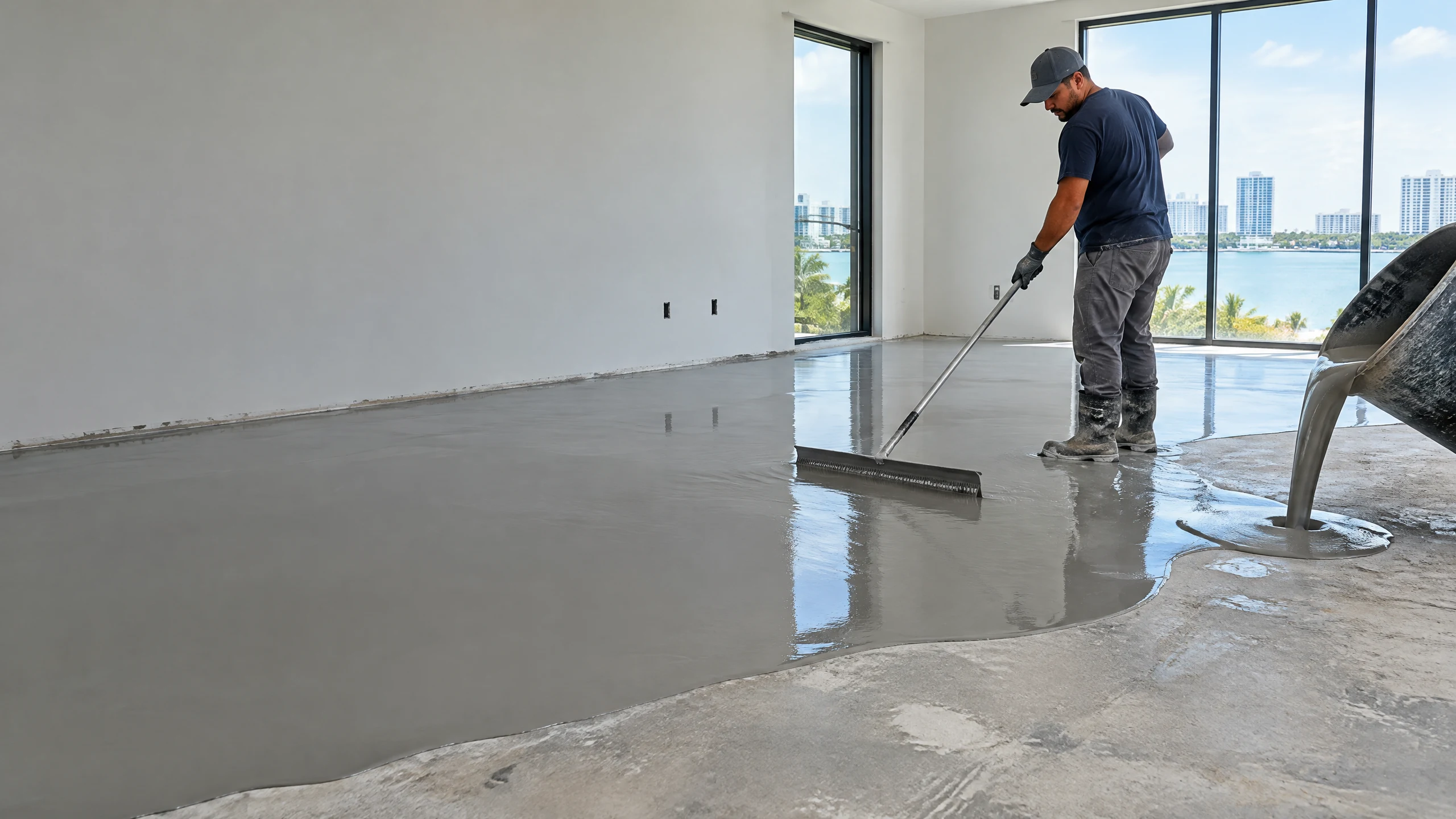
J. Perry & Sons levels, grinds, patches and moisture-tests concrete slabs before new flooring goes down. Almost every South Florida home sits on a slab-on-grade that was poured fast and finished rough, then covered with thick-set tile that hid the dips for thirty years. When that tile comes out, the slab underneath is rarely flat enough for large-format porcelain, LVP or engineered wood. We fix the slab so the floor on top lasts. Floor leveling is for homeowners, condo owners, property managers and GCs in Broward and Palm Beach. See all renovation services or start with the floor leveling cost guide.
Floor Leveling Cost in South Florida: $3–$6 per sq ft installed
| Scope | Typical size | Installed range |
|---|---|---|
| Self-leveling underlayment, 1/4"–1/2" average depth, with primer | 400–1,500 sq ft | $3–$6 per sq ft |
| Deep fill self-leveler, 1/2"–1 1/2", two lifts or aggregate-extended | localized low areas | $6–$10 per sq ft of fill |
| Slab grinding to knock down high spots and old thinset ridges | 300–2,000 sq ft | $1.50–$3 per sq ft |
| Moisture mitigation, epoxy vapor barrier (two coats) | full room or house | $2–$4 per sq ft |
| Patching cracks, spalls and plumbing trenches with repair mortar | per area | $150–$600 per spot |
| Moisture test (calcium chloride or in-situ RH probes) | per house | $250–$600 |
| Full prep package: grind, patch, prime, self-level, before tile or LVP | 1,000–2,000 sq ft | $5–$9 per sq ft |
The range depends on how far out of flat the slab is. A slab that is 1/4 inch out over 10 feet needs a thin pour; one that drops 1 inch across a room needs deep fill, more bags and sometimes two lifts. Material is a big part of the cost here, so we shoot the floor with a laser before quoting and price by the bag count, not a guess. Tile over the leveled slab is priced on the tile installation page; LVP and wood on the flooring installation page.
Free Estimate
Free estimate — call (561) 556-7509 or email jperrysonsgc@gmail.com with project photos, the city, approximate dimensions, and material selections.
Leveling methods and materials
Self-leveling underlayment (SLU). A cement-based compound mixed to a pourable consistency that flows out flat and cures hard enough to tile in a few hours. We use a polymer-modified SLU rated for the depth we need, over a bonding primer, with the perimeter and any drains dammed. Most jobs use a standard-depth product; deep spots get a product rated to 1 1/2 inches or an aggregate-extended pour.
Slab grinding. A walk-behind or hand grinder with diamond cup wheels takes down high spots, old thinset, paint, adhesive and ridges at cold joints. Grinding is cheaper than filling, so we grind the high areas first and level to the new plane, which cuts the bag count. Dust is captured with HEPA vacuums.
Moisture testing and mitigation. Florida slabs sit on wet ground year-round and most older ones have no working vapor barrier. Before any glued-down LVP, wood or epoxy we test with calcium chloride kits or in-situ RH probes. If the slab reads above the flooring manufacturer's limit, we roll a two-coat epoxy moisture barrier rated for 100% RH, then prime and pour SLU over it. Skipping this is the most common cause of cupped wood and lifting LVP here. More in epoxy floors and moisture.
Patching and crack repair. Shrinkage cracks are routed and filled with semi-rigid epoxy or polyurea. Spalls, plumbing trenches and tile-removal gouges are filled with fast-set repair mortar and feathered. Active structural cracks go to our concrete restoration work first.
Flatness vs level. Flat means no dips or humps under a 10-foot straightedge; level means one elevation across the floor. Tile and LVP need flat. For large-format tile we work to 1/8 inch in 10 feet, which the tile standards call for and most slabs do not meet after demo.
Free estimate — call (561) 556-7509 or email jperrysonsgc@gmail.com. Send a photo of the bare slab and the square footage and we'll return a same-day range.
How we level a floor
- Laser survey. After demo we set a rotary laser and mark high and low spots on a grid. That sets the grinding area and the bag count, and both go on the estimate.
- Residue removal. Old thinset, mastic, paint and carpet glue are ground or scraped off; primer does not bond through them. See tile removal and demolition.
- Moisture test. Calcium chloride kits or RH probes sit 24–72 hours. Results are documented for the flooring warranty.
- Grind high spots. Ridges and humps are ground toward the target plane with dust collected at the tool.
- Patch and crack repair. Cracks routed and filled, trenches and spalls patched, surface vacuumed.
- Moisture barrier when needed. Two coats of epoxy vapor barrier, cured and sanded or broadcast for the primer to grip.
- Dam, prime and pour. Doorways, drains and the perimeter are dammed, bonding primer dries to tack, and SLU is mixed by drill or pump, poured in sections and spread with a gauge rake to the laser marks. Deep areas go in two lifts.
- Cure and check. Walkable in 2–4 hours, tile-ready in 4–6, glued LVP or wood after 24–72 hours depending on depth. We re-check with straightedge and laser before the floor goes down.
Floor leveling in Broward and Palm Beach: what the slab does here
Slab-on-grade with no vapor barrier. Homes built before the 1990s often have a torn or missing poly sheet under the slab, with groundwater a few feet down. Vapor comes up through the concrete daily. Tile does not care; glued LVP, engineered wood and epoxy do, so we test before we quote those floors.
Thick-set tile beds. Older tile was set in a mud bed an inch or more thick. When it comes out, the slab can sit an inch below the next room and pocked where the bed was chipped. Deep fill is common.
Humidity and cure. Self-leveler cures by hydration, so humidity does not stop it, but it slows the surface drying adhesives need. We run air movement and dehumidifiers and follow the adhesive's RH limits.
Condo slabs. Post-tension and precast floors often hump at mid-span. We work over the association's sound underlayment and never cut or drill a post-tension slab. See condo flooring rules and STC.
Commercial slabs. Retail, office and turnover slabs carry old VCT adhesive, carpet glue and fit-out trenches. We grind, patch and level after hours or in phases, with a moisture barrier standard under LVT.
Permits. Floor leveling is prep work and needs no permit in Broward or Palm Beach. A plumbing trench or structural crack uncovered along the way may, and we pull it when it does.
Related floor leveling services
- Tile installation: large-format porcelain is the floor that most often needs a leveled slab first.
- Flooring installation: LVP, engineered wood and laminate over a flat, dry slab.
- Tile removal and demolition: the demo that happens right before leveling.
- Epoxy flooring: garage and commercial epoxy needs the same moisture test and grind.
- Concrete restoration: structural cracks, spalling and slab repairs beyond surface patching.
- Commercial renovation: slab prep for retail, office and multifamily flooring.
What a floor leveling estimate includes
Our written floor leveling estimate lists the following so you can compare it to other quotes:
- Square footage by room with the laser survey readings
- Bag count and depth of self-leveling underlayment, product named
- Grinding area and what is being removed
- Moisture test method, test points and the flooring manufacturer's limit
- Moisture mitigation product and coverage if needed
- Patching: cracks by linear foot, spalls and trenches by count
- Primer, damming, cure times before the next trade
- Dust control, protection of adjacent rooms and haul-away
- Workmanship warranty terms
Floor leveling contractors by city
Broward County Floor Leveling in Fort Lauderdale · Floor Leveling in Hollywood · Floor Leveling in Davie · Floor Leveling in Tamarac · Floor Leveling in Weston · Floor Leveling in Pembroke Pines · Floor Leveling in Miramar · Floor Leveling in Pompano Beach · Floor Leveling in Parkland · Floor Leveling in Southwest Ranches
Palm Beach County Floor Leveling in Boca Raton · Floor Leveling in Delray Beach · Floor Leveling in West Palm Beach · Floor Leveling in Palm Beach Gardens · Floor Leveling in Boynton Beach · Floor Leveling in Wellington · Floor Leveling in Jupiter
Miami-Dade County Floor Leveling in Miami · Floor Leveling in Miami Beach · Floor Leveling in Coral Gables · Floor Leveling in Aventura
Planning guides: Floor leveling cost in South Florida · Floor leveling before new flooring · Self-leveling underlayment guide · Epoxy floors and slab moisture · 24x48 tile: leveling, layout, lippage · LVP installation cost
Floor Leveling — FAQ
How much does floor leveling cost in South Florida? $3–$6 per square foot for self-leveling underlayment at typical depths, $1.50–$3 per square foot for grinding, and $2–$4 per square foot for an epoxy moisture barrier when the slab needs one. A full prep package on a 1,500 sq ft house usually lands at $5–$9 per square foot.
Does my slab really need leveling before tile? For large-format tile (any side 15 inches or more) the standard is 1/8 inch in 10 feet, and most slabs after demo are not close. Standard 12x12 or 12x24 tile tolerates more, and a good setter can take up small dips in the thinset. We shoot the floor with a laser and tell you what it needs.
Can I put LVP straight on a Florida slab? Floating LVP tolerates minor unevenness but still telegraphs humps and dips, and most manufacturers require 3/16 inch in 10 feet. Glue-down LVP and any wood product also need a moisture test, and most older slabs here fail it without a barrier.
How long does floor leveling take? Grind, patch and prime in one day, pour the next morning, and tile the same afternoon or the day after on a typical 1,000–1,500 sq ft job. Add 24–72 hours for a moisture barrier to cure and for deep pours before glued flooring.
Can you level a condo floor? Yes. We work over the association's required sound underlayment, never drill or cut a post-tension slab, and schedule pours within building work hours. Material is carried up and mixed in the unit to keep hallways clean.
How do I get an exact price? Call (561) 556-7509 or email jperrysonsgc@gmail.com with photos and rough dimensions. A written estimate is typically ready within 24–48 hours after a site review and scope confirmation.
Free estimate — call (561) 556-7509 or email jperrysonsgc@gmail.com. Licensed Florida general contractor CGC1540699. Serving Broward and Palm Beach counties.
Permits and compliance handled. J. Perry & Sons pulls the permit, schedules the inspections, and builds to the city and county codes that apply — Broward and Palm Beach municipal building departments, HVHZ requirements where they apply, and HOA/condo association rules. Licensed Florida general contractor CGC1540699.
Free Estimate
Free estimate — call (561) 556-7509 or email jperrysonsgc@gmail.com with project photos, the city, approximate dimensions, and material selections.