
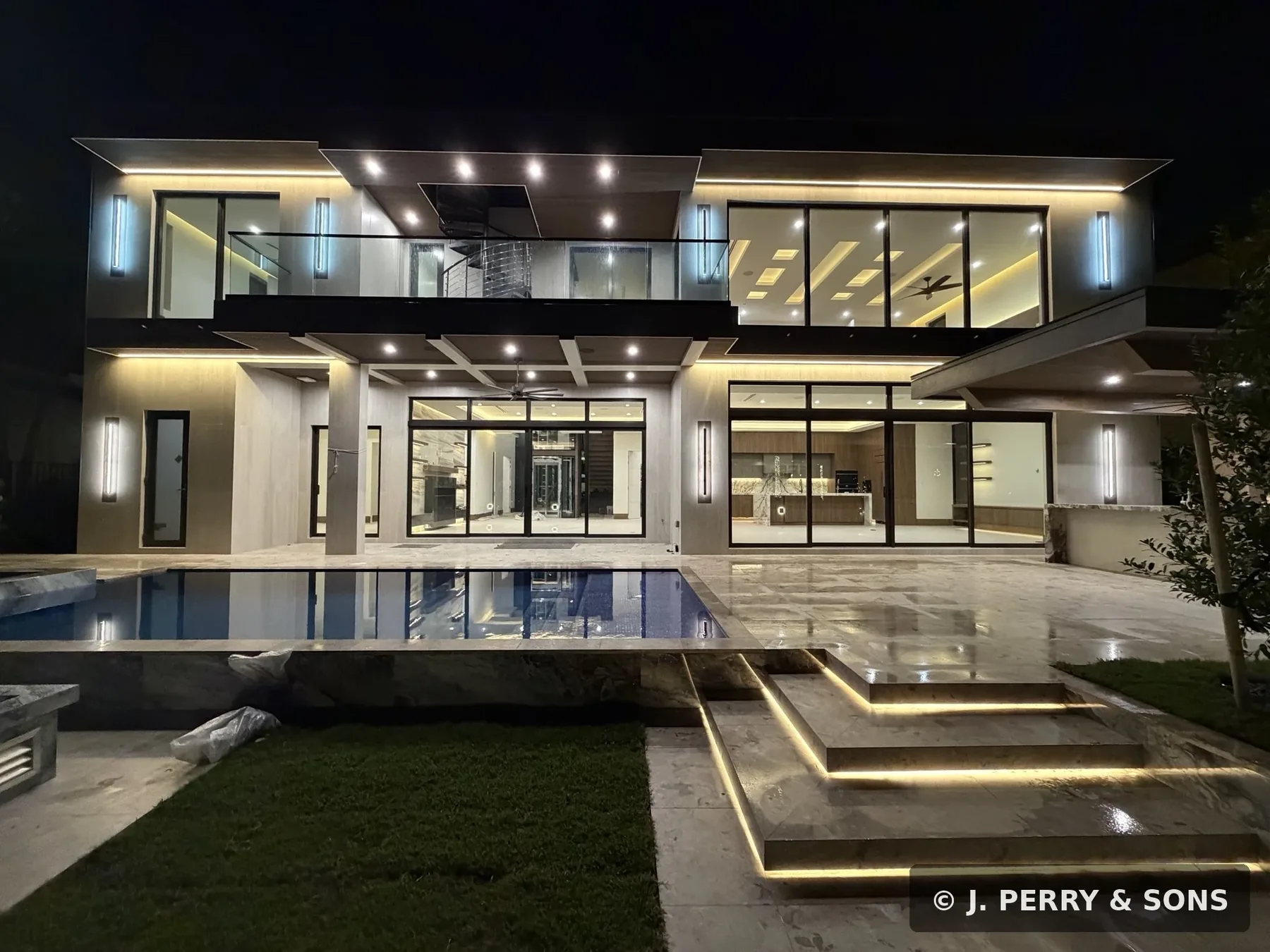
Travertine is the stone most South Florida homeowners end up choosing for a pool deck, and for good reason: it stays cooler than concrete in August sun, tumbled pieces grip wet feet, and the color range runs from ivory to walnut. J. Perry & Sons is a paver installation contractor serving Broward and Palm Beach counties, and travertine is the material we set most. This page covers installed cost, tumbled versus honed, driveway-grade thickness, sealing, and how travertine compares with marble.
Travertine Pavers Installation Cost in South Florida: $18–$30 per sq ft installed
| Scope | Typical size | Installed range |
|---|---|---|
| Travertine pool deck, ¾ in or 1¼ in tumbled, new base | 400–900 sq ft | $18–$30 per sq ft |
| Travertine patio or walkway, new base | 150–400 sq ft | $20–$30 per sq ft |
| Travertine driveway or motor court, 1¼ in on heavy base | 600–1,200 sq ft | $20–$28 per sq ft |
| Travertine overlay on a sound existing pool deck slab | 300–800 sq ft | $14–$22 per sq ft |
| Travertine bullnose coping, 12 in | 80–140 linear ft | $45–$75 per linear ft |
| Penetrating sealer after cure | per visit | $1.00–$2.00 per sq ft |
Ranges cover demolition of the old surface, compacted limerock base, bedding sand, the travertine, edge restraint and joint sand, with the stone supplied by the owner unless we quote supply. Pool decks run higher per foot than driveways because of coping, more cuts around the shell and equipment, and drainage. Sealing is a separate visit 30–60 days after install.
Free Estimate
Free estimate — call (561) 556-7509 or email jperrysonsgc@gmail.com with project photos, the city, approximate dimensions, and material selections.
Travertine options: tumbled vs honed, thickness, pattern
Tumbled. The pavers are run through a tumbler so edges round over and the face picks up a soft, pitted texture. This is the pool deck standard: better grip when wet, hides chips, and reads relaxed and Mediterranean. Joints are left slightly open and filled with sand.
Honed and filled. The face is ground flat and the natural holes are filled with resin or cement. Sharper, more formal look that suits a modern house, but it is slicker when wet and shows scratches. We recommend it for covered patios and walkways more than open pool decks.
Thickness. ¾ in (about 2 cm) works on a pool deck or patio set on a compacted base. Driveways and anything a vehicle drives over need 1¼ in (3 cm) driveway-grade pavers, which cost more per piece and need a deeper base but will not crack under a truck.
Sizes and color. 6x12, 12x12, 16x16 and 24x24 are stocked locally; the French (Versailles) pattern mixes four sizes for the classic look. Ivory and silver stay coolest underfoot; noce and walnut hide stains but run warmer.
Free estimate — call (561) 556-7509 or email jperrysonsgc@gmail.com. Send a photo of the area and rough dimensions and we'll return a range the same day.
How we install travertine pavers
- Layout and grades. We mark the footprint and set the finished height at doors, the garage slab and the pool beam, with a fall of about ⅛ in per foot away from the house and the pool.
- Demolition. Old concrete, Chattahoochee or worn pavers are broken out and hauled. Irrigation is capped and the pool is covered.
- Subgrade and fabric. The sand subgrade is compacted and a geotextile fabric goes down so the limerock does not migrate into the fill.
- Limerock base. 4–6 in for decks and patios, 6–8 in for driveways, compacted in lifts. Travertine is a soft stone; it only stays flat if the base does.
- Coping first. On a pool deck the bullnose coping is set on mortar at the beam and the field is laid to it.
- Bedding and setting. One inch of screeded coarse sand, then pavers laid from a fixed line in the chosen pattern, with a soldier-course border where wanted.
- Cutting. All cuts are made wet on a diamond saw to keep edges clean and dust down.
- Edge restraint and joints. Concrete or spiked edging on every open edge, polymeric sand swept in and compacted, then activated and the surface washed.
- Sealing. After a 30–60 day dry-out, a penetrating sealer rated for natural stone is applied in a separate visit.
Permits and compliance handled. J. Perry & Sons pulls the permit, schedules the inspections, and builds to the city and county codes that apply — Broward and Palm Beach municipal building departments, HVHZ requirements where they apply, and HOA/condo association rules. Licensed Florida general contractor CGC1540699.
Travertine in South Florida: heat, salt, sealing and stains
Travertine's main advantage here is surface temperature. A light travertine deck in direct afternoon sun runs noticeably cooler than gray concrete pavers or a brown porcelain, which is why barefoot pool decks keep coming back to it.
The trade-off is porosity. Travertine is a limestone and it absorbs water, sunscreen, oil and tannin from oak and sea grape leaves. A penetrating silane/siloxane sealer slows that down without changing the look. Around a pool, especially a saltwater pool, plan to re-seal every 1–2 years; patios away from the water stretch to 3 years or more. Salt systems are harder on marble than travertine, but both hold up well when sealed on schedule. See the paver sealing guide for product types and cost.
Efflorescence, the white haze in the first season, is salts working out of the base and stone as they dry. It fades once the paver has cured, which is why we wait before sealing.
Rain is the other factor. An under-built base is what makes travertine rock and sink, so we build the limerock thicker than national guides call for and keep a fall to a drain or swale. Permits are needed for driveways in the right-of-way, widening and most full pool deck rebuilds in Broward and Palm Beach cities, typically $150–$600 and 2–4 weeks; HOA approval is common in Weston, Parkland, Wellington and Boca communities.
Travertine vs marble pavers
Both are natural stone sold as 2 cm and 3 cm pavers and install the same way. Marble is denser, lighter and more formal, with veining instead of travertine's pitted texture. It costs more, $22–$34 per sq ft installed versus $18–$30, and is less forgiving of saltwater pools and acidic spills. Travertine hides a chip better and is easier to match later. For a daily-driver driveway, 1¼ in travertine is the safer choice; marble suits a light-traffic motor court. The full comparison, including porcelain, is in travertine vs marble vs porcelain pavers.
Related paver services
- Paver driveway: heavy base, borders and right-of-way permit for driveways and motor courts in travertine or concrete.
- Pool deck pavers: overlay or full replacement of a pool deck in travertine, marble, shellstone or porcelain.
- Pool coping: travertine bullnose and other coping set on the beam before the deck goes in.
- Paver repair, releveling and sealing: fixing sunk areas and re-sealing an existing travertine deck.
Real travertine paver work
Weston outdoor living and pool hardscape. A backyard package in Weston with a paver pool deck, patio and connected outdoor living area built as one job, so the pattern and grades run continuous from the house to the water.
Travertine pavers by city
Pavers in Fort Lauderdale · Pavers in Miami · Pavers in Boca Raton · Pavers in West Palm Beach · Pavers in Weston · Pavers in Delray Beach · Pavers in Parkland · Pavers in Wellington
Planning guides: Travertine vs marble vs porcelain pavers · Pool deck resurfacing cost · Paver sealing guide · Paver driveway cost · Paver installation complete guide
Travertine pavers — FAQ
How much do travertine pavers cost installed in South Florida? $18–$30 per sq ft for pool decks and patios on a new base, $20–$28 per sq ft for a 1¼ in driveway, and $14–$22 per sq ft as an overlay on a sound slab. Coping adds $45–$75 per linear foot.
Should I choose tumbled or honed travertine for a pool deck? Tumbled. The textured face grips wet feet and hides chips and small stains. Honed looks sharper but is slicker when wet, so we keep it for covered patios and walkways.
Can travertine pavers be used on a driveway? Yes, in 1¼ in driveway-grade thickness on a 6–8 in compacted limerock base. The ¾ in deck pavers will crack under vehicle load.
How often does travertine need to be sealed? Every 1–2 years around a pool, 3 years or more on a patio away from the water. The first coat goes on 30–60 days after install, once the stone has dried out.
Does travertine get hot in the Florida sun? It gets warm but stays well below gray concrete or dark porcelain in the same sun. Ivory and silver colors stay coolest; walnut and noce run warmer.
How do I get an exact price? Call (561) 556-7509 or email jperrysonsgc@gmail.com with photos and rough dimensions. A written estimate is typically ready within 24–48 hours after a site review and scope confirmation.
Free estimate — call (561) 556-7509 or email jperrysonsgc@gmail.com. Licensed Florida general contractor CGC1540699. Serving Broward and Palm Beach counties.
Free Estimate
Free estimate — call (561) 556-7509 or email jperrysonsgc@gmail.com with project photos, the city, approximate dimensions, and material selections.