
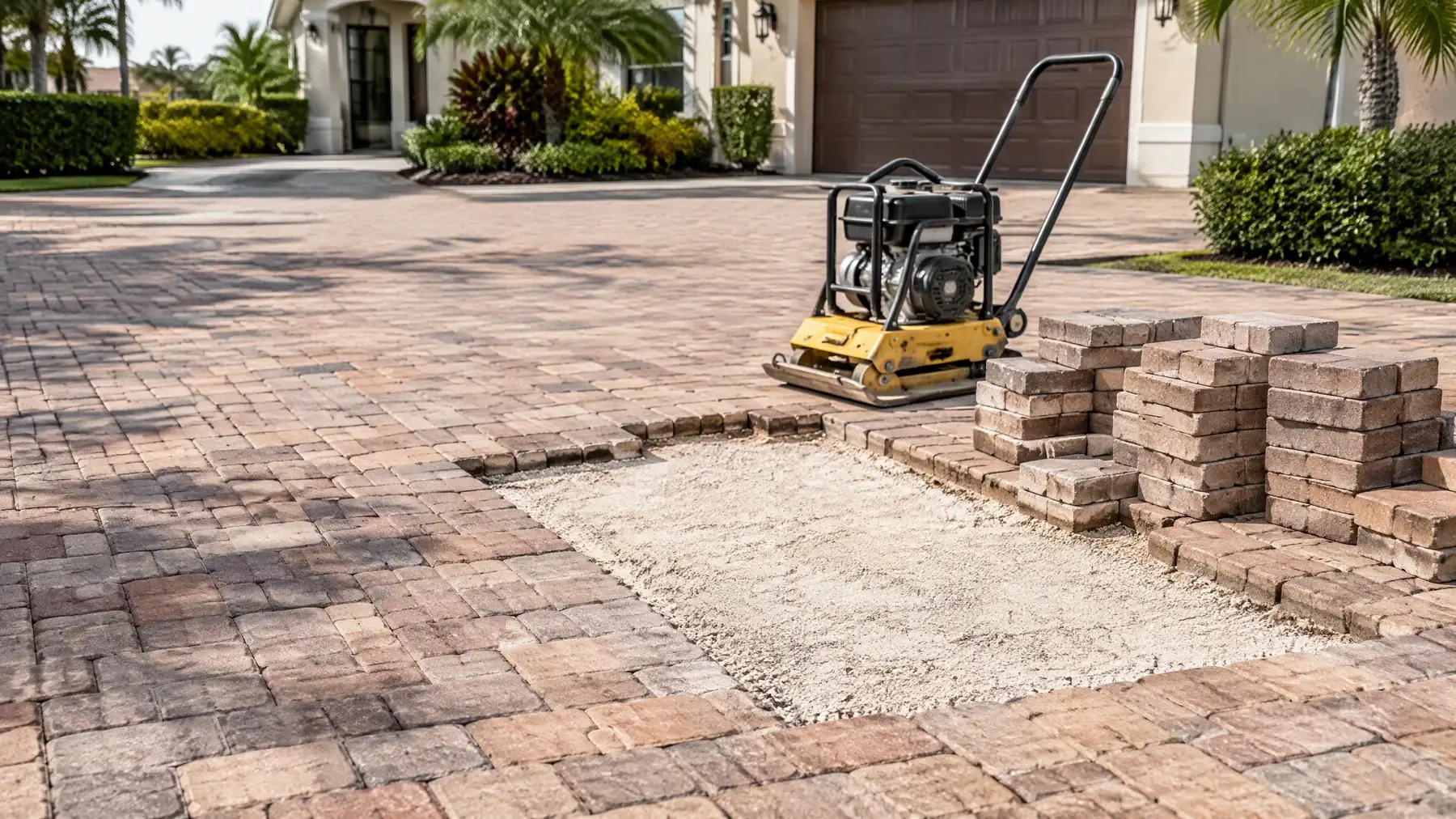
Fixing sunk or shifted pavers costs $8–$18 per square foot in Broward and Palm Beach counties, with a $400–$900 minimum for a single low spot, and cleaning and sealing a paver surface runs $1.00–$2.50 per square foot. J. Perry & Sons is a paver installation contractor that repairs the driveways, pool decks and patios other crews installed as well as our own: we lift the pavers, rebuild the base that failed, relay the same pieces, re-sand with polymeric sand and seal. This page covers why pavers sink, what releveling costs, and how often to seal in this climate.
Paver Repair and Sealing Cost in South Florida: $8–$18 per sq ft repair, $1–$2.50 per sq ft sealing
| Scope | Installed range | Notes |
|---|---|---|
| Single low spot under 25 sq ft (sprinkler head, downspout, edge) | $400–$900 | Minimum charge |
| Driveway apron or tire tracks, 50–150 sq ft | $8–$16 per sq ft | Base rebuilt with compacted limerock |
| Pool deck section at coping or drain | $10–$18 per sq ft | Coping reset often needed |
| Full lift and relay, same pavers | $7–$12 per sq ft | Cheaper per foot than spot repair at scale |
| Edge restraint replacement | $6–$12 per linear ft | Where the edge has spread |
| Replace broken pavers (owner supplies matching) | $3–$6 per paver | Plus the minimum charge |
| Pressure wash, re-sand joints with polymeric sand, seal | $1.50–$2.50 per sq ft | The standard maintenance package |
| Pressure wash and seal only, joints sound | $1.00–$1.50 per sq ft | Concrete pavers in good shape |
| Strip failed old sealer, clean, re-sand, re-seal | $2.50–$4.00 per sq ft | Milky or peeling sealer |
Repair ranges include lifting and stacking the pavers, removing the failed bedding and base, recompacting new limerock, screeding sand, relaying the original pavers and re-sanding the repaired area. Sealing prices assume a driveway or deck over 500 sq ft; small patios carry a minimum. Detailed cost tables are in the sinking pavers repair guide and the paver sealing guide.
Free Estimate
Free estimate — call (561) 556-7509 or email jperrysonsgc@gmail.com with project photos, the city, approximate dimensions, and material selections.
Repair and sealing options
Spot releveling. For a dip at a sprinkler head, a downspout, the garage edge or where a tree root lifted a few pieces. We lift 1–3 ft past the visible low spot, because the failed base always extends further than the dip you see.
Tire-track and apron rebuild. The most common driveway repair. The two ruts and the apron at the street get lifted, the base is rebuilt to 6–8 in and compacted, and the pavers go back.
Full lift and relay. When more than about a third of the field has moved, lifting the whole area is cheaper per foot and the only way to get one flat plane. Same pavers, new base.
Edge restraint. A spreading edge lets the whole field drift. We cut in a concrete or spiked plastic restraint and pull the field tight.
Polymeric sand. Joint sand with a polymer binder that firms up when wetted, locks the pavers, resists washout and slows weeds and ants. It goes in on every repair.
Sealing. Water-based acrylic for concrete pavers (natural or wet look), penetrating silane/siloxane for travertine, marble and shellstone. Porcelain is never sealed.
Free estimate — call (561) 556-7509 or email jperrysonsgc@gmail.com. Send a photo of the sunk area or the surface and rough dimensions and we'll return a range the same day.
How we repair and relevel pavers
- Find the cause. A dip at a downspout is washout; a long trough is a shallow base; a heave is a root or a broken pipe. Fixing the paver without fixing the cause means doing it again in a year.
- Lift and stack. The pavers are pried up with extractors and stacked in order so the pattern and color blend go back exactly as they were.
- Remove the failed base. Soft, saturated or thin bedding and limerock come out down to firm material. Washout at a downspout or sprinkler is dug out and the leak fixed.
- Rebuild and compact. New limerock goes in and is compacted in lifts with a plate compactor to the depth the use needs: 4–6 in for a deck, 6–8 in for a driveway.
- Screed bedding sand. One inch of coarse sand screeded flush with the surrounding field so the repaired area ends up on the same plane.
- Relay. The original pavers go back in pattern. Broken pieces are swapped for owner-supplied matches, or pulled from a hidden edge when no match exists.
- Restrain the edge. Any open edge gets a restraint before the joints are filled.
- Re-sand and compact. Polymeric sand is swept in, the area is compacted, the sand is activated and the surface is cleaned.
- Seal. After the repair dries, or 30–60 days later on new stone, the surface is sealed in a separate visit.
Permits and compliance handled. J. Perry & Sons pulls the permit, schedules the inspections, and builds to the city and county codes that apply — Broward and Palm Beach municipal building departments, HVHZ requirements where they apply, and HOA/condo association rules. Licensed Florida general contractor CGC1540699.
Why pavers sink in South Florida, and how often to seal
South Florida sits on sand and limerock over a high water table. Rain drains through the joints into the bedding sand, and a summer storm delivers a lot of it fast. If the base is thin, uncompacted or missing its geotextile fabric, the sand migrates into the fill and the pavers follow it down. Ruts show up first in tire tracks and at the apron, where the load is highest, and at downspouts and sprinkler heads, where the water is.
Roots are the second cause. Ficus, oak and black olive roots lift pavers into a hump. A root barrier along the edge during the repair keeps it from returning.
Ants and washout take the joint sand out, which lets pavers rock and then shift. Polymeric sand holds far better than plain sand here, and re-sanding at each sealing visit keeps the field locked.
Sealing frequency depends on the sealer and the exposure. Acrylic sealers on concrete paver driveways last 2–3 years in full sun. Penetrating sealers on travertine and marble last 1–2 years around a pool and 3 years or more on a patio away from the water. Re-seal when water stops beading or color fades. A milky or peeling sealer trapped moisture and has to be stripped first.
Most paver repairs do not need a permit. Rebuilding an apron in the right-of-way sometimes does, and a pool deck repair that resets coping can bring the pool barrier into review. HOA notice is common in gated communities.
Related paver services
- Paver driveway: when the base is too far gone and a new driveway makes more sense than a relay.
- Pool deck pavers: deck overlay or replacement when a pool deck has settled throughout.
- Pool coping: resetting loose or popped coping along with the deck repair.
- Travertine pavers: sealing schedules and care for travertine decks.
What a paver repair or sealing estimate includes
- Area measured in square feet, with each low spot or rut mapped
- Likely cause stated (washout, thin base, root, edge spread) and the fix for it
- Lift, base rebuild to a stated depth, bedding and relay
- Replacement pavers, owner-supplied or quoted
- Edge restraint by linear foot where needed
- Polymeric sand for the repaired area or the whole field
- Pressure washing and sealer type, with square footage
- Permit, if the apron or pool area requires one
Paver repair and sealing by city
Pavers in Fort Lauderdale · Pavers in Miami · Pavers in Boca Raton · Pavers in West Palm Beach · Pavers in Weston · Pavers in Delray Beach · Pavers in Parkland · Pavers in Wellington
Planning guides: Sinking pavers repair and releveling · Paver sealing guide · Paver driveway cost · Sealing natural stone in Florida humidity · Paver installation complete guide
Paver repair, releveling & sealing — FAQ
How much does it cost to fix sinking pavers? $400–$900 for a single low spot under 25 sq ft, $8–$16 per sq ft for driveway ruts and aprons, $10–$18 per sq ft for a pool deck section, and $7–$12 per sq ft to lift and relay a whole driveway with the same pavers.
Why are my pavers sinking? Almost always a thin or uncompacted base that washed out under summer rain, usually at tire tracks, the apron, a downspout or a sprinkler head. Roots and broken irrigation lines are the other common causes. We fix the cause, not just the dip.
Can you reuse my existing pavers? Yes. We lift them in order, rebuild the base and relay the same pieces, so the repair matches the rest of the field. Broken pieces are swapped for owner-supplied matches or pulled from a hidden edge.
How often should pavers be sealed in South Florida? Every 2–3 years for acrylic-sealed concrete pavers in full sun, every 1–2 years for travertine or marble around a pool, and 3 years or more on a shaded patio. Re-seal when water stops beading or color fades.
Is pressure washing included with sealing? Yes. Every seal starts with a wash at a pressure that does not blow out the joints, then joints are topped up with polymeric sand before the sealer goes on. Washing alone is also available as maintenance.
How do I get an exact price? Call (561) 556-7509 or email jperrysonsgc@gmail.com with photos and rough dimensions. A written estimate is typically ready within 24–48 hours after a site review and scope confirmation.
Free estimate — call (561) 556-7509 or email jperrysonsgc@gmail.com. Licensed Florida general contractor CGC1540699. Serving Broward and Palm Beach counties.
Free Estimate
Free estimate — call (561) 556-7509 or email jperrysonsgc@gmail.com with project photos, the city, approximate dimensions, and material selections.