By John Perry
Pavers in South Florida fail for four reasons: a thin or poorly compacted base, no edge restraint, water running the wrong way, and joint sand that washes out. Get those four right and a paver driveway, patio or pool deck lasts decades. Get them wrong and it ruts, sinks and grows weeds within a few rainy seasons.
After the project review, your written proposal lists the following scope and pricing: Installed prices start at $29 per sq ft for an 80 mm concrete paver driveway, Starting at $29 for a travertine pool deck and for 2 cm porcelain. This guide shows what goes into those numbers, which paver goes where, and how the work is built so it stays flat.
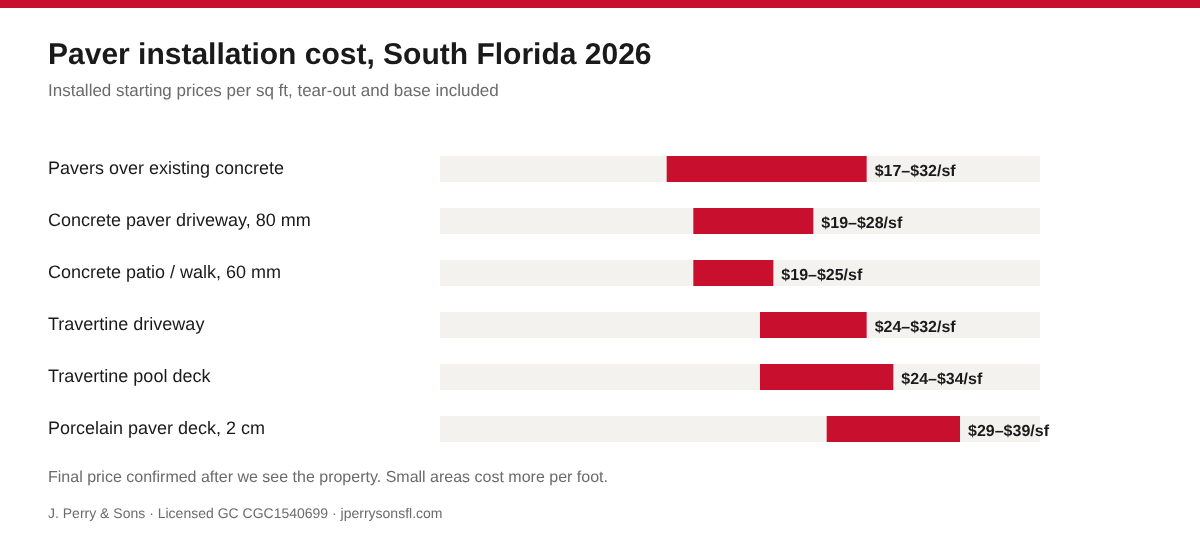
What pavers cost in South Florida (2026)
| Scope | What goes in | Starting from |
|---|---|---|
| Paver driveway, all materials | Tear-out, limerock base, sand bed, pavers, edge restraint, joint sand | Starting at $29 per sq ft |
| Concrete paver driveway, 80 mm | Herringbone field with border | Starting at $29 per sq ft |
| Travertine driveway or motor court | 1¼ in driveway-grade travertine, heavier base | Starting at $33 per sq ft |
| Pavers over existing concrete | Sound slab kept, leveling extra | Starting at $32 per sq ft |
J. Perry & Sons starting prices. Your final price is based on the property, access, the material and the full scope, and is confirmed after we see the project. Small areas cost more per foot, because the compactor, cutting station and crew cost the same on 150 sq ft as on 600.
Typical project totals:
- After the project review, your written proposal lists the following scope and pricing: 2-car driveway, about 1,000 sq ft, 80 mm concrete pavers: starting.
- After the project review, your written proposal lists the following scope and pricing: Pool deck, about 800 sq ft, travertine: starting, plus coping.
- After the project review, your written proposal lists the following scope and pricing: Back patio, about 400 sq ft, 60 mm concrete pavers: starting.
The Owner's Guide to Pavers, Pool Decks and Outdoor Living
The technical detail behind pavers that stay flat: base and compaction, drainage, edge restraints, sealing, HOA approvals and how to compare paver quotes.
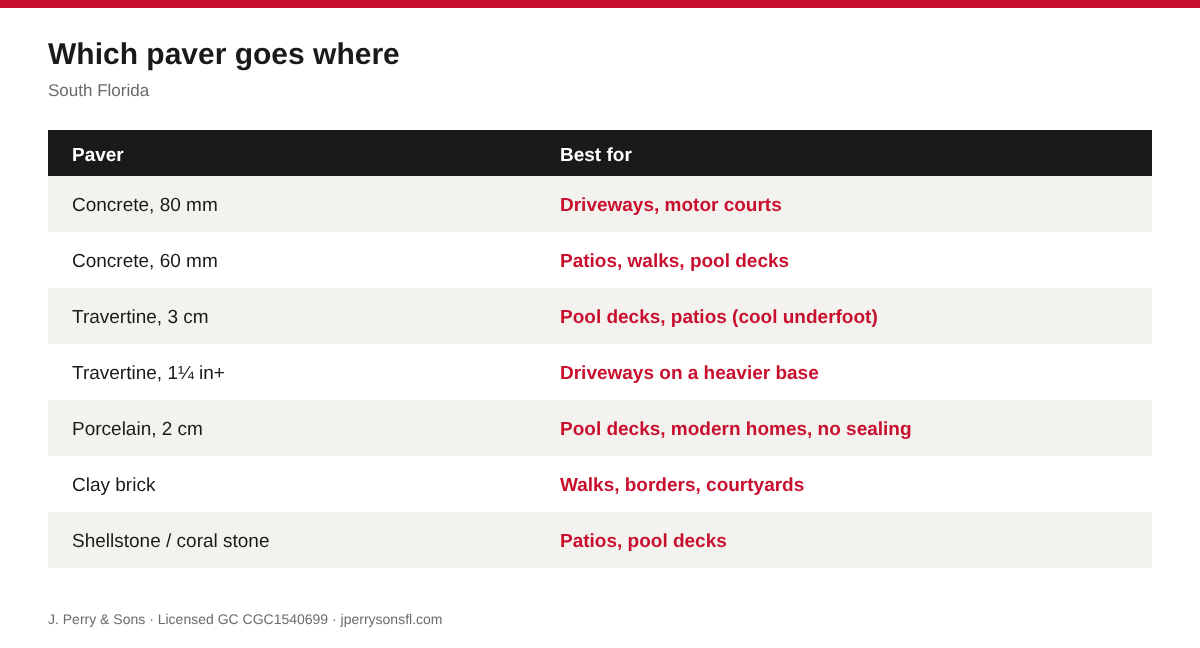
Which paver goes where
| Paver | Best for | Why |
|---|---|---|
| Concrete, 80 mm | Driveways, motor courts | Thick enough for turning tires; easy to replace one piece |
| Concrete, 60 mm | Patios, walks, pool decks | Foot traffic; wide color range |
| Travertine, 3 cm | Pool decks, patios | Stays cooler underfoot, grips when wet, matches travertine coping |
| Travertine, 1¼ in+ | Driveways and motor courts | Driveway grade on a heavier base |
| Porcelain, 2 cm | Pool decks, patios, modern homes | Doesn't stain, fade or need sealing |
| Clay brick | Walks, borders, courtyards | Color that never fades; traditional look |
| Shellstone / coral stone | Patios, pool decks | Warm natural color, cool surface |
| Tumbled marble | Formal patios and decks | Light, elegant; needs sealing near salt water |
We install Belgard first, with Tremron and Pavestone as alternatives. All three are stocked by South Florida suppliers, which makes matching a broken piece years later easy.
Call (561) 556-7509 or send us your project with photos, the city, approximate dimensions, and material selections.
Thickness matters
- 60 mm (2⅜ in): patios, walkways, pool decks, side yards.
- 80 mm (3⅛ in): driveways and anything a car turns on. Driveways get 80 mm pavers, built to carry car loads.
- Thin overlay pavers: about half the thickness, made to go over a sound concrete slab where door heights can't rise much.
- 2 cm stone and porcelain: set on a bonded mortar bed over concrete, never on loose sand, because thin pieces crack under a point load.
The base: where paver jobs last or fail
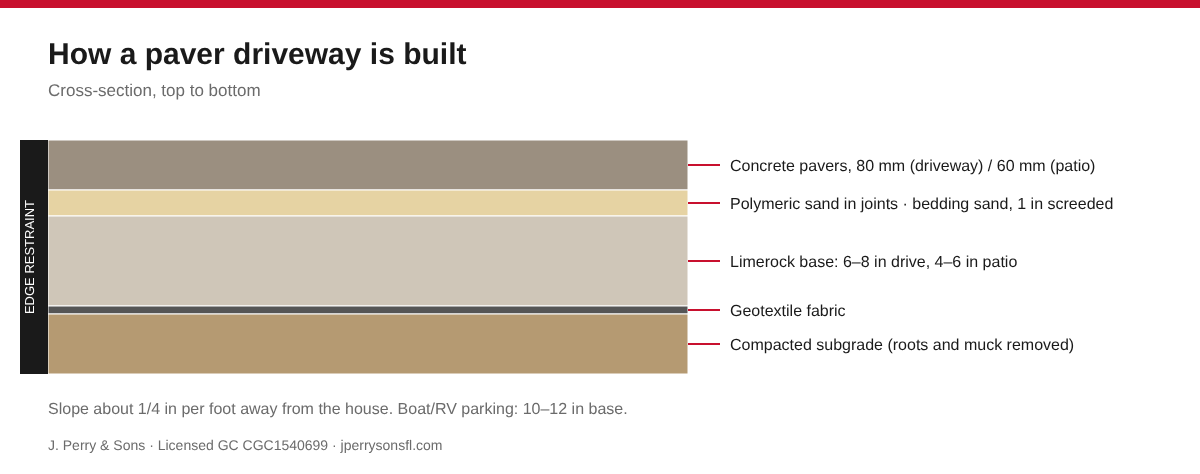
South Florida ground is sand and limerock over a high water table. It drains well, but loose fill settles fast after a summer storm drops several inches in an afternoon. That's why we put the base depth in writing on every estimate.
| Area | Compacted limerock base |
|---|---|
| Patios, walkways, pool decks | 4–6 in |
| Residential driveways | 6–8 in |
| Boat, RV or trailer parking | 10–12 in |
| Commercial drives | To the engineer's drawing |
How the base is built:
- Excavate to depth, remove roots, organic soil and muck pockets, compact the subgrade.
- Geotextile fabric on driveways and soft ground, so the limerock doesn't migrate into the sand.
- Limerock in lifts no thicker than 4 in, wetted and compacted before the next lift.
- Bedding sand: 1 in of washed coarse sand, screeded flat and left uncompacted until the pavers go down.
- Pavers laid in pattern, cut clean at edges.
- Edge restraint: spiked heavy edging on patios and walks; a concrete toe or curb on driveways.
- Compaction with a pad on the plate compactor.
- Polymeric sand swept in, compacted, cleaned off and misted.
Why pavers fail (and how we prevent it)
| Failure | Cause | Prevention |
|---|---|---|
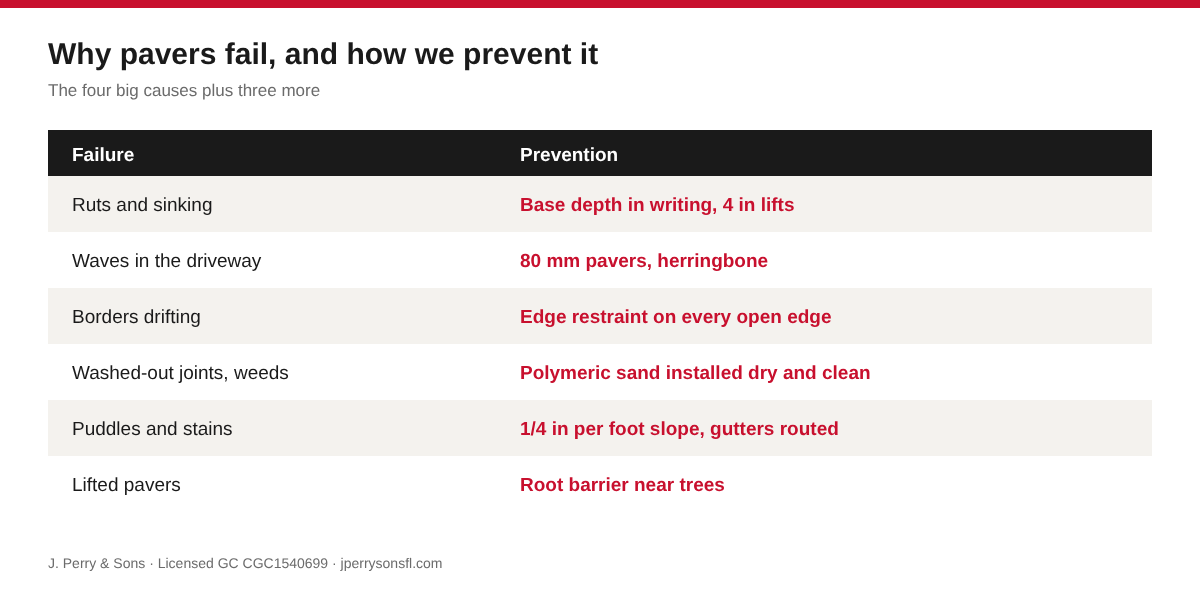
| Ruts and sinking | Thin base, compacted all at once | Base depth in writing, 4 in lifts |
| Waves in the driveway | Wrong pattern or 60 mm pavers on a driveway | 80 mm in herringbone |
| Borders drifting, joints opening | No edge restraint | Edging or concrete toe on every open edge |
| Washed-out joints, weeds, ants | Poor polymeric sand install | Dry pavers, compaction, clean surface, misting |
| Puddles and stains | Wrong slope, downspouts onto pavers | 1/4 in per foot away from the house, plan gutters |
| Lifted pavers | Tree roots | Root barrier along the edge |
| Too much sand | Over 1 in of bedding sand | Screeded 1 in bed |
Patterns
- Herringbone (45° or 90°): the interlocking pattern for driveways; turning tires can't push the field into waves.
- Running bond: clean and modern for walks and patios.
- Basket weave: traditional look for patios and courtyards.
- French pattern (Versailles): four sizes of travertine or marble; the classic pool deck pattern.
- Soldier course border: pavers on end around the field; frames the look and gives the edge a straight line.
Polymeric sand done right
We use Techniseal or Alliance Gator polymeric sand. The steps matter more than the brand: pavers completely dry, sand swept in, compacted, topped off below the chamfer, every grain blown off the surface, then misted in sections. We don't activate polymeric sand with rain in the forecast. Leftover sand on the surface turns into a haze that only a chemical cleaner removes.
Drainage and slope
We set about 1/4 in per foot of slope away from the house on patios and pool decks, and toward the street or a swale on driveways, never toward the garage. At sliding doors, pavers stay below the interior floor with room for the threshold. Before finishing grades, we check where gutters discharge. When a lot is close to its limit for hard surface or holds water, permeable pavers on an open-graded stone base let rain soak in instead of running off.
Pavers over existing concrete
If a slab is flat, uncracked and not settling, pavers can go over it and the tear-out line disappears. We check offset cracks, height at every door and drain, and where water will go once the surface is raised. Overlay works well on patios, pool decks and walks; driveways are decided case by case.
Sealing: wet look or natural
- When: after efflorescence clears; 30–60 days for stone. Timing is confirmed in your written proposal.
- Wet look: darkens the color with a sheen; good on driveways, never on pool decks (slippery).
- Natural/matte: protects without changing the color much; right for pool decks and patios.
- Stone: travertine, marble and shellstone get a penetrating sealer; porcelain never needs sealing.
- Reseal every 2–4 years, sooner near the coast.
Permits and HOAs
- Driveway aprons sit in the public right-of-way, so most cities require a permit, even for a like-for-like rebuild. Widening a curb cut is a separate approval.
- Pool deck replacements usually need a permit, and the inspector checks the pool barrier: fence height, self-closing gates and door alarms.
- Patios inside the yard often need no permit.
- HOAs usually want the paver brand, color, pattern and a site plan before work starts. We prepare the package.
J. Perry & Sons pulls every permit and follows each city and county's requirements.
Timeline
| Project | Typical time |
|---|---|
| Patio, 300–500 sq ft | Timing is confirmed in your written proposal. |
| Driveway, 800–1,200 sq ft | apron inspection. Timing is confirmed in your written proposal. |
| Pool deck with coping | Timing is confirmed in your written proposal. |
| Sealing | 60–90 days after install. Timing is confirmed in your written proposal. |
The dry season, October through April, is the best window. Summer jobs are scheduled around afternoon storms. See the best time to install pavers.
Driveway, pool deck or patio: what's different
Driveways
- 80 mm pavers in herringbone, always
- 6–8 in compacted base; 10–12 in for boats and RVs
- concrete toe or curb along open edges
- apron permit in the right-of-way
- slope to the street or swale, never toward the garage
Pool decks
- travertine, porcelain or 60 mm concrete pavers
- coping set first, then the field
- slope away from the pool and the house at once
- natural or matte sealer only, never gloss
- permit and pool barrier inspection
Patios and walkways
- 60 mm pavers or stone on a 4–6 in base
- running bond, basket weave or French pattern
- spiked edging along lawns and beds
- downspouts routed away from the surface
Questions to ask any paver contractor
- How deep is the base, and is that written in the estimate?
- Will the base be compacted in lifts?
- What edge restraint will you use on each edge?
- Which polymeric sand, and how do you activate it?
- Where will the water go?
- Who pulls the permit and handles the HOA?
- What's the warranty?
If a quote doesn't answer these, it's not comparable to one that does.
Keeping pavers looking new
<!-- COMBINED_ADDON_SECTION -->Paver repair, releveling and sealing for an existing driveway or pool deck
Not every paver project starts with a tear-out. Many owners searching for paver repair near them have a driveway or pool deck that is mostly sound, with a sunken strip by the garage, a lifted section over a root, or joints that have washed out and filled with weeds. The question is whether to repair, restore or replace, and the answer comes from the base, not from how the surface looks.
<div data-infographic-placeholder="combined-nov24-journal-paver-installation-south-florida-complete-guide-1" data-infographic-title="Repair, restore or replace?" aria-hidden="true"></div>Repair. When one area has sunk, we lift the pavers, find out why (soft fill, a broken irrigation line, a downspout, a root) and fix the cause before rebuilding the base in compacted lifts. The same pavers go back down and the joints are re-sanded. After the project review, your written proposal lists the following scope and pricing: Releveling. Our guide to sinking and releveling pavers covers the causes in detail.
Restore. If the surface is flat but tired, a restoration brings it back: a deep clean, joint sand removed and replaced with polymeric sand, then a sealer matched to the surface. Wet look on a driveway, natural or matte on a pool deck. After the project review, your written proposal lists the following scope and pricing: Paver sealing. See paver repair and sealing and our paver sealing guide.
Replace. When the base has failed across most of the area, or a driveway was laid in 60 mm pavers, a repair only moves the problem a few feet. At that point a new paver driveway built on a proper base is the better money.
Matching is the part owners worry about most. Belgard, Tremron and Pavestone colors are stocked by South Florida suppliers, so a broken piece can usually be replaced with the same product; older or discontinued colors are pulled from an out-of-sight area, such as under a planter, and the new pieces go there. On a pool deck, the coping is checked at the same visit, because loose coping is often the first sign of a base problem around the pool. See pool deck pavers.
We repair pavers whether we installed them or not. Every repair starts with a look at the base, and the written estimate says whether we are repairing, restoring or replacing, and why.
Next step: Send us a photo of the problem area and one of the whole driveway or deck, and we'll tell you whether it's a repair, a restoration or a replacement.
Sweep regularly, rinse off leaves and pool chemicals, keep sprinklers off the surface, top off joint sand where it gets low and reseal on schedule.
Get a price
Send photos of the area and a rough length and width, or call (561) 556-7509. We'll visit, measure, check slope, soil and door heights, bring samples and send a written estimate with every item on its own line. J. Perry & Sons is a licensed Florida general contractor (CGC1540699) with 150+ completed projects and a workmanship warranty.
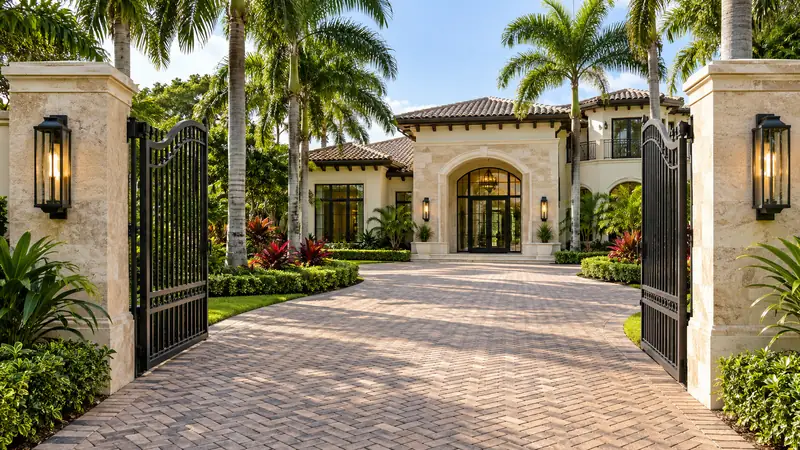
Paver and stone driveways laid on a base built to stay level.
Free project review · (561) 556-7509
FAQ
How much do pavers cost per square foot in South Florida? After the project review, your written proposal lists the following scope and pricing: Concrete paver driveways start at $29 per sq ft installed, travertine pool decks cm porcelain. Tear-out, base, edge restraint and polymeric sand are included.
How deep should the base be under a paver driveway? 6–8 in of compacted limerock for a residential driveway, built in lifts no thicker than 4 in, and 10–12 in for boat or RV parking.
Which pavers are best for a pool deck? Travertine and porcelain. Travertine stays cooler underfoot and grips when wet; porcelain doesn't stain and never needs sealing.
Why do pavers sink? Usually a thin or poorly compacted base, too much bedding sand, roots, or water running under an unrestrained edge. After the project review, your written proposal lists the following scope and pricing: Releveling.
When should new pavers be sealed?
After the white haze (efflorescence) clears. Timing is confirmed in your written proposal. Porcelain doesn't need sealing.
Do I need a permit for pavers? Driveway aprons and most pool deck replacements need permits; most backyard patios don't. We pull the permits and handle HOA approval.
<!-- COMBINED_ADDON_FAQ -->Do you repair pavers another company installed?
Yes. Most of the paver repair we do is on driveways and pool decks someone else built. We lift the problem area, find the cause, rebuild the base in compacted lifts and relay the same pavers. After the project review, your written proposal lists the following scope and pricing: Releveling. See paver repair and sealing.
Can you match my existing pavers?
Usually. Belgard, Tremron and Pavestone colors are stocked locally, so a current product can be matched piece for piece. For an older or discontinued color, we take pavers from an area nobody sees, use them in the repair, and put the closest new color in the hidden spot. Sealing the whole surface afterward evens out the color.
Should I repair or replace my paver driveway?
Repair when one or two areas have sunk and the rest is flat. Replace when the base is failing across most of the driveway, the pavers are 60 mm on a surface cars turn on, or broken pieces cannot be matched. After the project review, your written proposal lists the following scope and pricing: A new paver driveway with tear-out and base included.
Call (561) 556-7509 or send us your project with photos, the city, approximate dimensions, and material selections.
Share your vision for your South Florida home.
Free project review · (561) 556-7509