By John Perry
In Coral Gables, the first question for a paver project isn't the color. It's the water.
Much of the city sits on limestone rock close to the surface, with a high water table and heavy summer rain. Water that can't run off has to soak in somewhere, and limestone doesn't absorb it like sand. Add old driveways that slope toward garages, downspouts dumping onto walks and courtyards that hold water, and you can see why paver projects here start with drainage.
Then come the city's design standards: Coral Gables reviews exterior materials and appearance more closely than most South Florida cities. Plan both before you pick a paver.
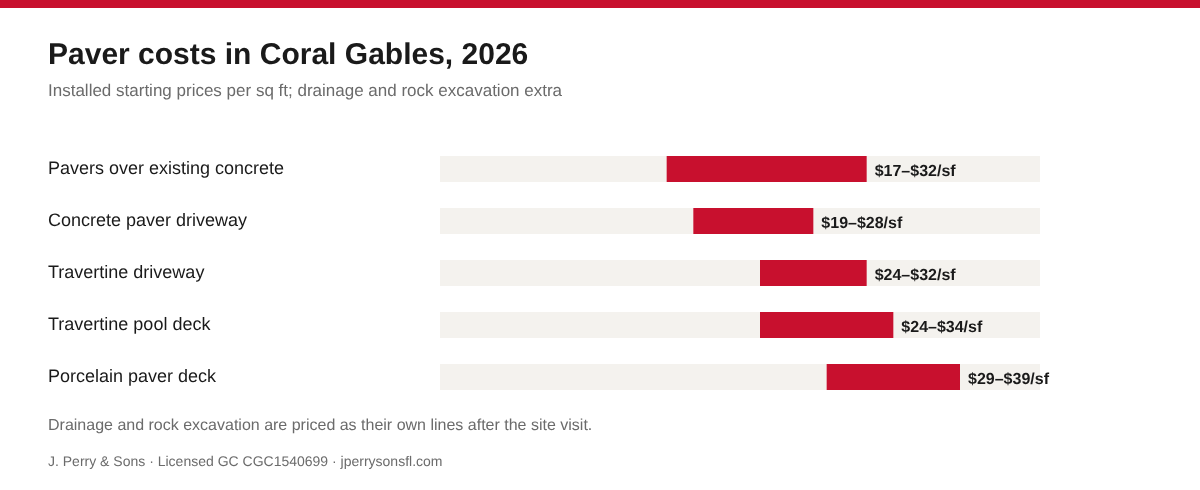
Prices (2026)
| Scope | Starting from |
|---|---|
| Concrete paver driveway, 80 mm | Starting at $29 per sq ft |
| Travertine driveway or motor court | Starting at $28 per sq ft |
| Pavers over existing concrete | Starting at $32 per sq ft |
J. Perry & Sons starting prices. Drainage additions (trench drains, catch basins, dry wells) and rock excavation are priced as their own lines, because they vary with the site. Final pricing is confirmed after we see the property.
The Owner's Guide to Pavers, Pool Decks and Outdoor Living
The technical detail behind pavers that stay flat: base and compaction, drainage, edge restraints, sealing, HOA approvals and how to compare paver quotes.
Why drainage comes first in Coral Gables
- Limestone near the surface: excavation for the base often hits rock, which takes more equipment and time, and water doesn't drain into it the way it does into sand.
- High water table: in heavy rain, the ground fills quickly and water stays on the surface longer.
- Older properties: many homes have driveways and walks poured decades ago with little slope, or slope toward the house.
- Courtyards and walls: enclosed courtyards and garden walls trap water if there's nowhere for it to go.
- Big trees: mature oaks and other trees push roots under old concrete and lift pavers.
Call (561) 556-7509 or send us your project with photos, the city, approximate dimensions, and material selections.
Where will the water go? A simple checklist
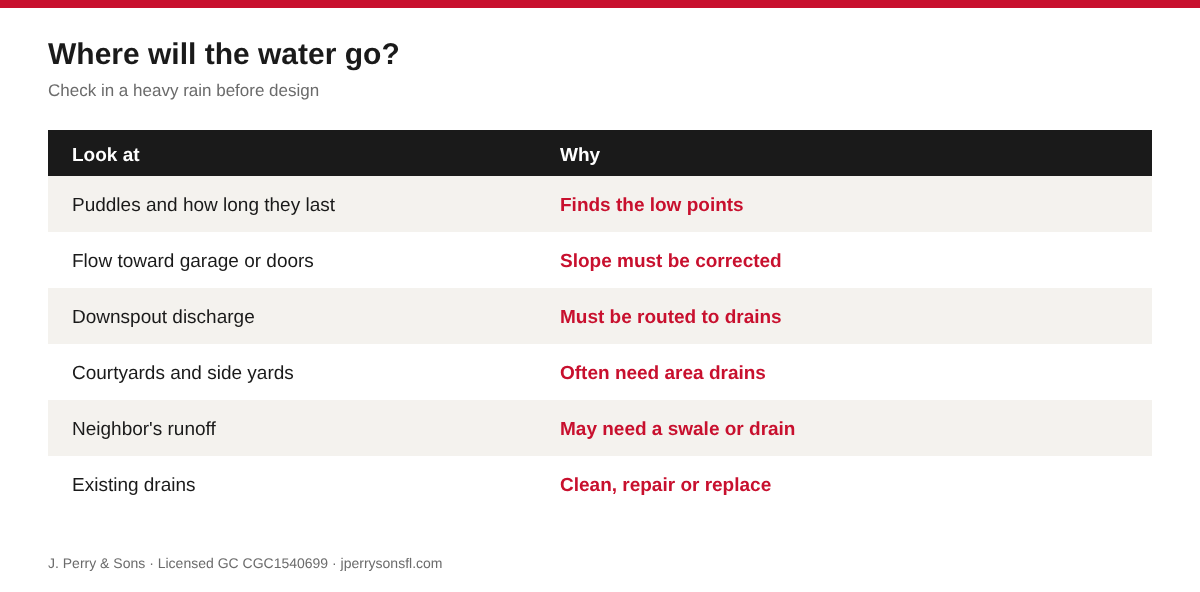
Before design, walk the property in a heavy rain or right after one:
- Where do puddles form, and how long do they last?
- Does water run toward the garage, front door or a sliding door?
- Where do gutters and downspouts discharge?
- Does the courtyard or side yard hold water?
- Where does the neighbor's water come from?
- Is there an existing drain, and is it working?
Photos or a short video of the rain are the most useful thing you can send us.
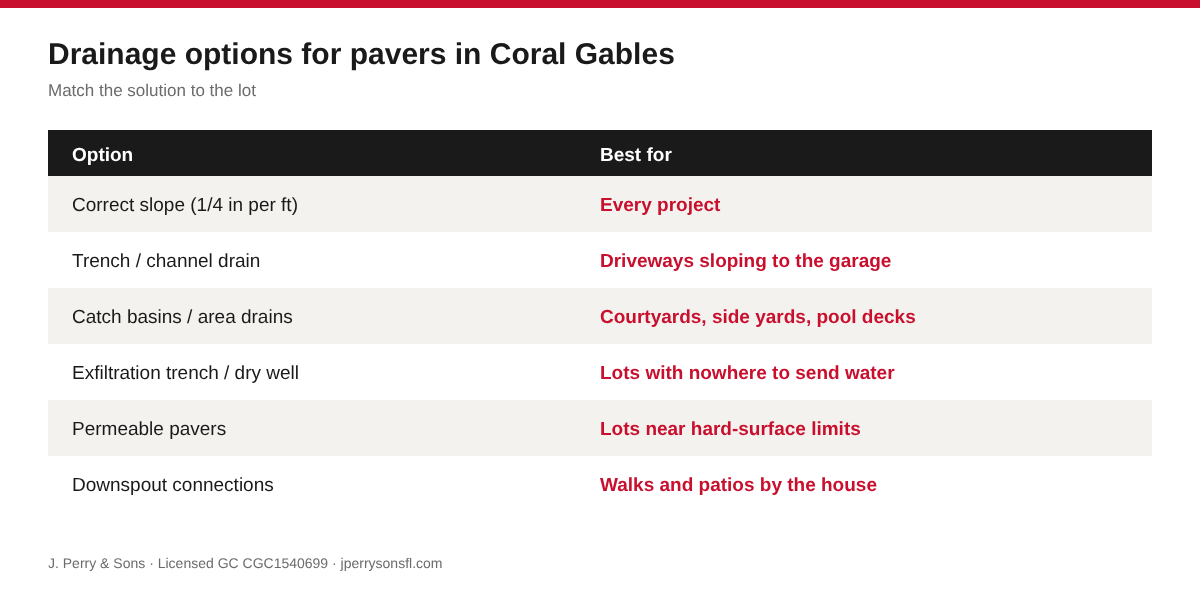
Drainage options
| Option | What it does | Best for |
|---|---|---|
| Correct slope | About 1/4 in per foot away from the house, toward the street or lawn | Every project |
| Trench (channel) drain | Catches sheet flow across a driveway or at a garage | Driveways sloping toward the garage |
| Catch basins / area drains | Collect water at low points | Courtyards, side yards, pool decks |
| Exfiltration trench or dry well | Stores water and lets it soak into the ground over time | Lots with no place to send water |
| Permeable pavers | Wide joints with crushed stone over an open-graded base | Lots near their limit for hard surface |
| Downspout connections | Route gutters to drains instead of onto pavers | Walks and patios near the house |
The right combination is based on the lot. When a drainage design needs engineering, we coordinate a licensed engineer and build to the drawings.
Design review in Coral Gables
Coral Gables is known for its architectural standards. Exterior changes, including driveways, walks and visible hardscape, may need city review and approval before a permit is issued, with attention to material, color and how the work fits the house. Practical tips:
- choose materials that fit the architecture: travertine, coral-stone tones, clay or tumbled pavers often suit Mediterranean homes
- bring a site plan showing paver areas, borders, drainage and landscaping
- include product sheets and color samples
- allow extra time for review
We prepare the submittal package and pull the permit.
Materials that suit Coral Gables homes
- Travertine in ivory, walnut or coral-stone tones: classic Mediterranean look, cool underfoot.
- Coral stone / shellstone: native look that matches many homes; needs sealing.
- Tumbled concrete pavers in warm blends: durable and easy to repair.
- Clay brick for walks and courtyards.
- Porcelain pavers for modern homes and pool decks.
How the project runs
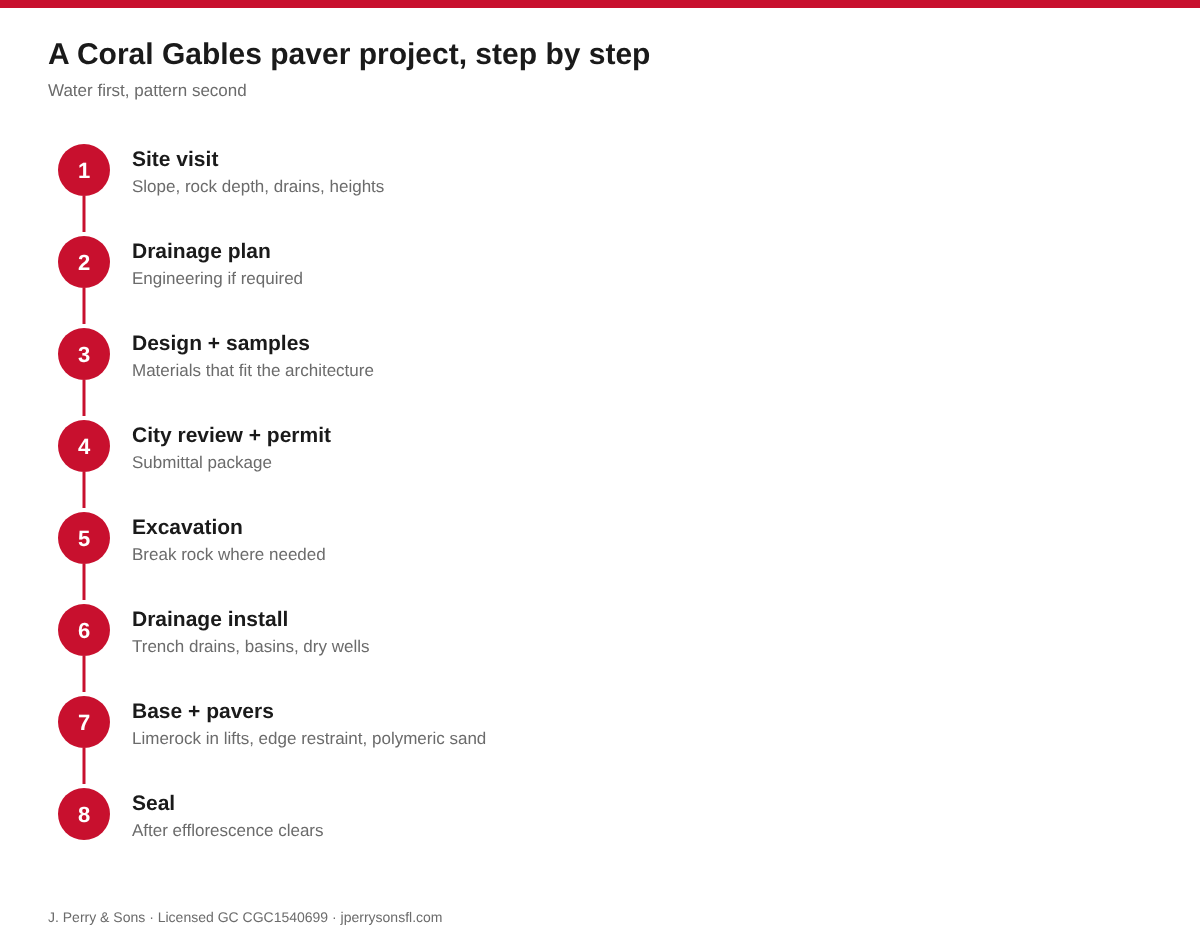
- Site visit: measure, check slope, rock depth, drains, heights at doors and garage.
- Drainage plan: slope, drains, downspouts, and engineering if required.
- Design and samples: material, color, pattern, borders.
- City review and permit: submittal package and permit.
- Excavation: remove old concrete, dig to depth, break rock where needed.
- Drainage install: trench drains, catch basins, piping, dry wells.
- Base: compacted limerock in lifts, geotextile where needed.
- Pavers: pattern, borders, edge restraint, polymeric sand.
- Inspection and cleanup.
- Sealing after the efflorescence clears.
Driveway aprons and swales
The driveway apron and the swale between the sidewalk and the street are in the public right-of-way. Changes there usually need a permit and must keep stormwater flowing to the street or swale. Widening a curb cut is a separate approval. We check these with the city before designing.
Trees and roots
Coral Gables values its tree canopy. When pavers go near large trees:
- avoid cutting major roots; adjust the design or use a root barrier
- consider permeable pavers near trees so roots still get water
- check whether tree work needs a permit before removing or trimming
Timeline
| Step | Typical time |
|---|---|
| Design and drainage plan | Timing is confirmed in your written proposal. |
| City review and permit | Timing is confirmed in your written proposal. |
| Driveway with drainage | Timing is confirmed in your written proposal. |
| Pool deck with coping | Timing is confirmed in your written proposal. |
Mistakes to avoid
- choosing the paver before solving the water
- ignoring downspouts that dump onto the new surface
- skipping rock excavation and building a thin base
- starting without city approval
- sealing too early and trapping efflorescence
Rock excavation: why it matters for the price
When the excavation for a paver base hits limestone:
- the rock has to be broken or trenched to reach the right depth for the base and drains
- larger equipment may be needed, which affects access and protection of the property
- it takes longer than digging sand
- debris volume increases
We look for exposed rock and check depth during the site visit, and we list rock excavation as its own line so you can see exactly what it adds.
Courtyards and enclosed areas
Many Coral Gables homes have courtyards surrounded by walls or the house itself. They look beautiful and hold water easily. For courtyards:
- set the low point away from doors
- add area drains connected to a dry well or exfiltration trench
- consider permeable pavers or wide joints with stone
- keep the finished surface below the interior floor at every door
- choose a stone that grips when wet
Pool decks in Coral Gables
- slope away from the pool and the house at once
- deck drains connected to a working outlet
- travertine or coral-stone tones that suit the architecture
- coping matched to the deck
- permit and pool barrier inspection
Maintenance after installation
- seal travertine and coral stone with a penetrating sealer; reseal every 2–4 years
- keep trench drains and catch basins clean, especially after leaves fall
- check downspout connections before the rainy season
- top off polymeric sand where joints get low
Permeable pavers: how they're built
Permeable pavers are a good fit for lots with little room for runoff:
- pavers with wider joints, filled with small clean crushed stone instead of polymeric sand
- a bedding layer of clean stone instead of sand
- an open-graded crushed stone base that stores water while it soaks into the ground
- edge restraint like any other paver system
They need a lot where the water can eventually soak in or overflow to a safe place, and they need occasional vacuuming of the joints to keep them open. We tell you on the site visit whether they make sense for your property.
Costs that vary with the site
These items are priced after the visit because they vary so much from lot to lot:
- rock excavation and haul-away
- trench drains, catch basins and piping
- dry wells or exfiltration trenches
- engineering, when required
- apron and swale work in the right-of-way
What to send us first
- photos of each area and any standing water
- a short video during or right after heavy rain
- rough length and width
- photos of the house front, so we can suggest materials that fit the architecture
- any letters or notes from the city about previous work
With that, we can tell you on the first visit what drainage the lot likely needs and what the city will want to see.
Why a licensed GC
Drainage, right-of-way work and city review mean a paver project in Coral Gables isn't just installation. We pull the permits, coordinate engineering when needed and take responsibility for the whole job.
Nearby
We also install pavers in South Miami, Pinecrest, Palmetto Bay, Kendall, Key Biscayne, Miami and throughout Miami-Dade County.
Questions to ask before hiring
- How will you handle water on my lot: slope, drains or both?
- What happens if you hit limestone during excavation?
- Will you prepare the submittal for the city's review?
- How deep will the base be under the driveway?
- Who pulls the permit for the apron in the right-of-way?
- How will you protect the trees on the property?
- What's included in the estimate, and what's priced separately?
Before the first visit
Gather photos of standing water after a storm, any previous permits for the driveway, and the property survey if you have one.
Get a price
Send photos of the area, a short video of how water flows in the rain, and rough dimensions, or call (561) 556-7509. We'll visit, check slope, rock and drainage, bring samples and send a written estimate with drainage as its own line. J. Perry & Sons is a licensed Florida general contractor (CGC1540699) with a workmanship warranty.
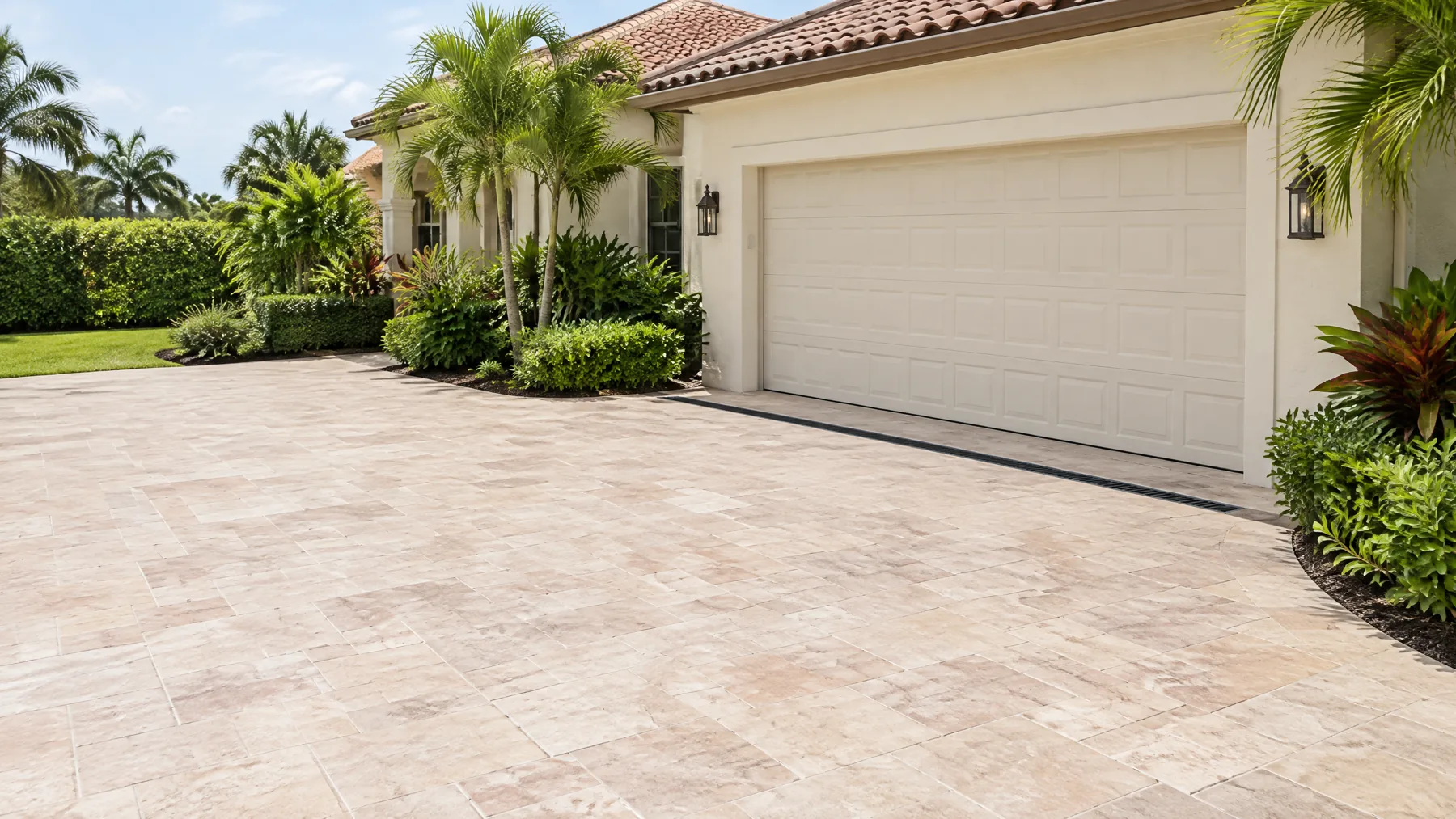
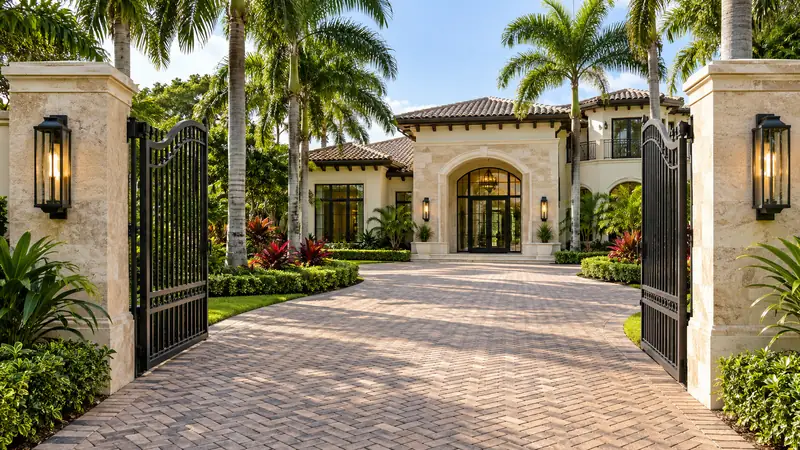
Paver and stone driveways laid on a base built to stay level.
Free project review · (561) 556-7509
FAQ
Why is drainage so important for pavers in Coral Gables? Limestone near the surface and a high water table mean water doesn't soak in easily. Without the right slope and drains, water pools and washes out joints.
How much do pavers cost in Coral Gables? Concrete paver driveways start at $29 per sq ft and travertine starting at $28. Drainage additions and rock excavation are priced separately.
Do I need city approval for pavers in Coral Gables? Exterior changes like driveways and visible hardscape may need city review before the permit. We prepare the submittal and pull the permit.
What drainage options work in Coral Gables? Correct slope, trench drains, catch basins, exfiltration trenches or dry wells, permeable pavers and downspout connections, based on the lot.
Which pavers suit Mediterranean homes? Travertine and coral-stone tones, tumbled concrete pavers in warm blends and clay brick for walks and courtyards.
Can pavers be installed near large trees? Yes, with care: avoid cutting major roots, use a root barrier or permeable pavers, and check tree permit rules first.
Call (561) 556-7509 or send us your project with photos, the city, approximate dimensions, and material selections.
Share your vision for your South Florida home.
Free project review · (561) 556-7509