
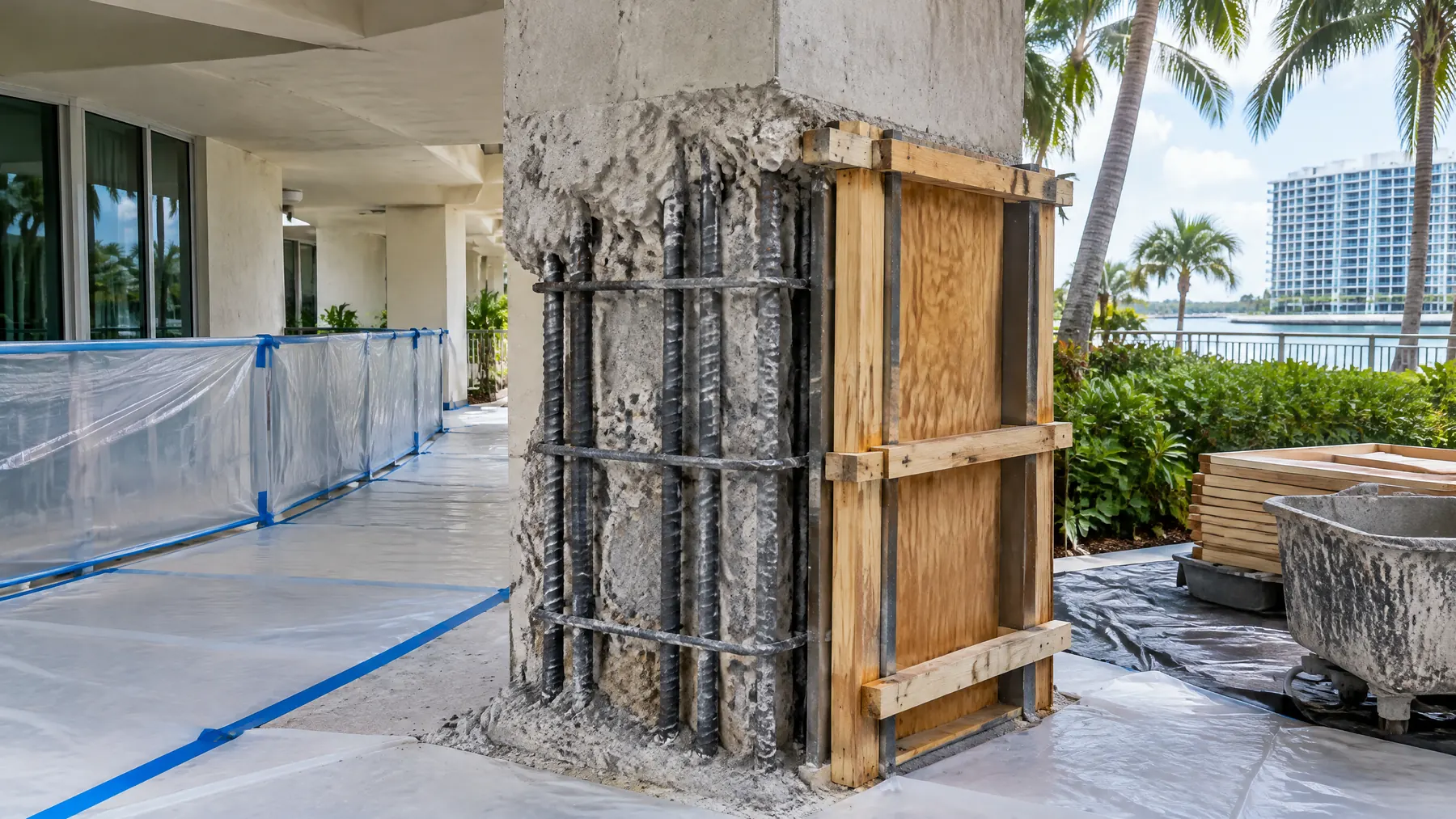
"A piece of concrete fell from the edge of a slab. A column at the parking level has a long vertical crack with rust bleeding out of it. The beam over the walkway sounds hollow when you tap it, and the stucco over it is bulging. The engineer says it's spalling. What happens now?"
These are signs of spalling: concrete breaking apart because the steel inside it is rusting. On South Florida buildings it is the most common structural repair, and it doesn't fix itself. J. Perry & Sons repairs spalled concrete on columns, beams, slab edges, slab undersides and walls for condo associations, property managers and commercial owners across Broward, Palm Beach and Miami-Dade, following the engineer's repair details.
Short answer: a spall repair removes the cracked concrete back to sound material and behind the steel, cleans the rust off the rebar, replaces or adds steel where the engineer specifies, protects the steel, and rebuilds the section with repair mortar or formed concrete, then seals and finishes it to match the building. On columns and beams the structure is shored first where the engineer requires it. Spall repair starts at $150 per sq ft of concrete repaired, priced by unit so the building pays for what is actually found.
This page is the technical guide to repairing the structural element itself. For running a repair program across a whole occupied property, see commercial concrete restoration. The overview of all our concrete work is on concrete restoration.
Next step: if concrete has fallen, close off the area below, notify the engineer and the manager, and send us photos.
The Board & Manager Pack
How to scope, bid and compare building projects, and what to require before work starts.
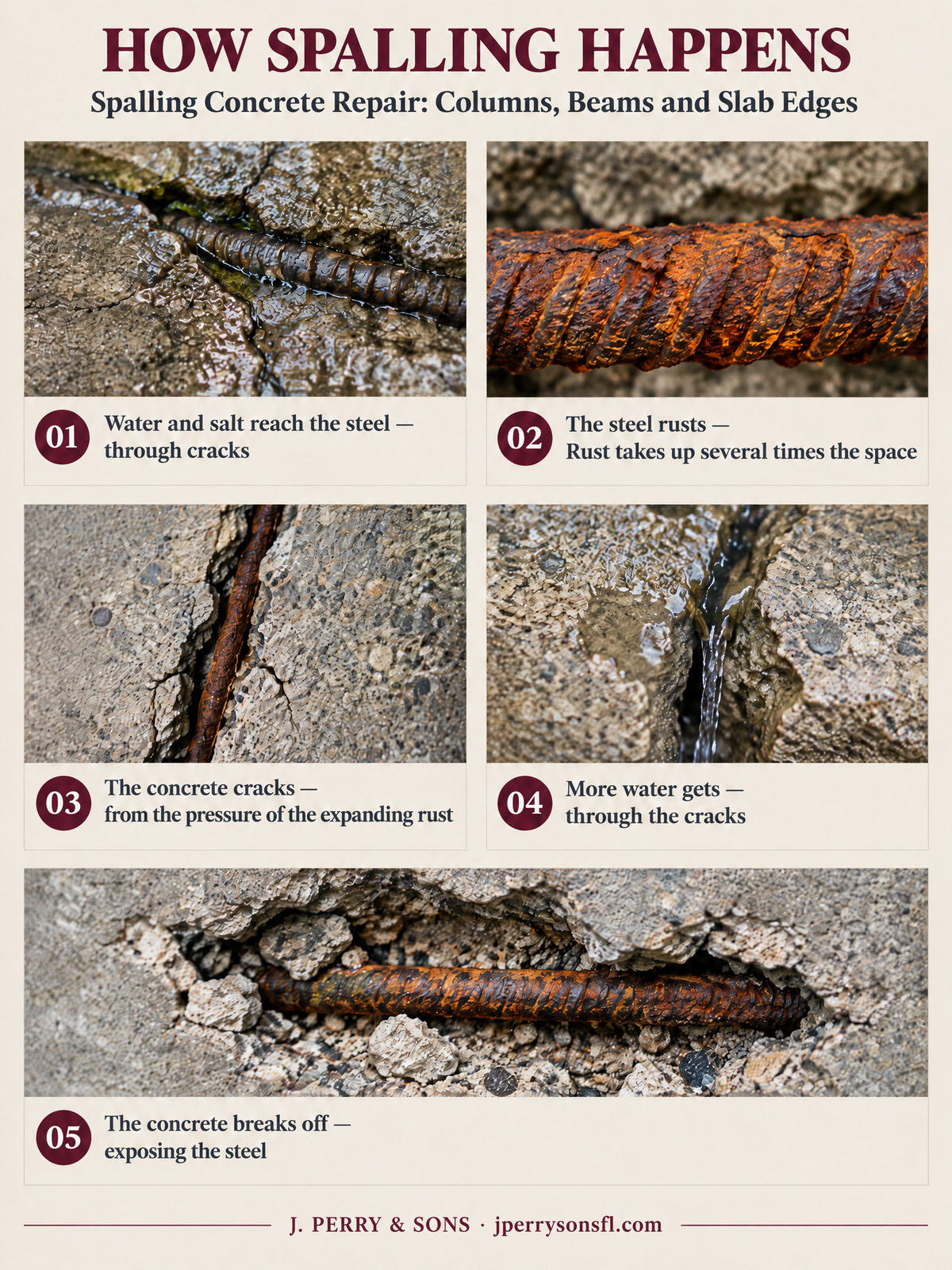
How spalling happens
- Water and salt reach the steel through cracks, porous concrete, failed coatings or thin concrete cover.
- The steel rusts. Rust takes up several times the space of the original steel.
- The concrete cracks from the pressure of the expanding rust.
- More water gets in through the cracks, speeding up the rust.
- The concrete breaks off, exposing the steel.
In South Florida, salt air near the coast, wind-driven rain, humidity and buildings from the 1960s to the 1990s with thin concrete cover all make spalling common.
Signs of spalling owners and managers can see
- Rust stains running down stucco or concrete
- Cracks that follow a straight line, often along a column corner or slab edge
- Bulging or hollow-sounding stucco over concrete
- Small pieces of concrete on the ground below balconies or walkways
- Exposed, rusted steel
None of these is a diagnosis, but each is a reason to call the engineer and plan the repair before more concrete falls.
Next step: walk the building with a phone and photograph each sign with a location note (column line, floor, elevation). That list speeds up the engineer's survey.
Where we repair spalling
- Columns: parking-level columns, exterior columns, balcony columns and lobby columns
- Beams: exterior beams, walkway beams, garage beams and beams over openings
- Slab edges: the exposed edge of every floor, under balconies and at walkways
- Slab undersides: balcony soffits and ceilings below walkways and plazas
- Walls: concrete walls, parapets and shear walls
- Stairs and landings: see stairs restoration
- Balconies: see balcony repair
Spalled ceilings, beams and slabs inside a parking garage are part of parking garage restoration, which J. Perry & Sons coordinates, with the project staying under J. Perry & Sons.
Who designs the repair
Structural concrete repairs on condo and commercial buildings are designed by a licensed engineer. The engineer identifies the damaged areas, specifies the repair method and materials, decides where steel must be replaced or supplemented and sets the inspection points. On buildings with milestone or recertification inspections, spall repairs are usually the largest part of the required work. See 40-year recertification and milestone repairs and our milestone inspection board guide. We build to the engineer's details. We are not the engineer and we never change the repair on our own.
Reading the engineer's repair schedule
The engineer's documents usually group repairs by type. Knowing the types helps a board compare bids line by line.
| Repair type | Where it's used | How it's built |
|---|---|---|
| Partial-depth surface repair | Shallow spalls on slab tops, walls, soffits | Saw-cut, chip behind the steel, hand-applied repair mortar |
| Overhead repair | Slab undersides, beam bottoms | Overhead-grade mortar in lifts, or formed and poured |
| Formed slab edge repair | Exposed floor edges, balcony edges | Formed to the original profile and poured |
| Column repair | Corners, bases, full sections | Shored as directed, formed and poured with flowable repair material |
| Beam repair | Walkway, garage and opening beams | Shored as directed, formed from below |
| Steel supplement or replacement | Bars with section loss | New bars lapped or doweled as drawn |
Each line carries its own unit: per sq ft of surface repair, per cubic foot or sq ft of formed repair, per linear foot of edge or steel. When two bidders price the same schedule differently, the quantities and units on each line show why.
Next step: send the repair schedule with your Free Project Review request and we will price it line for line.
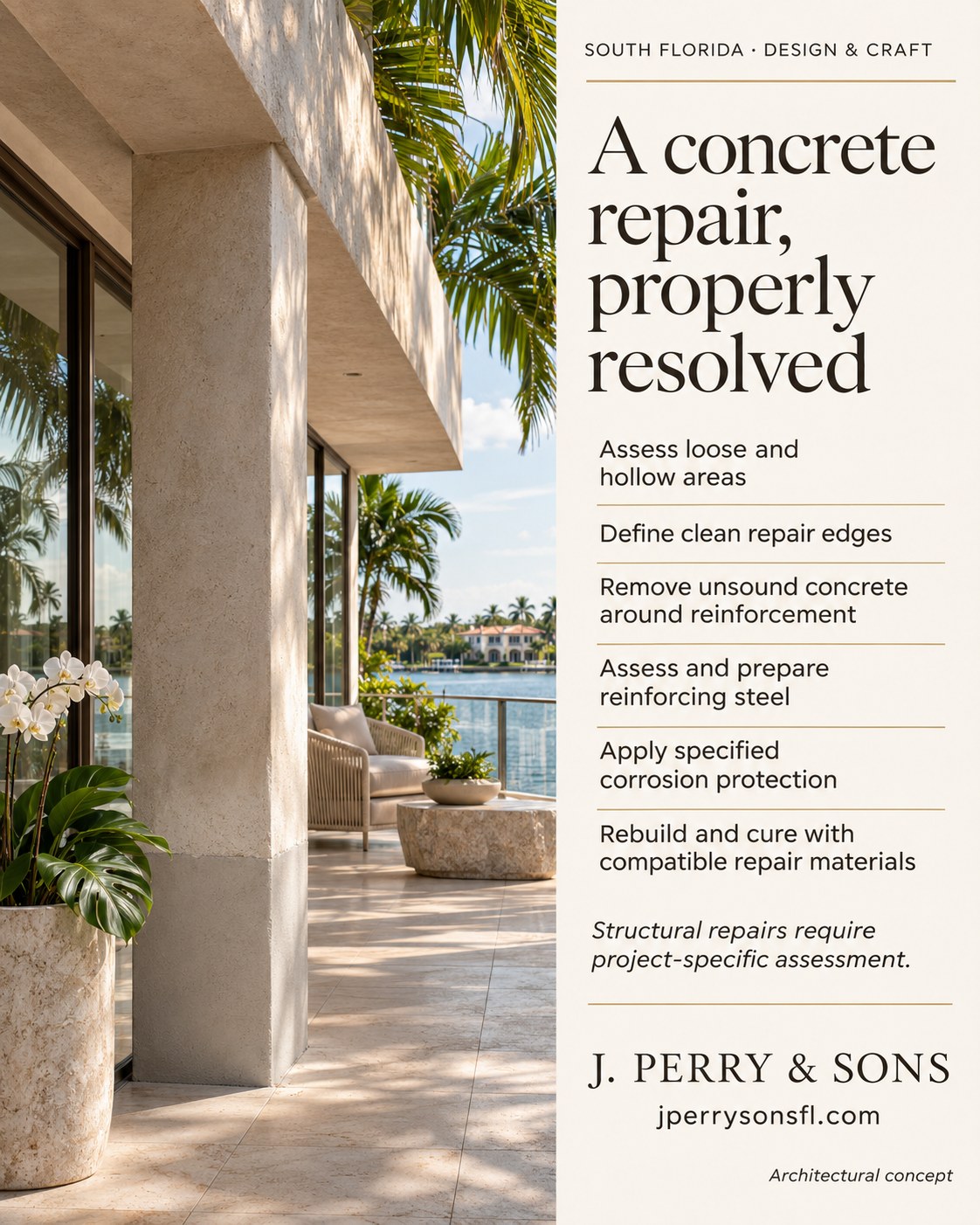
The repair, step by step
- Survey and sounding. Hammer sounding to find hollow concrete and mark the repair areas.
- Shoring. Temporary supports where the engineer requires them, especially on columns and beams.
- Saw-cut the perimeter. Clean, square edges at each repair area, so the repair doesn't feather out and fail.
- Remove concrete. To sound material and behind the steel, so the full circumference of the bar is exposed.
- Clean the steel. Rust removed to bare metal.
- Replace or supplement steel. Where it has lost too much section, as the engineer specifies.
- Engineer inspection. Of the prepared area where required, before anything is closed.
- Protect and prepare. Coat the steel and prepare the surface as the repair system requires.
- Place. Repair mortar or concrete, hand-applied or formed and poured.
- Cure. Shaded, kept moist where required, protected from afternoon storms.
- Finish. Stucco, coating and paint so the repair matches the building.
Columns
Column repairs often need shoring, because the column carries the load of the floors above. The engineer decides how much concrete can be removed at a time and how the column is supported while it's repaired. Larger column repairs are formed and poured with concrete or flowable repair material. Columns at parking levels and near the coast are the most common. Stucco-clad columns are rebuilt to match by our stucco crew; see commercial stucco column repair.
Beams
Beams over walkways, garages and openings are repaired from below with formed repairs. When the damage is on the underside, overhead repair mortars or formed pours are used. Beams carrying heavy loads may need shoring during the work.
Slab edges
The exposed edge of each floor slab is one of the most common places for spalling, because it's directly exposed to rain and salt air. Edge repairs are formed and poured to restore the original profile, then finished to match the stucco and paint. Where the edge is a balcony, the repair ties into the balcony waterproofing; our balcony spalling repair guide explains how.
Concrete cover and older buildings
The concrete between the steel and the surface, called cover, is what protects the steel. Many South Florida buildings from past decades were built with less cover than today's standards, especially at slab edges and balcony tops. Thin cover lets water and salt reach the steel faster, which is why these buildings often need repeated repairs. During the repair, the engineer may specify more cover, coatings on the steel or added protection to slow future corrosion. Added steel and new concrete sections are covered on structural concrete reinforcement.
Spalling on stucco-covered concrete
On many buildings, spalled concrete is hidden under stucco. The first sign is often a crack or bulge in the stucco, or a hollow sound. The stucco is removed over the damaged area, the concrete is repaired, and the stucco is rebuilt and painted to match. Because stucco is one of our own trades, the finished repair blends into the wall.
Repair materials and curing in South Florida
Repairs use materials made for structural concrete repair: polymer-modified repair mortars for smaller and overhead repairs, flowable repair concrete for formed repairs, bonding agents and corrosion protection where specified. The engineer selects the system; we follow the manufacturer's preparation, mixing, placement and curing instructions.
Fresh repairs must cure slowly to reach their strength without cracking. In the summer heat, repairs are shaded, kept moist when required and protected from afternoon storms. Curing is one of the places where a careful contractor and a rushed one produce very different results.
Safety around the building
Spalled concrete can fall. Before repairs start, loose concrete is removed or netted, walkways and entrances under work areas are protected or rerouted, and work zones are marked. On occupied buildings, residents and tenants get notices with the dates and routes.
Engineer's inspections, photos and unit pricing
Concrete damage is only fully visible once the concrete is opened. Proposals include unit prices per square foot of surface repair, per cubic foot or square foot of formed repair and per linear foot of steel replacement, so the owner pays for what's actually found.
The engineer usually inspects the prepared areas before they're closed, checking the depth of removal and the condition of the steel. We schedule those inspections, keep the areas ready and photograph every repair at each stage. The photos and quantities become part of the engineer's documentation for the building department and the association's records. We pull the permit on the engineer's signed and sealed drawings and follow city and county requirements; see permits and compliance.
What a concrete spalling repair proposal should cover
When a board or an owner compares proposals for concrete spalling repair, the totals rarely tell the real story. Two contractors can price the same engineer's report very differently, and the difference usually shows up later as change orders. A clear proposal answers four things before work begins.
First, the unit for each repair type. After the project review, your written proposal lists the following scope and pricing: Spall repair on this page starts at $150 per sq ft of concrete repaired, and formed slab edge and underside repair. Every repair type in the engineer's schedule should have its own unit, so hidden damage found after the concrete is opened is billed at the same agreed rate.
Second, how the repaired area is measured and verified, with photos before closing and the engineer's sign-off.
Third, what happens to the finish. A repaired column wrapped in stucco needs the stucco rebuilt and painted. A repaired balcony edge usually needs the waterproofing and tile replaced. We perform the stucco, paint and tile ourselves, so the finish is in the same proposal and under the same contractor, not left for another company.
Fourth, protection and access: how walkways, cars and residents are kept safe while loose concrete is removed.
Call (561) 556-7509 or send us your project for a Free Project Review.
Spalling on homes and commercial buildings
On homes, spalling usually appears on balcony edges, entry columns, window lintels and older pool deck edges. The repair is small but still structural, with an engineer involved when the damage affects structure. A rusted lintel in a block house is covered on CMU block wall reinforcement; homeowners can also see residential concrete.
Offices, retail centers, hotels and mixed-use buildings have the same spalling problems as condos, often with tenants who can't be disturbed. We phase repairs, work night shift on commercial jobs where needed and coordinate with property managers.
After the repair
Spall repairs last when water is kept out: cracks sealed, coatings maintained, sealant joints replaced and drainage working. Many owners follow spall repairs with a repaint and sealant program. See waterproofing and sealants and commercial painting. Coordinating spall repair, balconies, sealants, stucco and painting in one sequence, with one contractor, saves on access equipment, disrupts residents once and protects new repairs from water right away.
Hurricane season on repair projects
Repairs often continue through hurricane season. Before any storm, loose materials are removed from scaffolds and balconies, access equipment is secured or lowered, open repairs are protected and the manager gets a status report. After the storm, we check the work areas and report back.
Questions to ask any concrete repair contractor
- Will you follow the engineer's details and inspection points?
- How do you price hidden damage?
- How will walkways and residents be protected?
- How will you cure the repairs in the heat?
- What documentation will we receive?
J. Perry & Sons is a licensed Florida general contractor (CGC1540699) with 150+ projects completed. Licensed and insured. Certificate of insurance available on request. Concrete repair, stucco and paint by our own crews under one contract, with photos and quantities for every repair.
Starting price
Spall repair starts at $150 per sq ft of concrete repaired. The final price is based on the depth of the damage, the steel that needs replacing, access, shoring and the finish, and hidden damage is billed at the unit price after it's measured.
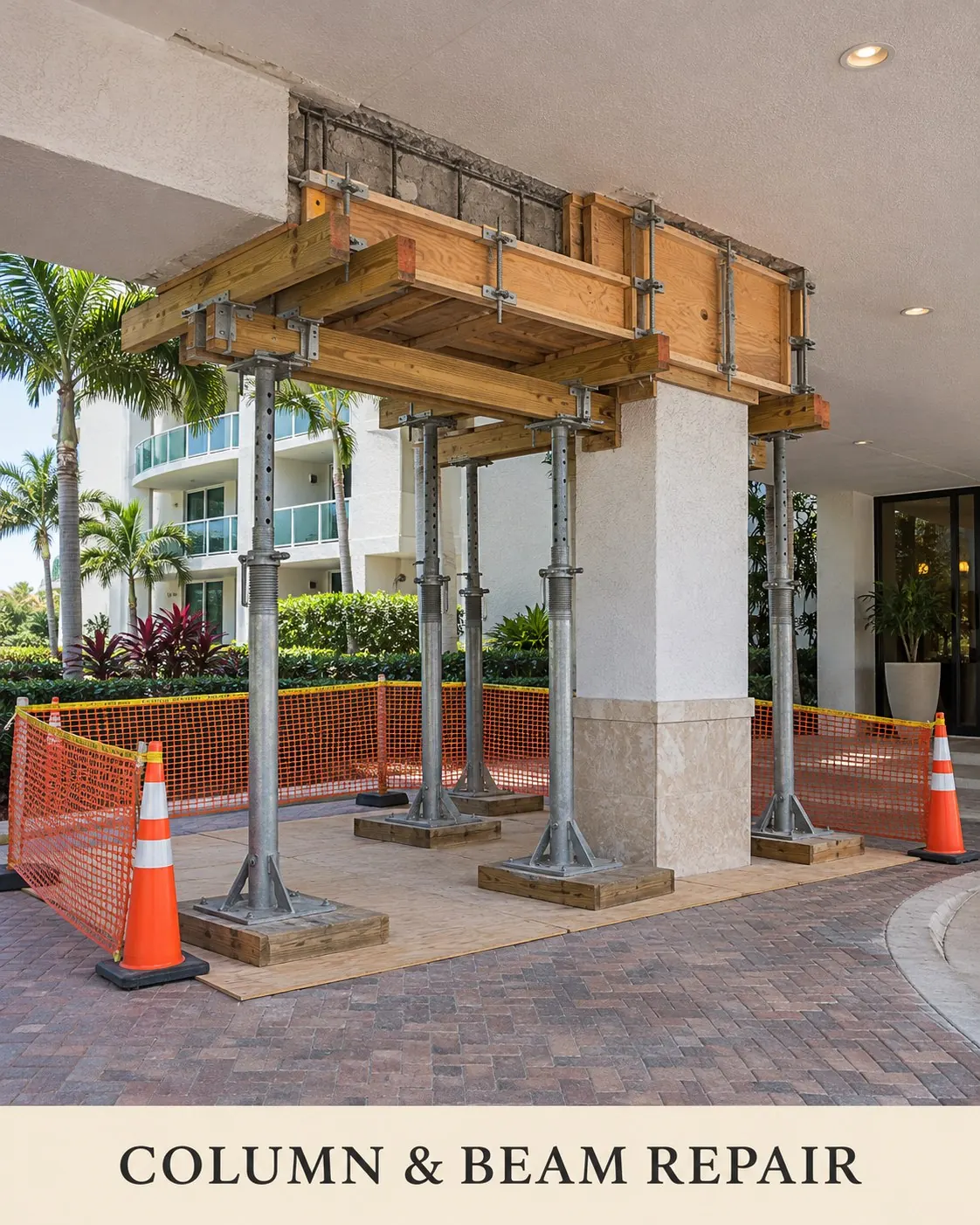
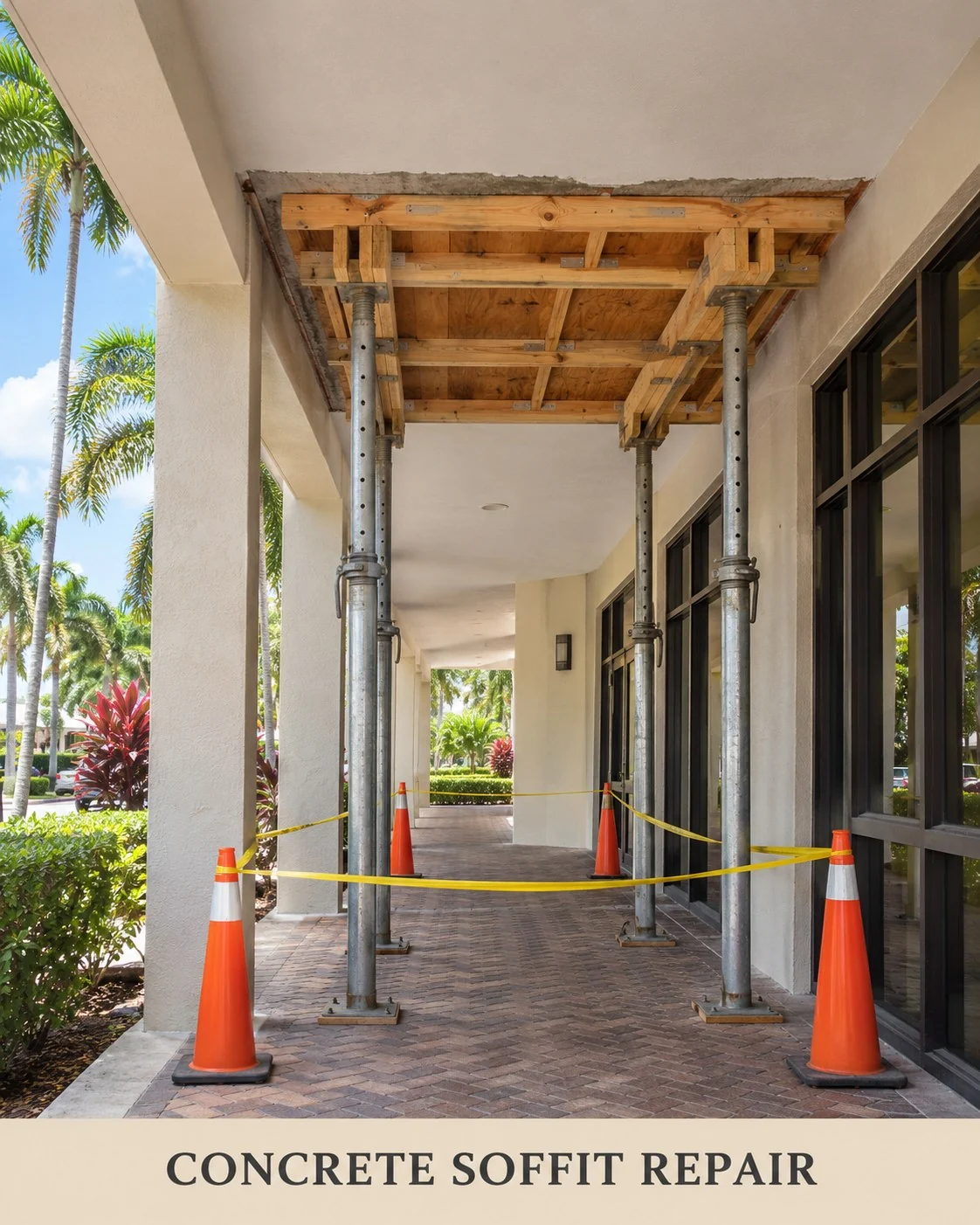
Balcony, column and walkway repairs, done to the engineer's plans.
Free project review · (561) 556-7509
FAQ
How much does spalling repair cost?
Spall repair starts at $150 per sq ft of concrete repaired. The final number is based on depth, steel replacement, shoring, access and the finish. Because damage is hidden until the concrete is opened, the proposal uses unit prices and every area is measured and photographed before it is closed.
Is spalling dangerous?
It can be. Loose concrete can fall on people and cars below, and advanced damage reduces the strength of the column, beam or slab. It should be reviewed by an engineer, and any area where concrete is falling should be closed off right away.
Can you just patch over spalled concrete?
No. A patch over rusting steel fails because the rust keeps expanding underneath. The damaged concrete must be removed behind the steel, the steel cleaned or replaced and protected, and the area rebuilt with a proper repair material.
Do columns need shoring during repair?
Often, yes. The engineer decides how much concrete can come out at once and how the column is supported while it's repaired. We install the shoring the engineer specifies before removal starts.
Why does spalling keep coming back on older buildings?
Many older buildings have thin concrete cover over the steel, so water and salt reach it quickly. The engineer may specify added cover, steel coatings or other protection during repair, and keeping cracks, sealants and coatings maintained afterward slows it down.
Do you work from our engineer's milestone or recertification report?
Yes. We price and build to the engineer's repair drawings and schedule, pull the permit on them and coordinate the engineer's inspections. We never design or change the repair ourselves.
Does concrete spalling repair include the stucco, paint or tile finish?
It can, and on most buildings it should. Once the concrete is repaired, the stucco over a column or beam has to be rebuilt and painted, and a balcony edge usually needs new waterproofing and tile. We perform those finishes with our own trades and list them in the same itemized proposal, so one contractor is responsible from the repair to the finished surface.
Is spalling repair the same as concrete resurfacing?
No. Resurfacing puts a new layer over concrete that is still sound. Concrete spalling repair removes the broken concrete back behind the rusted steel, cleans and protects or replaces the rebar, and rebuilds the section to the engineer's details. Resurfacing over active spalling hides the damage for a while, but the rust keeps expanding and the new surface breaks.
Do you repair spalling concrete on single-family homes?
Yes. On homes, spalling usually shows up on balcony edges, columns, lintels over windows and garage openings, and pool deck edges. Where the repair is structural, an engineer designs it and we build it, pull the permit and finish the surface to match the house. Spall repair starts at $150 per sq ft of concrete repaired.