
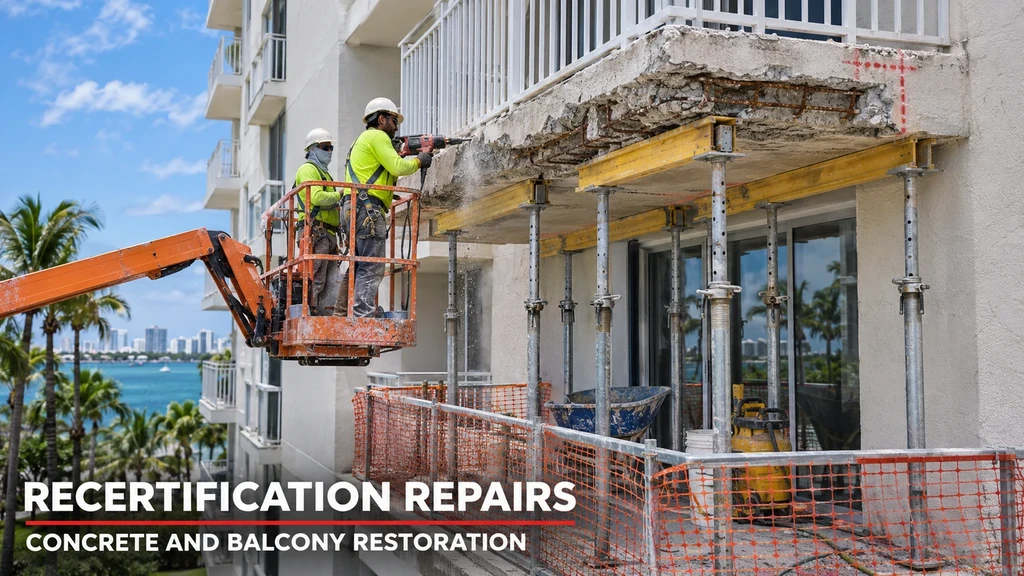
The engineer's report is in. It lists concrete spalls, balcony edges, rails, walkways and waterproofing that the building has to repair, and now your board needs a licensed contractor to price it, build it and close it out with the building department. That is the part of the 40-year recertification process most pages skip, and it is the part we do.
Short answer: after a 40-year recertification or milestone inspection, the engineer's report lists the repairs. A contractor then bids that list, pulls the permit, completes the work to the engineer's details and supports the re-inspection. J. Perry & Sons is the contractor, a licensed Florida general contractor that builds to your engineer's details. We do not inspect or certify buildings and we are never the engineer.
Whether your manager calls it the 40-year certification, the 40-year recertification or the milestone report, the next step is the same: a licensed contractor who prices the engineer's repair list line by line and builds it to the engineer's details.
What the report asks for: the repair list in plain language
A recertification or milestone report is written by a licensed engineer or architect. It describes the condition of the structure and the electrical systems and lists what must be repaired. Board members often receive it as a long document with technical language, so here is what the repair side usually looks like.
- Concrete spalls and delamination. Surface concrete that has broken off or sounds hollow, often with exposed or rusting steel.
- Cracks. Structural or non-structural cracks in slabs, beams, columns and walls that need to be repaired or monitored.
- Balcony slabs, edges and soffits. The most common repair line in a high-rise or mid-rise building.
- Rails and posts. Rusted, loose or non-compliant guard rails.
- Walkways, stairs and landings. Corridors, exterior stairs and edges.
- Parking areas and ramps. Slab cracks, spalls and expansion joints.
- Waterproofing and sealants. Windows, joints, roof edges and terraces that let water into the structure.
- Electrical and other items. J. Perry & Sons coordinates items outside our trade.
The report will mark items by urgency. Items flagged as unsafe or needing prompt attention are handled first, according to the engineer and the building department. What you need from a contractor is a clear way to turn that list into a bid you can compare, a permit and a result the engineer can sign off.
For a deeper look at the board's side, read our milestone inspection guide for Florida condo boards and the 40-year recertification balcony repairs guide.
Next step: send us the engineer's report, or just the repair schedule from it, through our project form.
From engineer's report to approved scope: how a board bids repairs
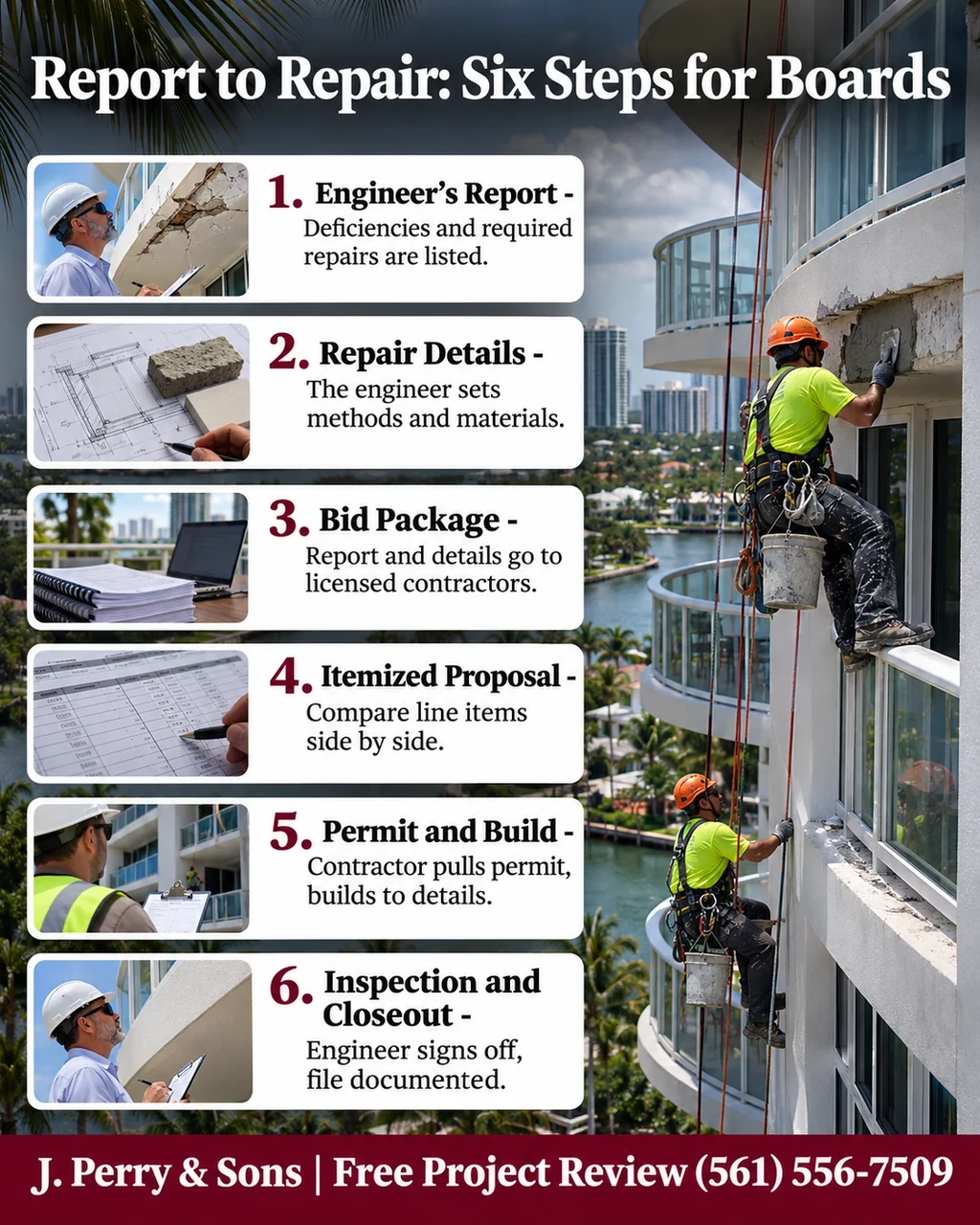
The order matters, and boards that follow it avoid change orders and surprises.
- The engineer's report. It names the deficiencies and, in many cases, the locations and quantities.
- Repair drawings or specifications. For structural work, the engineer provides details: how concrete is removed, how steel is treated, which repair materials and waterproofing systems are used and where inspections are required.
- The bid package. The board or manager sends the report and the details to licensed contractors so every bid covers the same scope.
- Review and walk-through. We walk the building with the manager so quantities and access are checked against the report.
- Itemized proposal. Prices are listed by item so the board can compare apples to apples.
- Approval and permit. The board approves, and J. Perry pulls the permit on the engineer's signed and sealed documents.
- Construction, inspections and closeout. We build to the engineer's details, coordinate the engineer's inspections and deliver documentation for the file.
We work from the report and the engineer's details. If something in the field does not match the report, we document it with photos and measurements and send it to the engineer for direction. We do not guess, and we do not change the engineer's method.
Our article on condo common area renovation and board approval explains how boards approve and fund work like this.
Next step: if your engineer is still preparing the details, tell us. We can review draft scopes with you.
Typical repairs on a 40-year recertification list
Here is what we build, in the order boards usually meet it.
Spalls, rebar and structural concrete
Deteriorated concrete is cut back to sound material, corroded steel is cleaned and protected or replaced as the engineer specifies, and the section is rebuilt with repair mortar or concrete. See our pages on spalling column and beam repair and structural concrete reinforcement.
Balcony slabs, edges and soffits
Finish removal, concrete repair, slope correction, waterproofing, drip edge and finish. Balconies are the largest line in most buildings, so we cover them on a dedicated page: concrete balcony repair.
Rails and guards
Rail removal and resetting in sealed anchors, or replacement with new guards, built to the engineer's details and the code requirements the engineer references. J. Perry & Sons coordinates custom metal fabrication; our crew installs it.
Walkways, stairs and parking areas
Slab repairs, edge rebuilding, expansion joint replacement, traffic coatings and line restoration where the report calls for them.
Waterproofing and sealants
Balconies, terraces, roof edges, windows and joints. See waterproofing and sealants for the waterproofing systems J. Perry & Sons coordinates.
Electrical and other items
When a report includes electrical or life-safety items outside our trade, we coordinate the licensed work so you deal with one general contractor and one schedule.
Next step: mark the line items on your report that you want us to price first.
Permits and the engineer's inspections
Repairs of this kind are permitted, and structural repairs are inspected. J. Perry pulls the permits and the project stays with J. Perry. We follow the city and county compliance requirements the building department sets, schedule inspections, keep the engineer's inspection points open until they are signed off, and keep the paperwork the building department asks for.
The engineer of record decides when a repair can be closed. We never close a repair before the engineer sees it. Photos are taken before, during and after each repair so the file shows what was found and what was done.
Read how we handle this on our permits and compliance page.
Next step: tell us which jurisdiction your building is in and whether a permit is already open.
Repainting and waterproofing as one envelope package
Concrete repairs leave patched surfaces, and a building that has been repaired is usually repainted. Doing the paint and the waterproofing as one package means one scaffold or rope-access setup, one color plan and one coordinated closeout, instead of three trades arriving separately.
J. Perry & Sons coordinates licensed rope-access crews for painting buildings of many stories, so the exterior can be repaired, sealed and painted in one coordinated program. We also coordinate waterproofing on terraces, roof edges and joints. For the painting side, see our commercial painting page, which covers the building envelope work.
Next step: tell us if the board wants to paint right after the repairs so we price them together.
Occupied-building logistics
Most recertification work happens with residents in the building. A good plan keeps them safe and informed.
- Notices. Residents receive a clear notice about what to remove from their balcony, such as furniture, plants and grills.
- Protection. Walkways, entries, cars and the units below are protected or rerouted while concrete is cut.
- Debris. Material is lowered or chuted, never carried through units or lobbies.
- Access for owners who are away. We coordinate through the manager.
- Storm preparation. Loose materials are removed and open repairs are protected before a storm.
- Daily updates. The manager receives a daily update on what was done and what is next.
Timing for your building is confirmed in your written proposal after the project review.
Next step: send the manager's contact so we can plan access and resident notices.
Itemized proposals, COI and license proof, and what goes in a bid package
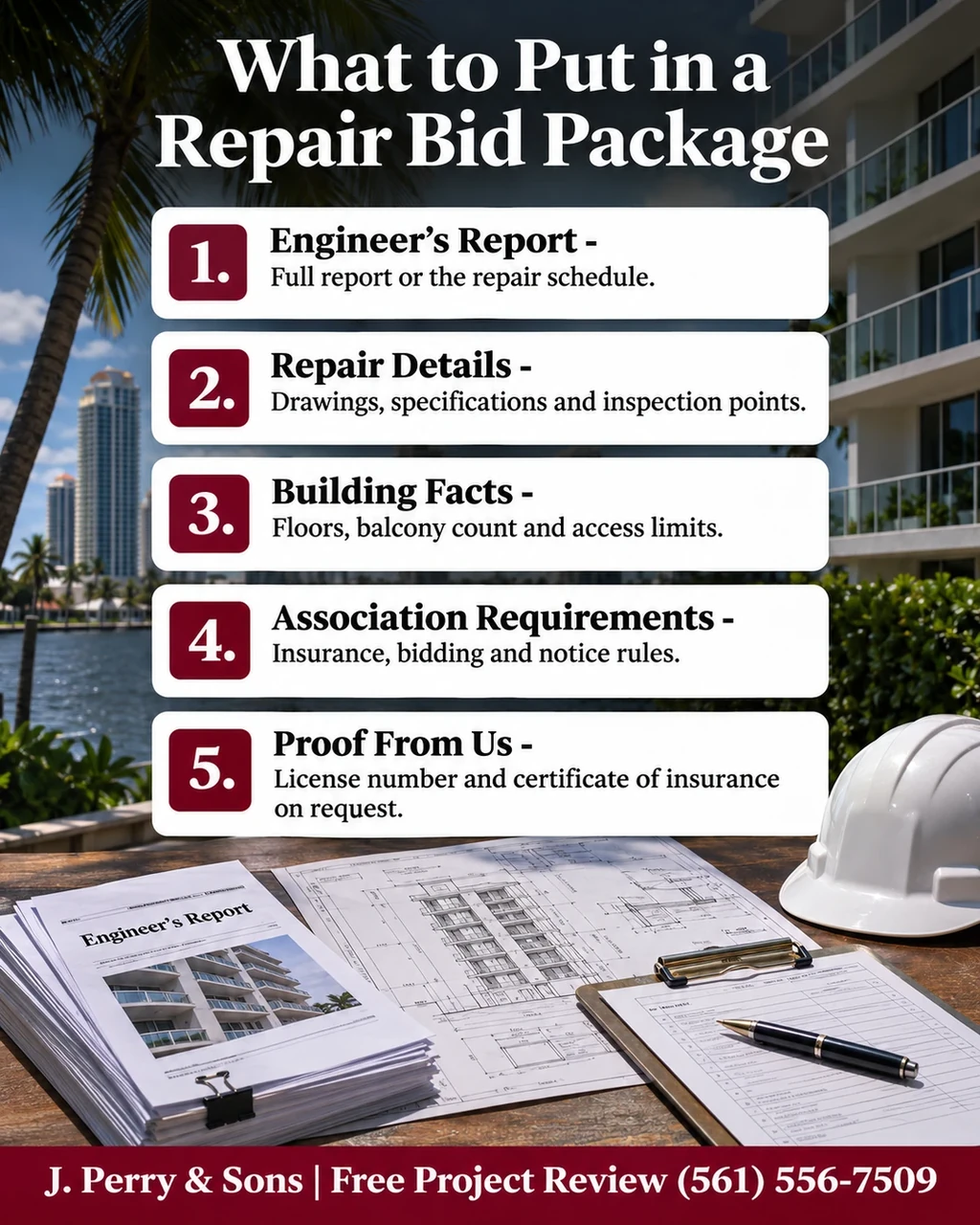
Boards are told to collect multiple bids. We make that easy by giving you a proposal you can compare line by line, and the documents your attorney and insurance carrier will want.
What we include in the proposal:
- Scope tied to the line items in the engineer's report
- Unit prices for concrete repair, edges, rail posts and other repeated items
- Removal, protection and haul-away
- Waterproofing systems and finishes as specified
- Permit fees and inspection coordination
- Exclusions and coordinated work, listed plainly
- Documentation: photos and quantities
What we provide on request:
- License. We are a licensed Florida general contractor, license CGC1540699.
- Insurance. Licensed and insured. Certificate of insurance available on request.
What the board should send us for a bid: the engineer's report, the repair drawings or specifications, the building's floor and balcony count, access constraints and any association requirements for insurance and bidding.
Hidden damage is handled by unit price after it is measured and photographed, so the association pays for what is found, not a guess.
Next step: tell us what your association requires so the paperwork is ready with the proposal.
Current thresholds and schedules
Florida law and your county set when a building must be inspected, how often and by when. Milestone inspections are governed by Florida statute 553.899, and counties and cities may apply their own recertification rules, which is why you will hear different terms such as 40-year recertification, building recertification and milestone inspection. Because these rules have changed over time, we do not state ages, dates or deadlines on this page. Your engineer and the building department set them for your building, and your association's attorney can confirm what applies to you. Then we price the repairs the report requires.
Next step: ask your engineer which items on the report are required and which are recommended, and send us both.
40-year certification or recertification: what the report means for your board
Boards and owners use several names for the same thing. Some say 40-year certification, some say 40-year recertification, and newer state rules call it a milestone inspection. In every version, a licensed engineer or architect inspects the building's structure and safety items and puts the findings in a signed report. The building is not finished with the process when the report is filed. If the report lists repairs, those repairs must be built, inspected and confirmed by the same professional before the building is in good standing.
That is where a contractor comes in. The engineer writes what must be repaired and how. We price that list line by line, pull the permits, build each repair to the engineer's details and call the engineer to review the work before it is closed. We never redesign a repair or skip a step to bring a number down.
After the project review, your written proposal lists the following scope and pricing: typical report items such as spall repair, a full balcony package, and exterior walkway or stair restoration with a new finish. After the project review, your written proposal lists the following scope and pricing: Your building's total, based on the quantities in the report and what is found once the concrete is opened.
Call (561) 556-7509 or send us your project for a Free Project Review.
40-year recertification repairs in your area
Our concrete restoration work covers Broward, Palm Beach and Miami-Dade, including Miami, Fort Lauderdale, West Palm Beach and Pompano Beach. Send us your building's city on the project form and we will confirm coverage.
For other readers
Homeowners with a single balcony problem can start with our balcony repair page, and general contractors can see our subcontractor page for GCs.
Frequently asked questions
What is the 40-year recertification?
It is a building safety inspection program in parts of South Florida in which a licensed engineer or architect reports on the structure and lists required repairs. The building must complete those repairs and have them verified. Your building department sets the details.
Is it 30 or 40 years now?
The trigger has changed and is not the same everywhere. State milestone inspection rules and local recertification programs both exist, so confirm your building's requirement with your engineer and the building department.
How much do recertification repairs cost?
The price is set after we review the engineer's report and walk the building. It is based on the quantity of concrete repair, the balconies and rails, the waterproofing and the access. We send an itemized proposal after a Free Project Review.
Who does the repairs: the engineer or a contractor?
A licensed contractor does the repairs. The engineer inspects and approves them. We are the contractor, we build to the engineer's details and we never act as the engineer.
What is a SIRS and how does it relate to repairs?
A structural integrity reserve study looks at a building's major structural components and the money reserved for them. It is separate from the milestone inspection. Repairs from either report are bid and built by a contractor. Your engineer and attorney can explain what applies to your association.
Can residents stay during repairs?
In most cases yes. We protect walkways and entries, give residents notice and coordinate access through the manager. Your engineer will tell you if an area has to be closed.
Do you provide license and insurance proof?
Yes. We are a licensed Florida general contractor, we are licensed and insured, and a certificate of insurance and license proof are available on request with the proposal.
Is the 40-year certification the same as the 40-year recertification?
Yes, in everyday use. Owners and managers use both names for the same building safety program, in which a licensed engineer or architect inspects the structure and reports what must be repaired. Newer state rules for condo buildings call it a milestone inspection. Whatever the name, the repairs on the report are built by a licensed contractor and confirmed by the engineer.
Can you price our 40-year recertification report before the board chooses a contractor?
Yes. Send us the engineer's report and drawings, and we will walk the building and return an itemized proposal with a line and a unit price for each repair type. That lets the board compare bids on the same basis and see how hidden damage will be billed before anyone signs. Start with a Free Project Review at (561) 556-7509.
Do you handle recertification and milestone repairs in Palm Beach County as well as Broward?
Yes. We build 40-year recertification and milestone inspection repairs serving Broward and Palm Beach, including Fort Lauderdale, Hollywood, Pompano Beach, Boca Raton, Delray Beach, West Palm Beach and Palm Beach. The engineer confirms which program applies to your building, and we pull the permits and follow each city and county's requirements.