By John Perry
The best time to install pavers in South Florida is the dry season, from October through April. October is when it starts: the rainy season is ending, hurricane risk is dropping, crews have more open days, and a project finished in October or November is ready before the holidays and the winter season.
Pavers can be installed any month, and we build through summer too. But the weather changes how fast the job moves, when polymeric sand can be activated and when sealing can happen. Here's how each part of the year affects a paver project, and how to plan so your installation lands in the best window.
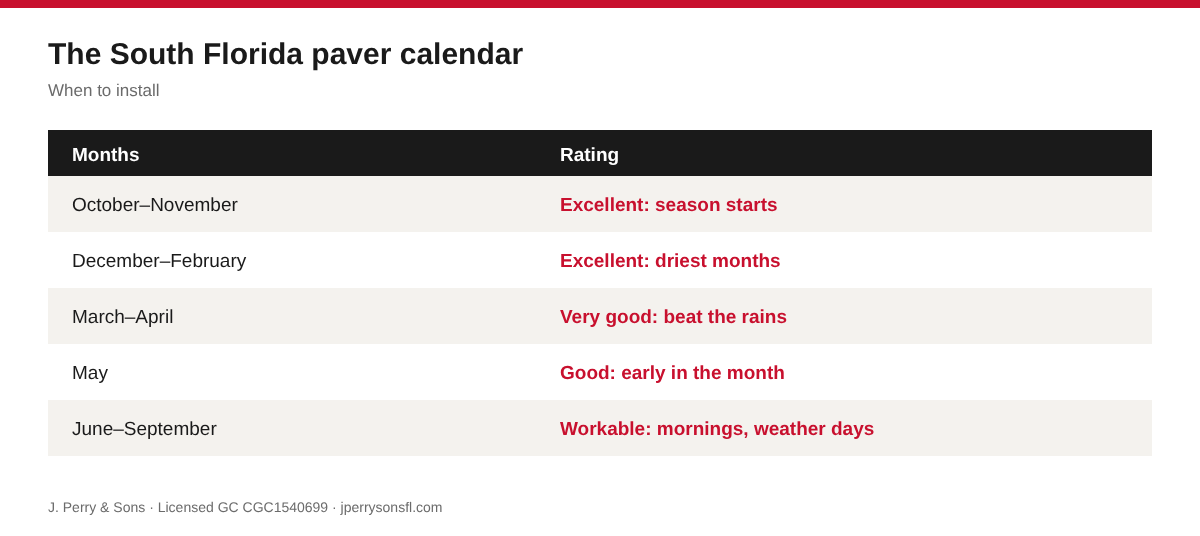
The paver calendar
| Months | Conditions | What it means for pavers |
|---|---|---|
| October–November | Rain tapering, cooler, hurricane season ending | Excellent: start of the best window; finish before the holidays |
| December–February | Driest, coolest months | Excellent: fastest progress; peak demand from seasonal owners |
| March–April | Dry, warming | Very good: finish before summer rains |
| May | Rains begin late in the month | Good: schedule early in the month |
| June–September | Daily afternoon storms, heat, hurricanes | Workable: mornings, weather days, slower sand and sealing |
The Owner's Guide to Pavers, Pool Decks and Outdoor Living
The technical detail behind pavers that stay flat: base and compaction, drainage, edge restraints, sealing, HOA approvals and how to compare paver quotes.
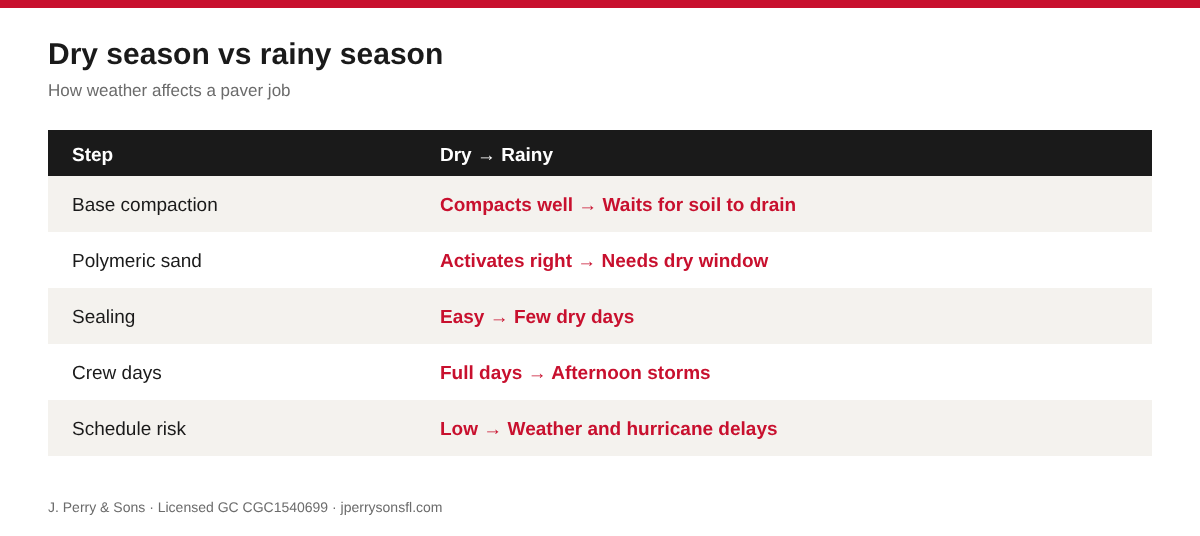
Why dry season makes a better paver job
| Dry season | Rainy season | |
|---|---|---|
| Base compaction | Ground at good moisture, compacts well | Saturated soil, waits for it to drain |
| Polymeric sand | Pavers dry, sand activates correctly | Needs dry pavers and no rain in the window |
| Sealing | Easier to find dry days | Fewer dry windows |
| Crew productivity | Full days | Afternoon storms stop work |
| Concrete curbs and toes | Cure predictably | Rain can damage fresh concrete |
| Schedule risk | Low | Weather days, hurricane delays |
Polymeric sand needs dry pavers and no rain for the period on the bag. In summer, that window is hard to find, and sand activated before a storm can wash out or haze the surface.
Call (561) 556-7509 or send us your project with photos, the city, approximate dimensions, and material selections.
Plan backward: when to start planning
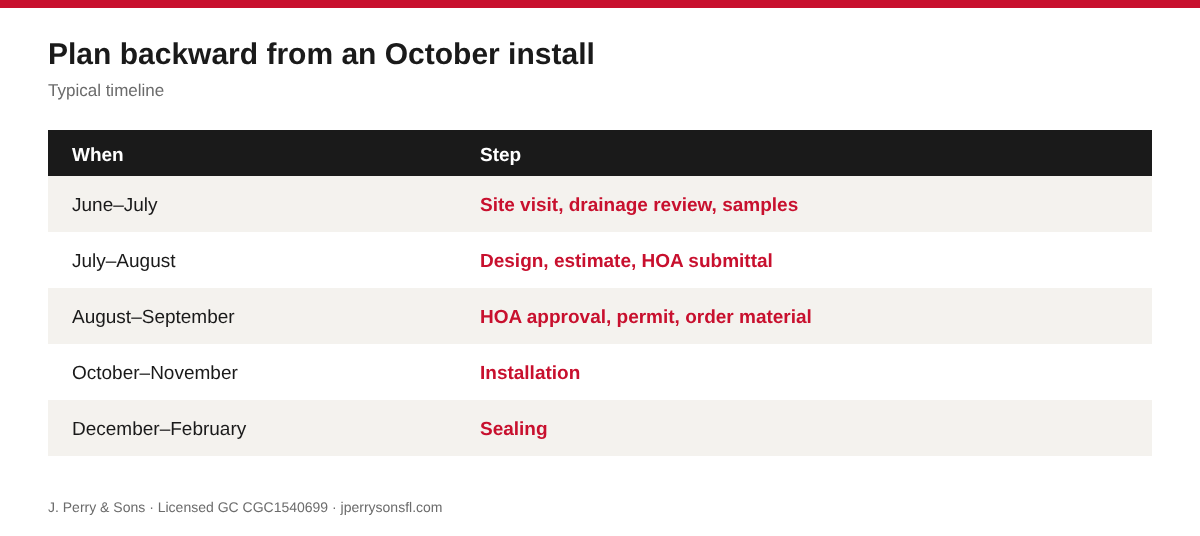
To install in October or November, start in summer:
| When | Step |
|---|---|
| June–July | Site visit, measurements, drainage review, samples |
| July–August | Design, written estimate, HOA submittal |
| August–September | HOA approval, permit for driveway apron or pool deck, material ordered |
| October–November | Installation |
| December–February | Sealing, after efflorescence clears (60–90 days for concrete pavers, 30–60 for stone) |
HOA architectural committees often meet monthly. Timing is confirmed in your written proposal. Permits for driveway aprons and pool decks add time. Starting in summer gets you to the front of the dry-season schedule.
Seasonal owners
Many South Florida owners arrive in November and leave in April. Two common plans:
- Finish before you arrive: plan and approve in spring, install in October, return to a finished driveway and pool deck.
- Install while you're away: approve before leaving in April, install in May or during summer mornings, with photo and video updates.
What it costs (2026)
Season doesn't change our starting prices:
| Scope | Starting from |
|---|---|
| Concrete paver driveway, 80 mm | Starting at $29 per sq ft |
| Travertine driveway or motor court | Starting at $28 per sq ft |
| Porcelain paver deck, 2 cm | Starting at $34 per sq ft |
J. Perry & Sons starting prices including tear-out, compacted base, edge restraint and polymeric sand. Final pricing is confirmed after we see the property. Booking early in the dry season gets you better date choices, not a different price.
Building in the rainy season: how we do it right
When a project has to happen in summer, we adjust:
- Morning starts to work before afternoon storms
- Keep excavation limited so an open area doesn't fill with water overnight. Timing is confirmed in your written proposal.
- Cover the bedding sand and screeded areas before rain
- Wait for the subgrade to drain before compacting
- Activate polymeric sand only with dry pavers and a clear forecast
- Weather days built into the schedule
- Hurricane plan: materials secured and the site cleaned when a storm is forecast
Pool decks before summer or after it?
Most families want the pool deck ready for summer. The best plan is to install between January and April, so the deck is done before the pool season and before the rains. If that's too soon, October–November works well, with the deck ready for the holidays.
Driveways and the holidays
A new driveway is the first thing guests see. To be ready for Thanksgiving or the December holidays, plan approvals by September and installation in October or early November.
Sealing on the calendar
- Concrete pavers need 60–90 days before sealing; stone needs 30–60.
- An October installation is ready to seal in December or January, the driest months.
- Reseal every 2–4 years, ideally in the dry season.
Mistakes to avoid
- waiting until October to start planning and missing the first half of the season
- activating polymeric sand with rain in the forecast
- sealing too soon and trapping the white haze
- leaving an excavated area open overnight in summer
- skipping HOA approval to save time
What happens during a dry-season installation
A typical October driveway project:
- ** protect the house and landscaping, remove the old driveway, haul away debris. Timing is confirmed in your written proposal.
- ** excavate to depth, compact the subgrade, lay geotextile fabric. Timing is confirmed in your written proposal.
- ** limerock base in lifts, wetted and compacted. Timing is confirmed in your written proposal.
- ** screed the bedding sand, start laying pavers in herringbone. Timing is confirmed in your written proposal.
- ** finish the field and borders, set edge restraint, cut the edges. Timing is confirmed in your written proposal.
- ** compact, sweep in polymeric sand, compact again, clean and mist. Timing is confirmed in your written proposal.
- Then: apron inspection, cleanup, and sealing about 60–90 days later.
In the dry season, these days usually happen back to back. In summer. Timing is confirmed in your written proposal.
Hurricane season: what changes
From June through November, a named storm can stop work for days. If a storm is forecast:
- we stop excavation and close open areas
- pallets of pavers and sand are secured or covered
- debris is hauled away so nothing becomes a projectile
- the schedule resumes once the ground drains
That's another reason October and November work well: hurricane risk is falling while the dry season is beginning.
Pavers and other projects on the same calendar
The dry season is also the best time for:
- pool deck and coping replacement
- exterior painting and stucco
- stone veneer on exterior walls and columns
- outdoor kitchens and covered patios
Combining exterior projects in one season means one round of disruption and a finished property for the winter. See patio and outdoor living renovation.
How busy the season gets
From November through March, many seasonal owners return and want work done while they're here, so schedules fill quickly. If you want a specific date, especially before Thanksgiving, the December holidays or a family event, reserve it early.
What to send us to get on the schedule
- photos of the area, and of any sinking or cracked spots
- rough length and width
- your target finish date
- HOA guidelines if you have them
Choosing materials for a dry-season project
Ordering early matters as much as booking early:
- Concrete pavers (Belgard, Tremron, Pavestone) are usually in stock locally, but specific colors and borders can take weeks.
- Travertine comes in lots; order the deck and coping together, with extra for repairs, so the color matches.
- Porcelain pavers often ship from distributors; confirm availability before setting the date.
- Polymeric sand and sealers are matched to the paver and the joint width.
When the material is on site before the crew starts, the job moves without gaps.
Is it worth waiting for the dry season?
Wait if:
- the project is cosmetic and nothing is failing
- your HOA approval isn't in yet
- you want sealing done in the same season
Don't wait if:
- pavers have sunk and create a trip hazard
- water is reaching the house or garage
- roots are lifting sections near walkways
Safety and water problems should be fixed when they're found; the finishing touches can follow in the dry season.
Maintenance by season
- Spring: check joints and top off polymeric sand before the rains.
- Summer: keep drains and gutters clear; rinse off leaves and pool chemicals.
- Fall: inspect for sunken areas after the storm season.
- Winter: best time to clean and reseal.
Why a licensed contractor matters
Driveway aprons and pool decks need permits, and pool decks need a barrier inspection. As a licensed Florida general contractor, we pull the permits, prepare the HOA package and build to code, with the base depth and materials in writing. One contract covers the tear-out, base, pavers, drainage and sealing.
Commercial and HOA projects
Associations and property managers often schedule common-area pool decks and walkways for the dry season too, but the board approval, bidding and phasing take longer. For an October–November installation, start the process in spring.
Quick planning summary
- Plan in summer, install in fall or winter, seal in the driest months.
- Reserve dates early for holiday deadlines.
- Order materials before the crew starts.
- Fix safety and water problems right away, whatever the month.
Where we install pavers
We install pavers across Broward, Palm Beach and Miami-Dade, including Boca Raton, Delray Beach, Parkland, Weston, Fort Lauderdale, Wellington, Palm Beach Gardens, Jupiter, Coral Gables and Miami.
Questions to ask when booking
Ask when the crew can start, how long the job will take, whether HOA approval and permits are included, which base depth and paver thickness are planned, and how the schedule changes if it rains.
Holiday deadlines
For a driveway finished before Thanksgiving, aim for HOA approval by late September. For the December holidays, approval by mid-October usually leaves enough time.
After installation
Keep vehicles off new pavers until the joint sand has set, and wait for the haze to clear before sealing.
Book your dry-season installation
Send photos of the area and rough dimensions, or call (561) 556-7509. We'll visit, check drainage and heights, bring samples, help with HOA approval and reserve your installation date. J. Perry & Sons is a licensed Florida general contractor (CGC1540699) with a workmanship warranty.
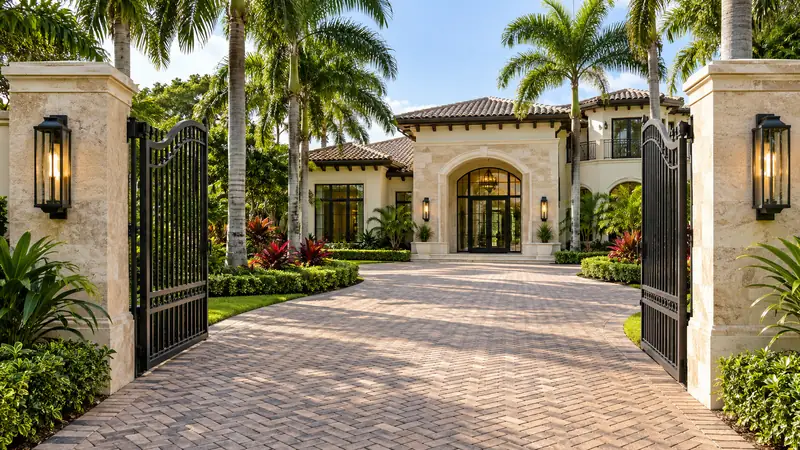
Paver and stone driveways laid on a base built to stay level.
Free project review · (561) 556-7509
FAQ
What is the best month to install pavers in South Florida? October through April is the best window, with October starting the season. December through February are the driest months.
Can pavers be installed during the rainy season? Yes. We work mornings, protect open areas and activate polymeric sand only on dry days, but the job may take longer.
When should I start planning to install in October? In June or July, so design, HOA approval and permits are done by September.
Does the season change the price of pavers? No. Our starting prices are the same all year; booking early gets you better date options.
When should new pavers be sealed? About 60–90 days after installation for concrete pavers and 30–60 days for stone, ideally in the dry season.
When should I redo my pool deck? Between January and April to have it ready for summer, or October–November to have it ready for the holidays.
Call (561) 556-7509 or send us your project with photos, the city, approximate dimensions, and material selections.
Share your vision for your South Florida home.
Free project review · (561) 556-7509