
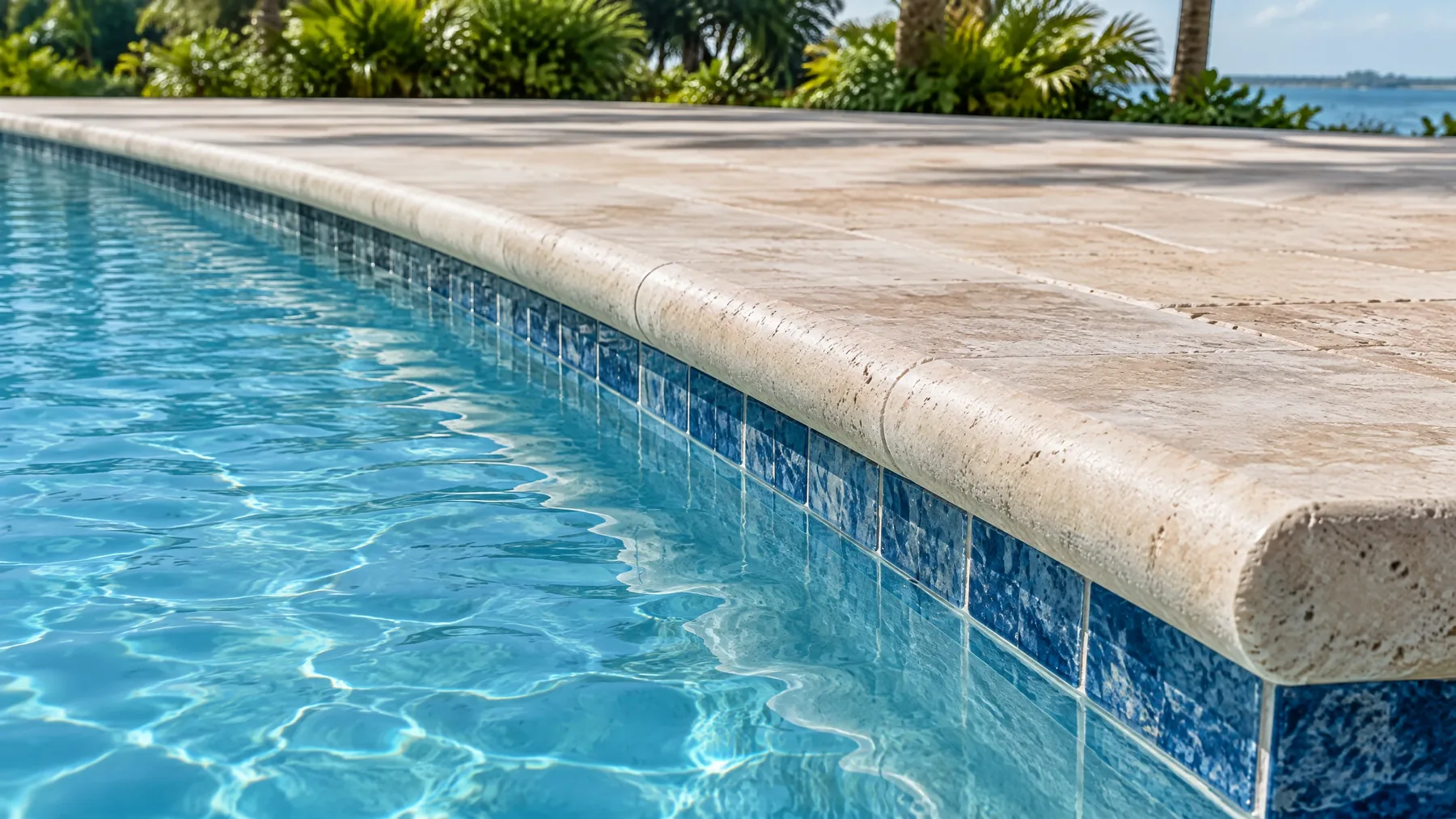
Pool coping installation runs $35–$85 per linear foot installed in Broward and Palm Beach counties, so a typical 100 ft pool perimeter costs $3,500–$8,500 depending on material and whether the old coping has to come off. Coping is the cap that sits on the pool's bond beam, covers the top of the shell and gives you the edge you grab, sit on and dive from. J. Perry & Sons is a paver installation contractor that sets coping as part of a deck job or as a stand-alone replacement, and this page covers cost, bullnose and other profiles, the tile line and the beam.
Pool Coping Installation Cost in South Florida: $35–$85 per linear ft installed
| Coping material | Installed range | 100 ft pool perimeter |
|---|---|---|
| Precast concrete bullnose | $35–$60 per linear ft | $3,500–$6,000 |
| Poured-in-place cantilever concrete | $40–$65 per linear ft | $4,000–$6,500 |
| Travertine bullnose, 12x24 or 16x24 | $45–$75 per linear ft | $4,500–$7,500 |
| Marble or shellstone bullnose | $55–$85 per linear ft | $5,500–$8,500 |
| Porcelain coping, matched to porcelain pavers | $55–$85 per linear ft | $5,500–$8,500 |
| Removal of existing coping, add | $8–$15 per linear ft | $800–$1,500 |
Ranges cover setting on the beam with a polymer-modified mortar bed, leveling, mitered or radius cuts, and the joint to the deck, with the coping supplied by the owner unless we quote supply. Removing old coping, beam repair, resetting the waterline tile and spa or raised-wall coping are separate lines. Curved and freeform pools carry more cuts and price toward the top of each range. Material-by-material detail is in the pool coping cost guide.
Free Estimate
Free estimate — call (561) 556-7509 or email jperrysonsgc@gmail.com with project photos, the city, approximate dimensions, and material selections.
Coping materials and edge profiles
Travertine. The most common choice here, and it matches a travertine deck piece for piece. Tumbled face for grip, 12x24 or 16x24 in 1¼ in (3 cm) or 2 in thickness. Needs a penetrating sealer.
Marble and shellstone. Lighter and more formal. Choose honed over polished at a pool edge. Both are softer than travertine at a saltwater pool and depend on sealing.
Precast concrete. The budget option and the most consistent in size. Durable, but it runs hot in the sun and the look is plainer.
Porcelain. 2 cm coping with a factory bullnose or square edge, matched to porcelain deck pavers. No sealing, no fading, limited profiles.
Profiles. Bullnose (rounded edge), double bullnose (both edges rounded, used on raised walls and spas), square or eased edge for a modern look, and cantilever, where the deck material runs straight to the water edge with no separate cap.
Free estimate — call (561) 556-7509 or email jperrysonsgc@gmail.com. Send a photo of the pool edge and the perimeter length and we'll return a range the same day.
Bullnose coping
Bullnose is the half-round edge most people picture at a pool, and it is the profile we set most. The rounded nose is comfortable to sit on and grab, has no sharp arris to chip, and sheds water instead of pooling at the lip. Travertine bullnose is cut from the same stone as the deck pavers, usually 12x24 or 16x24 with the long side along the water; precast comes in fixed 12 in and 16 in units. On a rectangular pool we run full pieces along the straights and miter the corners. On a freeform pool each piece is radius-cut so the joints stay tight on the curve, which is where the labor goes. Overhang is typically 1–1½ in past the tile line.
How we install pool coping
- Removal. Existing coping is cut free and lifted. The old mortar is chipped off the beam down to sound concrete and the beam is checked for cracks and spalling.
- Beam repair. Cracks are routed and filled, spalled areas are patched with a repair mortar, and the beam is brought level. Coping is only as flat as the beam under it.
- Tile line. The waterline tile is protected, or reset if it is loose or if the owner is changing it, before the coping goes on. The coping overhang is set to the finished tile face.
- Layout. Pieces are dry-laid around the perimeter to balance cuts at corners and radiuses so no sliver pieces land in a visible spot.
- Setting. Each piece is set in a polymer-modified mortar bed with full coverage under the stone, leveled around the whole pool with a laser, with the nose at a consistent overhang.
- Expansion joint. A flexible joint between the coping and the deck lets the pool shell and the deck move independently. Skipping it is why coping cracks and pops.
- Grout and seal. Joints between pieces are grouted with a sanded, exterior-rated grout. Stone coping is sealed after 30–60 days in a separate visit.
- Deck tie-in. When we are also doing the deck, the field pavers run to the coping last so the coping is never the piece that gets cut to fit.
Permits and compliance handled. J. Perry & Sons pulls the permit, schedules the inspections, and builds to the city and county codes that apply — Broward and Palm Beach municipal building departments, HVHZ requirements where they apply, and HOA/condo association rules. Licensed Florida general contractor CGC1540699.
Pool coping in South Florida: the beam, salt, movement and the barrier
Coping fails at the beam, not the stone. South Florida pools are gunite or shotcrete shells, and the bond beam takes decades of thermal movement, water chemistry and deck settling. When old coping pops, the cause is almost always a hollow mortar bed on a beam that was never cleaned, or a missing expansion joint between coping and deck. We repair the beam first and set every piece in full mortar.
Saltwater systems leave brine on the coping every day, and the coping is the piece that stays wettest. Travertine and porcelain hold up; marble and shellstone need sealing every year or two at the edge.
In most Broward and Palm Beach cities a full pool deck rebuild needs a permit, typically $150–$600 and 2–4 weeks. Coping-only replacement often does not, depending on the city, but whenever a permit is opened on the pool area the inspector checks the pool barrier: fence height, self-closing gates, latch heights, door alarms. We check both before we start. HOA approval is common in Weston, Parkland, Wellington and Boca communities. See the pool deck permit guide.
Related paver services
- Pool deck pavers: overlay or full replacement of the deck in travertine, marble, shellstone or porcelain.
- Travertine pavers: the deck stone that matches travertine bullnose coping.
- Paver repair, releveling and sealing: resetting a sunk section at the coping and re-sealing coping and deck.
- Paver driveway: driveways and motor courts in the same paver as the pool area.
What a pool coping estimate includes
- Perimeter measured in linear feet, with straights, corners and radiuses noted
- Removal of existing coping and mortar, by linear foot
- Beam repair, by area, if needed
- Waterline tile protection or reset
- Coping material (owner-supplied or quoted supply), profile and thickness
- Mortar setting, grout and the expansion joint to the deck
- Spa, raised wall and step coping as separate lines
- Permit, if required, and sealing as a separate visit
Pool coping by city
Pavers in Fort Lauderdale · Pavers in Miami · Pavers in Boca Raton · Pavers in West Palm Beach · Pavers in Weston · Pavers in Delray Beach · Pavers in Parkland · Pavers in Wellington
Planning guides: Pool coping installation cost · Pool deck resurfacing cost · Travertine vs marble vs porcelain pavers · Pool deck permit requirements · Paver sealing guide
Pool coping — FAQ
How much does pool coping cost per linear foot in South Florida? $35–$60 for precast concrete, $45–$75 for travertine bullnose, $55–$85 for marble, shellstone or porcelain, installed on the beam. Removing old coping adds $8–$15 per foot. A 100 ft pool runs $3,500–$8,500.
What is bullnose coping? Coping with a rounded front edge. It is comfortable to sit on and grab, resists chipping, and sheds water. It is the standard profile in travertine, marble and precast; square-edge and cantilever are the alternatives.
Can you replace the coping without redoing the deck? Yes. We cut the old coping free, clean and repair the beam, set the new coping and install a fresh expansion joint to the existing deck. Matching the deck color is the main design question.
Why does pool coping crack or come loose? A hollow or cracked mortar bed on a dirty beam, or no expansion joint between coping and deck. The shell and the deck move differently, and without the joint the coping takes the stress.
Does the waterline tile have to be replaced with the coping? Not if it is sound. We protect it and set the coping overhang to the tile face. If it is loose, cracked or you want a new look, resetting it at the same time is the cheapest moment to do it.
How do I get an exact price? Call (561) 556-7509 or email jperrysonsgc@gmail.com with photos and rough dimensions. A written estimate is typically ready within 24–48 hours after a site review and scope confirmation.
Free estimate — call (561) 556-7509 or email jperrysonsgc@gmail.com. Licensed Florida general contractor CGC1540699. Serving Broward and Palm Beach counties.
Free Estimate
Free estimate — call (561) 556-7509 or email jperrysonsgc@gmail.com with project photos, the city, approximate dimensions, and material selections.