

Tired of stair carpet that never looks clean, or tile steps that feel slippery and cold? White oak stairs are the upgrade most of our clients pick, and in South Florida they go over the concrete stair you already have. We take off the old finish, prepare the concrete, and fit solid white oak treads and risers one step at a time, scribed to the walls and matched to your floor. This page covers that stair remodel from start to finish: cost, what happens to the concrete, how we match the stairs to engineered wood floors, finish choices and how long it takes. For floating and steel stairs, go back to our stairs page.
White oak stairs cost
| Scope | Unit | Starting price |
|---|---|---|
| White oak tread and riser, fitted over concrete | per step | $350–$550 |
| Typical staircase, 13–15 steps | per staircase | about $5,500–$8,500 |
| Landing in matching white oak | per job | priced per job after we see it |
| Removing carpet, tile or marble from the stair | per job | priced per job after we see it |
| New railing, glass | per linear ft | $450–$750 |
| New railing, metal or cable | per linear ft | $250–$450 |
About these prices. These ranges are starting points based on typical South Florida projects. Your final price depends on the condition of the property, access, the materials or system specified and the full scope of work. We confirm every number after we review your project in person or from the drawings, and the price in your signed proposal is the one that applies.
What moves a staircase inside the range? Open sides that need a return on the tread end, a curved or winding section where each tread is a different shape, the thickness of the old tile bed that has to come off, and whether the risers are white oak or paint grade.
Why white oak for hardwood stairs
White oak is hard enough for daily foot traffic, takes stain evenly, and has a tight grain that hides small dents better than softer woods. It is also the most common species in engineered wood floors right now, so stairs and floor come from the same wood and age the same way.
You'll hear two cuts mentioned. Plain sawn white oak shows the classic cathedral grain pattern. Rift and quartered white oak has straight, tight lines and moves less with humidity, which is why many designers prefer it on stairs in Florida homes. Either can be stained or left natural.
Treads are solid wood, typically about an inch thick, with a rounded or square nosing on the front edge. Risers can be white oak to match, or a primed paint-grade board painted white or to match your trim. White risers with oak treads are the most requested look we see.
Want to see rift and plain sawn side by side? Call (561) 556-7509 and we'll bring both to your house with stain samples.
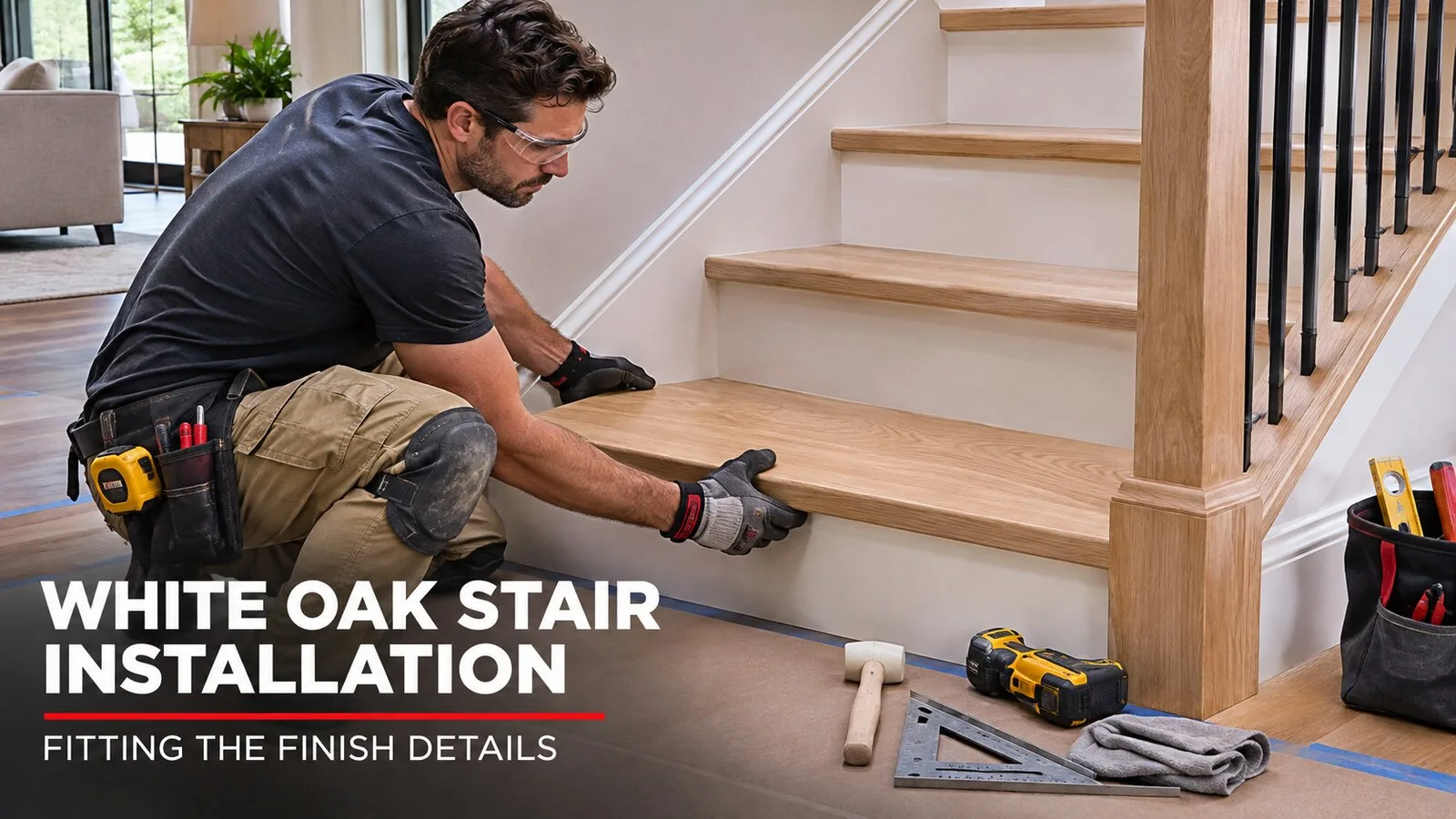
The stair remodel, step by step
What actually happens on your stair? Here is the order of work for a remodel from tile or carpet.
- Protect the house. Floors at the top and bottom are covered, and dust walls go up where the stair opens to living areas.
- Remove the old finish. Carpet, pad and tack strip come off, or tile and marble are cut out with the mortar bed under them. Stair tile in older homes is often set thick, so this step can change the height of the first and last steps.
- Prepare the concrete. We grind high spots, patch chips at the nosings, and fill voids so each tread will bear evenly. The surface has to be clean and sound for the adhesive.
- Measure every riser. Concrete stairs are rarely perfect. We record each riser height and plan the tread and riser thicknesses so the finished steps come out within the variation the code allows.
- Fit treads and risers. Each piece is cut and scribed to its own space, because the walls on either side are rarely parallel. Risers go in first, then treads, set on a urethane construction adhesive with concealed fasteners into the concrete where needed.
- Finish. Sanding, stain if you chose one, and the topcoats. Prefinished treads skip this step.
- Railing and trim. The railing is reinstalled or replaced, skirt boards or trim are fitted, and touch-up paint goes on the wall where needed.
Matching your stairs to engineered wood floors
Planning new floors too? The best result comes when the stairs and the floor are planned together. Our engineered wood flooring page covers the floor side.
There are two ways to match:
- Matching stair parts from the flooring maker. Many engineered floor lines sell treads, nosings and risers in the same color and finish. The match is close, but the selection is limited to their stock sizes and many are veneer over a core rather than solid wood.
- Solid white oak finished on site to match. We fit solid treads, then stain and finish them to match a sample board of your floor. This is the more flexible option for wide or uneven stairs. We make stain samples on scrap from your own treads and you approve one before we finish the stair.
Where the floor meets the stair, the top step gets a flush nosing that sits level with the floor, so there is no lip to trip on.
Doing floors and stairs together? Send us your floor sample photo through our project form and we'll plan both in one proposal.
Finish choices
- Natural or clear. Shows the true white oak color, which warms slightly with time.
- Stain. From light grays and whitewashed tones to walnut browns. Stain on oak is very sensitive to sanding and wood cut, so we always do samples on your treads.
- Matte, satin or semi-gloss topcoat. Matte hides scratches and looks closest to raw wood. Higher sheens look more formal and show wear sooner.
- Water-based or oil-modified polyurethane. Water-based stays clearer and dries faster with less odor. Oil-modified adds an amber tone and a richer look.
Stairs take more wear than floors because everyone steps on the same spot. A topcoat built for floors, with at least three coats on the treads, is what we recommend.
Timeline for a typical staircase
For a 13–15 step stair, a typical schedule looks like this:
- Removal and concrete prep: one to two days, more if the old tile bed is thick.
- Fitting treads and risers: two to three days.
- Sanding, stain and finish coats: three to four days, including drying time between coats.
That puts most staircases at around one to two weeks from start to finish. The stair is off limits while finish coats dry, so plan for another way up and down, or for a short stay away, during that window. Prefinished treads cut the finishing days out of the schedule.
Before work starts, we can prepare a rendering, in house or with our designer, so you see the stair with your chosen stain and railing.
Need the stair done before a move-in date? Call (561) 556-7509 and we'll build the schedule backward from that date.
Permits, railings and safety
Replacing the finish on an existing stair usually does not need a building permit. Changing the railing often does, and any structural change to the stair always does. J. Perry & Sons pulls its own permits and follows every city and county requirement; our permits and compliance page explains how we handle it. Handrail height, guard height and the gap between balusters all follow the Florida Building Code, and we check the existing railing against those rules before you decide whether to keep it.
Prefer to send photos or plans? Send us your project
White oak stairs FAQ
How much do white oak stairs cost?
Solid white oak treads and risers over a concrete stair start at $350–$550 per step, and about $5,500–$8,500 for a typical 13–15 step staircase. Removing the old finish and any new railing are priced on top. Final pricing is confirmed after we review your project.
Can you replace tile stairs with hardwood stairs?
Yes. We cut out the tile and its mortar bed, prepare the concrete and fit white oak treads and risers. Removing thick tile can change the first and last step heights, so we measure every riser before we start.
Will wood stairs over concrete squeak?
No. Treads glued and anchored to concrete have nothing to flex against, which is one of the advantages of a Florida stair.
Can the stairs match my engineered wood floor?
Yes. Either use matching stair parts from the flooring maker, or fit solid white oak and finish it on site to match a sample of your floor.
Can I use the stairs during the remodel?
For most of the job, yes, with care. You lose the stair for a few days while finish coats dry, and we tell you those days in advance.
How do I get an exact price for my staircase?
Call (561) 556-7509 or send us your project with a photo of the stair, the number of steps and what is on it now. We visit, measure each step and send a written proposal.
Free estimate: call (561) 556-7509 or send us your project. Licensed Florida general contractor CGC1540699. Serving Broward, Palm Beach and Miami-Dade counties.