
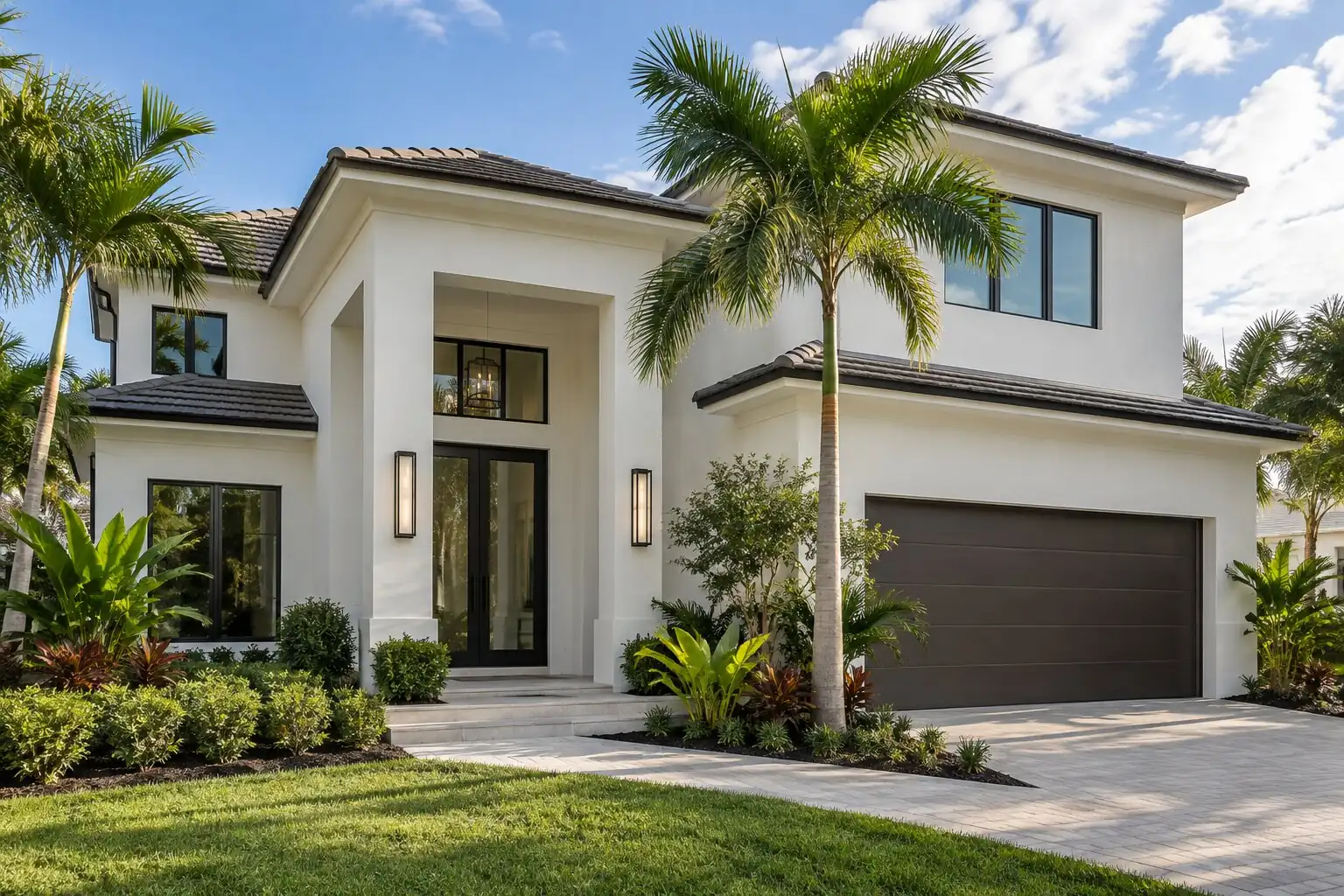
Does your wall sound hollow when you knock on it? It may be EIFS, often called by the brand name Dryvit: a foam-board cladding with reinforcing mesh, a base coat and a thin synthetic finish. It isn't cement stucco and is repaired differently. This page is the EIFS repair and material guide for owners, property managers, association boards and GCs who need to know what can be repaired, what must be resealed and when it makes sense to convert to hard-coat. It belongs to our commercial stucco work, and the cement material is described on the stucco overview.
EIFS vs hard-coat stucco on commercial buildings
| EIFS (Dryvit) | Hard-coat cement stucco | |
|---|---|---|
| Build | Foam board, base coat with mesh, synthetic finish | Lath or block, scratch, brown and finish coats of cement |
| Weight | Light | Heavy |
| Sound when tapped | Hollow, gives slightly under pressure | Solid, rock-like on block |
| Broken corner shows | White or tan foam | Gray cement |
| Weak point | Joints and penetrations that admit water | Cracking, bond failure and rust at steel |
| Impact tolerance | Dents and punctures | High |
| Where it appears here | Commercial buildings, some condos, frame additions, bands and cornices | Most CBS buildings |
The two should never be patched with each other's materials. A cement patch over foam cracks away from it, and a foam patch on block doesn't bond the way the original did.
EIFS repair and what we do with high-build systems
Repair in kind. Small impact damage with a dry, sound substrate is cut out and rebuilt with new foam, base coat, reinforcing mesh and a matching finish. Small impact repairs typically start around $650–$1,200 per repair, confirmed after we see the project.
Joint and sealant work. Most EIFS leaks start at windows, doors, penetrations and expansion joints. We cut out failed sealant and reseal with backer rod and the right sealant, typically starting around $9–$18 per linear foot, confirmed after we see the project.
Probes. Before pricing a failing wall, we open small test spots, mostly under windows and along the bottom edge, to check what is behind the finish. EIFS repair is priced after probes because the cost depends on what's behind the finish, not on the size of the visible crack.
Substrate repair. If the sheathing or framing behind the system is wet or rotted, it is removed and replaced before new cladding goes on. For structural questions we do not do engineering; we build to the engineer's drawings and coordinate a licensed engineer when the work needs one.
Conversion to hard-coat. Where probes find widespread moisture, where a building has been patched many times, or where ground-floor impact keeps damaging the wall, we remove the EIFS and build lath and a three-coat cement stucco on a backing suited to it. Conversion from EIFS to hard-coat stucco typically starts around $16–$24 per square foot of wall, confirmed after we see the project. Converting only the first floor is a common compromise.
High-build coatings and foam shapes. Cornices, bands, quoins and column caps are often foam shapes with a synthetic or high-build coat. We repair, recoat and re-detail these, and replace shapes that are cracked or rotted. Foam band and cornice replacement typically starts around $55–$110 per linear foot, confirmed after we see the project.
About these prices. These ranges are starting points based on typical South Florida projects. Your final price depends on the condition of the property, access, the materials or system specified and the full scope of work. We confirm every number after we review your project in person or from the drawings, and the price in your signed proposal is the one that applies.
Send close-ups of the damage and a wide shot of each elevation through our project form, and we'll tell you where to probe first, free.
Why EIFS fails differently
How can an EIFS wall look fine while it rots behind the finish? Cement stucco on block tolerates some moisture because the block behind it doesn't rot. Older barrier-type EIFS was designed to keep all water out at the face. When water gets in at a window corner, a sealant joint or a penetration, it can sit behind the board and stain, delaminate or rot a wood or gypsum substrate without any sign on the outside. Newer drainage-type systems manage water better, so the age and type of system matter in the diagnosis. We identify which one you have before we quote.
Warning signs on a commercial wall:
- Soft spots or sponginess when pressed
- Cracks at window corners and along joint lines
- Staining or streaks below windows and penetrations
- Dents and punctures at ground level
- Sealant that has split, pulled away or hardened
- Bubbling or peeling of the finish coat
- Interior water stains or musty odor on the wall behind
Seeing a few of these? Call (561) 556-7509 to schedule a walk and probe before the damage spreads.
How an EIFS or high-build repair runs
- Identify the system. EIFS, direct-applied finish or hard-coat; barrier or drainage type if known from the drawings or the original builder.
- Probe and photograph. Small openings at suspect spots, with moisture readings and photos of the substrate.
- Decide repair, reseal or convert. The board or owner gets the findings per elevation with a recommendation and a price for each path.
- Substrate. Wet or damaged sheathing is removed and replaced; the weather barrier is reconnected.
- Rebuild. New foam, base coat with mesh and finish for repairs; lath and three coats for conversion.
- Seal the joints. Windows, doors, lights, hose bibs and expansion joints get new backer rod and sealant. This is where most EIFS leaks start.
- Finish and coat. The finish is matched and the elevation is coated so the repair disappears.
How we work with GCs, property managers and boards
- Walk and probe first. We don't guess a price on a wall we haven't opened.
- Options per elevation. Repair, reseal or convert, each priced, so your board votes on a decision and not on a mystery.
- COI naming the owner. Certificates with additional insured endorsements go out before mobilization.
- Phasing. We work by elevation and keep entrances and walkways open.
- Documentation. Photos of every probe and of the substrate before it was covered, which matters for insurance and for the next owner.
- Permits. Re-cladding and substrate repairs can need a permit. We pull it and coordinate inspections.
Workmanship warranty on every job; materials carry the manufacturer's warranty. Terms are in your written contract.
Need repair and conversion priced side by side for your board? Send the building address through our project form to set up a walk.
EIFS and high-build conditions in South Florida
Wind-driven rain. Storms push water sideways into any open joint, and EIFS depends on its joints more than any other cladding.
Impact. Lawn equipment, shopping carts, delivery trucks and storm debris put holes in foam that cement stucco would shrug off.
Humidity. Moisture trapped behind a finish stays wet longer in our climate, so the damage progresses quietly.
Associations. Condo work follows association rules and insurance requirements. We provide the documentation your carrier and your board will ask for.
Related commercial stucco services
- Commercial stucco: the commercial overview for GCs and managers.
- Full building stucco: when a whole elevation is converted or recoated.
- New construction stucco: lath and cement coats on new buildings.
- Commercial stucco column repair: columns and caps.
- Portland cement stucco: the hard-coat material in detail.
For the sealant side, see the EIFS vs stucco repair guide and window and door perimeter caulking.
EIFS and Dryvit repair by city
Commercial EIFS and stucco in Aventura, Hollywood, Boca Raton, Fort Lauderdale, Pompano Beach and West Palm Beach.
Prefer to send photos or plans? Send us your project
EIFS and Dryvit FAQ
Is Dryvit the same as stucco? No. Dryvit is a brand of EIFS, a foam-board system with a thin synthetic finish. Hard-coat stucco is a thicker cement plaster, usually over block or lath in South Florida.
How do I know if my commercial building has EIFS? Press and knock on the wall. EIFS sounds hollow and gives slightly; stucco on block is hard and solid. A broken corner that shows foam confirms it. Bands and cornices on a stucco building are often EIFS even when the walls are not.
Can EIFS be patched? Yes, when the substrate behind it is dry and sound. Foam, base coat, mesh and finish are rebuilt and matched. If the substrate is wet, the wall is opened and repaired first.
Should we convert EIFS to hard-coat stucco? Often at ground level, or where probes find widespread moisture. Conversion runs $16–$24 per square foot of wall, more than a patch, but it removes the vulnerable system, so we price repair and conversion side by side per elevation. Final pricing is confirmed after we review your project.
How do I get an exact price? Send photos of the damage and the wall, or the building address, through our project form or call (561) 556-7509. After a walk and probes, the written bid follows.
Free estimate — call (561) 556-7509 or send us your project. Licensed Florida general contractor CGC1540699. Serving Broward, Palm Beach and Miami-Dade counties.