
New construction stucco is a scheduling job as much as a plastering job. Our crew follows your framer, window installer and roofer, and we have to be out of the way before paint, landscape and final inspections. This page is for general contractors and developers who need a stucco subcontractor on ground-up buildings and additions. It is part of our commercial stucco work. As a licensed Florida general contractor, J. Perry & Sons sees the sequence the way you do. Scopes are bid per square foot of wall from the drawings.
The scope: what is in a new construction stucco package
| Component | What it covers |
|---|---|
| Weather barrier and lath | Paper or approved barrier, laps, metal lath fastened to the framing, self-furring or flat as the system calls for |
| Accessories | Weep screed at the base, casing bead at terminations, corner bead, control joints, expansion joints |
| Scratch coat | First coat, cross-raked, forced into the lath |
| Brown coat | Second coat, floated flat and plumb |
| Finish coat | Texture and color per the approved sample |
| Details | Reveals, bands, returns at windows and doors, soffits, fascia, columns |
| Inspection support | Lath inspection and any special inspections called for by the drawings |
Three coats on block typically start around $7–$10 per sq ft of wall, and lath plus three coats on frame walls around $9–$13 per sq ft of wall, confirmed after we see the drawings. Where your job lands depends on wall height, the number of details and phasing.
About these prices. These ranges are starting points based on typical South Florida projects. Your final price depends on the condition of the property, access, the materials or system specified and the full scope of work. We confirm every number after we review your project in person or from the drawings, and the price in your signed proposal is the one that applies.
Have a set ready to price? Send the elevations, wall sections and stucco details through our project form and we'll return a unit-priced bid within 48 hours.
Sequence on a ground-up or addition job
1. Dry-in and barrier. Windows and doors are set and flashed. The weather barrier is lapped shingle-fashion (upper layer over lower) over the flashing, and the roof edge is in place. Stucco needs the building dried in, or the barrier fails.
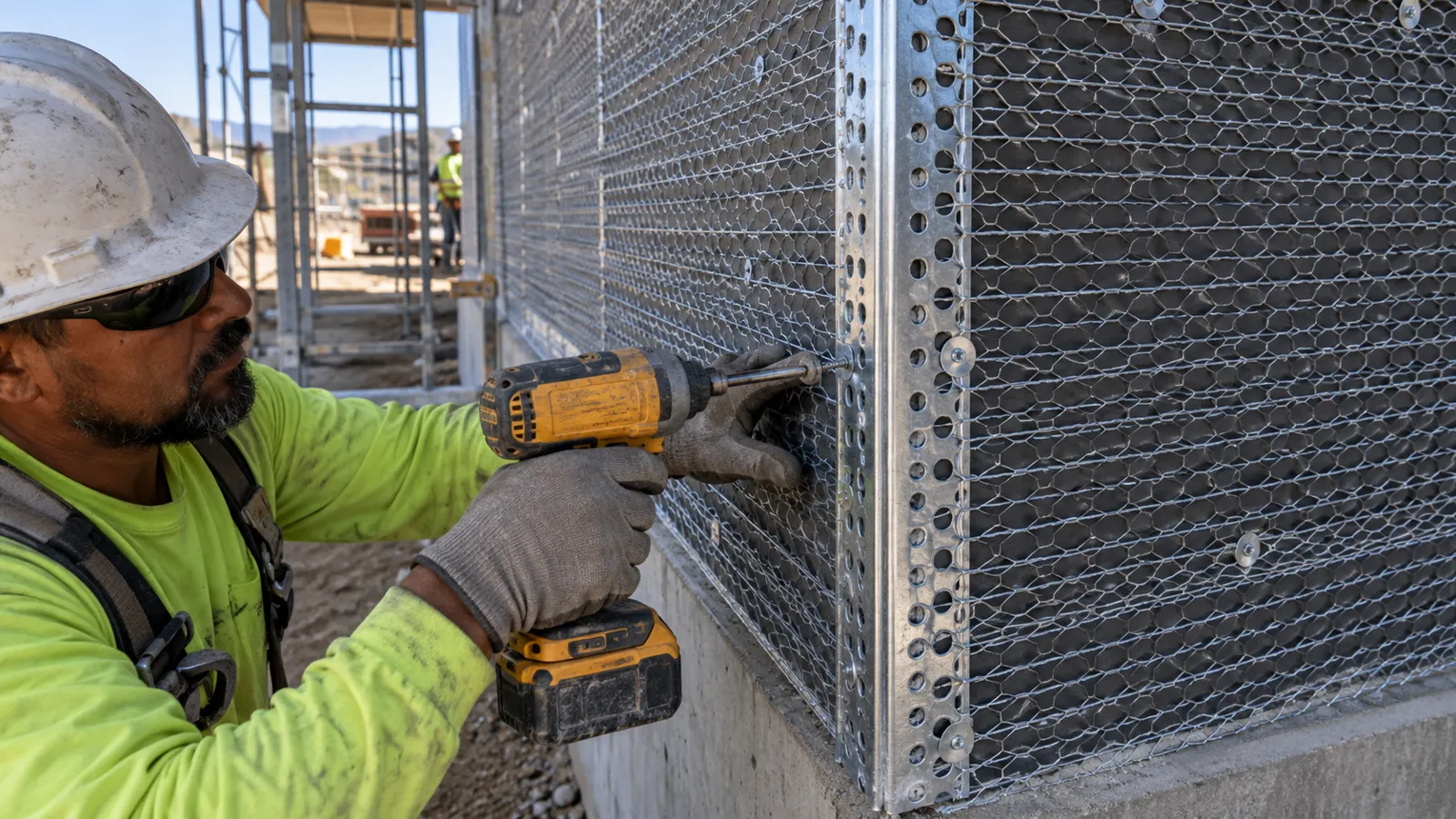
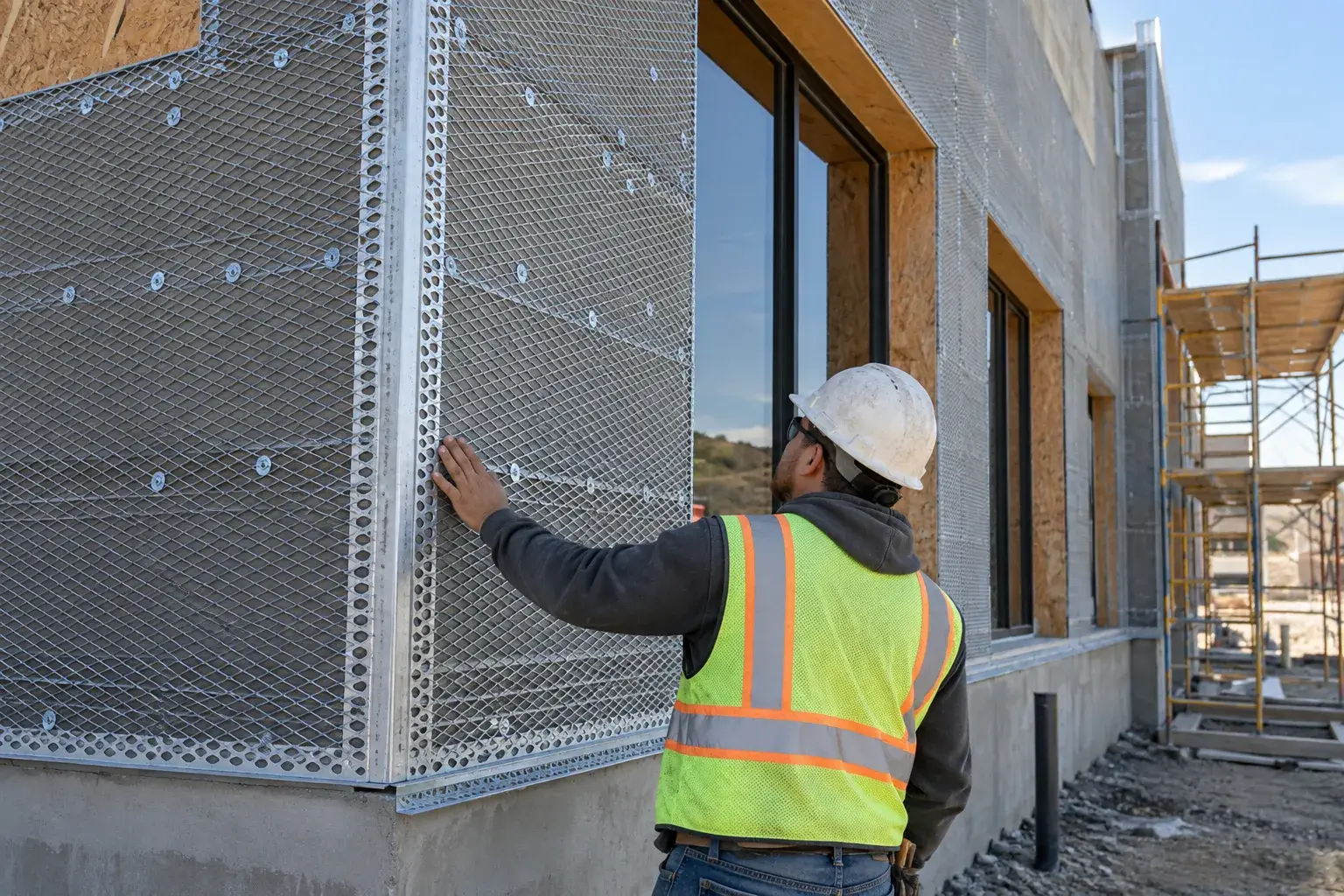
2. Lath and accessories. We fasten lath, the metal mesh the stucco grips, to studs or sheathing at the spacing the specification gives, with laps staggered and tied at corners. Weep screed goes at the bottom of the wall with the right clearance above grade or slab. Casing bead goes where the stucco stops, and control joints go where the drawing locates them.
3. Lath inspection. Where the building department calls for it, the lath is inspected before the scratch coat covers it. We schedule the inspection and do not close the wall until it passes.
4. Scratch coat. Applied and cross-raked so the brown coat has something to grip. It has to cure before the next coat.
5. Brown coat. Floated to plane with a straightedge. This coat decides whether the finish is straight, so we check it at corners, reveals and around openings.
6. Finish coat. Color coat or textured finish, applied in continuous runs. We never stop a finish coat mid-wall; it stops at joints and corners.
7. Cure, then paint or seal. Cement stucco cures before it is coated. If the finish is integral color (color mixed into the stucco itself), the cure matters for an even look.
Control joints, weep screeds and the details that fail later
Most callbacks on new stucco start in a detail, not in the open field of the wall.
- Control joints. Long panels crack at random if no joint tells them where to move. Joints go where the drawing shows, at window and door corners where cracks start, and at floor lines on multi-story frame buildings. We flag spacing that looks too long and ask the designer before we plaster over it.
- Weep screed. This is the drain at the foot of the wall. It must stay exposed, sit above the slab or grade by the distance the code requires, and never be buried by pavers, mulch or a slab pour. We coordinate with the landscape and paving trades so it stays clear.
- Window and door perimeters. Backer rod and sealant at the stucco-to-frame joint, with the barrier flashed under the flange. This is where wind-driven rain gets in.
- Penetrations. Hose bibs, light fixtures, vents and electrical boxes get flanged or sealed so water does not follow them behind the stucco.
- Dissimilar materials. Where stucco meets stone, siding or a parapet cap, a joint or a flashing keeps them apart.
Want a second set of eyes on your control joint layout before the scratch coat? Call (561) 556-7509 and we'll review the details with you.
How we work with GCs on new construction
What do you need from a stucco sub besides a good wall? A clean bid, a reliable schedule and paperwork on time.
- Bid from the set. We take off lath, stucco and accessories by elevation and wall type, with details counted separately. Added scope, revisions and alternates are priced at the same unit rates.
- Schedule in your sequence. We commit to lath-ready dates, put the crew right behind the framer and window installer, and tell you early when an upstream delay moves our dates.
- COI naming the owner. Certificates with additional insured endorsements for the owner and the GC go out before mobilization.
- Inspections on the calendar. When the scope is ours, we schedule lath, bead and any other inspections with the building department. When it is yours, we coordinate with your superintendent.
- Mockups and samples. We build a finish sample on site. Once approved, it is the standard for the building.
- Closeout documents. Product data sheets, inspection records, a closed punch list and the workmanship warranty.
Workmanship warranty on every job; materials carry the manufacturer's warranty. Terms are in your written contract.
New construction stucco in South Florida: HVHZ, block and frame
Block construction. Concrete block buildings take stucco directly or over a bonding agent. The scratch coat bonds to clean block, so we remove dust and form-release residue first.
Frame construction. Frame stucco depends on the barrier, the lath fastening and the weep detail. In our humidity it is the more failure-prone system, so we inspect the barrier laps before any lath goes over them.
HVHZ. Miami-Dade and Broward sit in the High-Velocity Hurricane Zone, where product approvals and fastening schedules are specific. We build to the approved assemblies on the drawings and flag any substitution to you and the designer before it is made.
Humidity and cure. Summer humidity slows curing. We stage coats a day or more apart and never rush a coat to hit a milestone.
Engineering. We do not do engineering; we build to the engineer's drawings and coordinate a licensed engineer when the work needs one.
Building in the HVHZ? Call (561) 556-7509 and we'll go through the approved assemblies on your set with you.
What a new construction stucco bid includes
- Lath type, barrier and fastener schedule as drawn
- Accessories listed by type and material (galvanized, PVC, stainless)
- Square footage of each wall type and elevation
- Details counted separately: reveals, bands, returns, soffits, columns
- Control joint and expansion joint layout as shown
- Finish type, color, sample and approval step
- Scaffold or lift and who provides it
- Inspection schedule and permit responsibility
- Exclusions, such as paint, sealant at the frame, and sheathing repair
Related commercial stucco services
- Commercial stucco: all of our commercial stucco work.
- Full building stucco: renovations of existing buildings.
- Commercial stucco column repair: column rebuilds on existing work.
- EIFS and high-build stucco: foam and synthetic systems on new work.
- Portland cement stucco: the cement material in detail.
New construction stucco by city
New-build stucco bids across: Boca Raton · Miami · West Palm Beach · Weston · Fort Lauderdale · Wellington · Jupiter
Prefer to send photos or plans? Send us your project
New construction stucco FAQ
What does a new construction stucco subcontractor handle? As the stucco contractor on the job, we handle lath, the weather barrier where it is in our scope, accessories, the scratch, brown and finish coats, details, and inspection coordination. The bid names what is ours and what is excluded, such as paint and sealant, so nothing falls between trades.
Do you bid from the drawings? Yes. We take off each elevation and detail from the set and return a unit-priced bid within 48 hours. Work on block and lath over frame are each priced per square foot of wall, with starting ranges listed above. Final pricing is confirmed after we review your project.
How many coats does new stucco get? Traditional cement stucco is three coats: scratch, brown and finish. One-coat systems exist, and we use the system the drawings and the approved assembly call for. The cement material is described on our stucco overview.
When can painting start after stucco? Once the stucco has cured to the moisture level the paint manufacturer requires. We put the cure date in the schedule so your painter isn't held up and the coating doesn't go on a wet wall.
How do I get an exact price? Send the elevations, wall sections and stucco details through our project form or call (561) 556-7509. With the set and the schedule in hand, the written bid comes back in 48 hours.
Free estimate — call (561) 556-7509 or send us your project. Licensed Florida general contractor CGC1540699. Serving Broward, Palm Beach and Miami-Dade counties.