
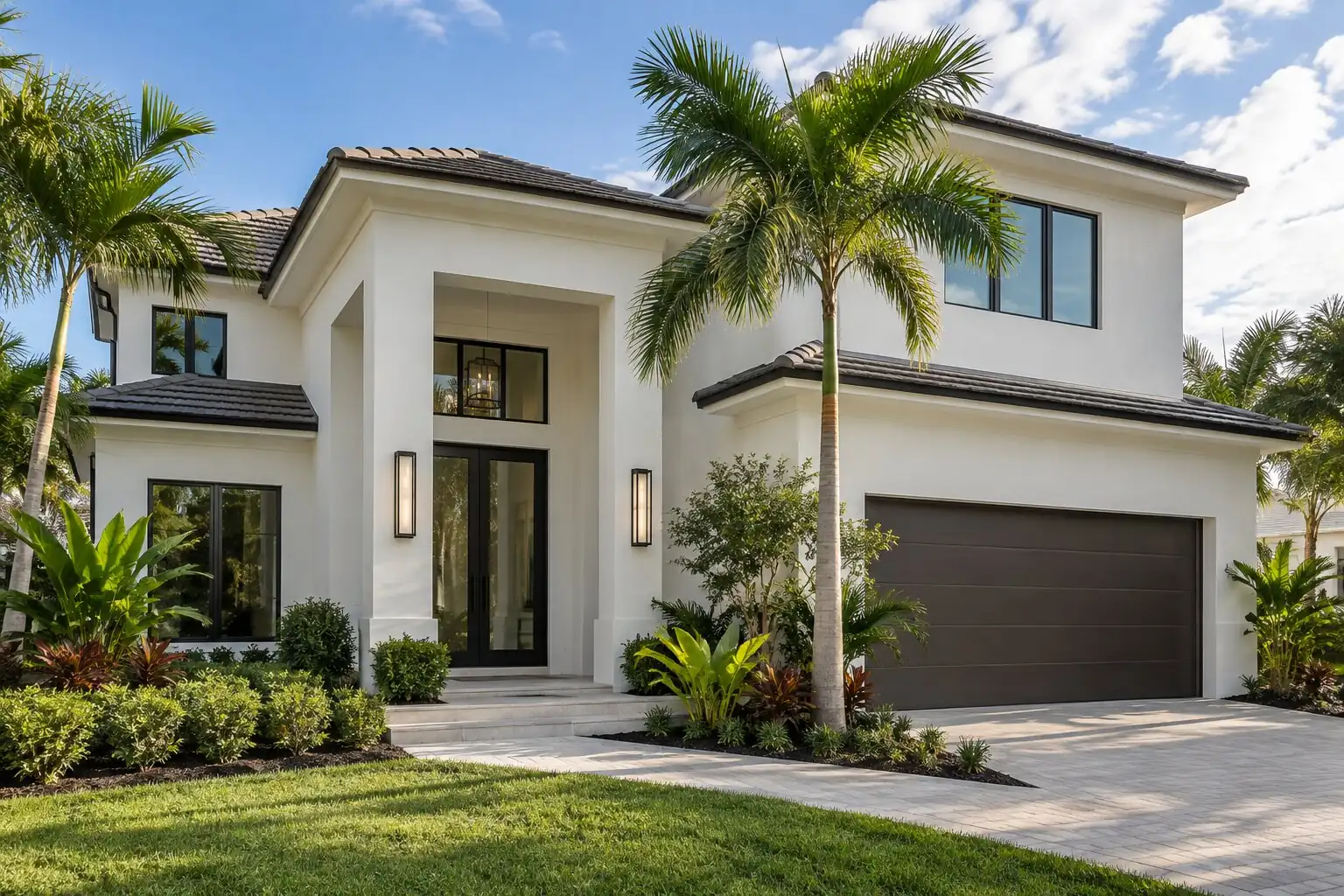
Ever notice how many kinds of wall you pass in a few Miami blocks? A block ranch, a duplex with a dash-textured front, a tower with a foam cornice, a storefront skimmed smooth. This page sorts out which stucco system and finish you are looking at in the City of Miami and what that means for a repair or a new coat. Homeowners can skip straight to residential stucco in Miami. General contractors, managers and boards should go to commercial stucco in Miami. Our other trades in town are listed on the Miami page.
Reading a Miami wall before anyone quotes it
What is your wall made of? That is the first question on any Miami job, because the answer changes the repair.
Concrete block with cement stucco. Most single-family houses built after the Second World War, and most low-rise commercial buildings, are CBS: hollow concrete block, a poured tie beam at the top, and cement stucco bonded straight to the block. This is hard-coat stucco, and it is the easiest to repair well.
Older masonry and frame. Houses from before the war in the older parts of the city can carry stucco over wood lath, over clay tile block, or a lime-rich mix that is softer than modern cement. A hard modern patch on a soft old wall cracks along its edge, so we identify the mix before choosing the patch material.
Lath over framing. Additions, second floors added to block houses, and some newer townhome and mixed-use construction use wood or metal studs with metal lath and a weather barrier behind the stucco. Water that gets behind it needs a drainage path to the weep screed (the metal strip at the base that lets water out).
EIFS and foam shapes. Many towers and retail buildings from the late twentieth century carry foam bands, cornices and window surrounds finished in an acrylic coat, and some have full EIFS elevations. Foam is repaired differently from cement, and the details are on EIFS and high-build stucco.
Not sure which of these you have? Call (561) 556-7509 and we'll identify the wall on a free visit before we quote anything.
The finishes you see across the city
Miami walls carry most of the textures used in South Florida, and your texture decides how visible a repair will be.
| Finish | Where it turns up in Miami | Repair difficulty |
|---|---|---|
| Sand float | The default on block houses and plazas | Blends well |
| Dash | Older houses and duplexes, garden walls | Hard to match by hand |
| Skip trowel | Mediterranean-style houses with barrel tile roofs | Moderate |
| Smooth | Renovated houses, new retail fronts, tower podiums | Shows every flaw |
| Knockdown | Houses re-coated in later decades | Blends well |
| Lace | Occasional, mostly on older remodels | Hard to match |
Smooth is the look owners ask for most now, especially once a house gets flat-profile impact windows. It needs the straightest base coat and the most patience, and our smooth stucco finish page covers how it is built.
What salt, rust and rain do to Miami stucco
Rust at the openings. The most common serious failure we see on Miami block buildings is spalling above windows and at corners. Steel in the lintel or tie beam rusts, swells and pushes the stucco off. Patching over it fails, because the steel keeps growing. We open the concrete, clean and treat the steel, restore the concrete, and only then apply stucco. On commercial buildings this is often part of a larger restoration scope.
Salt air near the bay. Properties close to Biscayne Bay, and anywhere near the coast, take salt on every wall. Steel corner bead and lath rust and bleed through paint. We use galvanized or PVC accessories and coated fasteners on those jobs.
Afternoon storms. In the rainy season, a fresh coat can get hit by a downpour hours after it goes on. We schedule exterior coats for the morning and cover them when the sky turns.
Wind-driven water. Miami-Dade is in the High-Velocity Hurricane Zone. Rain driven sideways finds every open sealant joint at a window. A crack that would be cosmetic inland can carry water to the block here, so we seal the window perimeter as part of the stucco scope, not as an afterthought.
Permits, county lines and historic districts
Does a Miami mailing address mean the City of Miami issues your permit? Not always. Inside city limits, the City of Miami Building Department handles it. Many neighborhoods with a Miami address, such as Kendall, are unincorporated, and those permits go through Miami-Dade County instead. We confirm the jurisdiction from the folio (the county parcel number) before we file.
Like-for-like patching and refinishing on the same footprint generally do not need a permit. Re-stucco over new lath, new stucco on an addition, and any change to an opening do, and J. Perry & Sons pulls those permits itself and follows every city and county requirement. In HVHZ territory, lath and accessories on the building envelope also have to carry the product approval the code calls for, which we check against the submittal.
Properties inside a City of Miami historic district can need a preservation review before an exterior finish or opening changes. If your address is in one, tell us early so the review is on the schedule.
We do not do engineering; we build to the engineer's drawings and coordinate a licensed engineer when the work needs one.
Two price lines, and everything else
We publish two prices for Miami stucco, both starting points confirmed after we see the project. Repair of cracked or hollow areas, with the texture matched, typically starts around $13–$21 per sq ft. Re-stucco of a wall with new scratch, brown and finish coats typically starts around $14–$23 per sq ft. Spalling, where the concrete is chipped to the steel and the rebar treated, is its own line, typically starting around $22–$34 per sq ft. Small patches sit higher in the range, since setup and three coats take as long on a few feet as on a panel. Columns, arch reshaping, smooth conversions and whole-house work for homeowners are priced per job after a site visit. Full buildings, new construction and EIFS for commercial owners are priced from drawings.
About these prices. These ranges are starting points based on typical South Florida projects. Your final price depends on the condition of the property, access, the materials or system specified and the full scope of work. We confirm every number after we review your project in person or from the drawings, and the price in your signed proposal is the one that applies.
Workmanship warranty on every job; materials carry the manufacturer's warranty. Terms are in your written contract.
Want a written number for your own wall? Send photos and the address through our project form and we'll schedule a free estimate.
Pick your path
If you own the house, start with residential stucco in Miami, which covers repairs, columns, arches, HOA paperwork where you have one, and living at home during the work. If you build, manage or govern a building, commercial stucco in Miami covers bids from drawings, insurance certificates, phasing and closeout. For a single crack or spall on any building type, the method is on stucco repair.
Nearby: stucco in Miami Beach · stucco in Coral Gables · stucco in Hialeah
ZIP codes we serve in Miami
33125, 33127, 33129, 33130, 33131, 33132, 33133, 33135, 33136, 33137, 33138, 33142, 33145.
Prefer to send photos or plans? Send us your project
Miami stucco questions
How can I tell if my Miami wall is stucco or EIFS? Tap it. Cement stucco sounds solid and feels like stone. EIFS sounds hollow, gives slightly under a firm press, and often shows foam at a chipped corner. Towers and retail buildings are more likely to have EIFS bands and trim than houses.
Why does stucco keep falling off above my windows? Usually rusting steel in the lintel or tie beam. The rust expands and pops the stucco. The fix is a concrete repair first, then stucco. A patch on top without treating the steel comes back.
What do you charge per square foot in Miami? Repair typically starts around $13–$21 per sq ft with the texture matched, and spalling repair around $22–$34 per sq ft. A full re-stucco of a wall starts around $14–$23 per sq ft. Other scopes are priced after a site visit for homes or from drawings for commercial buildings. Final pricing is confirmed after we review your project.
Does the City of Miami or the county issue my permit? It depends on where the property sits, not on the mailing address. Inside city limits it is the City of Miami; in unincorporated areas it is Miami-Dade County. We check before we file and pull the permit ourselves.
Can you match a dash texture on an older house? Close, not perfect. Dash is thrown by hand, so we test a sample on the wall and blend past the patch edge. On a large repair, re-coating the whole panel to the nearest corner gives the cleanest result.
Free estimate — call (561) 556-7509 or send us your project. Licensed Florida general contractor CGC1540699. Serving Broward, Palm Beach and Miami-Dade counties.