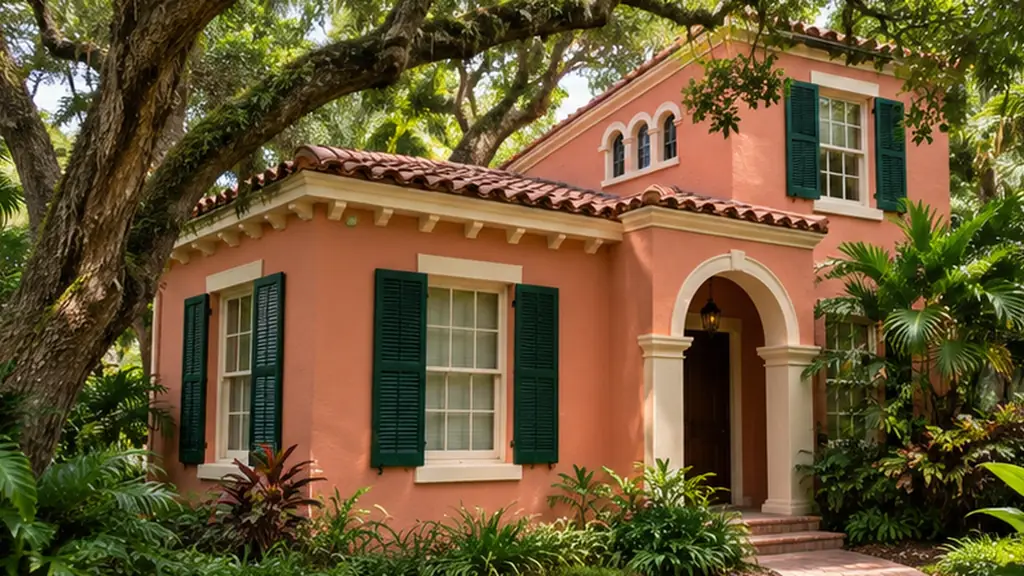
When the Cracks Come Back Through the New Paint
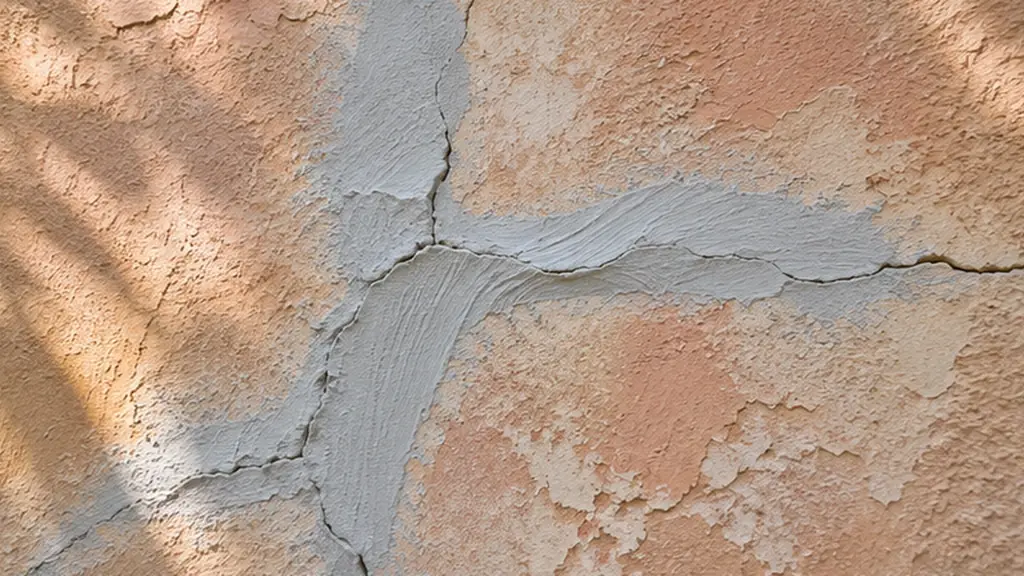
Did you repaint your Miami house, only to watch the same spiderweb cracks reappear in the stucco a short time later? That usually means the cracks were filled with paint or a thin patch, not repaired. Stucco moves with heat and moisture, and a rigid fill over a moving crack just splits again along the same line.
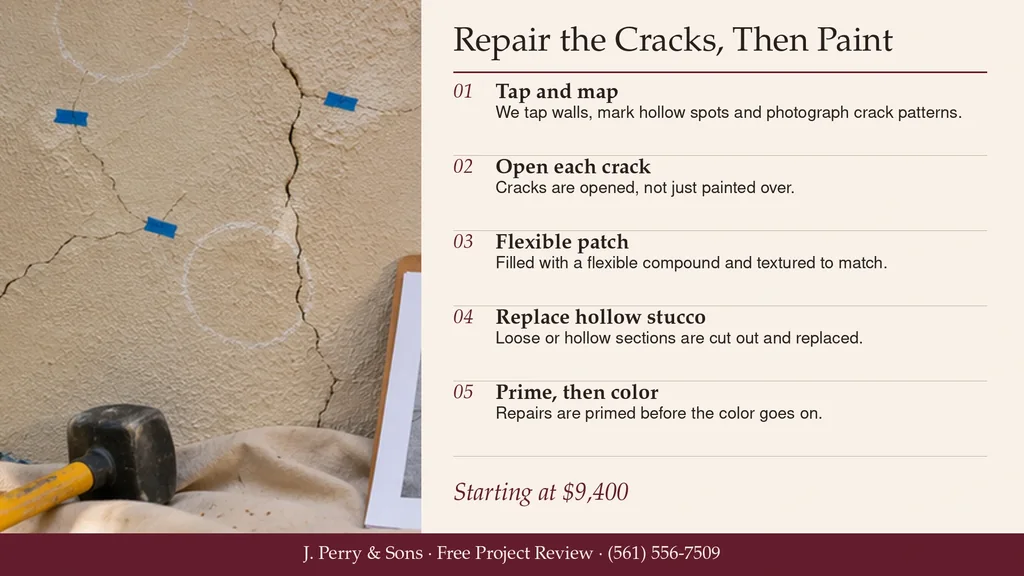
The fix is to open each crack, fill it with a flexible patching compound, texture it to match the wall around it, and prime it before the color goes on. Where the stucco is loose or hollow when you tap on it, the bad section has to be cut out and replaced. That is real masonry work, and it is the part of the job a typical exterior painting contractor skips.
We see this constantly in the 1920s through 1950s homes of Shenandoah, The Roads and Little Havana, and in the bungalows tucked between newer buildings in the Upper East Side. Those houses have been patched and repainted many times by different house painters, and every layer of quick fixes shows up eventually.
Before we quote, we tap the walls, mark hollow spots and photograph every crack pattern, so you can see the condition of your stucco for yourself rather than taking our word for it. That record also becomes the checklist the crew follows during prep.
Does Painting Need a Permit in the City of Miami?
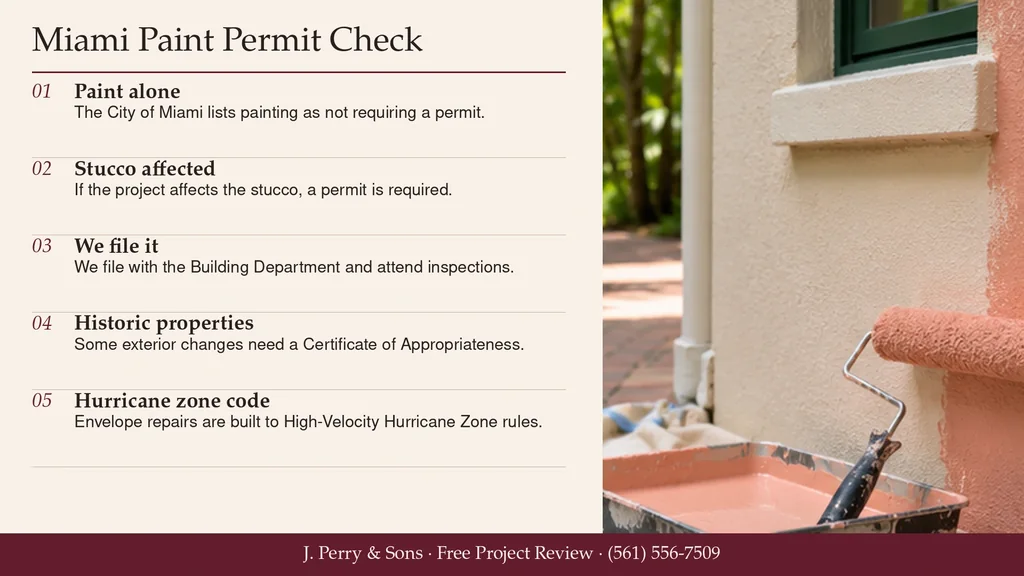
Here is the straight answer. The City of Miami lists applying paint or similar finishes to the interior or exterior of a building as work that does not require a permit. The city also states that if the painting project affects the stucco, a permit is required. On older Miami homes, stucco repair is part of almost every honest exterior repaint.
So we look at the walls first and tell you which side of that line your project falls on. If stucco has to be cut out and replaced, J. Perry & Sons files the permit with the City of Miami Building Department and is present for the inspections. Historically designated properties in the city can also need a Certificate of Appropriateness for some exterior changes, and we check that during the review. Because all of Miami-Dade falls under the High-Velocity Hurricane Zone rules, envelope repairs here are built to that tougher code.
Brickell and Edgewater: Painting High-Rise Buildings
Miami's skyline is mostly condominium and rental towers, and painting one is a logistics job as much as a painting job. Our crews use rope access on tall elevations, which lets a painter work around balconies, glass and architectural fins without a heavy swing stage on the roof. Boom lifts cover the podium levels, garage walls and amenity decks.
Before anything starts, we sit down with the property manager to settle anchor locations, drop zones, sidewalk protection, elevator use and resident notices. Downtown streets are busy, so barricades and overhead protection at the base of the building are part of the plan. Association and multifamily buildings in Miami and Kendall are already part of our track record, and boards that have hired other commercial painting companies notice the difference in how we organize.
The Owner's Guide to Stucco, Stone Veneer and Exterior Walls
How exterior walls keep water out, what cracks and stains mean, and what to ask any contractor.
Homes in Coconut Grove and The Roads
The single-family side of Miami runs from shaded, tree-heavy lots in Coconut Grove to Mediterranean and Mission-style homes in The Roads and Shenandoah. Shade means mildew and moss on walls and roof edges; big trees mean leaf debris in every gutter and stain on the fascia. For stucco painting on these lots, we treat the growth, clean the stains, and seal the stucco with a Sherwin-Williams Loxon conditioner before the topcoats.
Finish coats are a premium Sherwin-Williams exterior acrylic, and Benjamin Moore when the homeowner prefers it. Wood windows, shutters and doors on these older homes get their own sanding, priming and enamel, because wood moves differently than masonry and needs a more flexible finish.
Interiors in these homes often have plaster walls, arched openings and detailed millwork. Plaster cracks are cut and repaired with compatible material, and painted trim that has built up layers over the decades is sanded smooth so the new enamel lays flat.
- Walls, fascia, soffits and trim
- Wood and metal doors, shutters and gates
- Garage doors, pergolas and pool cabanas
- Painted concrete patios and walkways
- Full interior painting, including cabinets
Price Factors When You Hire a Miami Painting Contractor
In Miami, exterior painting for a single-story home is reviewed on site and quoted in writing. What a specific house costs is based on its size, how much stucco has to be repaired or replaced, the trim and wood detail, the wall height, the number of openings and shutters, and whether a permit is needed for the stucco work.
For towers and mid-rise buildings, pricing is based on building height, the access method per elevation, the extent of concrete and crack repair, balcony and railing count, street and sidewalk protection, and how the work is phased around residents. Our proposals separate each of those so boards can compare clearly.
We bring samples to the house or the building, and our designer can produce a simple rendering so you see the new color scheme before a gallon is opened.
Interior work across the city is priced by the room or by the floor, with plaster repair, skim coating and cabinet refinishing each shown separately.
You Run Your Life, We Run the Job
Many of our Miami clients are business owners, travel for work, or own a unit they only use part of the season. You do not need to supervise anything. We handle the permit if there is one, coordinate with your building or HOA, and keep you posted every day with a short written report and pictures of the progress. Owners who are out of town come back to it finished.
Call (561) 556-7509 or send us photos through the project form to set up your Free Project Review. We will check the stucco, tell you whether a permit applies, and give you a written scope for your Miami property.
Services We Offer in Miami
Why Miami Homeowners Choose J. Perry & Sons
Neighborhoods We Serve in Miami
Call (561) 556-7509 or send us your project with photos, the city, approximate dimensions, and material selections.
Interior and exterior painting, with the prep done right underneath.
Free project review · (561) 556-7509
For condo, HOA and commercial buildings, see our commercial painting services.
Interior & Exterior Painting in Miami — FAQ
Is a permit required to paint a house exterior in Miami?
Why do cracks keep showing up after exterior house painting in Miami?
How do you paint a condo tower in Brickell without disrupting residents?
What paint do you recommend for a shaded home in Coconut Grove?
Do you work in Kendall and other parts of Miami-Dade?
Share your vision for your South Florida home.
Free project review · (561) 556-7509