Worn Concrete Floors Hurting Your Miami Space?
Business owners in Miami often put it bluntly: the concrete looked industrial and cool when they moved in, and now it looks neglected. Polished-looking sealers have worn off in traffic lanes, spills have left permanent stains, and dust settles on the merchandise. Homeowners say something similar about their garages, where years of cars and storage have left the slab cracked and dull.
We turn that tired concrete into a finished floor. The slab is diamond ground, tested for moisture, patched where it is damaged, and then coated with a system chosen for what happens in that room every day. A gallery, a retail floor and a family garage each get a different build.
Miami Buildings and What They Mean for Your Floor
Miami has an unusual mix of concrete. Wynwood and parts of the Upper East Side are full of former warehouses turned into galleries, studios, showrooms and restaurants, often with old slabs that carry decades of patches, adhesive and paint. Brickell, Edgewater and Downtown are dominated by condo and office towers, where we usually coat parking-level storage, mechanical rooms or ground-floor retail. In Coconut Grove, The Roads and Shenandoah, single-family homes with garages and covered terraces make up most of the residential work.
Older warehouse floors can hide moisture problems and contamination that only show up once a coating fails. That is why we test before we specify the system, and why we remove old sealers and adhesives completely instead of covering them.
Commercial Epoxy Flooring in Miami
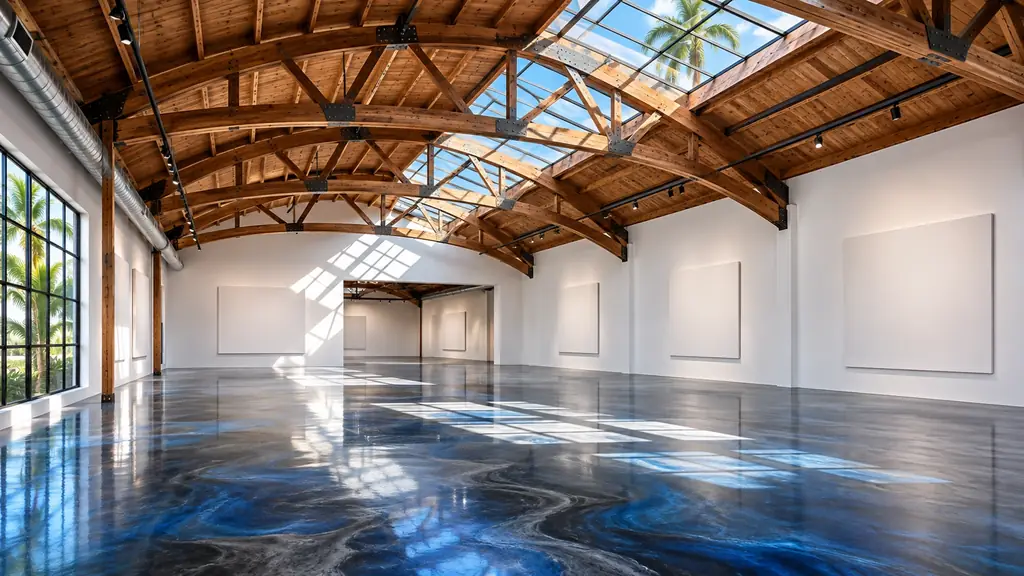
For showrooms, restaurants, warehouses and service areas, we install commercial 100% solids epoxy. It is a thick, high-build material without the solvents and water that make thinner products shrink, so it holds up to carts, pallet jacks and constant cleaning. A metallic epoxy floor is a popular choice for galleries and retail floors that want a statement finish, and it can be paired with a tougher system in back-of-house areas so the whole space is coated without overspending.
When your business can't close, we plan the work around your hours and phase the areas so customers and staff can keep moving. We bring samples so you can see the finish in your own lighting, and for customer-facing rooms our designer can show the floor in a rendering.

Garage and Patio Floor Coatings: Epoxy, Polyaspartic and Polyurethane
How epoxy, polyaspartic and polyurethane compare for garages and patios.
Garages and Terraces at Home
For a home garage floor coating, most clients land on full flake epoxy sealed with polyaspartic. It has a textured surface that hides dust and tire marks, resists hot tire pickup and keeps its color in the sun better than a standard epoxy finish. Solid color epoxy suits laundry and storage rooms, and a metallic floor works well in a home gym or entertainment space.
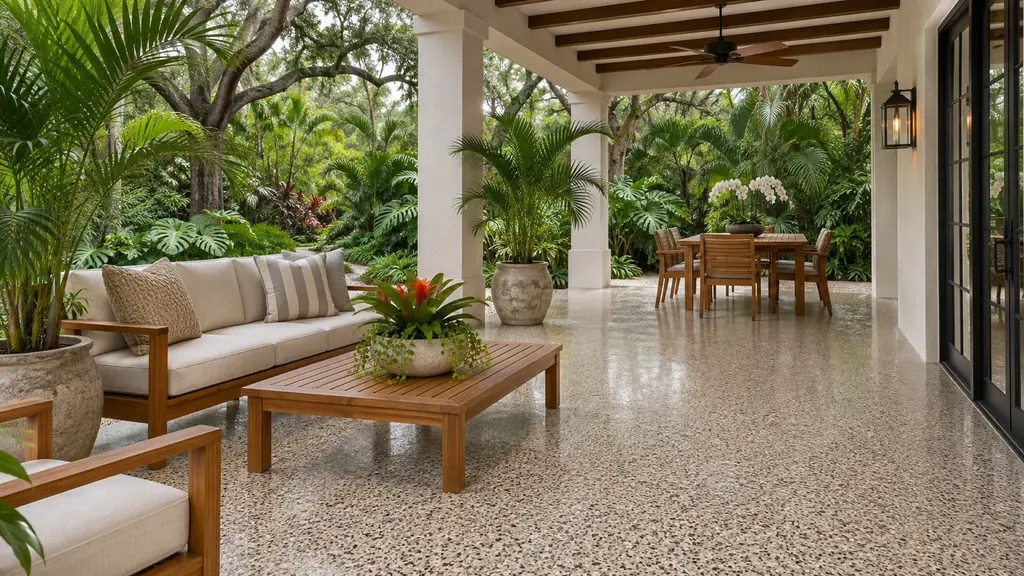
Covered terraces in Coconut Grove and The Roads are another frequent request. Under a roof, a flake floor finished with a UV-stable polyaspartic floor coating handles patio furniture, planters and the occasional blowing rain. Fully exposed areas are a different conversation, and we will tell you honestly when another surface, such as pavers or tile, is the better choice for an open terrace.
Permits, Condo Rules and Miami-Dade Code
Every project in Miami-Dade County is built to High-Velocity Hurricane Zone standards, and inside city limits, the City of Miami Building Department reviews permits. A floor coating does not usually require structural approval, but commercial build-outs, slab repairs and related work often involve permits. We pull them and handle every inspection.
We have completed condo and multifamily work in Miami and understand that towers require scheduling for service elevators, loading docks and contractor access. We coordinate those details with building management before the crew shows up.
Keeping a Coated Floor Looking New in a Busy Space
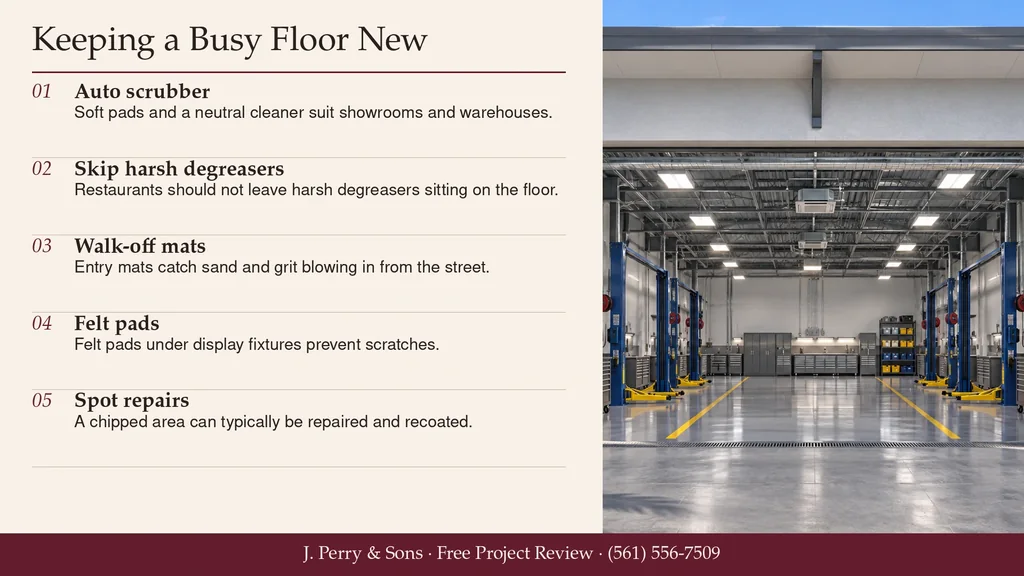
Commercial floors in Miami work hard, and a little routine care protects your investment. Auto scrubbers with soft pads and a neutral cleaner are ideal for showrooms and warehouses. Restaurants should avoid harsh degreasers left to sit on the surface. Walk-off mats at the entry catch the sand and grit that blow in from the street, and felt pads under display fixtures prevent scratches.
At home, a dust mop and occasional mopping keep a flake or metallic floor bright. If a heavy object chips the surface, the damaged area can typically be repaired and recoated without starting over. We go over care with every client when the work is complete, so your staff or family knows exactly how to treat the new floor.
Pricing, Progress Reports and Your First Step
After the project review, your written proposal lists the following scope and pricing: A two-car garage floor. Commercial and larger residential projects are priced after we review the space, and the number is based on square footage, the condition of the slab, how much old material needs to be removed, moisture readings, the system you select, and access constraints such as loading docks or after-hours work. Our written proposal lists each part of the scope so you can see exactly what you are paying for. Coconut Grove homeowners asking about epoxy garage floor cost get the same itemized breakdown as a commercial client.
Whether you are on a plane or across town running a company, the job keeps moving without you on site. We work out access with you or your manager, and daily reports with photos land on your phone. You come back to it finished. Start with a Free Project Review: dial (561) 556-7509 or describe the project in the form below.
Services We Offer in Miami
Why Miami Homeowners Choose J. Perry & Sons
Neighborhoods We Serve in Miami
Call (561) 556-7509 or send us your project with photos, the city, approximate dimensions, and material selections.
Epoxy, polyaspartic and microcement for garages, patios and businesses.
Free project review · (561) 556-7509
Epoxy Flooring in Miami — FAQ
Can you put epoxy over the old concrete in a Wynwood warehouse?
Can epoxy be installed while my Miami store stays open?
Is epoxy or polished concrete better for a Miami retail floor?
Do you coat parking levels or storage rooms in Brickell condo towers?
Why did the garage floor epoxy in my Coconut Grove home start peeling?
Share your vision for your South Florida home.
Free project review · (561) 556-7509