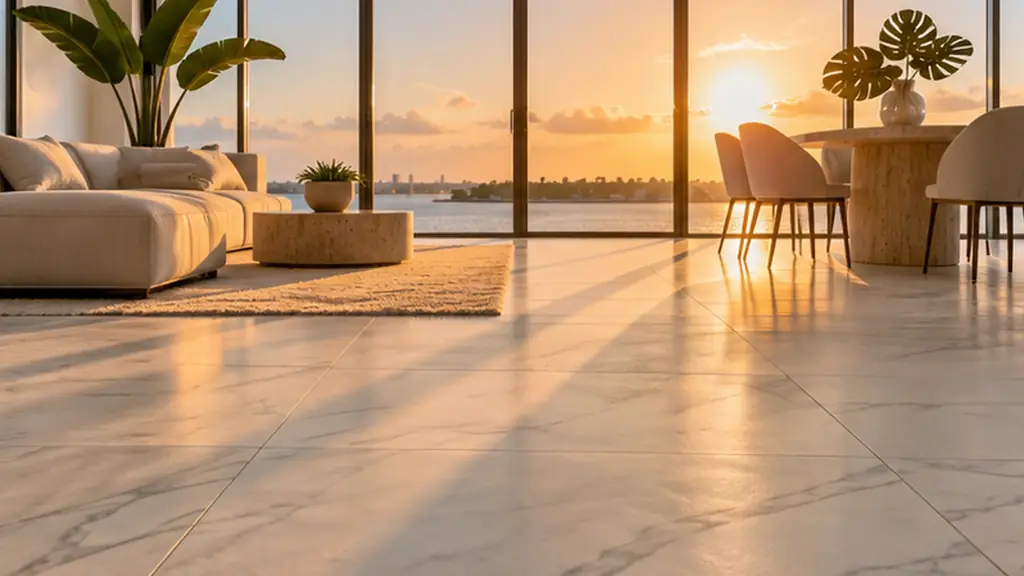
Can You Feel the Edges of Your Porcelain When You Walk Barefoot?
Did the porcelain in your Brickell or Edgewater condo go down with edges you can catch with a toe, or grout lines that wander across the living room? That is lippage, and in Miami it is the number one complaint we hear about large-format tile installed by someone else.
The cause is almost always the same: a slab that was never flattened, too little thinset coverage, or tiles set without a leveling system. The fix is to start over the right way. J. Perry & Sons flattens the substrate to 1/8 inch in 10 feet, back-butters every large piece and sets it in Mapei thinset with full contact, so the floor reads as one continuous plane under Miami's bright, low-angle light. Those are shortcuts a careful tile installer does not take.
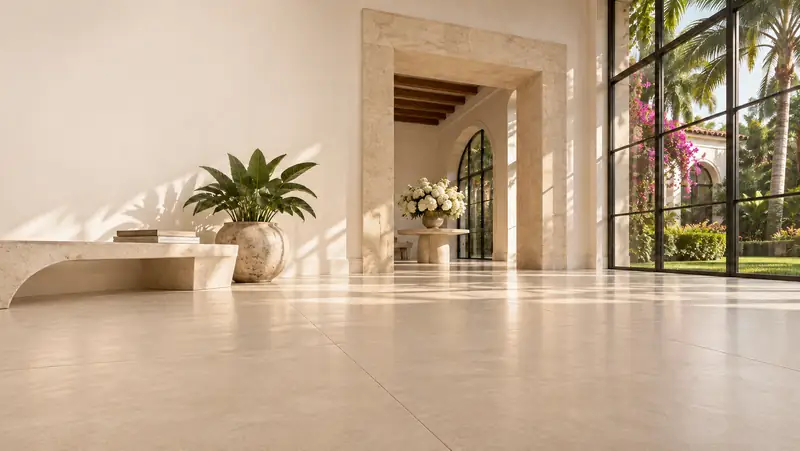
Bright light matters more than people expect. Floor-to-ceiling glass in a Miami condo throws sunlight almost parallel to the floor in the morning and late afternoon, and that raking light exaggerates every slight edge. A floor that looks acceptable at noon can look like a washboard at sunset. That is why we treat flatness as the most important part of the job, not an afterthought.
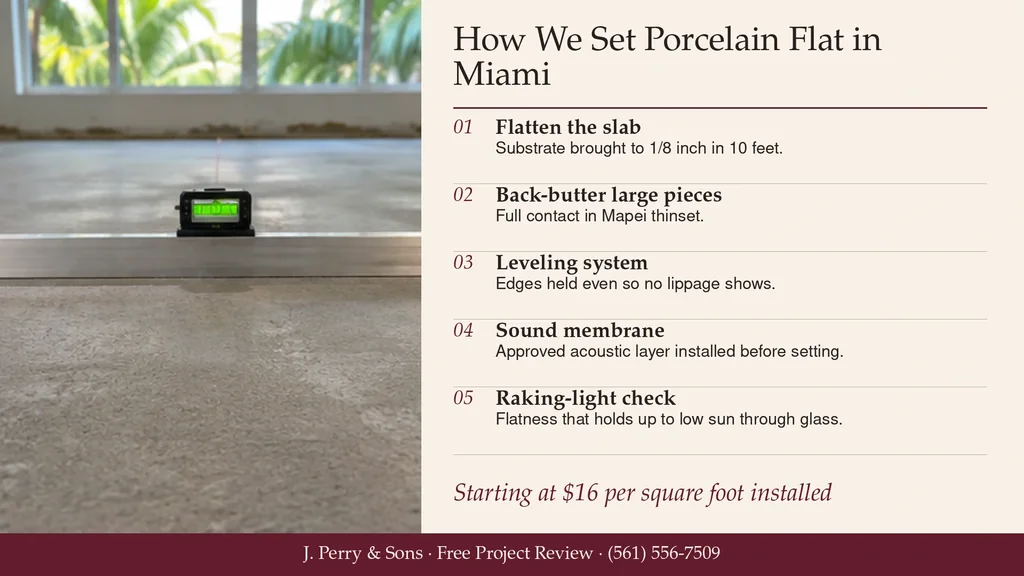
Picking the Right Porcelain for a Miami Interior
For most Miami homes, porcelain is the right material: dense, stain resistant, comfortable in humidity and available in looks from honed marble to concrete to wide wood planks. The decisions that matter are format, finish and layout, and we help you make them with samples in your own space and, when it helps, a rendering from our designer. That is why porcelain floor tile covers most of the living areas we tile in Miami.
What our Miami clients ask for most often:
- 24x48 and 48x48 porcelain for open living, dining and kitchen areas
- Matte or honed finishes that hide footprints and handle wet feet from the pool or balcony
- Marble-look porcelain on floors and shower walls instead of real stone where maintenance is a concern
- Wood-look porcelain planks in bedrooms of condos where the building limits other flooring
Porcelain in Brickell, Edgewater and Downtown High-Rises
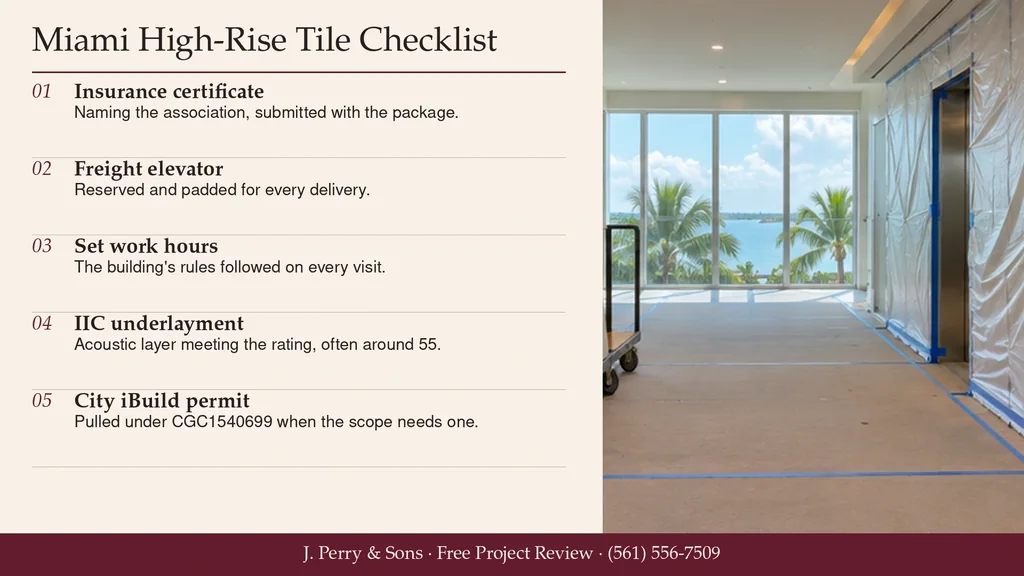
Tile work in a Miami tower is half installation and half building management. Associations in Brickell, Edgewater, Downtown and Midtown typically require a certificate of insurance naming the association, a reserved freight elevator, specific work hours and an acoustic underlayment that meets the building's IIC rating, often around 55. We assemble that package, get it approved and follow the building's rules on every visit. Associations expect a tile contractor to handle the certificates and elevator bookings, and that is part of our job.
Inside the unit, we cover cabinetry and glass, run dust control during removal, and install the approved sound membrane before setting. Getting the acoustic layer right protects you from complaints from the unit below long after we leave. When bathrooms are part of the scope, the shower tile goes over a flood-tested pan.
The Owner's Guide to Tile, Floors and Stone
How to choose the right floor, what makes it last, what to ask any contractor and how to care for it.
+ Free one-page checklist: Before You Order Your Tile
Older Homes in Coconut Grove, The Roads and Shenandoah
In Miami's established single-family neighborhoods, the surprises are under the floor. Older houses in Coconut Grove, The Roads, Shenandoah and the Upper East Side may have original terrazzo, thick mortar beds or slabs that have settled unevenly over time. We expose and assess what is there before we commit to a method, and we tell you if a beautiful original floor is worth keeping instead of covering.
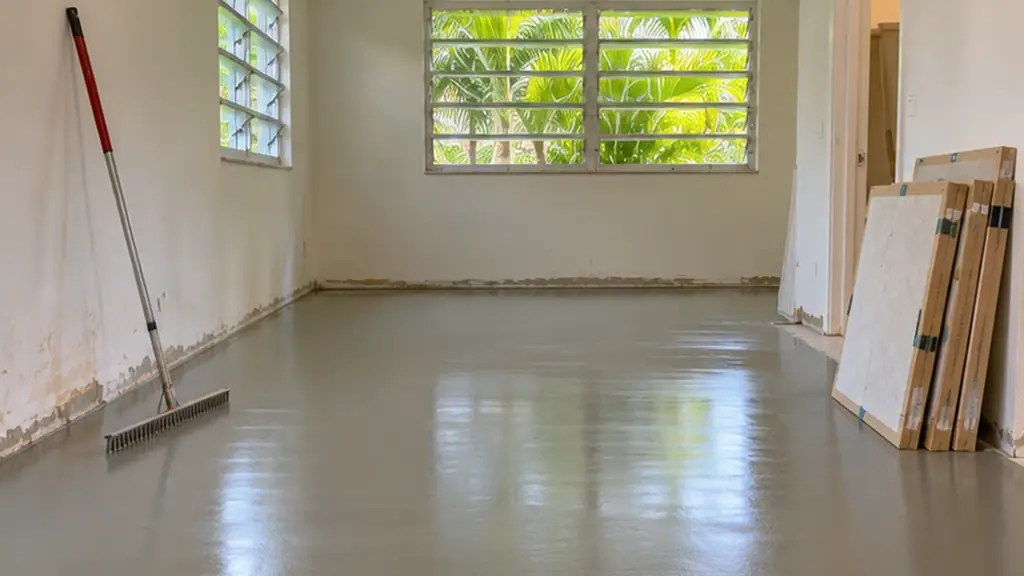
Where new tile is the right call, we grind, patch and self-level with Mapei products, then set your porcelain. Patios and covered terraces get an exterior-rated Sika thinset, and showers are built with a mortar pre-slope, Durock board and Laticrete or RedGard waterproofing, with a flood test before tile every time. In Coconut Grove homes with a more relaxed style, wood-look porcelain tile is a common pick for bedrooms.
City of Miami Permits and the High-Velocity Hurricane Zone
Miami-Dade County is in Florida's High-Velocity Hurricane Zone, which sets the strictest wind and water requirements in the state for exterior work. Inside the City of Miami, permits run through the Building Department's iBuild online system, and condo projects usually need association approval on top of that.
As a licensed Florida general contractor (CGC1540699), J. Perry & Sons pulls the permits your scope requires, coordinates inspections and works alongside your architect or engineer when a project involves plans. You do not have to stand in a line or learn a portal.
Tile Installation Cost in Miami
Porcelain tile floors in Miami start at $20 per square foot installed. The final figure is based on the existing floor and how much of it has to come out, the substrate prep needed to reach our flatness standard, tile size and pattern, the sound underlayment your building requires and access, including freight elevator windows and parking near the tower.
Large-format porcelain also carries more handling than standard tile. Pieces 48 inches and longer need two installers, careful cutting around columns and window walls, and sometimes a dedicated route through the building's service corridors. Those factors are visible during the Free Project Review, and we price them honestly rather than discovering them halfway through the unit.
Away From Miami? Come Back to It Finished
A lot of our Miami clients own a unit they only use seasonally, or they travel constantly for work. We set up access with the front desk or property manager, keep you informed with a photo report every day, and call you the same afternoon if something under the floor changes the plan. You come back to it finished.
Reach us at (561) 556-7509, or share a few photos, the tower's name and the porcelain you like through our project form. We will schedule your Free Project Review and give you a clear written scope.
Services We Offer in Miami
Why Miami Homeowners Choose J. Perry & Sons
Neighborhoods We Serve in Miami
Call (561) 556-7509 or send us your project with photos, the city, approximate dimensions, and material selections.
From large-format porcelain to natural stone, set right from the slab up.
Free project review · (561) 556-7509
Tile Installation in Miami — FAQ
How flat does a Miami condo slab need to be for 24x48 porcelain?
Do Brickell condo buildings require a special underlayment under porcelain?
Is porcelain or real marble better for a Miami bathroom?
Does tile installation in the City of Miami need a permit through iBuild?
Can you tile over the old terrazzo in my Miami house?
Share your vision for your South Florida home.
Free project review · (561) 556-7509