
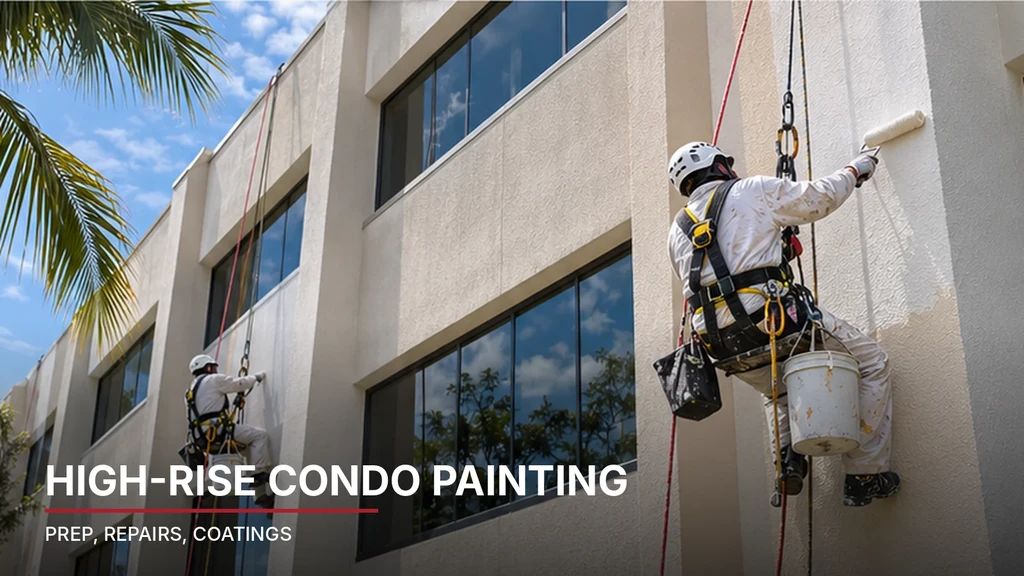
"Our building's paint is chalking, there are stains below every balcony, and the board has to get a proposal in front of owners. We have never run a repaint on a tall building. Where do we start, and what should the scope even say?"
This page is written for that board or manager: what a condo or high-rise repaint includes, how a tall building is reached, and what the board has to decide.
Short answer: painting a condo or high-rise in South Florida is a package, not just paint. It starts with pressure cleaning and repairs to stucco, concrete and sealants, then a coating system chosen for sun and salt, applied from rope access, swing stage or lifts. J. Perry & Sons coordinates the whole scope as a licensed general contractor, uses our own rope-access crews, and puts every elevation and repair in an itemized proposal your board can approve.
We work across Broward, Palm Beach and Miami-Dade with 150+ projects completed. Smaller commercial buildings, plazas and offices are covered on our commercial painting page, and the full range of work is under painting services.
Painting a condo or high-rise: what the scope includes and what the board approves
A condo repaint is more than the color on the wall. When the board reviews proposals, the scope sheet should answer five questions.
What surfaces are painted. Each elevation, balcony face and underside, soffit, parapet, stairwell, garage and common-area wall is listed. Anything excluded is listed too, so no one assumes it is included.
What prep and repair come first. Pressure cleaning, crack repair, hollow stucco, spalled concrete and sealant replacement are separate lines. These are where scope changes tend to arise, so they should be itemized, not buried in a lump sum.
What coating system goes on. The system type, the number of coats and the sheen, with product data sheets attached for approval.
What colors and where. The approved color schedule, with sample areas applied on the building before the full run.
How the building is run. Access method, notices to residents, phasing by elevation, protection of cars, landscaping and balconies, and cleanup.
If the board has an engineer's, architect's or consultant's report, we price to that report. If it does not, we walk the building with you and tell you what we see.
send your reports, if any, and photos of each elevation through our project form.
Reserve-study timing: plan the repaint before the money is needed
For buildings three stories and taller, Florida's structural integrity reserve study includes waterproofing and exterior painting among the items the association has to plan and reserve for. That makes the repaint a planning decision, not just a maintenance call.
The smartest time to talk to a painting contractor is while the reserve study or the milestone inspection is being prepared, not after the board has a number to spend. At that stage we can look at the walls, sealants and balconies and tell the board what the repaint is likely to include, so the reserve line reflects real conditions. Confirm the rules that apply to your building with your association's engineer and attorney.
Next step: send us your latest reserve study or engineer's report with your request for a Free Project Review.
Access on tall buildings: rope access, swing stage and lifts
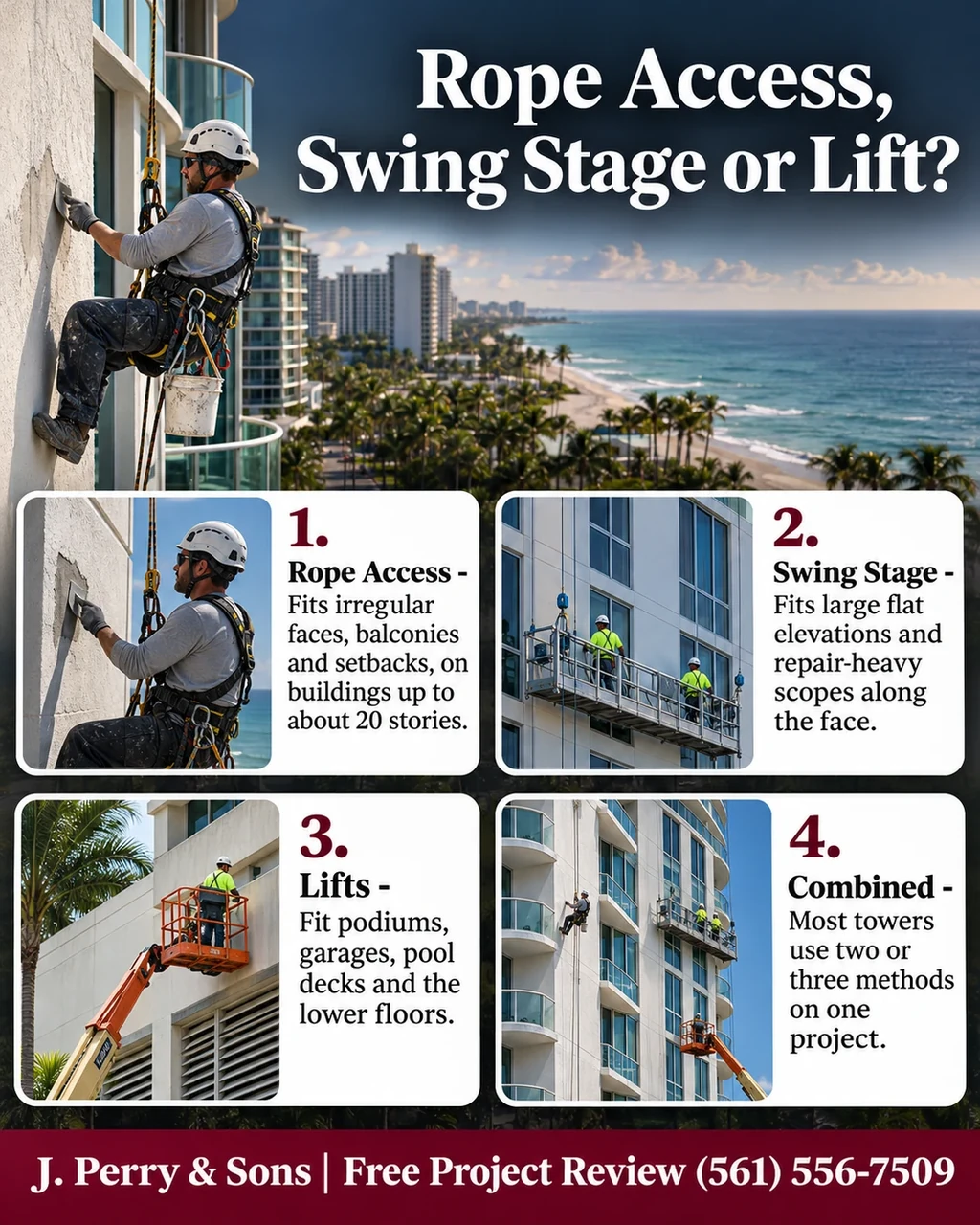
A tall building cannot be painted from the ground. The access method is decided by building height, shape, balconies, and what the wall needs beyond paint.
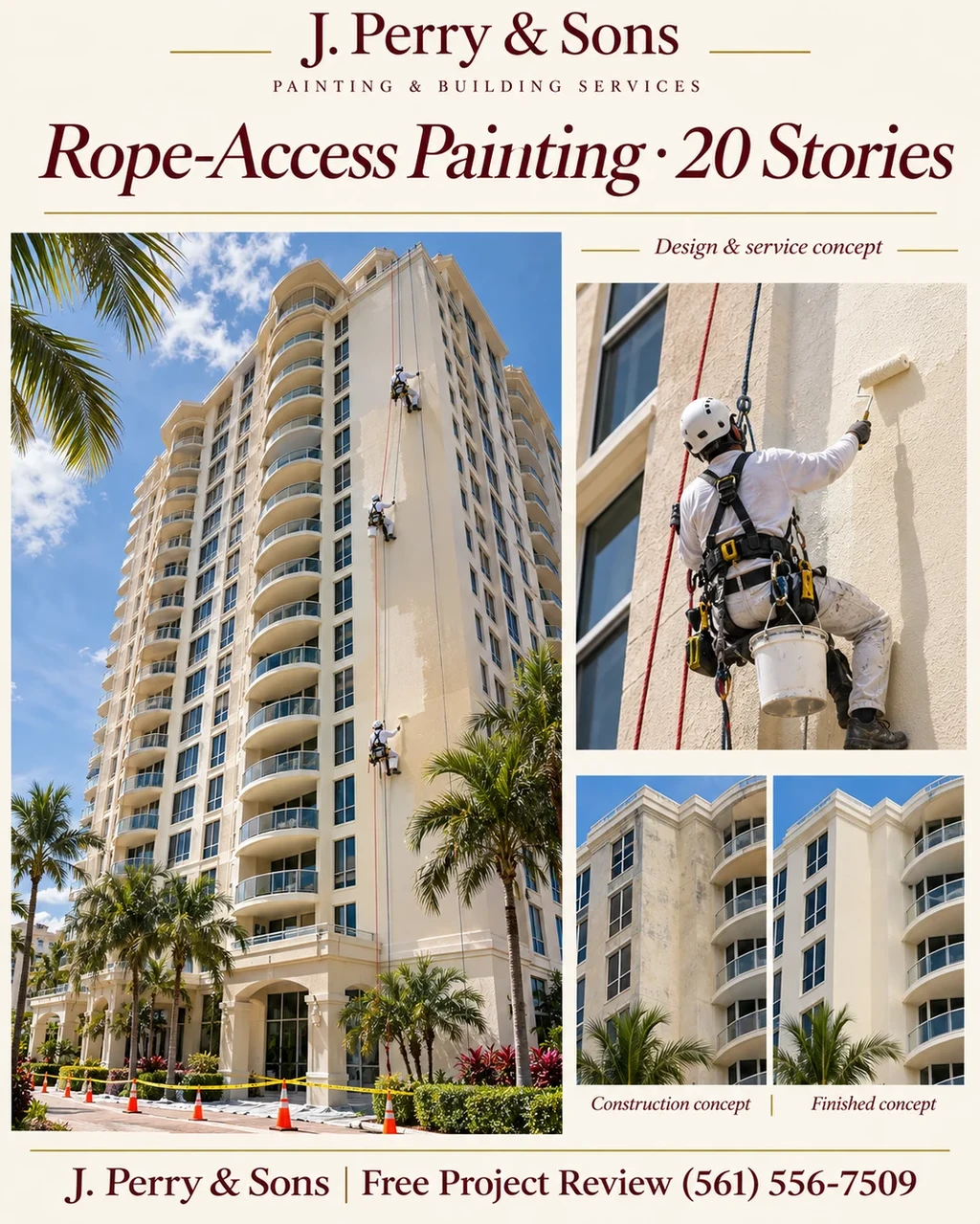
Rope access. Technicians work from ropes, moving down the face of the building. It is well suited to buildings with many balconies, setbacks or irregular faces where a stage is hard to hang. Rope-access work is done by J. Perry's own crews.
Swing stage. A suspended platform carries workers and materials along the face. It suits large, flat elevations and jobs with heavy repair work along with paint, because tools and materials travel with the crew.
Lifts. Boom and scissor lifts handle low-rise sections, podiums, garages, pool decks and the lower floors of a tower.
A mix of methods. Most towers use more than one: lifts at the base, rope access or stage on the shaft, ladders and scaffolds where a balcony or roof edge requires it.
| Access method | Fits best | Watch for |
|---|---|---|
| Rope access | Irregular faces, many balconies, setbacks | Wall anchors and roof edge approval |
| Swing stage | Large flat elevations, repair-heavy scope | Roof loading and tie-back points |
| Lift | Podium, garage, lower floors | Ground conditions and landscaping |
The permits and site plans for access are pulled and coordinated by J. Perry & Sons, which pulls all permits itself and follows every city and county compliance requirement.
tell us the building height, number of balconies and roof access, and we will recommend an access plan in the proposal.
Rope-access safety on an occupied tower
Rope access lets our crews reach elevations a swing stage cannot, but on a building full of residents, safety has to be planned and shown to the board, not assumed.
- Two independent lines for every technician: a working line and a backup safety line, each on its own anchor.
- Roof anchors inspected and documented before the first drop. OSHA requires the building owner to give the employer written confirmation that the anchors have been identified, tested and maintained, and we ask for that paperwork up front.
- Controlled zones below: barricades at entrances, pool decks and walkways, with drop zones moved as the crew moves.
- Tool tethering so nothing falls from the line.
- Weather calls: work on the line stops in high wind and lightning.
- Balcony and window protection while a technician passes each floor.
Ask any bidder to show you this plan in writing. We include it with our proposal.
Prep first: pressure cleaning, stucco and concrete repair, sealants and caulking
On a tall building, the cost of getting to the wall is high. Painting over a problem and then coming back to fix it means paying for access twice. That is why we inspect and repair first, while the crew is already on the face.
Pressure cleaning. Removes chalk, mildew, dirt and loose paint so new coating bonds. See pressure washing for buildings.
Stucco repair. Hairline cracks are routed and filled, hollow stucco is cut out and rebuilt, and water-damaged areas are opened and corrected. See building stucco repair.
Concrete repair. Rust stains and cracks at balcony edges, columns and slab edges often mean steel is corroding inside the concrete. That needs restoration, not paint. See concrete restoration and balcony repair.
Sealants and caulking. Failed sealant at windows, sliders, expansion joints and penetrations is replaced, because a new coating over a leaking joint fails early. See caulking contractor and building sealant replacement.
When the scope involves structural concrete, we build to the engineer's repair details. We do the construction, not the engineering.
ask us to mark the repairs on photographs of each elevation so the board sees them before approving.
Concrete and balcony repair before the first coat
On most condo buildings the biggest surprises are on the balconies: spalling slab edges, rusting rebar, cracked railing bases and failed waterproofing. Paint over any of that and the board pays twice: once to paint, and again to cut out the new coating and repair.
We sequence it the right way. Concrete and balcony repairs from the engineer's report are done first, then stucco and cracks, then sealants and expansion joints, then pressure cleaning, primer and paint. When the milestone or recertification report and the repaint are bid as one package, one scope feeds one schedule and the board does not pay for two crews setting up access twice. See our balcony repair and 40-year recertification repairs services.
Coating systems for coastal buildings
A coastal condo takes UV, salt, humidity and wind-driven rain on every face. The coating system should be matched to the substrate and to what is already on the wall. We describe types here; the exact product goes in your specification or our proposal.
Acrylic wall coatings. For sound stucco with hairline cracking. They breathe, hold color well and are straightforward to maintain.
Elastomeric coatings. A thicker, flexible film that bridges fine cracks and helps shed wind-driven rain. It limits how freely the wall can dry, so it belongs on a dry, sound wall. It is not used to hide a leak.
Primers and sealers. Alkali-resistant primer on new patches, bonding primer on slick or previously coated surfaces, and sealers where the substrate is porous.
Color-fastness. Strong, saturated colors fade faster in South Florida sun. If the board is choosing a dramatic color, we recommend sample areas on the building first.
Sheen. Flat is the most forgiving on large stucco walls. Satin and semi-gloss go on railings, doors and trim.
tell us whether the board already has a color or coating specification.
What the board should put in the painting spec
If the spec is loose, every bid will be different and the board will not be able to compare them. A good condo painting spec names:
- Order of work: repairs, stucco, sealants, cleaning, primer, paint.
- Repairs as unit prices: per crack, per patch, per square foot of concrete repair, per linear foot of sealant.
- The coating system by product, with number of coats and the film thickness from the manufacturer's data sheet.
- Sealant scope: window perimeters, expansion joints and penetrations, replaced or excluded.
- Metals: railings, doors and frames, with the rust-treatment system.
- Access method by elevation, and who provides anchor documentation.
- Protection: cars, pool deck, landscaping, windows and balconies.
- Resident notices and who sends them.
- Inspections and closeout: film-thickness checks, punch list, color schedule and touch-up stock.
- Insurance certificate and license from every bidder.
Our condo building painting guide for boards walks through each line.
How the board runs it: bid package, scope sheet, color approval, resident notices
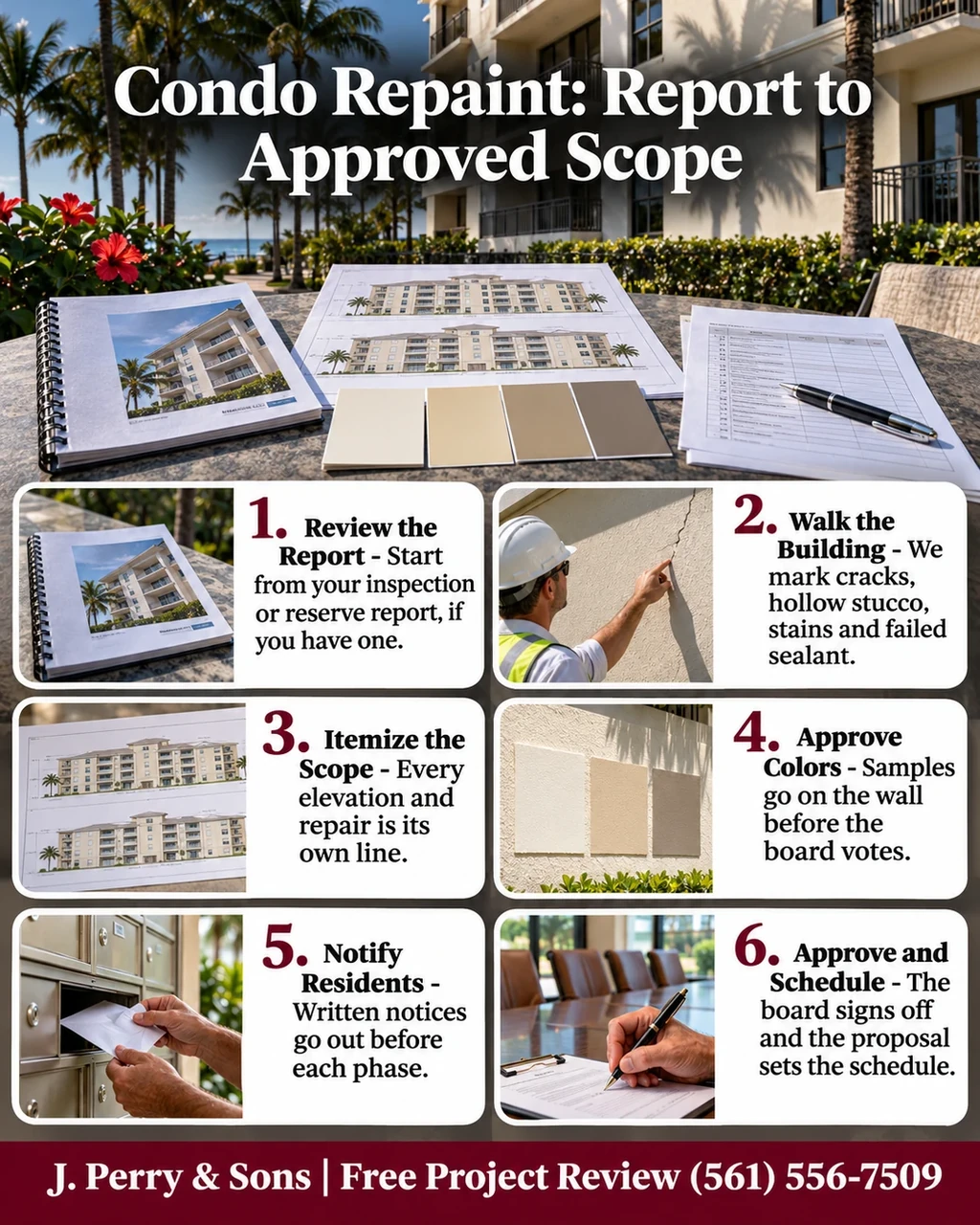
Boards get repaint proposals that cannot be compared: one includes repairs, one does not, one lists coats and one does not. A clear bid package fixes that.
The bid package. Give every bidder the same photos, the same inspection or reserve report if you have one, the same building dimensions and the same list of areas. Then ask each for an itemized proposal.
The scope sheet. One line per elevation and per repair type, with the coating system and number of coats, so proposals can be compared line by line.
Color approval. Boards often form a color committee. We apply sample colors on the building so owners can approve what they see on the wall, and we can prepare a rendering with our in-house designer; a simple rendering gives an idea, and detailed design work is billed separately.
Resident notices. We supply written notices for each phase: which elevation, which balconies, what residents should move or close, and who to call. The board or management company sends them under its own letterhead.
Association approvals. Each association has its own approval process: manager review, board vote and, for some communities, owner notice or a vote. Your association's attorney or manager confirms the steps your documents require. We provide the scope, proposal and insurance documents that process needs.
tell us what documents your board expects with a bid, and we will include them.
Occupied-building logistics
Residents live in the building through the repaint. The plan has to respect that.
Balcony access. Residents need clear notice to remove furniture, plants and grills, and to close sliders when a crew is on their elevation. We confirm who handles units that are vacant, seasonal or owned by out-of-town residents.
Phasing by elevation. The building is painted elevation by elevation, so residents know which side is active. Phases are scheduled in your written proposal, not promised verbally.
Protection. Cars, pool decks, landscaping, windows and entrances are covered or moved before each phase. Drop cloths and tarps are secured against wind.
Pressure cleaning and overspray. Water and spray are controlled so that neighbors, cars and open windows are not affected, and residents are told when cleaning is happening.
Noise and hours. Work hours follow your association rules and city requirements. Quiet hours are respected.
Cleanup and closeout. Walkways, balconies and common areas are cleaned as work moves along, and the board receives closeout photos by elevation.
tell us your building's rules on work hours, balcony access and resident notice.
Resident communication that keeps the job moving
A repaint slows down when residents are surprised. We give the board and manager notices for each phase: which elevation is next, when balconies need to be cleared, when windows and sliders stay closed, parking and pool closures, and one contact for questions. Notices go out before every phase, in the building's usual channels, so the manager is not fielding the same calls all day. At the end, owners get a short closeout note with the colors used.
One package with concrete restoration and waterproofing
Many condo repaints happen alongside an inspection finding. A milestone inspection or a structural report may call for concrete repair, balcony restoration or waterproofing by licensed specialty contractors, coordinated by J. Perry & Sons. Doing that work and the repaint as one project avoids mobilizing access equipment twice and puts one contractor responsible for the finished wall.
For boards with reports in hand, see our milestone inspection board guide. For related common-area work scheduled with the repaint, see condo lobby and common-area renovation and how boards approve common-area work. Waterproofing at roofs, decks and balconies is covered under waterproofing and sealants.
We build to the details your engineer or architect provides, and we pull all permits. The project stays with J. Perry & Sons.
if your board has an inspection report, send it with your first message so we can price repairs and paint together.
License, insurance, permits and itemized proposals
Boards and their attorneys ask for these documents first. We keep them ready.
Licensed general contractor. J. Perry & Sons Inc, CGC1540699.
Licensed and insured. Certificate of insurance available on request.
Our rope-access crews. Rope-access work is done by J. Perry's own crews.
Permits. We pull all permits ourselves and follow every city and county requirement.
Itemized written proposal. Each elevation, repair and coating system is its own line, so your board can compare bids fairly.
Engineer and architect details. Where repairs need engineering, we build to your engineer's drawings.
What to send us
- Photos of every elevation and close-ups of cracks, stains and peeling.
- Building height, number of stories and number of balconies.
- Your most recent inspection, reserve or engineering report, if any.
- Current colors, and any approved or proposed new colors.
- The name of your manager and any board approval timeline you need to meet.
Send it all through our project form.
Send us photos of each elevation, your inspection report if you have one, and the board's timeline. We follow up personally, walk the building and put the full scope in an itemized written proposal. Call (561) 556-7509 or send us your project.
Painting by city
Frequently asked questions
How often should a condo building be repainted?
There is no fixed calendar. It is based on the condition of the coating and the wall behind it. Chalking, fading, peeling, stains below balconies and failed sealant all mean it is time to have the building inspected. We look at the coating and the substrate and tell you what we see.
Can residents stay in the building while it is painted?
Yes. The building is phased by elevation, residents receive written notices before each phase and are asked to clear balconies and close sliders when their side is active. Cars, landscaping and entrances are protected.
Does a condo painting contractor need a license in Florida?
Requirements are based on the scope of work and local rules, so confirm them with your city or county building department and your association's attorney. J. Perry & Sons is a licensed Florida general contractor, CGC1540699, and we pull all permits ourselves.
What does condo painting cost?
Pricing is set after the project review. It is based on the area of each elevation, the repairs needed, the coating system and the access method. You receive an itemized proposal with each elevation and repair as its own line.
How do you paint a high-rise building?
From rope access, swing stage or lifts, often in combination. Our own rope-access crews work from the roof down the face of the building. The wall is pressure cleaned and repaired first, then coated, elevation by elevation.
Do you repair stucco and concrete before painting?
Yes. Cracks, hollow stucco, spalls and failed sealants are repaired first, so the coating goes onto a sound wall. Repairs are itemized so the board can see them.
When should a condo board bring in a painting contractor?
Bring one in while the reserve study or milestone inspection is being prepared, before a budget is set. A contractor can look at the walls, sealants and balconies and tell the board what the repaint is likely to include. That lets the reserve line reflect real conditions and lets the engineer's repairs and the repaint go out as one bid package.
What should a condo painting spec include?
It should name the order of work, repairs as unit prices, the coating system by product with coats and film thickness, the sealant scope, metal and railing treatment, the access method by elevation, protection, resident notices, inspections and closeout. With those lines written down, every bidder prices the same job and the board can compare bids line by line.
How do you keep residents safe during rope-access painting?
Every technician works on two independent lines tied to inspected, documented roof anchors. We barricade entrances, pool decks and walkways below, tether tools, stop work in high wind and lightning, and send notices before each elevation so residents know when to clear balconies and keep sliders closed. The safety plan is included in our proposal.