
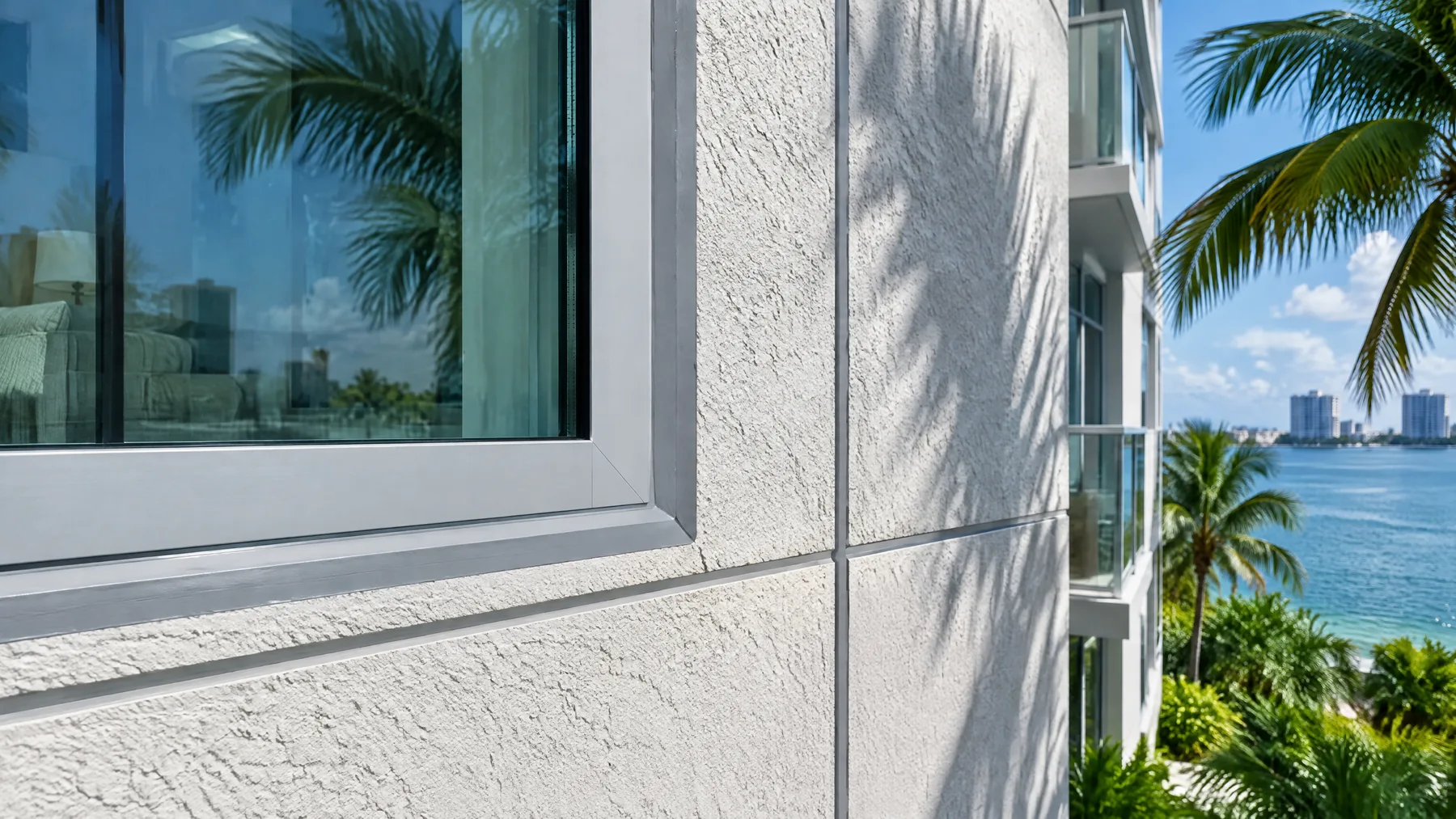
The call usually comes after a storm. An owner on the eighth floor has water on the windowsill, a stain spreading on the drywall under the window, or a musty smell in the corner of the bedroom. The manager calls the window company, the window company says the window is fine, and the water keeps coming.
In most of these cases, the water is getting in at the joints around the window, not through the window itself. Sealant, the flexible material in the joints between windows, doors, stucco, concrete and metal, is one of the cheapest parts of a building and one of the first to fail. In South Florida, where sun, heat, salt air and wind-driven rain work on every joint, it usually fails sooner than boards expect.
This guide explains how sealant fails, where to look, how replacement is done and how an association can plan a sealant program that keeps water out between major projects.
Book a leak and sealant reviewWe look at your project with you and tell you what's possible, what it will take and a starting price. Get a resealing planFor buildings: unit prices and phasing around residents. Call (561) 556-7509
What sealant does on a building
A building moves. Concrete and stucco expand in the heat and shrink at night. Windows and doors move with the wind. Balcony rails move with the people who lean on them. The joints between these materials have to move too, and sealant is what keeps them watertight while they move.
Sealant is found at:
- window and door perimeters
- expansion joints and control joints in the walls
- balcony rail posts and base plates
- penetrations: pipes, vents, lights and conduits
- copings and parapet caps
- joints between different materials: stucco to concrete, stucco to metal, stone to stucco
- sliding door thresholds and sill pans
How sealant fails
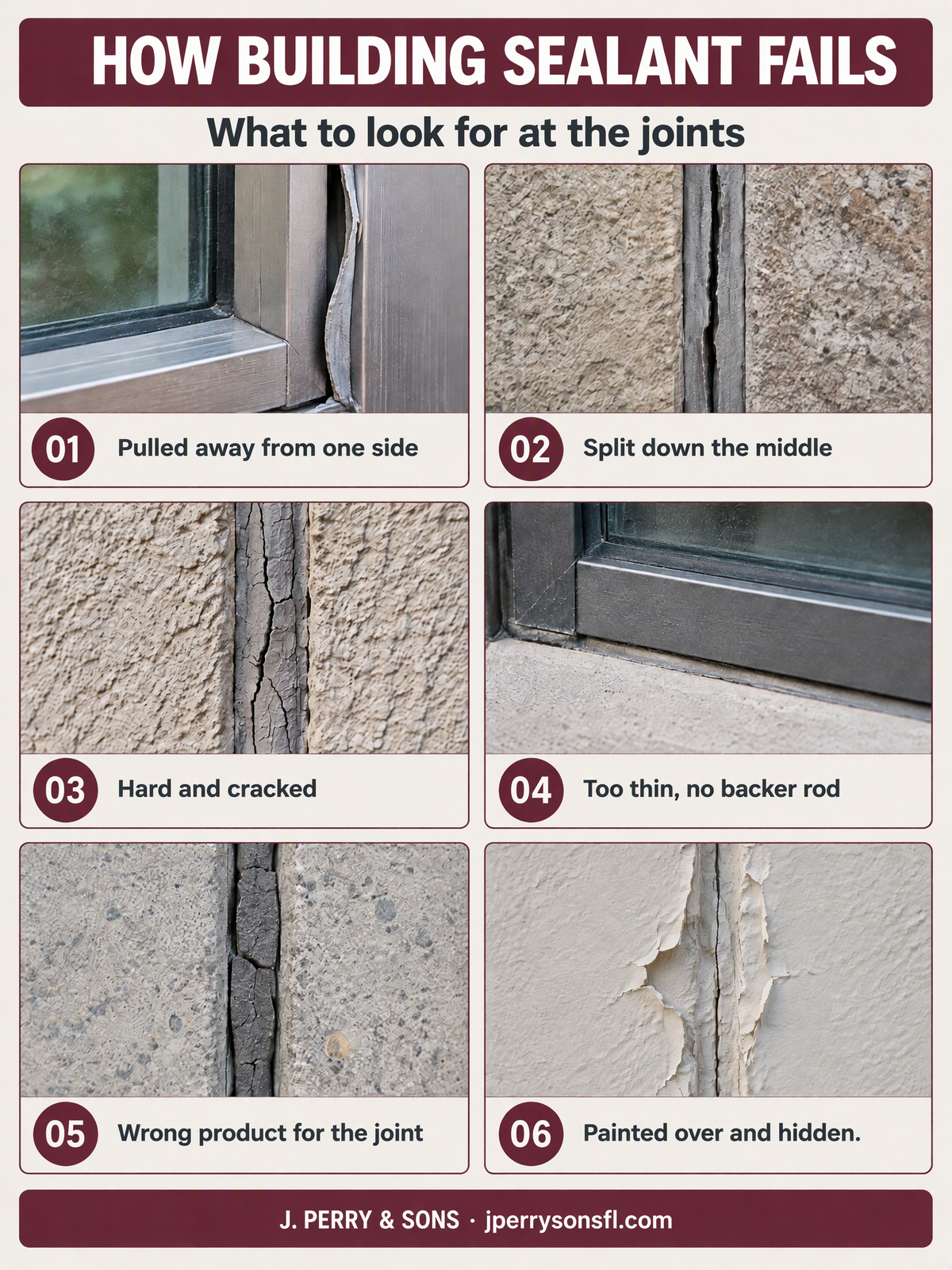
Sealant doesn't last forever. The common ways it fails:
- Adhesive failure: the sealant pulls away from one side of the joint, leaving a gap you can see.
- Cohesive failure: the sealant itself splits down the middle.
- Hardening and cracking: UV and heat dry the sealant out until it's hard and cracked on the surface.
- Too thin or wrong shape: joints that were filled without a backer rod, or with too little material, can't move without tearing.
- Wrong product: a sealant not made for the materials or the movement in the joint.
- Paint over sealant: some paints crack over sealant and hide the failure underneath.
Some failures you can see from the ground or a balcony. Others need a close look from a lift or a swing stage.
Finding the real source of a leak
Water inside a unit rarely comes in where the stain is. It can travel along the top of a window, down inside a wall or along the slab before it shows up. We start from the outside and work in:
- Talk to the owner and the manager: when does it leak, in which wind and rain, and where does the water show up?
- Look at the exterior around the problem area: window perimeters, sealant at joints, cracks in the stucco, the balcony above, rail posts, the parapet if it's a top-floor unit.
- Check the inside: the window frame, the sill, the drywall and the floor.
- Water-test the suspected source where needed, one area at a time, to confirm where the water is getting in.
- Document with photos and send the manager a short report with the source and the repair.
Finding the source first means the board pays to fix the right thing, not to replace a window that wasn't the problem.
How sealant replacement is done
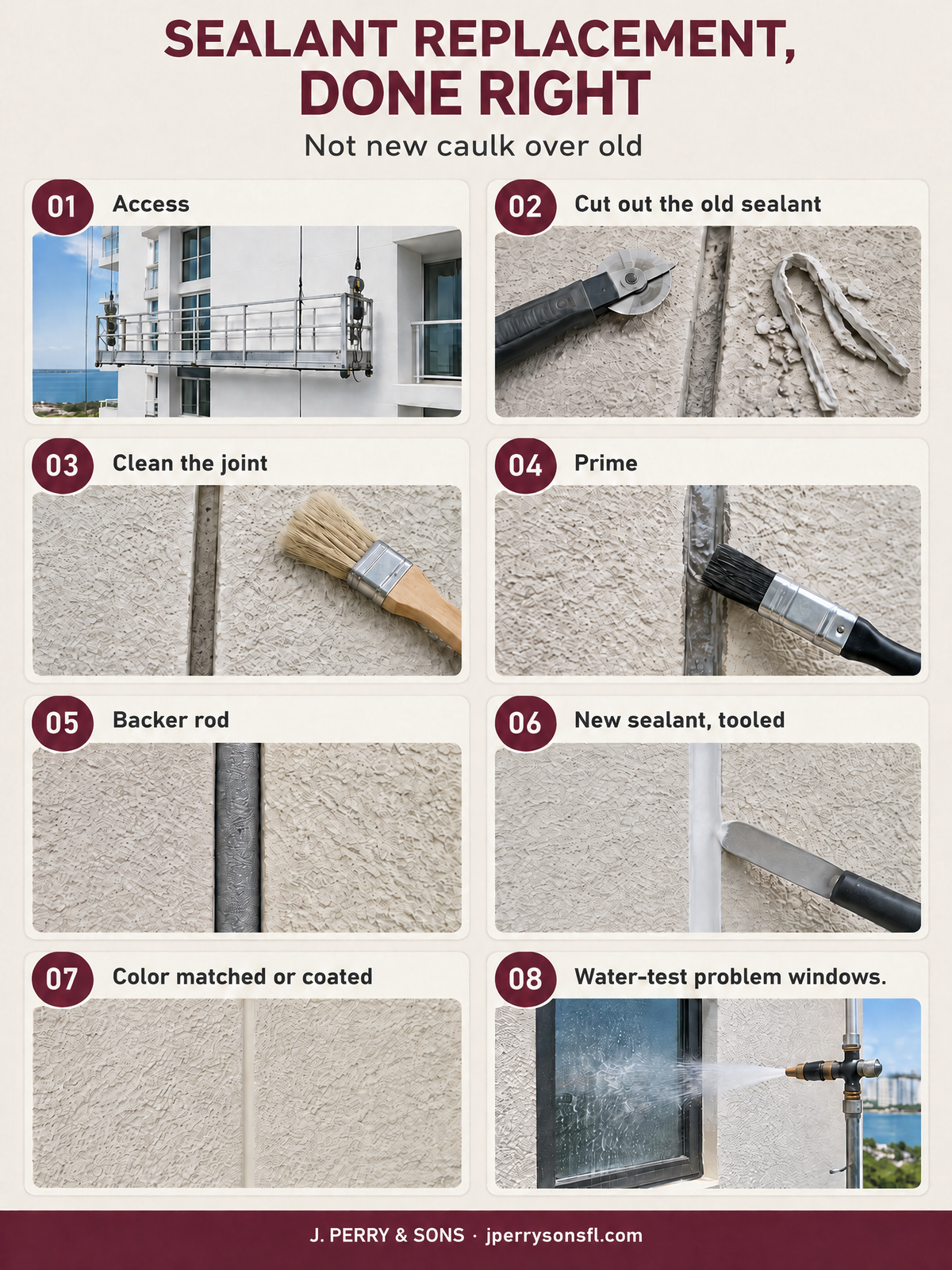
Replacing sealant correctly is more than putting new material over old. The steps:
- Access: ladders for low areas, lifts or swing stages for high elevations.
- Remove the old sealant completely, cutting it out of the joint.
- Clean the joint so the new sealant bonds to sound material, not to old residue or dust.
- Prime where the sealant manufacturer requires it for the substrate.
- Install backer rod to the right depth, so the sealant has the right shape and only bonds to the two sides of the joint.
- Apply the new sealant and tool it so it fills the joint and sheds water.
- Match the color to the building or paint it with a compatible coating when the building is being painted.
- Water-test problem windows to confirm the repair holds.
The sealant is chosen for the materials on each side of the joint and the movement expected. A joint between stucco and a window frame needs a different product from a horizontal joint on a balcony.
Sealant and the repaint
The best time to replace sealant on a whole building is during the repaint. The access equipment is already on the building, the surfaces are already being cleaned and repaired, and the new sealant can be coated so it blends in. Painting over old, failed sealant hides the problem and lets water keep getting in under a fresh coat. See our guide to waterproofing and sealants.
Sealant and the milestone repairs
Many milestone inspection reports include sealant items, and concrete repairs leave new joints that need to be sealed. Doing the concrete repairs, the sealant and the finishes in one sequence keeps water out of the new repairs, which is the reason they were needed in the first place.
A sealant program for the association
Instead of chasing leaks one unit at a time, many boards set up a sealant program:
- Survey the building elevation by elevation and record the condition of the joints.
- Fix the worst areas first, usually the elevations that face the prevailing rain and the top floors.
- Replace the rest in phases over the budget years, or all at once with the next repaint.
- Recheck the building every few years, so small failures are caught before they become leaks.
We can also return for a yearly maintenance walk, a paid service where we check sealants, coatings and common areas, so the board knows what's coming before it becomes a project.
Working in an occupied building
Sealant work is quiet compared with most building work, but it still affects residents. We send notices through the manager before each elevation, coordinate balcony access with owners, protect cars, landscaping and the pool area, and keep walkways clear under every work area.
Signs your building needs a sealant program
- more than one leak call after a storm
- sealant you can see pulling away or cracked from the ground or the balconies
- stains below windows on the exterior
- the last full sealant replacement was many years ago, or nobody knows when it was
- the building is due for a repaint or milestone repairs
Mistakes to avoid
- Caulking over old sealant. The new material doesn't bond to failed sealant and fails quickly.
- No backer rod. Joints filled solid can't move and tear.
- Wrong product for the joint. Not every sealant is made for every material or for horizontal surfaces.
- Blaming the window first. Replacing windows doesn't fix a leak that comes in through the stucco or the balcony above.
- Painting without replacing sealant. The paint looks good for a season while water keeps coming in.
Why boards and managers call us
- we find the source before we price the repair
- we water-test problem windows
- sealant, stucco, concrete repair and paint done in one sequence
- photo reports and a clear scope for the board
- a licensed Florida general contractor (CGC1540699)
See property managers and condo boards.
Choosing the right sealant
Sealants are not all the same. Silicone, polyurethane and hybrid sealants each have strengths: some handle more movement, some bond better to certain materials, some can be painted and some can't, and some are made for horizontal joints that people walk on. The product is chosen for the materials on each side of the joint, the width and depth of the joint, the movement expected and whether the joint will be painted. The sealant manufacturer's data sheet sets the primer, the joint shape and the cure time, and we follow it. Using the wrong product is one of the most common reasons a new sealant job fails within a few years.
Joint size and shape
A sealant joint works like a rubber band. It needs to be the right width and depth, bonded to the two sides only, so it can stretch and compress. That's what the backer rod is for: it sets the depth and keeps the sealant from bonding to the back of the joint. A joint that's too thin tears; a joint that's too deep can't stretch. Joints that are too narrow for the movement may need to be cut wider before new sealant goes in.
Windows, doors and sliding glass doors
Window and sliding door perimeters are where most leak calls start. Besides the perimeter sealant, sliding doors have sill pans and thresholds that need to drain to the outside, and window frames have weep holes that must stay open. Painting or sealing over weep holes traps water inside the frame. When we look at a leaking window, we check the perimeter, the frame joints, the weeps and the wall around it before we decide what the repair is.
Balcony rail posts and penetrations
Every rail post set into a balcony slab is a path for water into the concrete. When the sealant at the base fails, water reaches the steel in the slab and starts the rust that leads to balcony repairs. Resealing rail posts is one of the least expensive things a board can do to slow down concrete damage. The same goes for pipes, vents, light fixtures and conduits that pass through the walls.
Records the board should keep
After a sealant project, the board should have a record of which elevations and joints were done, the products used, the date and the product documents. That record makes the next survey easier and shows owners and future buyers that the building is maintained.
Caulking contractor for condos, HOAs and commercial buildings
As a commercial caulking contractor, we work on condo towers and HOA buildings, and on office buildings, retail centers and medical buildings where the same joints fail the same way. Window resealing, expansion joints, storefront perimeters and roof-to-wall transitions are all part of sealant work. We're also a waterproofing contractor for balconies and walkways, so a leak that starts at a joint and continues through a balcony is handled by one company.
We do caulking and window resealing for buildings in Miami, Fort Lauderdale, Pompano Beach, Boca Raton, Delray Beach and West Palm Beach.
For our services, process and starting prices, see our commercial building caulking page.
How we work
- Project Review. We walk the property with you, review the plans or the engineer's report and confirm the scope.
- Proposal. A clear proposal with unit prices where they apply, so you can compare bids on the same basis.
- Plan and schedule. A phased schedule around residents, tenants or customers, with insurance certificates and documents for the board or the owner.
- Installation. Installation by our crews and licensed specialty contractors, daily updates with photos, inspections and a closeout package, with the work coordinated by J. Perry & Sons.
Many of the buildings and businesses we work for prefer to stay private, so most of our work isn't online. When we meet, we'll show you projects similar to yours. See private clients.
Working with an architect or engineer? We build to their documents and coordinate with them through the whole project. See architects, engineers and designers.
The Board & Manager Pack
How to scope, bid and compare building projects, and what to require before work starts.
Sealants, balcony waterproofing and window caulking for homes and buildings.
Free project review · (561) 556-7509
Book a leak and sealant reviewWe look at your project with you and tell you what's possible, what it will take and a starting price. Get a resealing planFor buildings: unit prices and phasing around residents. Call (561) 556-7509
FAQ
How long does building sealant last in South Florida? It is based on the product, the joint and the exposure. Sun, heat and salt air shorten its life, so elevations facing the sun and the rain usually fail first. A survey shows where it's failing.
Can you just caulk over the old sealant? No. New sealant doesn't bond properly to old, failed sealant. The old material is cut out, the joint is cleaned and primed where needed, and new sealant is installed over a backer rod.
Is the window leaking or the sealant? Often it's the joint around the window, the stucco or the balcony above, not the window itself. We find the source first, with a water test where needed.
Do you water-test the repairs? Yes. We water-test problem windows to confirm the repair holds.
Should sealant be replaced during the repaint? Yes. The access is already there, and the new sealant can be coated to match the building.
Can residents stay home during sealant work? Yes. Sealant work is quiet. We coordinate balcony access with owners and send notices through the manager.