
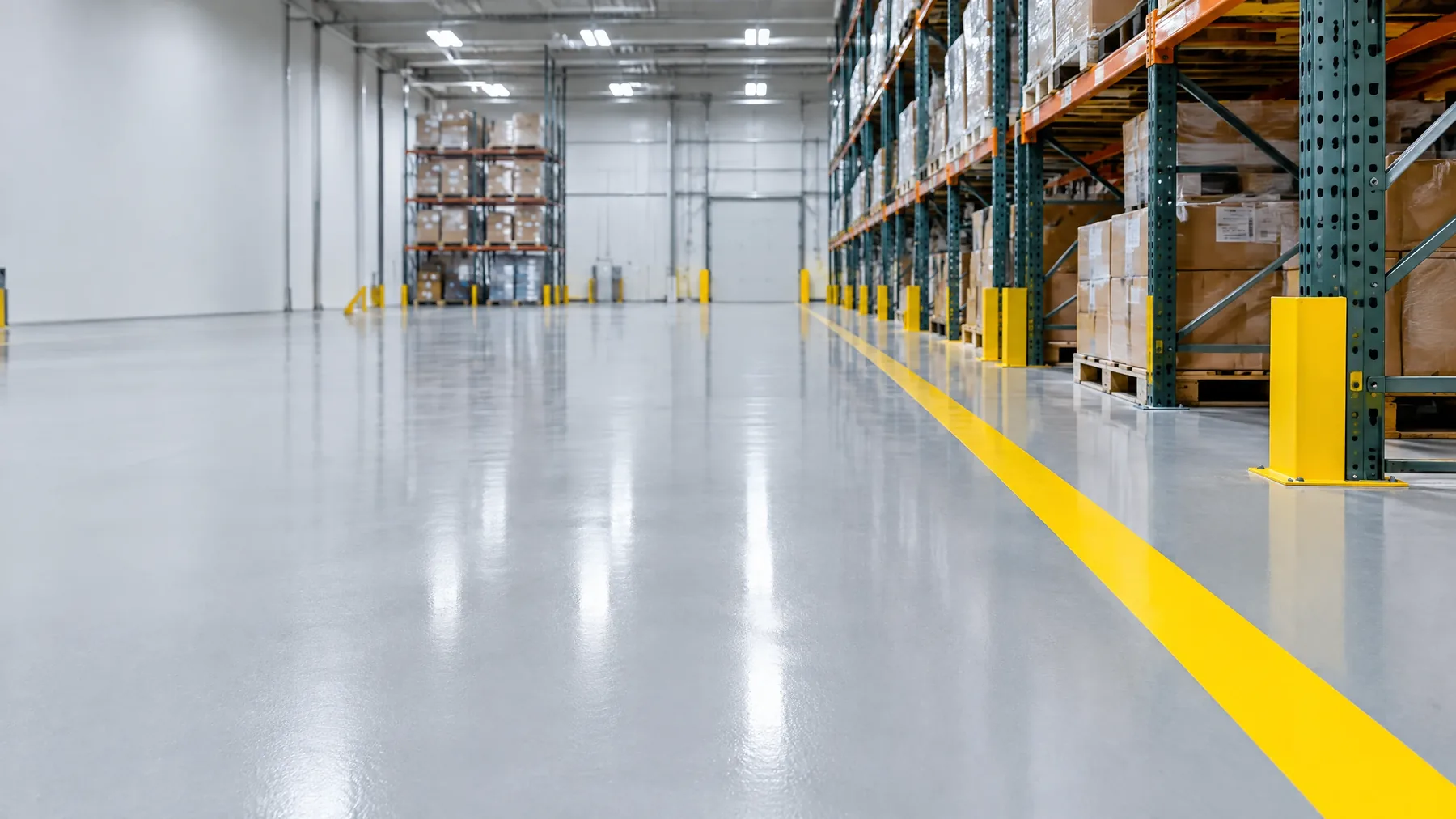
J. Perry & Sons installs commercial epoxy flooring for warehouses, showrooms, gyms, commercial kitchens, back-of-house and mechanical rooms in Broward and Palm Beach counties, for general contractors, property managers and business owners who need a floor that goes down fast, takes forklifts or hot grease, and can be hosed or scrubbed. It is the commercial side of our epoxy flooring contractor hub, and the rule is the same as on a garage: the coating only holds as well as the slab under it, so every job starts with a moisture test and diamond grinding.
Commercial Epoxy Flooring Cost in South Florida: $4–$9 per sq ft standard, $8–$14 heavy-duty
| Scope | Typical size | Installed range |
|---|---|---|
| Warehouse floor coating, 100% solids epoxy, urethane top | 5,000–50,000 sq ft | $4–$7 per sq ft |
| Showroom or retail, high-gloss or flake, polyaspartic top | 1,500–10,000 sq ft | $6–$9 per sq ft |
| Gym flooring, quartz or flake broadcast, anti-slip top | 2,000–8,000 sq ft | $6–$10 per sq ft |
| Commercial kitchen, urethane cement with integral cove | 500–3,000 sq ft | $9–$14 per sq ft |
| Heavy-duty quartz or mortar system, loading docks, wash bays | 1,000–10,000 sq ft | $8–$13 per sq ft |
| Moisture mitigation primer, where testing requires it | any | add $2–$4 per sq ft |
| Line striping, aisle marking, safety zones | per linear foot | $1.50–$4 per lf |
Ranges are 2026 South Florida figures and include grinding, crack and joint repair, primer, body coats and topcoat. Moisture mitigation is its own line because not every slab needs it. Removal of a failed coating ($1–$3 per sq ft), cove base, drain detailing and after-hours work are listed separately so a GC can compare bids on the same basis.
Free Estimate
Free estimate — call (561) 556-7509 or email jperrysonsgc@gmail.com with project photos, the city, approximate dimensions, and material selections.
Commercial coating systems and options
100% solids epoxy with urethane topcoat. The workhorse for warehouses and showrooms: epoxy primer, pigmented body coat at 15–20 mils, and an aliphatic urethane or polyaspartic top for abrasion, UV stability and chemical resistance. Forklifts and pallet jacks are what the urethane top is for.
Polyaspartic systems. For spaces that must reopen in a day. Polyaspartic cures in hours, holds color under skylights and open bay doors, and takes forklift traffic in 24 hours. The premium per gallon buys one fewer day of closure.
Urethane cement. A cementitious urethane mortar or slurry at 1/8 to 1/4 inch for commercial kitchens, food prep, breweries and wash-down areas. It tolerates thermal shock from hot water and grease, bonds through moderate moisture, and takes an integral cove base so the floor can be hosed to the drain.
Quartz and flake broadcast. Colored quartz or vinyl flake broadcast into the body coat for slip resistance in gyms, locker rooms, restrooms and loading areas.
Moisture mitigation and striping. A two-component mitigation primer rated for high vapor emission goes in when testing says the slab will push a standard coating off; see epoxy floors and slab moisture. Aisle lines, walkways, forklift zones and safety yellow are applied in the same system so they do not peel.
Free estimate — call (561) 556-7509 or email jperrysonsgc@gmail.com. Send a floor plan or a few photos with the square footage and we'll return a range the same day.
How we do it
- Moisture test. Calcium chloride or in-situ RH probes read before anything is ordered. The result sets the primer and the price.
- Phasing plan. Occupied warehouses and gyms coated in zones or after hours; kitchens during a scheduled closure, usually a weekend.
- Removal and grinding. Failed coatings, paint, adhesive and sealers come off. The slab is diamond-ground with HEPA extraction to a CSP 2–3 profile. No acid etching.
- Repairs. Cracks chased and filled with polyurea, control joints filled or honored, spalls patched with epoxy mortar, drain edges detailed.
- Primer. Penetrating epoxy primer, or a moisture-mitigation primer where testing requires it.
- Body coat and broadcast. Pigmented epoxy or urethane cement placed by squeegee and roller or trowel; quartz or flake broadcast where specified; cove base built with the same material.
- Topcoat. Urethane or polyaspartic with anti-slip additive to the agreed texture.
- Striping. Lines and zones masked and applied after the topcoat has cured to walk-on.
- Cure and return to service. Foot traffic in 12–24 hours, forklifts and racking in 24–72 hours depending on system. Written cure schedule handed to the manager.
Permits and compliance handled. J. Perry & Sons pulls the permit, schedules the inspections, and builds to the city and county codes that apply — Broward and Palm Beach municipal building departments, HVHZ requirements where they apply, and HOA/condo association rules. Licensed Florida general contractor CGC1540699.
Commercial epoxy in South Florida: moisture, heat and open bay doors
Slab moisture is the first question on every commercial floor here. Tilt-wall and block warehouses sit a few feet above the water table, many older slabs have no vapor retarder, and the air runs 70–80% humidity. Vapor lifts a coating from below and shows up as blisters in the first wet season. We test before we bid so mitigation is in the number or out of it on evidence.
Open bay doors and skylights put UV on part of the floor, which yellows plain epoxy; a urethane or polyaspartic top keeps the color even from dock to back wall. In rainy season, humidity near the dew point can blush the cure, so we schedule around the forecast and run dehumidification when a kitchen closure cannot move. Health inspectors want a smooth, coved floor in food prep; fire marshals want slip resistance and marked egress in warehouses. Both go into the spec.
How we work with GCs and property managers
- Certificate of insurance naming the owner, GC or landlord as additional insured, with general liability and workers' compensation, before mobilization.
- Bids from drawings in 48 hours. Send the floor plan and finish schedule; we return a per-square-foot bid with grinding, repairs, system, cove, striping and mitigation as separate lines, with a site visit to test the slab before the number is final.
- Phased and night work. Occupied space by zone; retail and gyms after hours; kitchens over a scheduled closure with a written reopening time.
- Unit pricing on change orders. Extra square footage, cove, striping and mitigation primer all priced per unit on the bid.
- Closeout documents. Moisture test results, product data, system build-up, cure schedule, care instructions, warranty letter and lien releases in one package.
Related epoxy flooring services
- Epoxy flooring: garage and residential coatings, the parent service.
- Commercial renovation: floor coatings as one trade on a warehouse, showroom or restaurant build-out.
- Restaurant and commercial kitchen tile: quarry tile and epoxy grout where tile is specified instead of urethane cement.
- Office and retail tile and flooring: showroom floors where porcelain, not coating, is the finish.
- Concrete restoration: spall, crack and joint repair when the slab needs structural work first.
What a commercial epoxy estimate includes
- Slab moisture test with written results
- Removal of existing coating, paint, adhesive or sealer
- Diamond grinding with HEPA extraction, target profile stated
- Crack fill, joint treatment, spall repair, drain detailing
- Primer, or moisture-mitigation primer where required
- System build-up by layer, with mil thickness or mortar depth
- Quartz, flake or anti-slip texture level; cove base and stem walls when selected
- Line striping and safety markings by linear foot
- Phasing, after-hours or closure schedule
- Cure schedule, return-to-service times, workmanship warranty terms
Commercial epoxy flooring by city
Epoxy flooring in Fort Lauderdale · Epoxy flooring in Miami · Epoxy flooring in Boca Raton · Epoxy flooring in West Palm Beach · Epoxy flooring in Weston · Epoxy flooring in Delray Beach · Epoxy flooring in Parkland · Epoxy flooring in Wellington
Planning guides: Commercial epoxy for warehouses and showrooms · Epoxy floors and slab moisture · Polyaspartic vs epoxy for Florida garages · Restaurant kitchen floors: quarry tile, epoxy grout, drains · Metallic epoxy floors
Commercial epoxy flooring — FAQ
How much does commercial epoxy flooring cost per square foot in South Florida? $4–$9 per square foot for 100% solids epoxy with a urethane or polyaspartic top on warehouses, showrooms and gyms. Heavy-duty quartz and urethane cement run $8–$14. Moisture mitigation adds $2–$4 where testing requires it.
Epoxy or urethane cement for a commercial kitchen? Urethane cement. It handles thermal shock from hot water and grease, bonds through moderate slab moisture, and takes an integral cove base. Standard epoxy in a kitchen delaminates at the dishwasher and fryer line.
How long is the floor out of service? Foot traffic in 12–24 hours, forklifts and racking in 24–72 hours depending on system. Polyaspartic reopens fastest. Occupied space is phased so part of the floor is always in use.
Do you test the slab for moisture before quoting? Yes, at the site visit. The result decides whether a mitigation primer is in the bid. A number given without a test is a guess.
Can you include line striping and safety markings? Yes. Aisle lines, walkways, forklift zones and column safety yellow are applied in the same system after the topcoat cures, priced per linear foot.
How do I get an exact price? Call (561) 556-7509 or email jperrysonsgc@gmail.com with photos and rough dimensions. A written estimate is typically ready within 24–48 hours after a site review and scope confirmation.
Free estimate — call (561) 556-7509 or email jperrysonsgc@gmail.com. Licensed Florida general contractor CGC1540699. Serving Broward and Palm Beach counties.
Free Estimate
Free estimate — call (561) 556-7509 or email jperrysonsgc@gmail.com with project photos, the city, approximate dimensions, and material selections.