
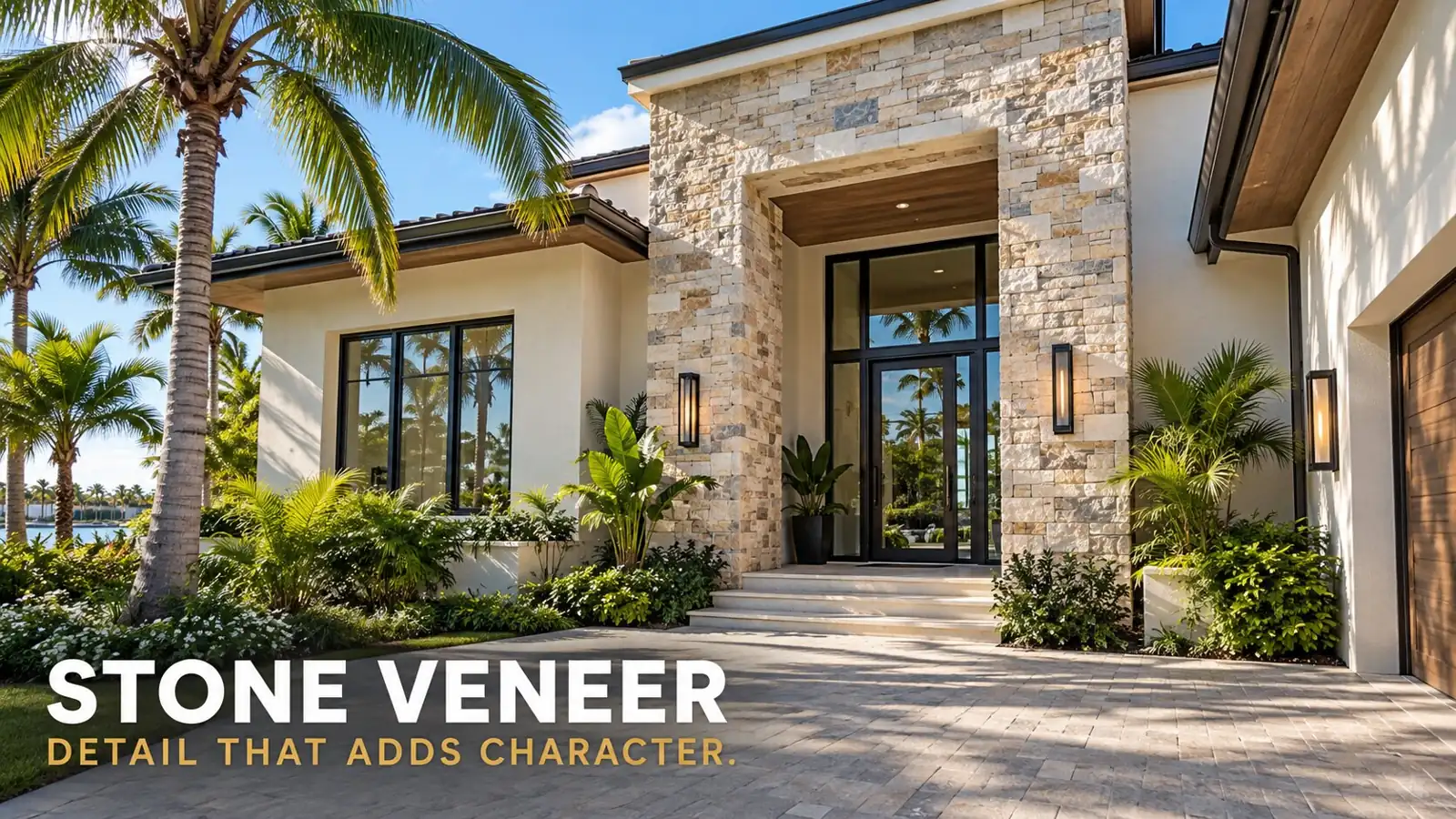
Want your stucco house to look like a stone house? This page is about exterior stone veneer on the outside walls of your home: a band along the front, the garage wall, the entry tower, a gable or the whole elevation. It is part of our residential stone veneer work. Whether you call it stone veneer siding or stone siding for house fronts, it is a thin layer of stone set over the wall. What decides whether exterior stone lasts is mostly what's behind it: the lath, the scratch coat, the screed at the bottom and the cap at the top. That is what we explain here, wall by wall.
Exterior stone cost by layout
| Layout | Typical stone area | Installed range |
|---|---|---|
| 300 sq ft front accent, manufactured stone | 300 sq ft | $8,000–$11,000 |
| 300 sq ft front accent, natural thin ledger panel | 300 sq ft | $10,000–$14,000 |
| 300 sq ft front accent, cut limestone or travertine | 300 sq ft | $12,000–$17,000 |
| Wainscot from grade to sill across the front | 150–300 sq ft | per sq ft rate plus sill cap |
| Sill cap along a wainscot or water table | per linear ft | $30–$46 |
| Full front facade, any stone | about 1,000 sq ft | $38,000–$63,000 |
About these prices. These ranges are starting points based on typical South Florida projects. Your final price depends on the condition of the property, access, the materials or system specified and the full scope of work. We confirm every number after we review your project in person or from the drawings, and the price in your signed proposal is the one that applies.
Every line includes wall prep, stone, mortar, corners and cleanup over sound block or stucco. Painted stucco that needs lath adds a per-square-foot charge. Work above 8 ft adds 15–25% for scaffold. Stucco repair found under an old finish, electrical relocation and new trim pieces are separate lines.
Three ways to put stone on the front
Water table or wainscot. Stone from the ground up to the bottom of the windows, usually 3–4 ft, wrapped around the front corners. The top edge gets a sill cap with a drip edge so rain sheds off instead of running down behind the band. It is the least expensive way to make a stucco house look like a stone house.
Accent areas. The garage wall, the entry tower or recessed porch, one gable, or the wall between two windows. A good accent ends at an inside corner or a return (where the wall turns), so the stone looks built in, not stuck on. We never stop stone in the middle of a flat stucco wall.
Full facade. Stone on the whole front elevation, or on every elevation. This is where product choice moves the total the most: 1,000 sq ft of manufactured stone and 1,000 sq ft of coral stone are tens of thousands of dollars apart. In stucco communities, full-front stone is the request boards turn down most often, so we confirm your coverage limits before you choose.
Picturing stone on your front? Send a photo marked where you want it through our project form and we'll send back a range.
The wall system behind the stone
Why does some stone fall off after a few years while other stone lasts decades? Stone veneer is a finish, not a waterproofing layer. Water will get behind it in a summer storm, and the system has to let that water out.
- Inspect and tap. We sound every wall with a hammer. Hollow stucco is marked and removed down to the block. Staining under windows tells us where a flashing or a sealant joint has already failed.
- Weather-resistive barrier. On lath installs, two layers of Grade D paper or a liquid-applied barrier over the area, lapped shingle style so water runs out, not in.
- Weep screed. A drainage strip at the bottom of every stone run, 4 in above soil or 2 in above pavers or a slab. Water that gets behind the stone exits here. Stone buried in mulch wicks water up and stains.
- Lath. 2.5 lb expanded metal lath, galvanized inland and stainless near the coast, fastened into the block every 6 in with masonry screws or pins, lapped at seams and wrapped around corners.
- Scratch coat. About 1/2 in of Type S mortar, scratched horizontally, kept out of the rain and cured 24–48 hours.
- Set the stone. Corners first, then field. Each stone is back-buttered and pressed into a full mortar bed. Stone from several boxes is blended so there is no color banding.
- Flash and cap. Flashing over window and door heads, a cap or sill with a drip edge on every horizontal top, a sealant joint where stone meets a window frame.
- Clean and seal. Brushed, cleaned with an acid-free cleaner, and natural stone sealed with a breathable penetrating sealer.
Over CBS block versus over stucco
Bare or newly exposed block. Clean block is the best base there is. Thin veneer bonds directly with a polymer-modified veneer mortar after the block is washed and dampened. No lath, no paper.
Unpainted, bonded stucco. Scarified or primed with a cementitious bonding agent, then direct bond, as long as the tap test is clean everywhere.
Painted or elastomeric stucco. If water beads on your wall, the stone would be bonded to paint. Paint is the weak link, so the wall gets the full barrier, lath and scratch coat system, fastened through to the block.
Wood-framed additions and gables. Framed areas always get barrier, lath, scratch coat and a weep screed. On a block house with a framed gable, the change from block to frame is where we look hardest for a flashing gap.
Our stone veneer over stucco and CBS block guide covers the method for each case and how to test your own wall.
Not sure which kind of wall you have? Call (561) 556-7509 and we'll come tap it and tell you.
South Florida details we build in
Salt air. Live near the ocean, or within a mile of the Intracoastal? Galvanized lath and fasteners rust there and push stone off, so we switch to stainless.
Sprinklers. Irrigation hitting the bottom rows twice a day causes most of the white staining we're called to fix. We redirect the heads before stone goes on.
Heat. Dark stone on a west wall expands. Movement joints every 15–20 ft and at the floor line on two-story walls keep it from cracking. Mortar is mixed in small batches and the wall dampened in August so it does not skin over.
Hurricanes. Adhered stone bonded to block holds as a masonry finish. Caps and sills are the parts that move, so they are fully bedded and pinned.
Windows and doors. If impact windows or a new front door are on your list, they go in first, or we leave a clean return so the installer doesn't have to cut stone. See impact windows and doors.
Workmanship warranty on every job; materials carry the manufacturer's warranty. Terms are in your written contract.
Timeline for exterior stone
- 200–400 sq ft accent: 4–7 working days
- Wainscot across the front with sill cap: 5–8 working days
- 1,000 sq ft facade: 2–4 weeks with scaffold
- HOA review before the start: 2–6 weeks
You stay in the house the whole time. If the stucco above the stone also needs a refresh, repaint after the stone so the paint line lands clean at the cap; see painting.
Have an HOA review to get through first? Call (561) 556-7509 or send us your project for help with the sample and drawing.
Exterior stone veneer by city
Parkland · Pembroke Pines · Miramar · Coral Gables · Palm Beach Gardens · Delray Beach · Pompano Beach
Related: residential stone veneer for choosing stone and HOA steps, and our entry wall stone cladding cost guide for small entries.
Prefer to send photos or plans? Send us your project
Exterior house stone veneer FAQ
What is a weep screed and does my stone need one? A metal or vinyl strip at the bottom of the stone with openings that let water drain out from behind it. Any stone over lath needs one. Without it, water sits at the base and shows up as staining and loose stone.
Can you add stone under the windows only? Yes. A water table or wainscot from the ground to the sill is the most common front job we do. The top gets a sill cap, priced per linear foot in the table above, so rain sheds off the band. Final pricing is confirmed after we review your project.
Why do you tear off some of my stucco first? Stone is only as strong as what it is bonded to. If the stucco under it is hollow, the stone falls off with the stucco. We remove the hollow areas to block and leave sound stucco in place.
Does a full stone facade need scaffold? Anything above about 8 ft does, which covers most gables and two-story walls. Scaffold adds 15–25% to that part of the wall and comes down when a storm watch is posted. Final pricing is confirmed after we review your project.
How do I turn a photo into a signed price? Send the photo through our project form or call (561) 556-7509 for a same-day range. We then visit, sound the walls, measure caps and corners, and send a written estimate that separates stone, prep and scaffold.
Free estimate — call (561) 556-7509 or send us your project. Licensed Florida general contractor CGC1540699. Serving Broward, Palm Beach and Miami-Dade counties.