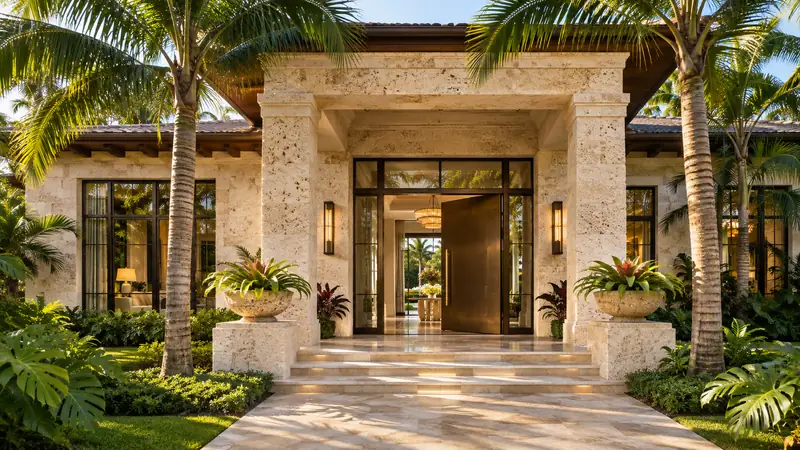
"Our house has coral rock around the front door and on the garden wall. We want stone on the new columns and the loggia, but it has to look like it was always there, and we know the city will look at every detail."
In Coral Gables, that is exactly the right way to start. The city was built with local coral rock, and its review process expects new work to respect the house it goes on. Most stone veneer requests here are not about adding something new; they are about matching, extending or restoring the stone a Mediterranean, colonial or classic revival home already has.
After the project review, your written proposal lists the following scope and pricing: Short answer: natural stone veneer in Coral Gables starts at $47 per sq ft installed, and outdoor kitchen island faces. J. Perry & Sons sets real coral stone, keystone, cut limestone and travertine on entry columns, door surrounds, garden and courtyard walls, loggias and fireplaces, over block or stucco, and prepares the material package for the Board of Architects. We install natural stone only.
We are a licensed and insured Florida general contractor (CGC1540699) with 150+ projects completed across Miami-Dade, Broward and Palm Beach. A certificate of insurance is available on request. See our stone veneer page for every application we build, or the Coral Gables renovation contractor page for the other trades we handle in the city.
Next step: take a close photo of any stone already on the house, with your hand or a coin in the shot for scale.
A city built from local rock
Coral Gables takes its name from the coral rock house its founder grew up in, and the local oolitic limestone people call coral rock or keystone is everywhere in the city's early architecture: walls, door surrounds, columns, steps, fountains and garden edging. That stone is the reason the city looks the way it does, and it is why a new stone element that does not match stands out from the street.
So the first conversation is never "which stone do you like?" It is "what is already on the house, and how do we continue it?" Coral stone varies a great deal: bright cream with open, shell-filled pores, tighter and grayer pieces, and everything between. The same quarry can produce different color from one batch to the next. A good match starts with looking at your existing stone in daylight, not in a showroom.
Next step: tell us which parts of the house already have stone and which parts you want to add.
Matching existing coral rock, step by step
Matching stone on an older house is part science and part patience. This is how we approach it.
Read the existing stone. We look at color, pore size, how the face was cut (sawn, split or tooled), the joint width and the mortar color. On an older house the mortar is often as important to the match as the stone itself.
Bring real samples. We bring several natural samples to the house and hold them against your stone in morning and afternoon light, wet and dry, because coral stone changes color when it is wet.
Lay it out on the ground. Before anything is set, we dry-lay the stone on the ground to blend color from several crates, so no wall ends up with a block of one shade.
Match the joint. A tight, hand-pointed joint in a mortar tinted to the original gives a new column the same rhythm as the old wall beside it.
Accept honest limits. Natural stone from a different bed will never be identical to stone set decades ago. We show you the closest options before ordering, so there are no surprises when the crates arrive.
Next step: if part of the house was already redone with a different stone, mention it; we will tell you which one to match.
Stone choices that suit Mediterranean and classic homes
If you are not matching an existing stone, these are the natural options that sit well on Coral Gables architecture.
Coral stone and keystone. The local look, with visible fossils and pores. Ideal for door and window surrounds, columns, garden walls, steps and pool areas. See our coral stone page.
Cut limestone. Smoother and more uniform than coral stone, in cream and buff tones. Suits a classic facade, a water table along the base of the house or a formal entry.
Travertine. Warm, slightly veined and very at home in a Mediterranean courtyard, a loggia wall or a fireplace surround.
Natural ledgestone. Better suited to an interior fireplace or a newer, modern home than to a historic street facade, where it can look out of place.
Next step: send a photo of the whole front of the house so we can suggest the stone that suits its style.
The Board of Architects package
Almost any stone on the outside of a Coral Gables house is visible from somewhere, so plan on Board of Architects review for exterior veneer, and historic preservation review on a historic-designated property. Interior work, such as a fireplace or a feature wall, generally does not go to the board, but it still follows the permit rules when it involves structure, gas or electrical work.
A clean submittal is what keeps the review moving. We prepare it with you:
- Photos of the house and the areas to receive stone
- Elevations or marked-up photos showing exactly where the stone goes
- A physical stone sample, plus product data
- Joint and mortar color, cap and coping details
- A simple rendering from our designer once you sign the proposal, when it helps the board picture the result
J. Perry & Sons pulls the permits itself and follows every city and county requirement on the job. Stone is ordered only after the approvals are in hand, so you never pay for material the board does not accept.
Next step: ask us whether your property is historic-designated before you finalize a design. It changes the review.
Attachment in the High-Velocity Hurricane Zone
Miami-Dade is in the High-Velocity Hurricane Zone, which carries the strictest wind provisions in the Florida Building Code. Stone on the outside of a Coral Gables house has to stay on the wall through hurricane-season wind and rain, and the attachment is built for that.
Over CBS block. We install metal lath with corrosion-resistant fasteners, a scratch coat, and set the stone in a polymer-modified mortar with full back-buttering so there are no voids behind the piece.
Over existing stucco. We sound the stucco first. Where it is loose or hollow, it comes off; stone set over stucco that is already letting go will follow it off the wall.
Water management. A weep screed at the base lets water out. Caps on columns and walls are sloped so rain runs off instead of soaking into the top of the stone.
Tall or heavy work. For new garden walls, taller columns and heavy stone, the structure and anchoring come from the engineer or architect and the code. New garden walls are typically built in CBS with filled cells and rebar to those drawings. Engineering is done by a licensed engineer, and we build to the engineer's drawings and pull the permit.
Next step: if you have the original plans or a survey of the house, keep them handy for the Free Project Review.
Caring for coral stone after it is installed
Coral stone is porous, and that is part of its beauty. It also means it has to be finished the right way.
Breathable sealer only. A penetrating, breathable sealer goes on at the end, after the setting materials cure as the manufacturer specifies. A film-forming coating traps moisture, and trapped moisture shows up as white efflorescence or a flaking face.
Efflorescence. White salt bloom on new stone is usually moisture working out of the mortar. It is cleaned with the right product, not a pressure washer, which can erode the soft face.
Mold and staining. Shaded walls and garden areas collect algae. Gentle cleaning and a resealing schedule keep the stone looking right. Our guide on sealing natural stone in Florida humidity explains more.
Next step: if your existing coral stone is stained or dark, send a photo. Sometimes cleaning and resealing is all it needs.
Typical Coral Gables projects
Entry columns at the front walk or the driveway are the most frequent request. See entrance columns and our guide to stone veneer entrance columns cost.
Door and window surrounds in coral stone or limestone that frame the entry the way the original houses did.
Garden, courtyard and retaining walls, clad in stone over CBS. See retaining walls.
A water table along the base of the house, which grounds a stucco facade visually.
Fireplaces and feature walls inside, often in travertine or limestone. See fireplace installation in Coral Gables.
Outdoor kitchens on the loggia, faced in coral stone to match the house. See outdoor kitchens.
When stone is one part of a bigger change to the outside of the house, our exterior renovation page explains how we sequence the trades.
How we build it
- Site visit, measurements and stone samples held against what is already on the house.
- We review every project personally and follow up with you directly.
- Permits where the work requires them; stone ordered and staged once approvals are in.
- Substrate prep: remove loose stucco, install the weather barrier on framed walls, lath and scratch coat, set the weep screed.
- Dry-lay the stone on the ground to blend color, then set it with tight, consistent joints and full back-buttering.
- Point joints, clean the face, apply the breathable sealer and walk the finished work with you.
What stone veneer costs in Coral Gables
After the project review, your written proposal lists the following scope and pricing: Natural stone veneer in Coral Gables starts at $47 per sq ft installed, and outdoor kitchen island faces. The final price is based on the stone you choose (matched coral stone is often the most selective order), the condition of the wall, the number of corners, caps and openings, how high we work, and whether new block construction is part of the job. Caps, column lights and new CBS walls are separate lines in your proposal.
| What you are pricing | Starting at |
|---|---|
| Natural stone veneer, installed | Starting at $47 per sq ft |
| Caps, lighting, new CBS walls, Board of Architects package | Itemized in your written proposal |
Related services in Coral Gables
Planning guides: stone veneer entrance columns cost · stone veneer vs stucco and paint · exterior stone veneer siding cost in Florida
Natural and coral stone veneer for façades, columns and feature walls.
Free project review · (561) 556-7509
FAQ
Can you match the coral rock already on my house?
Usually we can get very close. We bring several natural samples and compare them against your stone in daylight, wet and dry, and match the joint width and mortar color too. Color and pore size vary by quarry and batch, so we show you the closest options before anything is ordered.
Will exterior stone need review in Coral Gables?
Plan on it. The Board of Architects reviews visible exterior changes, and historic-designated properties add preservation review. We prepare the package with photos, marked-up elevations, a physical sample and product data, and we order stone only after approval.
Is real coral stone worth it over a cast imitation?
On a Mediterranean or older home, yes. Real coral stone has fossils, pores and color variation that read correctly next to original stone and age the same way. It is also the only kind we install.
Why do you insist on a breathable sealer?
Coral stone is porous. A film-forming coating traps moisture inside the stone, which leads to white efflorescence and a flaking face. A penetrating, breathable sealer protects it while letting moisture escape.
Can stone go over my existing stucco?
Only if the stucco is sound and bonded. We tap and inspect it during the Free Project Review. Loose or hollow stucco comes off first, then lath and a scratch coat give the stone a proper masonry base.
What does stone veneer cost in Coral Gables?
After the project review, your written proposal lists the following scope and pricing: Natural stone veneer starts at $47 per sq ft installed, and outdoor kitchen island faces. The final price is based on the stone, the wall condition, corners, caps and openings, and any new block work. We review every project personally and follow up with you directly.