
Need stone on a storefront, a sign base or a community entrance? J. Perry & Sons installs commercial stone veneer in Broward, Palm Beach and Miami-Dade for general contractors, building owners, property managers and HOA and condo boards. This is the commercial side of our stone veneer work. If the property is your own single-family home, the residential stone veneer page fits better. We bid commercial veneer by unit, from drawings or a site walk, and write the scope so you can compare it line by line.
Commercial stone veneer pricing by unit
| Application | Unit | Installed range |
|---|---|---|
| Manufactured stone veneer, exterior wall | per sq ft | $27–$37 |
| Natural thin-veneer ledgestone or stacked stone | per sq ft | $38–$50 |
| Natural limestone, travertine or coral stone panels | per sq ft | $46–$65 |
| Interior lobby feature wall | per sq ft | $36–$50 |
| Storefront column wrap, 4 sides, 10–12 ft | per column | $3,250–$5,250 |
| Monument sign base veneer and cap, 6–10 ft wide | each | $7,750–$14,000 |
| Stone caps and sills, cast stone, limestone or precast | per linear ft | $50–$80 |
| New footing and block structure for a monument sign, 6–10 ft wide, before stone | each | $4,500–$9,000 |
| New block community entry wall, before stone | per face sq ft | $55–$95 |
| Removing an existing sign base or entry wall | each | $1,500–$4,500 |
| Barrier, lath and scratch coat over framed storefront bump-outs | per sq ft | add $6–$10 to the stone rate |
| New CMU amenity building structure | per job | priced from drawings |
About these prices. These ranges are starting points based on typical South Florida projects. Your final price depends on the condition of the property, access, the materials or system specified and the full scope of work. We confirm every number after we review your project in person or from the drawings, and the price in your signed proposal is the one that applies.
Ranges cover labor, lath, scratch coat (the cement base coat the stone sets into), setting materials, grout and sealer. If you supply the stone, the unit price drops by the material. Lift or scaffold, after-hours premiums and permit fees are carried as separate lines so you can see them.
What we build for commercial clients
Storefronts and facades. Stone on retail piers, bulkheads under storefront glass, tower elements and full elevations on plazas, offices and medical buildings. Method and sequencing are on the storefront and facade stone veneer page.
Monument signs and community entry walls. CMU sign bases and entry walls built and faced in stone, with the sign cabinet opening blocked out to the sign company's dimensions. See monument signs and entry walls.
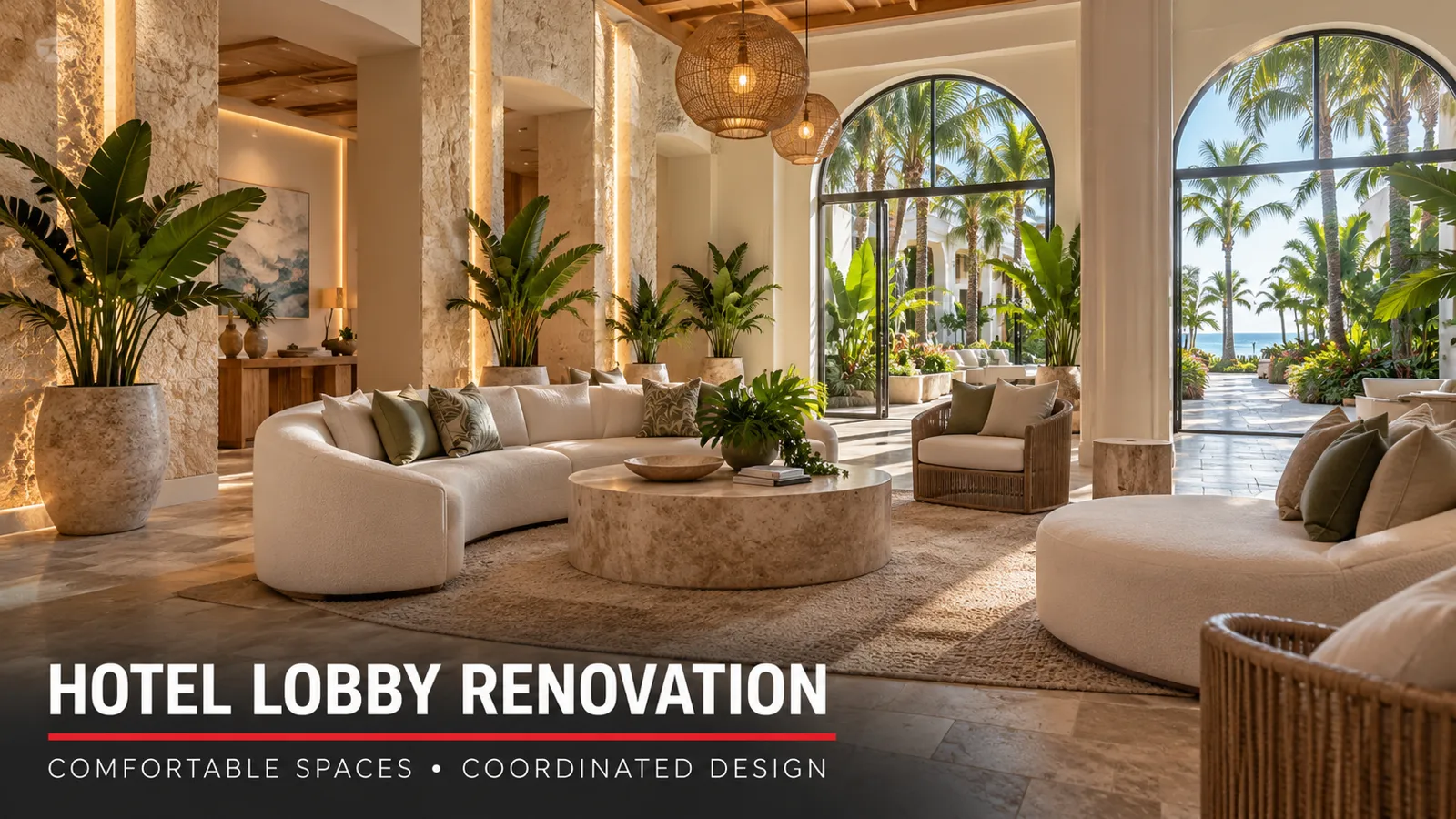
Amenity buildings and common areas. Clubhouse exteriors, pool cabanas, mailbox kiosks, guardhouses and lobby feature walls for HOA and condo associations. For full lobby renovations see condo lobby and common area renovation.
Columns and porte-cocheres. Column wraps at entries, drop-offs and covered walkways, with caps and bases in cast stone or limestone.
Have elevations or just a property address? Send either one through our project form and we'll return a unit-priced bid within 48 hours.
How we work with GCs, owners and boards
GC, owner or board, you need the same things from a stone sub: a clear bid, the right paperwork and a crew that works around your tenants.
- Bids from drawings in 48 hours. We take off each elevation by stone type and substrate, count corners, caps and sills in linear feet, and list columns and sign bases as units. Addenda and added walls are priced at the same unit rates.
- COI naming the owner. Certificates name the owner, the management company and the GC as additional insured where the contract requires it, and go out with the crew roster before mobilization.
- Phased and night work. On open storefronts and occupied communities we phase by elevation or by building, keep entrances and ADA routes clear, and move cutting and mixing outside business hours when the lease or the board requires it.
- Submittals and mockups. Product data, color samples and a mockup panel on site for approval before the stone is ordered in volume.
- Permits pulled by us. Where the scope needs a permit, we pull it under our Florida general contractor license and schedule the lath inspection before the stone covers it.
- Closeout documents. Product data sheets, inspection sign-offs, sealer records, attic stock count, a punch list closed with the superintendent or manager, and warranty paperwork.
Workmanship warranty on every job; materials carry the manufacturer's warranty. Terms are in your written contract.
Substrates on commercial jobs
CBS block and sound stucco. Most plazas and community structures here are concrete block. Clean block or well-bonded stucco takes stone directly with a polymer-modified veneer mortar, once we have sounded the wall (tapped it for hollow spots) and cut out any hollow stucco. If the elevation also needs stucco work beyond the stone areas, see commercial stucco.
Framed walls. Storefront bump-outs, canopies, parapet extensions and sign structures in wood or metal frame get two layers of water-resistive barrier, galvanized or stainless lath, a cured scratch coat, a drip or weep screed at the bottom and flashing at every head.
Interior lobbies. Over drywall we add cement board or lath and scratch coat, so the stone isn't hanging on paper-faced gypsum. Returns around elevator frames and reception desks are mitered or capped, never left as raw cut edges.
Not sure what's behind your existing walls? Call (561) 556-7509 and we'll check the substrate on a site walk.
Wind, water and code in South Florida
Miami-Dade and Broward sit in the High-Velocity Hurricane Zone, and Palm Beach is wind-borne debris territory. On framed walls, that means attachment details per the architect's drawings, product approvals for manufactured stone, and a lath inspection before the scratch coat. We do not do engineering; we build to the engineer's drawings and coordinate a licensed engineer when the work needs one.
Day to day, though, water is the bigger issue. Wind-driven rain can beat on a storefront for hours, so every top edge is capped or flashed and every base gets a weep (a drain path out). Within a mile or two of the coast we use stainless lath and fasteners. Joints where stone meets storefront framing are sealed; see storefront and curtain wall sealing.
Common veneer failures on commercial buildings and how we prevent them
Is the stone on your building already coming loose, staining or cracking? When we're called to a plaza or a community entrance to fix someone else's stone, the cause is almost always one of a few details. These are the ones we build against on every commercial wall.
| Failure | What causes it | How we prevent it |
|---|---|---|
| Stones letting go at the top courses | Mortar skinned over before setting, or stone set on a dusty scratch coat | Stone back-buttered and set in a polymer-modified veneer mortar (Mapei or Laticrete stone mortars, or approved equal) while the bed is wet; scratch coat dampened first |
| White bloom on the face | Water moving through the wall and carrying salts out | Caps with drip edges, sealed penetrations, and a breathable sealer on natural stone, never a film-forming one |
| Rust streaks below the stone | Uncoated lath or fasteners near salt air | Stainless lath and fasteners on coastal buildings, galvanized inland, stated on the bid |
| Stained or green base courses | Stone run into planters or mulch, irrigation hitting the face | Weep screed at the base, stone held above grade, irrigation heads turned |
| A crack running through several stones in a line | Veneer bridged across a control or expansion joint in the stucco or slab | Joints carried through the stone and filled with sealant |
| Color mismatch between phases | Manufactured stone ordered in separate runs | Full quantity ordered from one production run of Eldorado Stone, Coronado or the specified product, with boxes blended on site |
The scratch coat under the stone is a Type S mix, raked and cured before setting, and the lath inspection is passed before it is covered. On repair work we cut out to the cause before resetting any stone, and your bid states which of these conditions we found on the walk.
Already dealing with failing stone? Send photos of the worst areas through our project form.
Typical durations
- Monument sign base: 3–5 working days after the block is up
- Storefront column wraps, 4–6 columns: 1–2 weeks
- 500–1,000 sq ft storefront facade: 2–3 weeks including scratch coat cure
- Lobby feature wall, 150–300 sq ft: 4–7 working days
On a plaza renovation the veneer usually follows stucco repair and comes before paint, so the paint line lands clean at the stone.
Commercial stone veneer by city
Fort Lauderdale · Hollywood · Pompano Beach · Miami · Aventura · Delray Beach · Palm Beach Gardens · Miramar
See the stone veneer overview for stone types, or residential stone veneer for single-family homes. Our guide to commercial stone veneer on storefronts and monument signs gives worked examples.
Prefer to send photos or plans? Send us your project
Commercial stone veneer FAQ
Can you bid from architectural drawings without a site visit? Yes. Send the elevations, wall sections and finish schedule. We return a unit-priced bid within 48 hours and note anything we need to confirm on site, such as the condition of existing stucco.
Do you work as a subcontractor to the GC? Yes. We bid the veneer scope with unit prices, provide our license and COI, and schedule around the GC's sequence: after framing and stucco, before paint and signage.
Can the work happen while tenants stay open? Yes. We phase by elevation, keep entrances and walkways open behind barriers, and shift loud cutting outside business hours when the lease or the manager requires it.
Does the HOA or condo board need to approve the stone? Usually the board approves the product and color from a sample and a mockup panel. We build the mockup on site so the vote is on the real stone, not a catalog photo.
What is the fastest path to a firm commercial number? Send the drawings or the address through our project form, or call (561) 556-7509. Once scope, access and schedule are confirmed, the written unit-priced bid follows within 48 hours.
Free estimate — call (561) 556-7509 or send us your project. Licensed Florida general contractor CGC1540699. Serving Broward, Palm Beach and Miami-Dade counties.