By John Perry
Tile doesn't fail because of the tile. It fails because of what's under it. The wrong mortar, too little of it, or the right mortar mixed wrong is behind most of the cracked, hollow and popping floors we get called to fix in South Florida. For large-format tile we use large-format mortars such as Mapei Ultraflex LFT, Laticrete 4-XLT or Laticrete 254 Platinum, Schluter DITRA uncoupling membrane over slabs with cracks, and Schluter profiles at edges and transitions.
You'll never see the thinset once the job is done, so it's worth knowing what your installer is using and why. Here's how we choose it.
What thinset actually does
Thinset (or thin-set mortar) is the cement-based adhesive that bonds tile to the floor or wall. It has three jobs:
- Bond. Hold the tile permanently to the substrate.
- Support. Fill completely under the tile so there are no hollow spots that crack under weight.
- Flex. Absorb small movement from heat, the slab and the building, without letting go.
Different tiles and different locations need different mortars. One bag does not do everything.
The main types of thinset
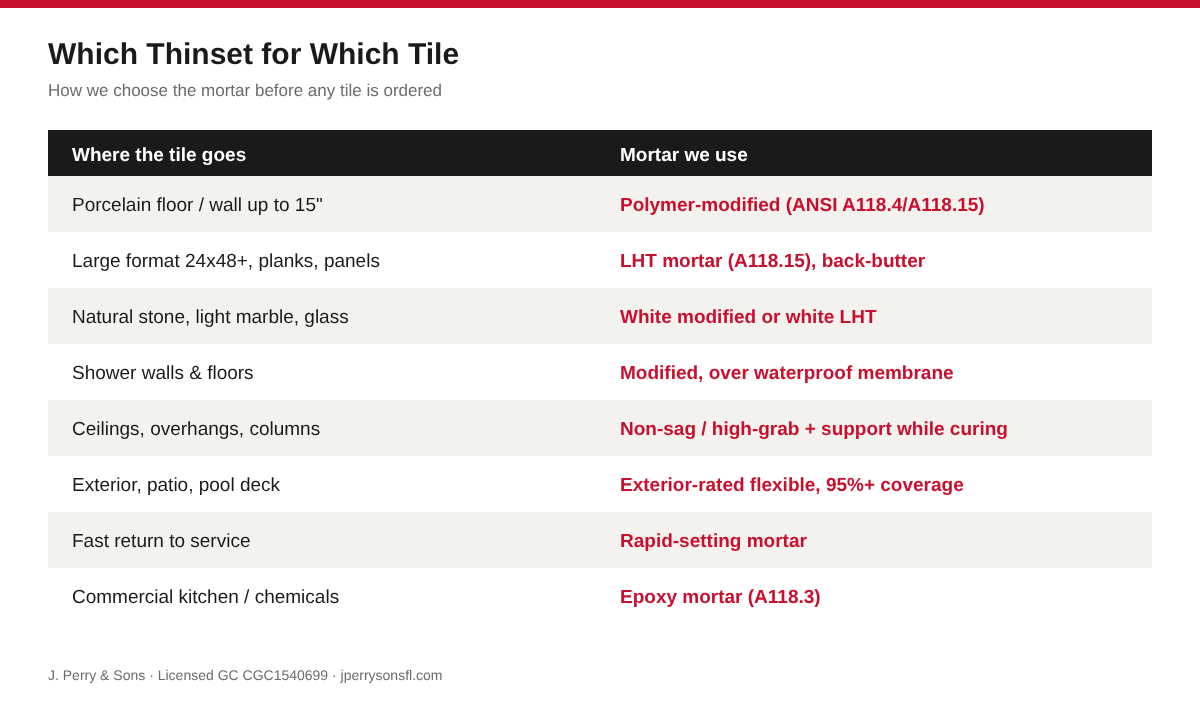
| Type | Industry standard | What it's for |
|---|---|---|
| Unmodified thinset | ANSI A118.1 | Required by some membrane systems (for example over certain sheet membranes). Rarely our choice on its own. |
| Polymer-modified thinset | ANSI A118.4 / A118.15 | Our baseline for porcelain floors and walls. Better bond, flexibility and water resistance. |
| Large and heavy tile (LHT) mortar | ANSI A118.15 (often with A118.11) | Tiles over 15" on any side, wood-look planks, panels, heavy stone. It builds up thicker without the tile sinking. |
| Rapid-setting mortar | varies | When the space has to be back in use fast, such as commercial jobs, condos and restaurants. |
| White vs gray | — | White under light stone, glass and light grout so nothing shows through. Gray for everything else. |
| Epoxy mortar | ANSI A118.3 | Chemical-resistant areas such as commercial kitchens and some pool and specialty work. |
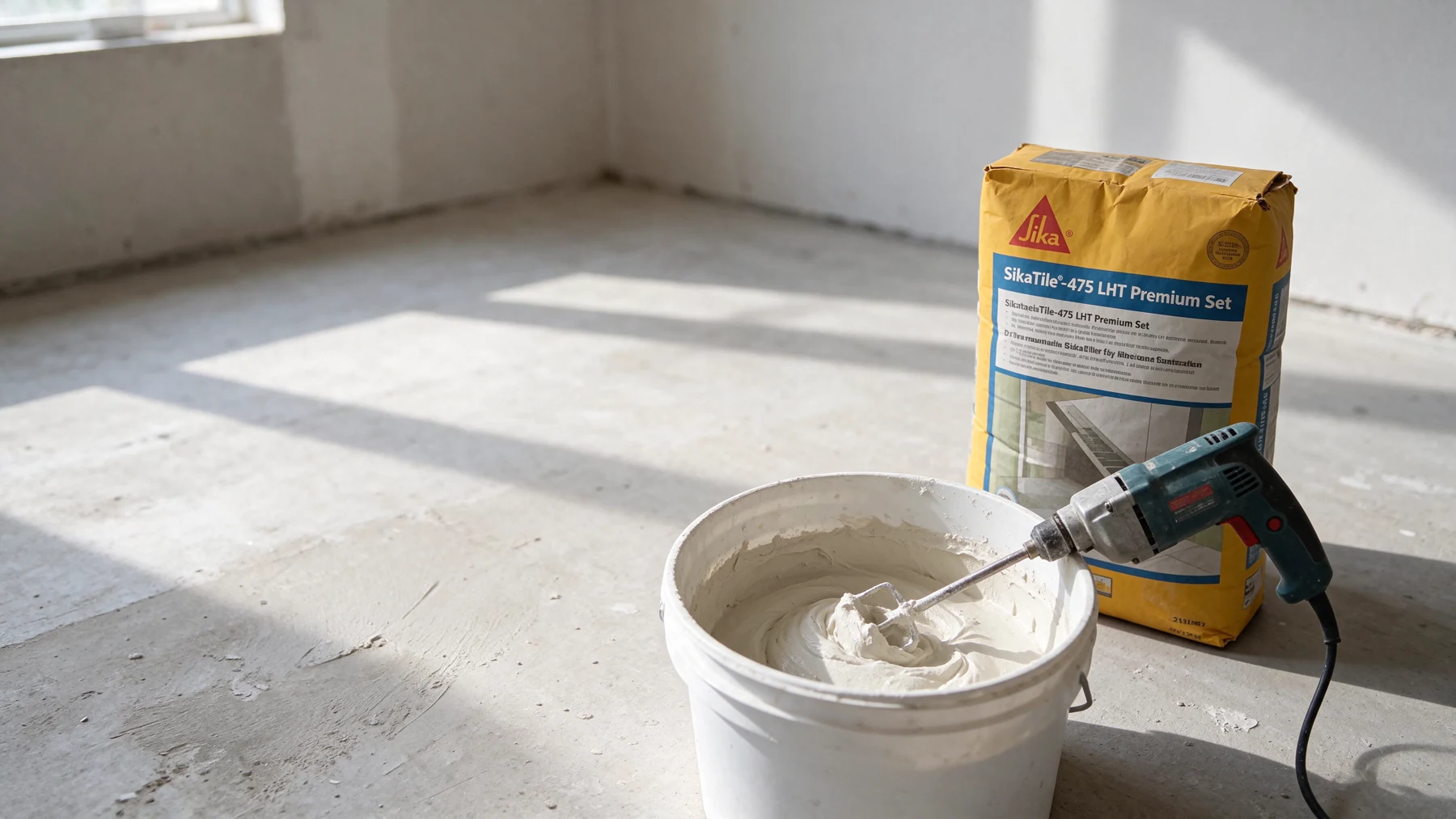
What we use on large-format porcelain: SikaTile-475 LHT Premium Set (white). It's a high-performance flexible LHT mortar, classified C2TE S1P1, made for large porcelain, gauged porcelain panels, marble, granite and natural stone, indoors and out. We also work with Mapei and Laticrete systems when a project or a membrane manufacturer calls for them.
Call (561) 556-7509 or send us your project with photos, the city, approximate dimensions, and material selections.
Floors, walls, ceilings and exterior: different jobs
- Floors. These need full support under every tile. Large formats need LHT mortar and back-buttering.
- Walls and showers. The mortar has to hold tile without slumping. Non-sag mortar keeps heavy wall tile from sliding while it sets. In showers it goes over a waterproof membrane, never straight onto drywall.
- Ceilings and overhangs. Tile on a ceiling or soffit needs a high-grab, non-sag mortar, plus mechanical support until it cures.
- Exterior walls, columns and patios. Florida sun and rain demand an exterior-rated, flexible mortar with 95% or better coverage so no water sits behind the tile. On exterior porcelain cladding we use LHT mortar, a leveling system and movement joints.
Trowel size and coverage
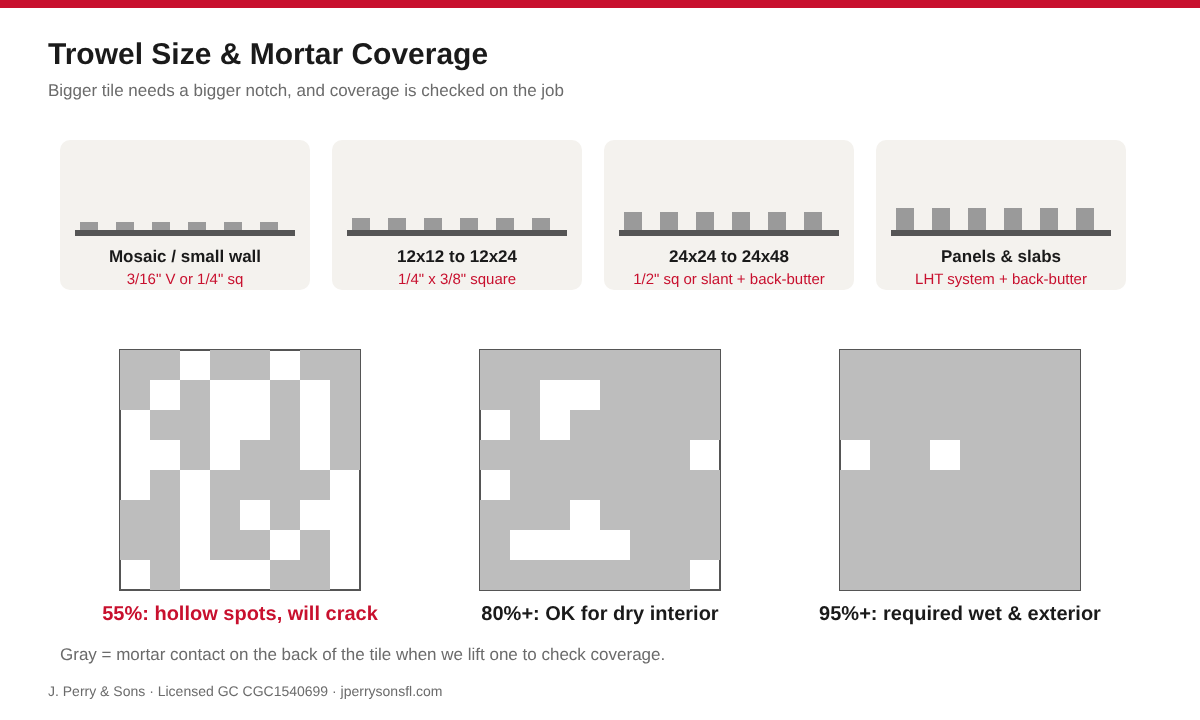
The trowel notch controls how much mortar ends up under the tile:
| Tile size | Typical trowel |
|---|---|
| Mosaics and small wall tile | 3/16" V-notch or 1/4" square |
| 12x12 to 12x24 | 1/4" x 3/8" square-notch |
| 24x24 to 24x48 | 1/2" square or slant/euro notch, plus back-butter |
| Panels and slabs | Manufacturer's LHT system, plus back-butter |
Coverage targets, which we check by lifting a tile during the job:
- 80% minimum in dry interior areas
- 95% minimum in showers, wet areas and outdoors
- edges and corners fully supported on large tiles
We comb the ridges in one direction and press the tile across them, so air can escape and the mortar collapses into a solid bed.
Mixing it right
Even the best mortar fails when it's mixed wrong:
- the exact water amount printed on the bag (more water means a weaker bond)
- mixed with a paddle at low speed, then left to slake (rest) and remixed
- used within its pot life, and never re-tempered with extra water once it starts to set
- open time respected: if the surface skins over, it gets scraped off and fresh mortar goes on
Shower floors are different: the mortar bed
A shower floor isn't just thinset. Under the tile there's a sloped mortar bed that makes water run to the drain at 1/4" per foot. We build the slope by hand, with a pre-slope under the liner or membrane, then the final bed, and we flood-test before any tile goes down. See our shower pan guide: shower pan replacement cost.
Signs the wrong mortar (or too little) was used
- tiles that sound hollow when tapped
- cracked tiles in walkways
- tiles popping or tenting up in summer
- loose wall tile or stone veneer
- efflorescence (white powder) bleeding through outdoor grout
If you're seeing these, the fix is usually removal and a proper reinstall. Re-grouting won't solve it.
Thinset and waterproofing membranes
In showers, balconies and wet areas, the mortar has to work with the waterproofing under it, and not every thinset does. Before we order material we check what the membrane manufacturer requires:
- Liquid-applied membranes (rolled on like thick paint). Most accept polymer-modified thinset once the membrane has fully cured.
- Sheet membranes (bonded fabric or plastic sheets). Some systems call for unmodified thinset or their own specific mortar, both to set the membrane and to set the tile on top.
- Traditional liners (PVC pan liner under a mortar bed). The tile is set on the cured mortar bed, not on the liner.
Mixing systems, for example the wrong mortar over a membrane, can void the manufacturer's warranty and lead to leaks. We keep each assembly within one manufacturer's tested system.
Natural stone needs extra care
Marble, travertine and limestone react differently than porcelain:
- White mortar for light stone, because gray mortar can shadow through translucent marble.
- Rapid-setting or low-water mortar for moisture-sensitive stone such as some green marbles, which can warp or curl when they absorb water from the mortar.
- Full coverage under every piece. Stone cracks easily over hollow spots.
- Sealing before grouting on porous stone, so the grout doesn't stain the surface.
Florida conditions: heat, humidity and fast-drying slabs
South Florida weather changes how mortar behaves:
- Heat shortens open time. On a hot slab or an outdoor wall in the sun, mortar can skin over in minutes. We mix smaller batches, work in the shade or early in the day outdoors, and check the ridges constantly.
- Dry, porous slabs pull water out of the mortar. New or very dry concrete gets dampened or primed so it doesn't steal the water the mortar needs to cure.
- Humidity slows final curing in closed rooms. We respect the cure time before grouting and before heavy traffic, and give extra time before flood tests and wet use.
- Rain on exterior work. Fresh exterior tile gets covered until the mortar has set.
Thinset is not a floor leveler
A common shortcut is to "build up" thinset under tiles to hide a wavy floor. It doesn't work. Thinset is designed for a specific bed thickness, and piling it up causes:
- shrinkage and weak spots as the thick mortar cures
- tiles that settle unevenly and leave lippage
- hollow areas that crack under weight
The right fix is to flatten the floor before tiling. High spots get ground down, low spots get a self-leveling underlayment, and only then does the tile go on with a normal mortar bed. LHT mortars allow a thicker bed than standard thinset, but they still aren't a substitute for a flat floor. More in our self-leveling and floor leveling guide. We prime the slab with Laticrete NXT Primer or Mapei Primer T before pouring a self-leveling underlayment such as Laticrete NXT Level.
How much mortar a tile job really uses
Clients are sometimes surprised by how many bags show up on a large-format job. On a typical floor:
- standard tile with a 1/4" x 3/8" notch uses roughly one 50 lb bag per 40–60 sq ft
- large format with a 1/2" notch plus back-buttering uses roughly one bag per 25–40 sq ft
- lightweight LHT mortars such as SikaTile-475 cover more area per bag (the bag states up to 50% more)
That's why a 2,000 sq ft large-format floor can need 50–80 bags of mortar. It's one of the reasons honest quotes for large tile cost more than "per sq ft labor only" numbers you see online.
Doing it right costs less than doing it twice
Mortar is a small part of the total cost of a tile floor, usually a few hundred dollars on a typical room. Tearing out and replacing a floor that failed because of the wrong mortar or poor coverage means:
- removing and disposing of the failed tile
- buying new tile (and hoping the same color is still available)
- reinstalling, usually at more than the original price
After the project review, your written proposal lists the following scope and pricing: On a large living area that can easily or more. Spending a little more on the right mortar and the time to install it properly is the cheapest insurance you can buy.
Questions to ask any tile installer about mortar
- Which mortar brand and type will you use, and does it meet ANSI A118.15 for large tile?
- Which trowel size, and will you back-butter?
- How do you check coverage on the job?
- Is the mortar compatible with the waterproofing membrane you're using?
- Will you wait for the mortar's cure time before grouting?
If the answer to the first question is "whatever's on the truck," keep looking.
Reading a thinset bag before you buy
Every bag of mortar tells you what it can and can't do. Before it goes on a job, check:
- the standard it meets: modified mortars for porcelain are typically labeled to meet ANSI A118.4 or the higher A118.15 for improved performance
- tile size it's rated for: large-and-heavy-tile mortars are labeled for big formats and thicker beds
- substrate list: concrete, cement board, membranes, plywood or existing tile
- interior or exterior: exterior and wet-area work needs a mortar rated for it
- open time and pot life: the working time once it's mixed, which matters in South Florida heat
- cure before grouting: usually 24 hours, faster for rapid-setting mortars
If the bag doesn't list your tile, your substrate or your conditions, it's the wrong mortar for the job.
Get it done right the first time
We specify the mortar, trowel and membrane for every job before the tile is ordered. Send us your project or call (561) 556-7509, and we'll tell you exactly what goes under your tile and why.
Why South Florida owners choose J. Perry & Sons
- A licensed Florida general contractor (CGC1540699) with 150+ completed projects and a workmanship warranty.
- Flat floors, full mortar coverage and movement joints done right.
- Our own tile crews on every job.
- Layouts planned with you so cuts fall where they look intentional.
- Daily updates with photos, and we call you before every decision.
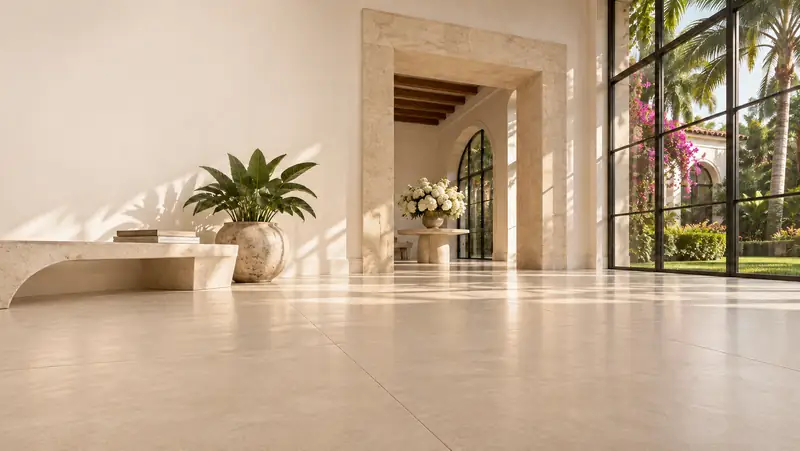
Want your floor to look like this? Plan your new floors
How we work
- Project Review. We look at the rooms with you, check the slab and talk about the tile you want.
- Proposal. A clear scope and a starting price, everything written down.
- Private Showroom Appointment. Choose the tile, the size, the layout and the grout with us, with samples in your light. You can add our designer for a full design plan; design time is billed separately.
- Installation. Removal, slab preparation, waterproofing where needed, tile, grout, sealing and a final walkthrough, with daily updates.
Away for the season?
Hand us your floor project and come back to it finished. You get photos and a short update every day, and we call you before every decision. Keys, deliveries, inspections and cleanup are handled. How renovating while you're away works →
Many of our clients prefer that their homes stay private, so most of our work isn't online. When we meet at your project, we'll show you work similar to yours. See private clients.
Working with an architect or designer? We take over and manage the whole project with them. See architects, engineers and designers.
The Owner's Guide to Tile, Floors and Stone
How to choose the right floor, what makes it last, what to ask any contractor and how to care for it.
From large-format porcelain to natural stone, set right from the slab up.
Free project review · (561) 556-7509
FAQ
What thinset should I use for large porcelain tile? A large and heavy tile (LHT) polymer-modified mortar that meets ANSI A118.15. Back-butter every tile and aim for at least 95% coverage in wet areas or outdoors.
Is modified or unmodified thinset better? For most porcelain floors and walls, modified thinset is better because it bonds and flexes more. Unmodified is used when a membrane manufacturer requires it.
Can I use the same thinset outside? Only if it's rated for exterior use. Outdoor tile in Florida needs a flexible, exterior-rated mortar with near-full coverage so water doesn't get trapped under the tile.
Why do my tiles sound hollow? Usually not enough mortar coverage, the wrong trowel, or mortar that skinned over before the tile was set. Hollow tiles are at risk of cracking.
What is white thinset for? For light-colored natural stone, glass tile and light grout, so gray mortar doesn't show through or stain.
Call (561) 556-7509 or send us your project with photos, the city, approximate dimensions, and material selections.
Share your vision for your South Florida home.
Free project review · (561) 556-7509