
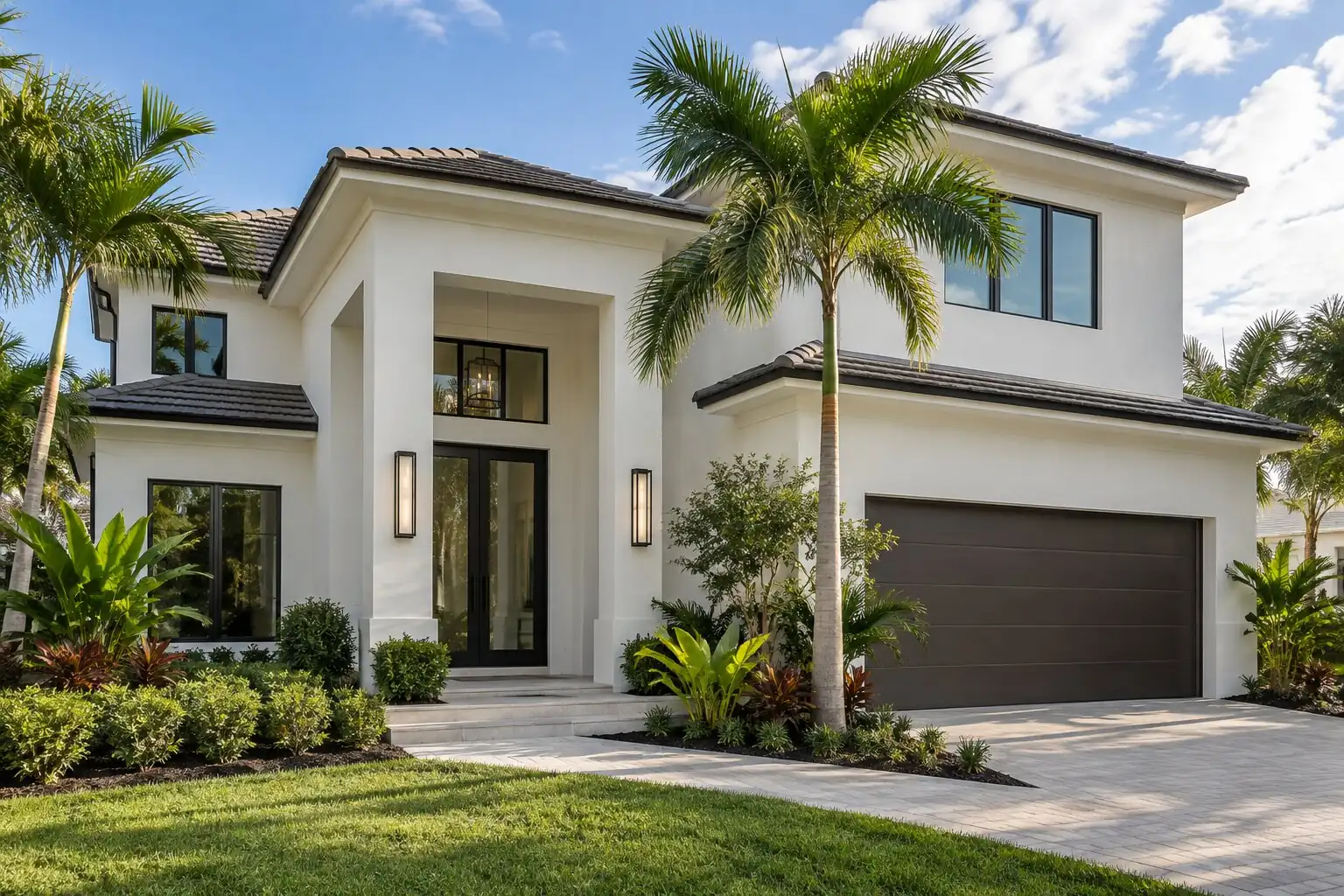
When Jupiter owners call us about stucco, they usually mean one of three things: hard-coat cement stucco, synthetic stucco and EIFS, or the smooth finishes that sit on top of both. They look alike from the driveway, yet each one is repaired in a completely different way. J. Perry & Sons works on all three, and our stucco services hub explains each system. If it is your house, continue to residential stucco in Jupiter; GCs, managers and boards should use commercial stucco in Jupiter.
Three systems on Jupiter walls
Hard-coat cement stucco. Most Jupiter homes and low-rise commercial buildings are concrete block with three-coat Portland cement stucco bonded to the block. On the east side, along the Loxahatchee River and the Intracoastal, much of the original housing dates from the 1960s and 1970s and carries sand or dash textures. Farther west, the gated and golf communities built from the 1980s onward are block, often with a framed second floor, and knockdown or skip-trowel finishes. Hard-coat is dense, takes impact well and is the system we recommend for houses.
Synthetic stucco and EIFS. People use the term synthetic stucco for two things. One is an acrylic finish coat troweled over a cement base. The other is EIFS: foam board fastened or glued to the wall, a reinforcing mesh in a base coat, and a flexible acrylic finish. Some of the larger homes in Jupiter and on Jupiter Island, and a share of the commercial buildings, have EIFS on whole walls or on cornices, bands and window surrounds. Foam dents under a hard hit, and water that gets behind it at a window or a roof line has no easy way out. It cannot be patched with cement. Our EIFS and high-build stucco page covers EIFS installation and repair.
Interior plaster. Some older river and inlet homes have plaster walls or ceilings inside instead of drywall. Plaster restoration is its own craft: we reattach loose plaster, fill the cracks and skim the surface. That work is on our plaster page.
Not sure which of the three is on your house? Call (561) 556-7509 and we'll identify it on a quick visit.
Stucco finishes you will see in Jupiter
The finish is the top layer, the part you see. The 1960s and 1970s houses near the water tend to have sand float or dash. Subdivision homes from the 1980s through the 2000s lean to knockdown and skip trowel. Many rebuilt waterfront homes and the newest communities on the far west side were finished smooth.
Own a Mediterranean-style house with a hand-troweled look? That Mediterranean stucco finish is usually a skip trowel or a heavier hand-applied texture, and matching it on a repair is about the trowel work, not the material. Decorative wall coatings, such as textured acrylic finishes and elastomeric coatings, go over sound stucco to add color, texture and crack bridging. Interior walls in older Jupiter homes sometimes have real plaster, which we repair and restore on our plaster page.
Thinking of going smooth? It is the most requested change. Smooth looks clean with large impact windows but shows every wave and hairline, so the brown coat (the middle layer) has to be floated true before the finish goes on. On EIFS, the finish is acrylic and can be colored all the way through; on hard-coat it is cement and gets painted. We make a sample on your actual wall before anything is committed, because a small chip never looks like a full elevation in the afternoon sun. See smooth stucco finish.
Salt air: what it does to stucco near the inlet
On Jupiter's east side, salt is the deciding factor. Steel lath, corner bead and the steel in lintels and tie beams rust. Rust expands, and that expansion pushes stucco off at window heads, band lines and corners. That is why stucco repair on Jupiter Island and along the inlet often turns into concrete repair: the steel behind the coat has to be cleaned, treated and covered with repair mortar before any stucco goes back on.
On coastal work we use galvanized or PVC accessories and coated fasteners. On water-facing walls we prefer a breathable finish so moisture in the block can leave. Inland, salt matters less, and the usual culprits are afternoon storms and irrigation hitting the wall.
What Jupiter stucco work costs
Two rates are published, and both are starting points. Patching cracked or hollow stucco with the texture matched typically starts around $13–$21 per sq ft of patch. Re-stucco of a full elevation in three coats typically starts around $14–$23 per sq ft of wall. Where rusted steel is involved, spalling repair, chipped to the steel and rebuilt, appears as its own line, typically starting around $22–$34 per sq ft. Each is confirmed after we see the project.
EIFS repair, smooth conversions, columns and arch changes on houses are priced per job after a site visit. Commercial buildings, new construction and EIFS facades are priced from drawings.
About these prices. These ranges are starting points based on typical South Florida projects. Your final price depends on the condition of the property, access, the materials or system specified and the full scope of work. We confirm every number after we review your project in person or from the drawings, and the price in your signed proposal is the one that applies.
Which office issues your permit
Which building department handles your address? The Town of Jupiter Building Department covers addresses inside town limits. Unincorporated parcels with a Jupiter mailing address go to Palm Beach County. Jupiter Island is a separate town in Martin County, and Tequesta and Juno Beach are their own municipalities too, so a Jupiter-area address can mean any of several permit offices. We confirm the right one before we quote.
Patching on the same footprint usually needs no permit; re-stucco over new lath, additions and opening changes do. J. Perry & Sons pulls every permit itself and follows every city and county requirement. We do not do engineering; we build to the engineer's drawings and coordinate a licensed engineer when the work needs one.
Have a crack, stain or soft spot you want looked at? Send a wide photo and a close-up through our project form for a free estimate.
Workmanship warranty on every job; materials carry the manufacturer's warranty. Terms are in your written contract.
Your house or a building you manage
For a home, the residential stucco page for Jupiter covers HOA samples, permits and living at home during the work. For plazas, offices, condo buildings and new construction, go to commercial stucco in Jupiter. Our other Jupiter trades are on the Jupiter page.
Nearby: stucco in Palm Beach Gardens · stucco in West Palm Beach · stucco in Wellington
ZIP codes we serve in Jupiter
33458, 33468, 33469, 33477, 33478.
Prefer to send photos or plans? Send us your project
Jupiter stucco FAQ
What is the difference between synthetic stucco and regular stucco? Regular stucco is a hard cement coating on block or lath. Synthetic stucco usually means EIFS, a foam board with mesh and a flexible acrylic finish, or an acrylic finish over a cement base. Each is repaired with its own materials.
How can I tell if my Jupiter house has EIFS? Press firmly on the wall away from a corner. EIFS has a slight give and sounds hollow and soft when tapped; hard-coat feels solid. We confirm it during the site visit before quoting.
Why does stucco near the inlet keep popping off? Usually rusting steel underneath. Salt air corrodes the lath, bead and the steel in lintels, and the rust pushes the coat off. The steel has to be treated before the stucco is rebuilt.
What does stucco work run in Jupiter? Patch repair typically starts around $13–$21 per sq ft, spalling repair around $22–$34 per sq ft and re-stucco of an elevation around $14–$23 per sq ft. EIFS work, columns and smooth conversions on homes are priced per job after a site visit; commercial work is priced from drawings. Final pricing is confirmed after we review your project.
Do you work on Jupiter Island? Yes. Jupiter Island is its own town in Martin County, so we confirm the permit office for your address and plan the exterior work around its coastal exposure.
Free estimate — call (561) 556-7509 or send us your project. Licensed Florida general contractor CGC1540699. Serving Broward, Palm Beach and Miami-Dade counties.