
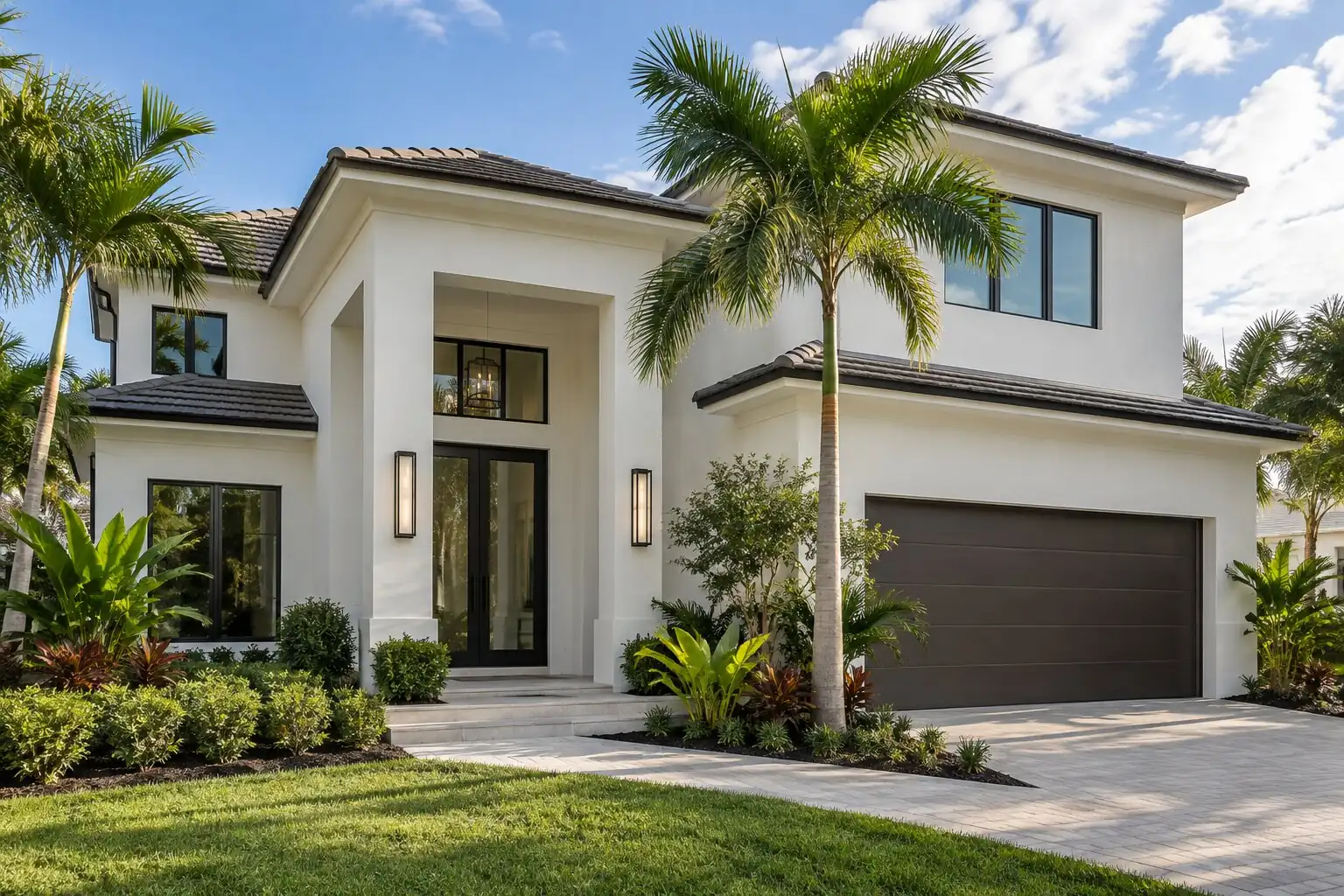
Wellington walls fall into two groups: the subdivision houses and shopping centers of the Village core, and the barns, stables and estate homes of the equestrian area to the south and west. J. Perry & Sons applies, repairs and refinishes stucco on both, and our stucco services hub covers the systems in general terms. If the wall belongs to your own house, go to residential stucco in Wellington. If you are a GC, a property manager or a board, use commercial stucco in Wellington. This page explains which stucco is on which Wellington buildings, and why that matters when yours needs a repair.
Stucco you will find on Wellington buildings
Most of the Village was built from the 1980s into the 2000s as planned communities, and the main system is three-coat Portland cement stucco bonded straight to concrete block. The single-story houses from the earliest phases are block from slab to roof. Many of the later two-story models are block on the ground floor with a wood-framed second floor, and those upper walls carry stucco over metal lath and a weather barrier. That transition is the most common place we find cracking in the Village: a horizontal line at the floor level, where two materials that move differently meet under one coat.
Barns and stable buildings are usually block, sometimes block below and frame above, with cement stucco on the outside. Their lower courses take daily water from wash racks and hoses, so the base of the wall fails long before the rest.
Shopping centers along the main commercial roads, medical offices and community clubhouses are mostly one- and two-story block with cement stucco. Some carry foam cornices, bands or reveals finished in an acrylic coat. Those shapes are EIFS (a foam-based finish system), not hard-coat, and we repair them with foam, mesh and base coat instead of cement.
Finishes, from the subdivisions to the barns
Ever notice that you can guess a Wellington house's age by its texture? It tells you as much as the roofline does. The older single-story homes tend to carry a sand float finish. Two-story models from the 1990s and 2000s more often have knockdown or skip trowel, with raised bands around the windows and arched heads over the front openings. Estate homes in the equestrian area lean toward smooth finishes, which look clean but show every wave in the wall and every hairline crack.
Matching matters more here than in neighborhoods with mixed housing. When thirty houses on a street share one builder texture, a patch that looks coarser or flatter than the wall next to it stands out from the sidewalk. So we build a sample on a hidden section of the same elevation and let it cure before the repair goes on. Wet stucco never looks like dry stucco.
If you want to change the texture instead of matching it, a skim over the existing coat can take knockdown or skip trowel to smooth. Details are on the smooth stucco finish page. In most Wellington communities, a change of texture goes to the architectural committee first.
What Wellington stucco costs
Two kinds of numbers apply across the Village: published starting rates and per-job prices. Cutting out and patching cracked or hollow areas, texture matched, typically starts around $13–$21 per sq ft of patch. Spalling (concrete popping off over rusted steel), chipped to the steel with the rebar treated and rebuilt, typically starts around $22–$34 per sq ft. Removing and rebuilding stucco across a whole elevation typically starts around $14–$23 per sq ft of wall. All of these are confirmed after we see the project. Patches cost more per foot because the setup, the three coats and the texture match take about the same effort on a small area as on a large one.
Everything else on a house, including columns, arch changes and smooth conversions, is priced per job after a site visit. Commercial scopes such as full buildings, new construction and EIFS work are priced from drawings. Barn elevations are long, flat and simple to scaffold, which helps the per-foot number on a re-stucco.
About these prices. These ranges are starting points based on typical South Florida projects. Your final price depends on the condition of the property, access, the materials or system specified and the full scope of work. We confirm every number after we review your project in person or from the drawings, and the price in your signed proposal is the one that applies.
Want to know where your house or barn falls in those ranges? Call (561) 556-7509 to set up a free site visit.
Village permit or County permit
Not sure which office handles your address? The Village of Wellington Building Department issues permits for addresses inside Village limits. Some properties with a Wellington mailing address sit in unincorporated Palm Beach County, and those go through the County. We confirm which office applies from the property address before we quote.
Patching on the same footprint usually needs no permit. Re-stucco over new lath, stucco on an addition and any change to a window or door opening do. J. Perry & Sons pulls every permit itself and follows each Village and County requirement. We do not do engineering. We build to the engineer's drawings and bring in a licensed engineer when the work needs one.
Inland weather and what it does to the wall
Wellington sits well west of the Intracoastal, so the salt-driven rust that eats lath and lintels on the barrier island is less of a factor here. The threats inland are different. Afternoon storms from June through September drive rain sideways into window heads and the floor-line joint. Irrigation heads aimed at the wall keep the base wet all year. On equestrian properties, hoses and wash areas do the same to the barn base.
On every repair, we trace the water first: window sealant, the weep screed at the slab (the metal strip that lets water out), sprinklers and grading. A patch built over an open water path fails in a season. In summer we stage coats a day apart so each one cures before the next, and we keep fresh work out of the afternoon rain.
Spotted a wet stain or hollow area after the storms? Send a wide photo and a close-up through our project form and we'll tell you where the water is coming from.
Services we provide in Wellington
- Stucco repair for cracks, hollow areas and failed barn bases
- Re-stucco of a whole house when patches no longer make sense
- Full-building stucco for plazas, offices and clubhouses
- EIFS and high-build stucco for foam bands and cornices
Workmanship warranty on every job; materials carry the manufacturer's warranty. Terms are in your written contract.
Homes or commercial property?
The same crews do both, but the paperwork and the pace differ. As a homeowner, you get a written estimate, HOA samples and a crew that works one wall at a time around your family. That path is residential stucco in Wellington. A GC or manager gets unit prices from drawings, a COI and a phasing plan. That path is commercial stucco in Wellington. Our other trades in the Village are on the Wellington page.
Nearby: stucco in West Palm Beach · stucco in Palm Beach Gardens · stucco in Jupiter
ZIP codes we serve in Wellington
33414, 33449, 33467.
Prefer to send photos or plans? Send us your project
Wellington stucco FAQ
Why does my two-story Wellington house crack along a line at the second floor? Many of these homes are block downstairs and wood frame upstairs. The two move differently, and the stucco coat that spans the joint cracks along it. The fix is cutting out the crack, bridging the joint correctly and rebuilding the coats, not caulking the surface.
Is barn stucco different from house stucco? The system is the same cement stucco, but the base of a barn wall takes constant water. We rebuild the lower section over a proper weep screed and point out any grading or splash issues that will keep it wet.
Can you match the knockdown on my street? Yes. We sample on a hidden part of the same wall, let it cure, compare it in daylight and adjust before the repair. Paint over the finished patch completes the blend.
How is stucco work priced in Wellington? Patching typically starts around $13–$21 per sq ft, spalling repair around $22–$34 per sq ft and full elevation re-stucco around $14–$23 per sq ft. Columns, arches and smooth conversions on homes are priced per job after a site visit, and commercial work is priced from drawings. Final pricing is confirmed after we review your project.
Who issues the permit for my address? Inside Village limits it is the Village of Wellington Building Department, and unincorporated addresses go to Palm Beach County. We check the address, file the permit when the scope needs one and schedule the inspections.
Free estimate — call (561) 556-7509 or send us your project. Licensed Florida general contractor CGC1540699. Serving Broward, Palm Beach and Miami-Dade counties.