
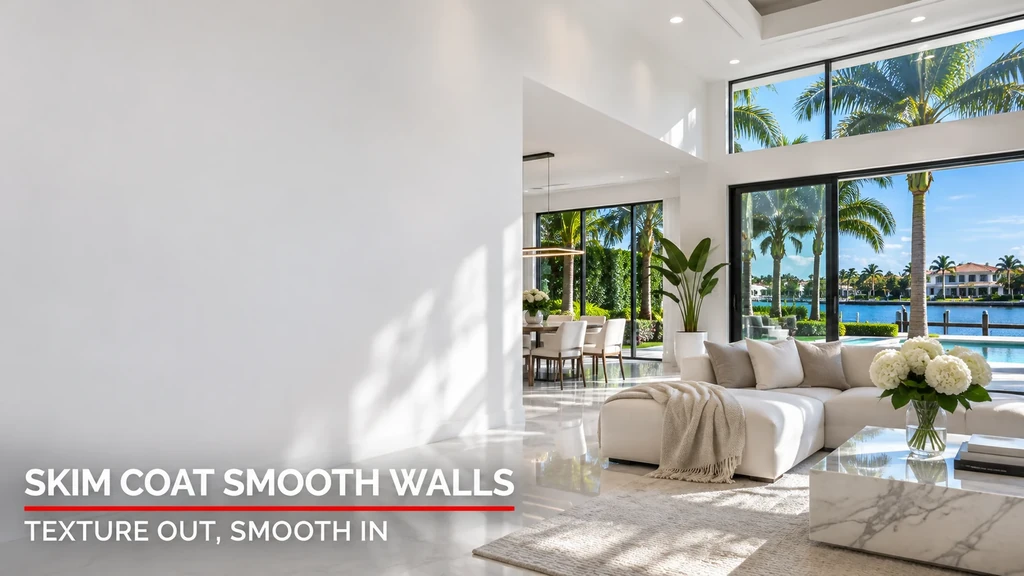
"My walls have that orange peel texture all over them, and I want them smooth before I paint. Can you skim coat over what is already there, or do I have to tear the drywall out?"
In most homes you do not have to tear anything out. Texture is a surface, and a skim coat replaces it.
Short answer: skim coating is the process of spreading a thin layer of joint compound over the whole wall, sanding it flat and priming it, so orange peel, knockdown or popcorn texture is covered and the wall is smooth and paint-ready. J. Perry & Sons skim coats texture in South Florida homes and condos, as a general contractor that pulls its own permits. Licensed and insured. Certificate of insurance available on request.
We work across Broward, Palm Beach and Miami-Dade, with 150+ projects completed. This page is for homeowners who want smooth walls. Our main drywall contractor page covers hanging, finishing and ceilings, and residential drywall covers repairs and texture matching in homes.
Skim coat: what it does and when to choose it
A skim coat is a thin, full-surface layer of joint compound. It fills the valleys in a textured wall, covers the ridges and leaves one continuous flat surface. It is not a patch. It is a new wall surface laid over the old one.
Choose it when:
- You want to remove texture such as orange peel, knockdown, skip trowel or popcorn before paint.
- You are putting wallpaper, plaster or a thin coating on the wall and need a smooth base.
- You are opening a room and the old and new walls have different textures that would never match.
- You want a modern, smooth look under good light.
Skip it when the wall is damaged beyond a surface problem, such as water-soaked board, in which case the board is replaced first. We tell you which one you have at the project review.
Take a photo of each textured wall in daylight and send them through our project form.
Removing orange peel, knockdown and popcorn texture
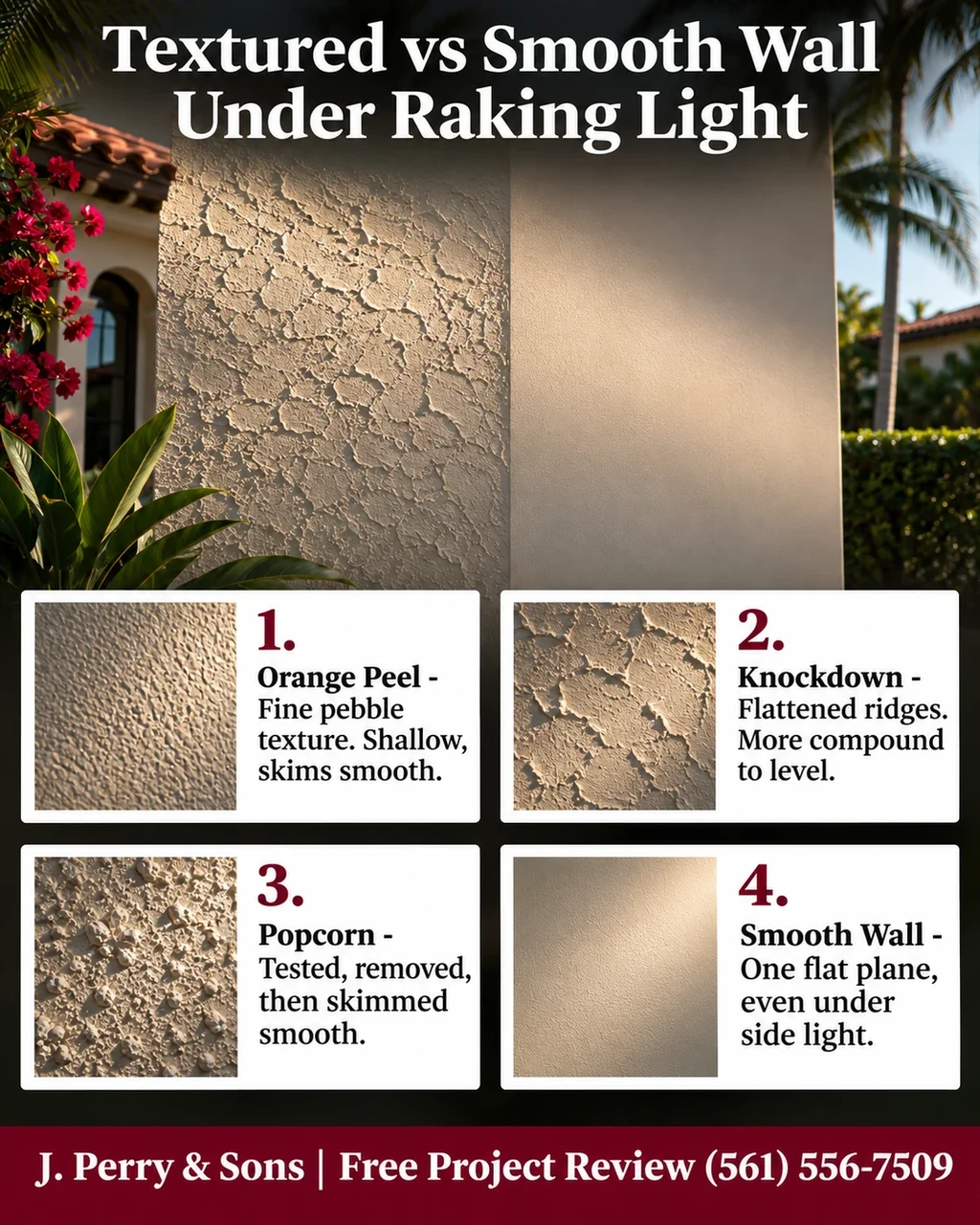
Different textures take different work, and the texture on your walls is the first thing we identify.
Orange peel. A fine, spray-applied pebble texture. It is shallow, and skim coating it gives a smooth wall without much buildup.
Knockdown. A heavier texture with flattened ridges. It carries more height than orange peel, so it needs more compound to bury the texture and level the wall.
Skip trowel and heavier hand textures. Deeper and more irregular. They can be skimmed smooth, and we assess the wall before we say how it goes.
Popcorn ceilings. The texture is removed first and the ceiling is skimmed smooth. Ceilings built before the 1980s should be tested before anything is disturbed. Our popcorn ceiling removal page covers the test and the process.
Painted and unpainted texture. Heavily painted texture, or a wall with glossy paint, is prepared so the compound bonds. We check the surface before skimming.
Older homes may also carry lead paint under later finishes, which affects how a wall can be sanded. Tell us the age of the house, and we handle it with licensed trades, coordinated by J. Perry & Sons when it is needed.
Tell us which texture you have, and whether it is walls, ceilings or both.
Skim coat vs Level 5 finish on new board
These two are close relatives, and the difference is where you start.
Skim coat over texture. You begin with a finished, textured wall, and the skim coat buries the texture.
Level 5 on new board. You begin with new drywall. Joints and fasteners are finished to Level 4, then a full skim coat goes over the whole wall. That is the Level 5 standard, written up in our guide to the Level 5 drywall finish.
If you are adding or replacing drywall anyway, ask for Level 5 on the walls that get the best light. If you are keeping your existing walls, a skim coat is the way to a smooth surface.
| Your situation | What fits |
|---|---|
| Textured walls you want to keep, made smooth | Skim coat |
| New board or an addition | Level 4 or Level 5 finish |
| Wall that gets strong side light or glossy paint | Level 5 or a full skim coat |
| Damaged or water-stained board | Replace the board, then finish |
Prep, skim, sand, prime: what we do
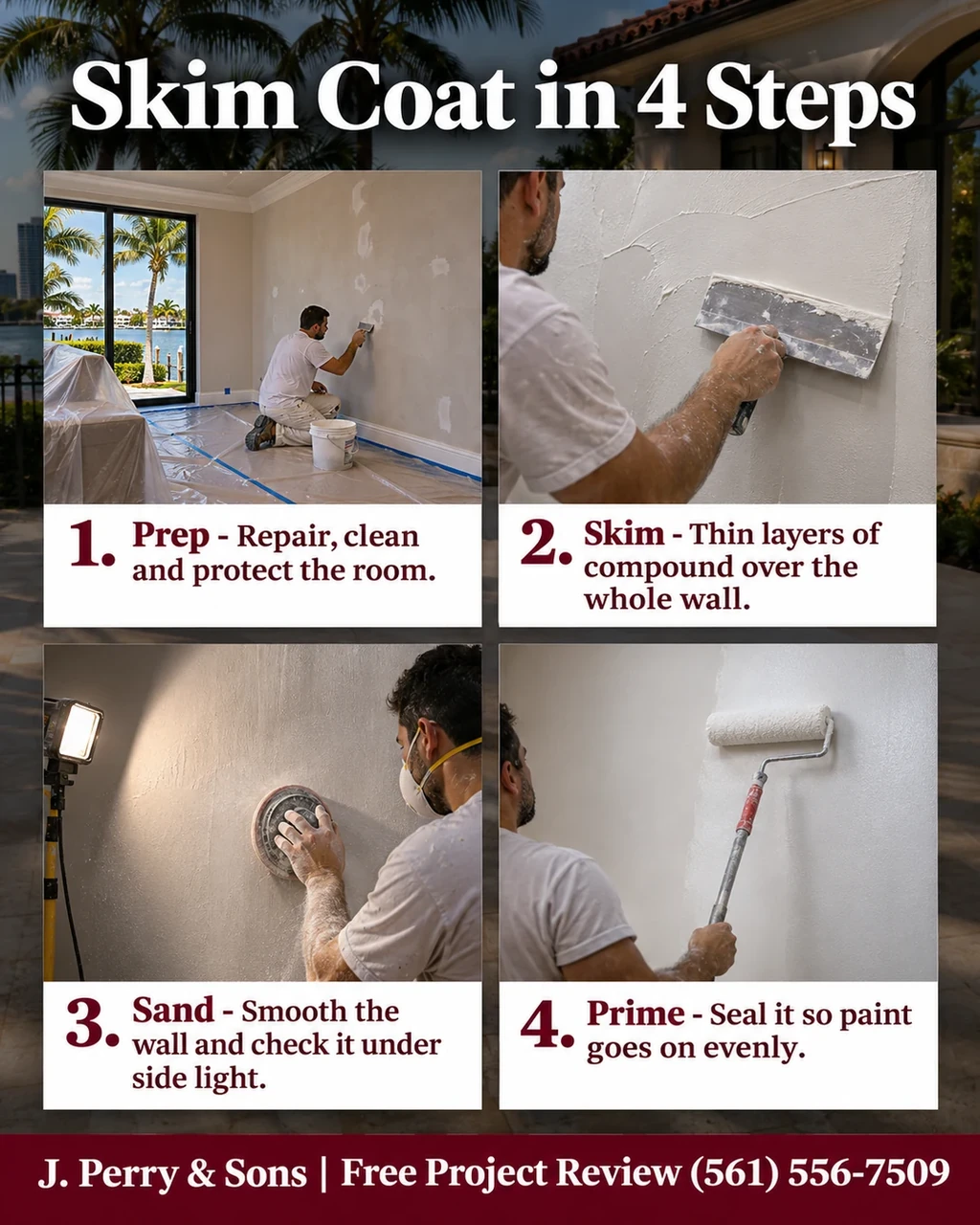
The result of a skim coat is decided by the prep and the sanding, not by the compound.
- Inspect and repair. We look at every wall, repair cracks, loose tape, dents and failed patches and set the plan.
- Protect the space. Floors, doors, cabinets and furniture are covered, and openings are masked.
- Prepare the surface. Dirt, grease and loose paint are cleaned off, and glossy paint is dulled so the compound bonds.
- Skim coat. Compound is applied in thin layers across the whole surface, leaving a flat plane.
- Sand. The wall is sanded smooth and checked under a work light held along the surface, because side light shows what flat light hides.
- Prime. A primer seals the surface so the paint goes on evenly.
We do not publish a number of coats. It is based on the texture, the condition of the wall and the light it gets, and we finish only when the wall passes the work-light check.
If you want a smooth result, plan the paint and the lighting with us before the skim starts.
Smooth walls for paint, wallpaper and plaster
A smooth wall is a good base for almost anything that goes on the wall afterward.
Paint. Smooth walls make color look cleaner, and they are easier to wipe and touch up. Higher sheens show more, so a smooth wall matters more with satin or gloss.
Wallpaper. Wallpaper looks best on a smooth, evenly sealed base. A textured wall can show through, and the seams can lift.
Plaster and thin-coat finishes. Venetian plaster and similar finishes follow whatever is under them, so they ask for a smooth substrate.
Feature walls. A smooth wall next to stone or wood looks intentional. See our feature wall and accent wall guide.
Paint is its own trade, and we coordinate the handoff; see painting.
Tell us what is going on the wall after the skim so we can set the right finish level.
Smooth walls vs textured walls
Textured walls were popular because they hide imperfections and require less full-surface finishing. Smooth walls are the current look in higher-end homes, and the difference is easy to see.
- Look. Smooth walls read as modern and clean. Texture reads as older, and it catches shadows.
- Light. Texture shows up in side light. A smooth wall stays calm.
- Cleaning and repair. Smooth walls wipe clean. Small repairs on texture have to match the pattern, and smooth walls patch more easily.
- Cost. Smooth takes more labor than texture, because the whole wall is finished, not just the joints.
What a good skim coat result looks like
You can judge a skim coat yourself after the work, before paint goes on.
- Flat. The wall has no ridges, trowel lines or ghost marks from the old texture.
- Uniform. The primer looks even, with no dull or shiny patches.
- Clean edges. Corners, trim lines and window returns are straight and sharp.
- No dust or debris. The room is clean and the floors are protected.
If something shows under the work light, we mark it and correct it before paint. A skim coat that passes this check will keep its look under paint. A skim coat that is rushed will show through, in side light, as soon as the sun hits the wall.
Walk each wall with a flashlight held low along the surface and tell us what you see.
Condo rules and dust control
Many of our skim coat jobs are in condos and townhomes, and the rules there matter as much as the drywall.
Approvals. Many associations want a work request, a certificate of insurance and a schedule before work begins. We follow the building's rules for contractors.
Hours and access. Associations set work hours and elevator or loading access. We plan the work around them.
Common areas. Hallways, elevators and lobbies are protected, and debris is carried out clean.
Dust. Sanding creates dust, and a skim coat creates a lot of surface to sand. We protect the space and confirm the dust-control plan with you before we start, so you know what to expect.
If your building requires a permit for the work, we pull it ourselves and follow every city and county compliance requirement.
Starting price for skim coat
Skim coating is priced per square foot, and the number is based on the texture on your walls, the condition of the surface, the ceiling heights and the finish you want. It is confirmed in writing after we review your project. Send photos and the rough size of each room and we will follow up with a scope.
How to protect a smooth wall after it is finished
A smooth wall shows everything, so the last coat of protection is as important as the finish. Keep heavy sanding and other trades' dust away from the finished surface, ask painters to prime before any touch-up, and check the wall in raking light before the final coat of paint goes on.
Send photos of the walls and the light in the room, and we'll set up the Free Project Review.
Free Project Review for your walls
Send us photos of your walls and ceilings and we will follow up personally, identify the texture and put the scope in writing. Call (561) 556-7509 or send us your project. Designers and architects specifying smooth walls will find the specifier version on our Level 5 drywall finish page.
Frequently asked questions
How much does skim coating walls cost?
Skim coating is priced per square foot and is based on the texture, the wall condition and the finish you want. We confirm the price in writing after a Free Project Review, so send photos of each room.
Can you skim coat over texture?
Yes. Orange peel, knockdown and most other textures can be skim coated smooth, after the wall is cleaned, repaired and prepared so the compound bonds. Very heavy texture is assessed first.
Skim coat vs new drywall?
A skim coat keeps your existing board and replaces only the surface, which is usually the better choice when the board is sound. New drywall is for walls that are damaged, wet or being moved. If you do replace the board, ask for a Level 5 finish.
Smooth walls vs textured walls: which is better?
Smooth walls look cleaner under light, wipe clean and patch more easily, and they are the standard in higher-end homes. Texture hides imperfections and costs less to apply, and it dates a room.
Can you skim coat a popcorn ceiling?
Yes, after the popcorn is removed. Older ceilings should be tested before any removal, and the process is on our popcorn ceiling removal page.
Will the skim coat show through paint?
Not when the wall is sanded flat and primed. We check each wall under a work light held along the surface before paint, because side light shows what flat light hides.