

You pulled up a corner of carpet or cracked a tile and found terrazzo underneath. Or you have lived with a dull, stained terrazzo floor for a long time and want to know if it can shine again, or if it is time to put in something new.
Short answer: most original terrazzo in South Florida homes can be restored. The covering is removed, the adhesive and tack strip damage are cleaned off, cracks and holes are filled with a matching mix, and the floor is ground flat with diamonds, honed and polished back to a clear, even shine. Where the old floor is too damaged, or where you want terrazzo in a space that never had it, J. Perry & Sons also installs new terrazzo. We do both: restoration and polishing, and new installation.
J. Perry & Sons handles terrazzo floor restoration, repair and refinishing serving Broward and Palm Beach, from a single room uncovered under old tile to every floor in a mid-century home or condo building.
We restore and install terrazzo for homeowners across Broward, Palm Beach and Miami-Dade. J. Perry & Sons is a licensed and insured general contractor with 150+ projects completed. For marble, travertine and other stone floors, see stone restoration. For a longer read on how old terrazzo is brought back, see our terrazzo restoration guide.
What terrazzo is, and why South Florida has so much of it
Terrazzo is a floor made of chips of marble, glass or other aggregate set in a binder, then ground and polished flat. The chips are what you see; the binder holds them together and fills the space between.
Cement terrazzo. The original type. The chips are set in a Portland cement binder poured over the slab. Many mid-century South Florida homes and older buildings have cement terrazzo, often with brass or zinc divider strips in a grid or pattern. It is durable, and it is the type most often found under carpet and tile.
Epoxy terrazzo. The modern type. The chips are set in an epoxy resin binder, installed thinner than cement terrazzo, with sharper colors and almost unlimited patterns. It is common in commercial lobbies, airports and modern homes.
Precast terrazzo. Terrazzo made in a shop as tiles, stair treads, thresholds and base, then installed like stone.
Terrazzo was popular here because it suits the climate: it is cool underfoot, it handles humidity, and it does not rot or swell. Many owners covered it later with carpet or tile because the look went out of style or the surface got dull. That covering often protected it.
Next step: send us a photo of the exposed terrazzo, close up and from standing height, and we will tell you which type it is.
Restoring old terrazzo: how it is done properly
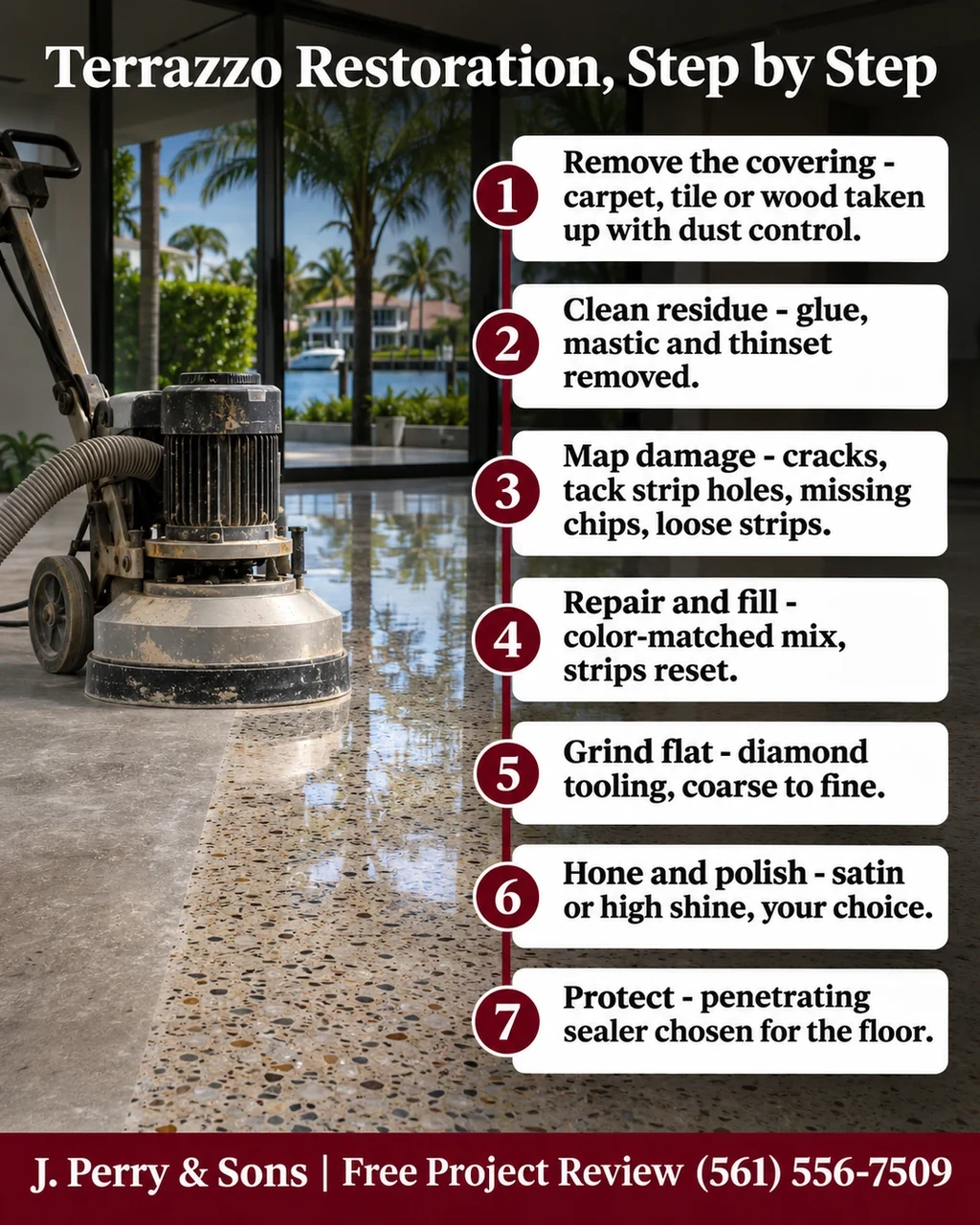
A terrazzo restoration is not a buff-and-wax. Done properly, it is a sequence of steps, and skipping one shows up in the finished floor.
1. Remove the covering. Carpet, pad and tack strip, or tile and thinset, are removed. Tile removal is the harder job, because thinset has to come off without gouging the terrazzo. We use methods chosen to protect the floor below, with dust control. See tile removal and demolition and dustless tile removal.
2. Clean off adhesive and residue. Carpet glue, mastic, paint and thinset residue are removed before grinding, so they do not get smeared into the surface.
3. Assess the damage. Now we can see the floor. Tack strip holes along every wall, cracks, missing chips, holes from old fixtures, stained areas and loose or lifted divider strips are mapped. Cracks are not all the same: some are surface cracks in the terrazzo, others follow a crack in the slab below and can return if the slab keeps moving.
4. Repair and fill. Holes and cracks are filled with a mix matched to the floor's binder color and chips. Matching is the craft part of the job: the color has to be close enough that the patch disappears after polishing. Loose divider strips are reset.
5. Grind flat. The floor is ground with diamond tooling, starting coarse to remove lippage, old coatings and scratches, then moving through finer grits. This is what brings back the chips and flattens the patches into the surface.
6. Hone and polish. Finer and finer diamonds bring the floor from flat to a satin or a high shine. The level of shine is your choice: honed for a softer look, polished for the classic mirror finish.
7. Protect. A penetrating sealer or a densifier and guard, chosen for the floor and the binder, helps resist stains. We do not recommend thick topical coatings on terrazzo; they scratch, yellow and have to be stripped.
Our article on marble polishing and honing explains the difference between honed and polished finishes, and the same logic applies to terrazzo.
Next step: tell us what is on top of the terrazzo now (carpet, tile, wood) and roughly which rooms, and we will tell you what restoration involves for your floor.
Terrazzo floor repair: cracks, holes, gaps and missing pieces
Most terrazzo floors in South Florida were not damaged by wear. They were damaged by the renovations done on top of them. Tack strip holes along every wall from old carpet, mastic and thinset left from tile, trenches cut for plumbing, gaps where a wall was removed, and chips at doorways where furniture and appliances were dragged. Terrazzo floor repair is what makes the difference between a restored floor that looks original and one that looks patched.
We start by mapping every repair before the first grind. Tack strip holes and small chips are filled with a color-matched mix of resin or cement and chips, chosen against your floor's actual matrix and aggregate. Larger areas, such as an old wall line or a plumbing trench, are filled with new terrazzo built to match as closely as the original allows, and divider strips are replaced or extended where they were cut. Surface cracks are routed and filled. Cracks that follow movement in the slab underneath are reviewed first, because filling a crack that is still moving does not hold, and we tell you that up front.
After the repairs cure, the floor is ground, honed and polished as one surface, which blends the repairs into the surrounding terrazzo. Some large patches will always be visible up close on older floors, and we show you the expected result before you commit. After the project review, your written proposal lists the following scope and pricing: Terrazzo floor repair.
Call (561) 556-7509 or send us your project for a Free Project Review.
Restoration or new terrazzo: how to decide
Not every old floor should be restored, and not every owner wants the original look. These are the questions we go through with you.
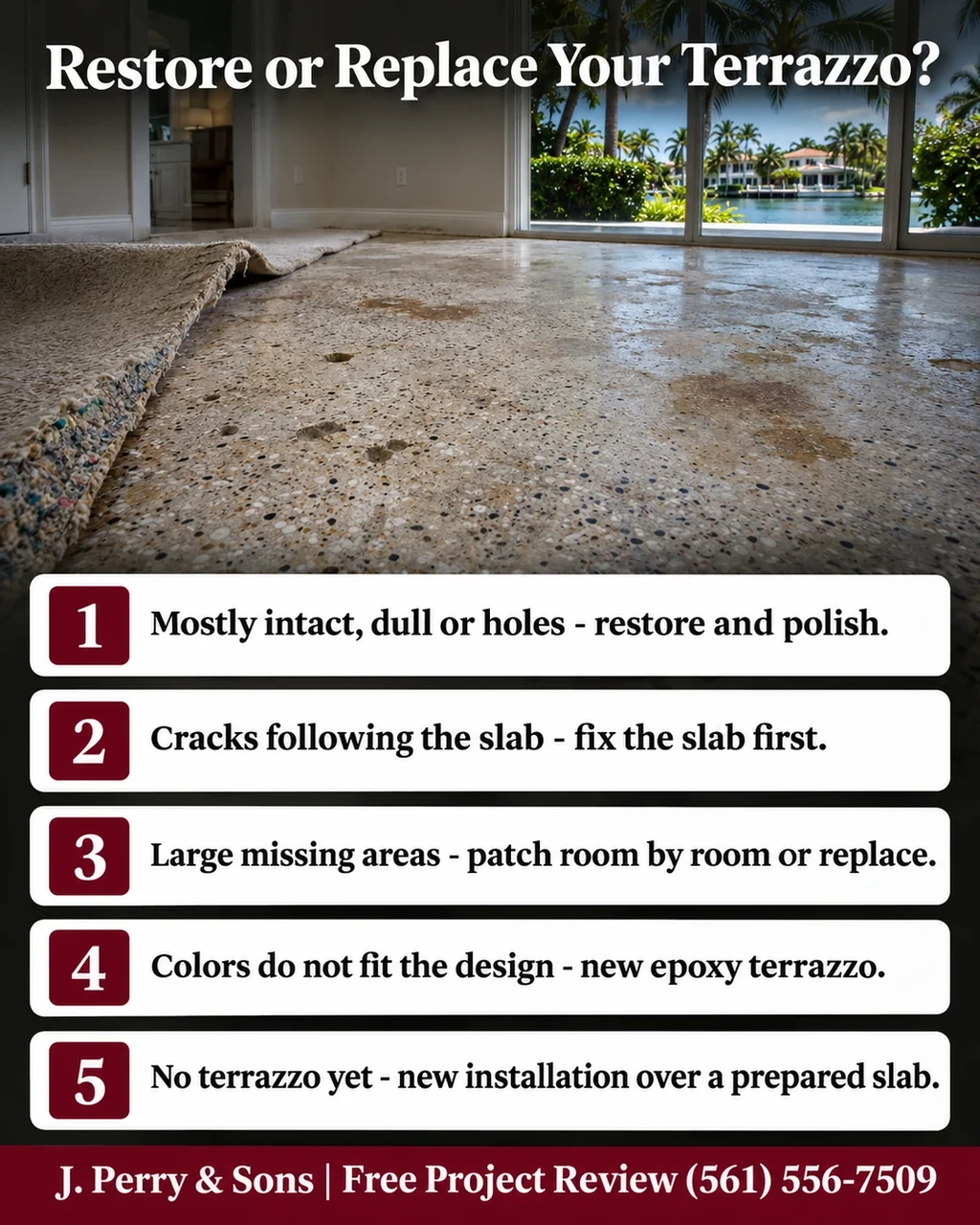
How much of the floor is intact? If most of the floor is sound and the damage is holes, cracks and dullness, restoration is usually the best value and keeps an original material you cannot easily buy back.
Is the slab moving? Wide, recurring cracks that follow the slab may come back after restoration. If the slab is the problem, that is addressed first, and in some cases the right answer is a new floor over a prepared slab.
Do you like the original colors? Restoration brings back what is there. If the colors and pattern do not fit your design, new terrazzo or another finish is the honest answer.
Was the floor partly removed? Walls moved, rooms added and kitchens rebuilt often leave areas with no terrazzo at all. Patching large missing areas is possible but harder to match; the decision is made room by room.
What else is happening in the house? If walls, kitchens and baths are being redone, restoration is usually scheduled near the end, after the heavy trades, so the polished floor is not damaged. We plan this as part of your interior renovation.
Next step: send photos of the damaged areas and we will tell you whether we would restore, patch or replace.
New terrazzo installation
When there is no terrazzo to save, or when you want it in a new space, we install new terrazzo.
Epoxy terrazzo. The most common choice for new floors; J. Perry & Sons handles installation. It is installed thinner than traditional cement terrazzo, comes in a very wide range of colors and chip sizes, and can include patterns, borders, logos and inlays. It needs a sound, prepared slab and a moisture check before installation, because moisture coming up through a slab affects resin floors.
Cement terrazzo. Chosen when an owner wants the traditional look and feel, or when restoring a matching area next to original cement terrazzo.
Precast terrazzo. Terrazzo tiles, stair treads, thresholds and base are made in a shop and installed like stone. Precast treads are a good way to carry terrazzo onto a stair.
Divider strips. Brass, zinc or other strips separate colors and create patterns. They also control cracking at joints in the slab, which is why their layout is planned with the slab, not only with the design.
Slab preparation. The slab is tested, repaired, leveled and, where needed, treated with a crack isolation layer before new terrazzo goes down. Our floor leveling work prepares slabs for new floors.
Design. We bring chip and binder samples, and once you sign the proposal a simple rendering is included so you can see the floor in your room. A more detailed design, such as a custom pattern or inlay, is done by the designer on our team as a separate scope. See renderings and samples.
Next step: send us a photo of the terrazzo look you want and the rooms it would go in.
Terrazzo in condos
If you own a condo unit, two things change.
Building rules. Many associations have rules for hard floors over occupied units, including sound control under the floor. Restoring the original terrazzo is often simpler than installing a new hard floor, because it is already part of the building. New floors may need an underlayment the association approves. Our guide to condo flooring rules and sound ratings explains what boards usually ask for.
Noise and dust. Grinding is loud and wet or dust-controlled work. We plan it with the manager: working hours, elevator use, protection of corridors and disposal.
Next step: ask your association for its flooring rules and send them with your photos.
Terrazzo floor restoration in a renovation: for owners, designers and builders
When a home or condo with original terrazzo is renovated, the floor is often the most valuable finish in the house, and the easiest one to damage during the work. Planning terrazzo floor restoration as part of the renovation, rather than as an afterthought, protects that value.
For owners, that means deciding early which rooms keep terrazzo and which change, so wall moves, plumbing and new tile edges are planned around the floor instead of cut through it. For designers, it means choosing the finish, the transitions to new tile or wood, and any new terrazzo or inlays together, so the old and new floors read as one design. For builders, it means sequencing: the uncovering and repairs happen early, while grinding and final polishing happen near the end, after the heavy trades are done, with the floor protected in between.
Because J. Perry & Sons handles tile, stone, terrazzo and the renovation itself, the floor is not left between trades who each blame the other. We remove old tile over terrazzo with our own crew, protect the floor through construction, and restore it at the right point in the project. New terrazzo, precast treads and stairs are part of the same scope when the design calls for them.
Call (561) 556-7509 or send us your project for a Free Project Review.
Care after restoration
A restored terrazzo floor is easy to keep, if it is cared for correctly.
Clean with a neutral cleaner. Acidic and harsh alkaline cleaners etch the marble chips and dull the binder. Vinegar, bleach and many all-purpose cleaners are not safe on terrazzo.
Keep grit off. Sand is the main cause of dulling in South Florida homes. Mats at the doors and regular dust mopping protect the shine.
Wipe spills. Wine, coffee, citrus and oils can stain or etch if left.
Re-polish when needed. Light wear can be brought back with a re-hone and polish without the full grind.
Our guide to sealing natural stone in Florida humidity covers sealer choices for stone and terrazzo floors.
Next step: ask us which cleaner and sealer we used on your floor so you can keep the same products.
Terrazzo floor refinishing: when the floor is exposed but dull
Not every terrazzo floor is hidden under carpet. Many are already exposed but look flat, cloudy or yellowed, and owners wonder whether refinishing terrazzo floors is worth it or whether they should cover them again. In most cases the floor underneath is in better shape than it looks.
A dull terrazzo floor usually has one of three problems. Old wax or a topical coating has built up and yellowed. Acidic or harsh cleaners have etched the surface. Or the traffic areas have simply worn the polish away. Terrazzo floor refinishing addresses all three: we strip any wax or coating down to the stone, hone the surface to remove light etching and scratches, then polish it back to the finish you want and apply a penetrating sealer. A full grind is only needed when the floor has lippage, deep damage or repairs to blend.
You choose the finish. A high polish gives the reflective look that defined South Florida homes in the mid-century era. A honed or satin finish is softer and more forgiving in kitchens and family rooms. We test the finish on a small area of your floor first, so you see the result in your own light before the whole room is done.
After the project review, your written proposal lists the following scope and pricing: Our terrazzo refinishing serves homes, condos and commercial buildings across Broward and Palm Beach, and it.
Call (561) 556-7509 or send us your project for a Free Project Review.
Starting price
Terrazzo pricing is based on what is on top of the floor now, the amount of repair, the size and layout of the rooms, the finish you want and, for new floors, the type of terrazzo, the pattern and the slab condition. We do not post a single starting figure for terrazzo, because removing tile from terrazzo and polishing an already-exposed floor are very different jobs. Pricing is given in the itemized written proposal after your Free Project Review, with removal, repair, grinding and polishing, sealing and any slab work on separate lines. Our article on marble floor restoration cost explains what drives stone restoration pricing in general.
Next step: send photos and the rough room list, and we will put the scope in writing.
Terrazzo by project type
- Terrazzo under carpet or tile. Uncover, repair, grind and polish.
- Dull or etched exposed terrazzo. Hone and polish, with repairs where needed.
- New terrazzo floors. Epoxy, cement or precast, over a prepared slab.
- Terrazzo stairs. Restored treads or new precast treads; see stairs.
- Other stone floors. Marble and travertine restoration: stone restoration.
Licensed and insured. Certificate of insurance available on request.
Frequently asked questions
Can terrazzo be restored after carpet or tile?
Usually, yes. Once the covering, glue and thinset are removed, tack strip holes, cracks and stains are repaired with a matching mix and the floor is ground and polished. Tile removal needs care so the terrazzo is not gouged, and that is part of how we price it.
Will the patches show?
We match the fill to the binder color and chips of your floor, and grinding blends it into the surface. A well-matched patch is hard to find. Large areas where terrazzo was removed are harder to match, and we tell you that before we start.
Can cracks in terrazzo be fixed?
Surface cracks can be filled and polished. Cracks that follow a crack in the slab can return if the slab keeps moving, so we look at the cause before promising they will not come back.
Polished or honed?
Polished gives the classic mirror shine. Honed is a softer satin look that shows less wear. Both come from the same grinding sequence; the difference is how far we take the polish.
Do you install new terrazzo?
Yes. J. Perry & Sons handles new terrazzo installation, including poured epoxy and cement terrazzo, with the project staying under J. Perry & Sons. Our crew prepares the slab and installs precast terrazzo tiles and treads.
Is terrazzo good for South Florida?
Yes. It handles humidity, it does not rot or swell, it stays cool underfoot and it lasts when it is cared for. Sand and acidic cleaners are the main enemies, and both are easy to manage.
Is grinding terrazzo messy?
It is heavy work, but it is controlled. We protect the rooms, contain the slurry or dust, and plan the work so the rest of the house stays usable where possible.
Can I live in the house during restoration?
In many cases, yes, with the rooms being worked on closed off. In a full renovation the floor is usually done near the end, after the other trades.
What is the difference between refinishing and restoring terrazzo?
Refinishing is for a floor that is already exposed and sound but dull: we strip old wax or coatings, hone light wear and polish and seal it. Restoration is the full process for a floor that has been covered or damaged: removing the old covering and adhesive, repairing holes and gaps, grinding flat, then honing, polishing and sealing. We tell you which your floor needs at the project review.
Can you remove old wax or yellowed coatings from terrazzo?
Yes. Yellowed wax and topical coatings are one of the most common reasons terrazzo looks dull. We strip them down to the stone, then hone and polish the floor mechanically and apply a penetrating sealer. The new finish comes from the terrazzo itself rather than a film on top, so it does not yellow or wear off in traffic lanes the way coatings do.
Can you fill the gap where a wall was removed on a terrazzo floor?
Yes. Where a wall is removed, we fill the strip with new terrazzo mixed to match the existing matrix and chips as closely as possible, set divider strips where needed, and grind and polish it with the rest of the floor so it blends. On older floors, a large fill can still be visible up close, and we show you the expected result before you commit.
Do you restore terrazzo in condo buildings and commercial spaces?
Yes. We restore and refinish terrazzo in condo units, lobbies, hallways and commercial spaces. We work with the board or manager on building rules, noise and access, contain slurry and dust, and protect adjacent finishes. Commercial work can be scheduled at night when the building requires it. Every scope is listed in an itemized written proposal after the project review.
Which areas do you serve for terrazzo restoration and refinishing?
We restore and refinish terrazzo serving Broward and Palm Beach, including Fort Lauderdale, Weston, Parkland, Boca Raton, Delray Beach, Wellington and Palm Beach. Send us a few photos of the floor, including any areas under carpet or tile, or call (561) 556-7509 to set up your Free Project Review.