
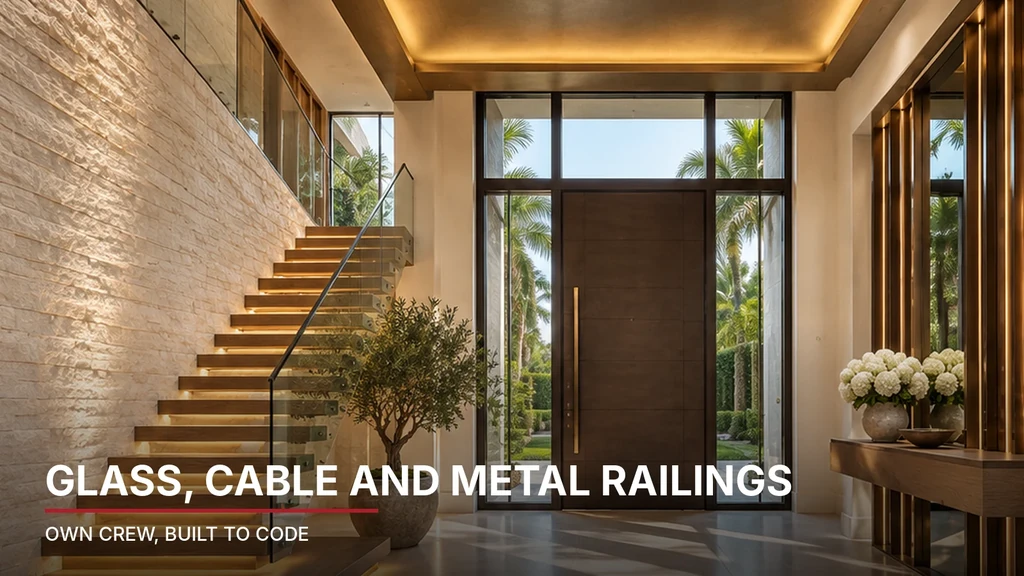
You want the view, not the railing
You built the deck, the pool terrace or the balcony for one reason: the view. The water, the garden, the skyline. Then the code requires a guard, and a row of thick pickets or a solid wall puts bars across the very thing you paid for.
Cable railing is the answer many owners and architects reach for. Thin horizontal stainless cables, stretched tight between posts, keep people safe while the view stays almost untouched.
In South Florida, the difference between those two outcomes comes down to three things: the grade of stainless steel, how the system is tensioned and framed, and how the design meets the building code. This guide covers all three, and compares cable with glass, so you can choose with confidence.
J. Perry & Sons installs cable, glass and metal railings with our own crew on decks, stairs, balconies and pool areas across Broward and Palm Beach. If you already have a project in mind, send us your project and we will review it with you.
What a cable railing system is
A cable railing system has four main parts:
- Posts. End posts, corner posts and intermediate posts, usually stainless steel or aluminum, sometimes wood or composite on a deck. End and corner posts carry the full pull of the cables.
- Top rail. A continuous rail that ties the posts together and stiffens the run. It can be stainless, aluminum, wood or composite to match the deck.
- Cables. Stainless steel wire rope running horizontally (or occasionally vertically) between the end posts, passing through holes in the intermediate posts.
- Fittings. Tensioners at one end, terminals at the other, and protective grommets or sleeves where cables pass through posts.
Intermediate cable braces, thin vertical spacers between posts, are often added to keep the cables from spreading apart when someone leans on them.
The result is a guard with very little visual mass.
Stainless steel grade: the most important choice in salt air
Not all stainless steel is equal, and in South Florida the grade is the first thing to get right.
Type 316 stainless steel contains molybdenum, which gives it much better resistance to chloride corrosion from salt air, salt water pools and chlorinated water. It is the grade widely used for marine and coastal work, and it is the grade we specify for cable railing near the ocean, the Intracoastal, canals and pools.
Type 304 stainless steel is a common, less expensive grade that performs well indoors and in many inland locations. Near salt water, 304 is more prone to surface rust staining, often called "tea staining," and to pitting over time.
| Type 316 stainless | Type 304 stainless | |
|---|---|---|
| Salt and chloride resistance | High, the marine-grade choice | Lower; can tea-stain and pit near salt |
| Best use | Coastal homes, waterfront decks, pool areas, balconies facing the water | Interior stairs and inland locations with no salt exposure |
| Appearance over time | Holds its finish with periodic rinsing | Brown staining is more likely outdoors near the coast |
| Cost | Higher | Lower |
Three things to know beyond the grade:
- Every metal part matters. Cables, tensioners, terminals, fasteners and post hardware should all be the same corrosion-resistant grade. One lower-grade fitting will rust and stain the surface around it.
- Rinsing matters. Even 316 stainless benefits from a regular fresh-water rinse on coastal properties. Salt left on the surface is what starts staining.
Tensioning and framing: why some cable rails sag
A cable rail only works when every cable is tight. A loose cable can be pushed apart, which defeats the guard and fails inspection. Most sagging cable rails we see have the same root causes.
End posts that bend
Each cable is pulled to a high tension, and the end post carries the sum of every cable on the run. A post that is strong enough for a picket railing can bow inward under cable load, and the moment it bends, every cable loosens. End and corner posts must be designed for cable loads, with solid blocking or a steel or aluminum post anchored into the structure. On a wood deck, that means framing designed for the post, not a post bolted to a rim joist alone.
Post spacing too wide
The farther apart the posts, the more a cable can deflect when someone leans on it. Intermediate posts and cable braces are spaced to keep the cables within the deflection limit. Manufacturers publish their own maximum spacing for their systems, and we install to it.
No top rail, or a weak one
The top rail ties the posts together and keeps the tops from pulling toward each other. A stiff top rail is part of the structure, not decoration.
Tension that is set once and forgotten
Cables settle after installation, and wood posts can shrink slightly. We set the tension at installation and check it again after the system settles, and owners should have it checked periodically. Good tensioners allow adjustment without taking the system apart.
Stairs
Cable railing on stairs follows the rake of the stair, so the cables run at an angle. That takes fittings designed for angled runs, careful hole drilling through each post at the right angle, and tight attention to the opening at the stair nosing. Stair runs are one of the places a well-built system shows its quality.
Cable railing and the building code, in general terms
Railing rules come from the Florida Building Code and are enforced by your city or county. The exact requirements for your project are confirmed with the permit, but these are the general principles every owner should know:
- When a guard is required. Guards are generally required along open sides of decks, balconies, porches and stairs where the walking surface is more than 30 inches above the floor or grade below.
- Height. Residential guards are generally required at a minimum height around 36 inches, and commercial and multifamily guards are generally taller, around 42 inches. Your plans and local code set the exact figure.
- Openings. The guard must not allow a sphere of a set size to pass through. In most residential applications, that sphere is 4 inches. With cable, the test is applied with the cable pushed under load, which is why tension and post spacing matter so much.
- Loads. The top rail and the infill must resist specified loads. Posts, anchors and the structure they attach to are part of that.
- High-velocity hurricane zones. Broward and Miami-Dade sit in the high-velocity hurricane zone, which brings stricter product approval and wind-load requirements for exterior building products. Railing systems on condos and higher structures are often engineered for the specific building.
- Condo and HOA approval. Many associations require approval of the railing type and color before work starts, and some do not allow cable at all.
J. Perry & Sons pulls every permit the work requires and follows city and county compliance on every job. On condo and HOA buildings, we build to the engineer's drawings and the association's requirements. Engineering and permits are priced separately from the railing work.
Where cable railing works best
Decks. Deck cable railing is the most common use. It pairs well with composite or wood decking, and the top rail can match the deck boards. See our composite decking and deck installation pages.
Stairs. Exterior and interior stairs, especially open-riser modern stairs, look lighter with cable. Our railings page covers stair railing in more detail.
Balconies. Cable keeps the view open on a balcony, but balconies on condos and taller buildings carry stricter engineering and association rules. Glass is often the preferred choice on high-rise balconies.
Pool areas and roof decks. Where a raised pool deck or roof terrace needs a guard, cable keeps the space open. On a roof deck, post attachment has to respect the waterproofing below.
Where it is a weaker choice. Where small children will be climbing, some owners and associations prefer glass or vertical pickets, because horizontal cables can be climbed. That is a family and association decision worth making on purpose.
Cable railing vs glass railing
Cable and glass are the two railing types people choose for a view. They solve the same problem in different ways.
| Cable railing | Glass railing | |
|---|---|---|
| View | Very open; thin lines across the view | Fully open; no lines, some reflection |
| Wind | Wind passes through | Blocks wind, good on high balconies |
| Look | Light, nautical, modern | Clean, minimal, high-end |
| Upkeep | Periodic tension checks, fresh-water rinse of stainless | Regular cleaning for salt spray, water spots and fingerprints |
| Climbability | Horizontal cables can be climbed | Not climbable |
| Structure | End posts must resist high cable tension | Heavier panels; base shoe or posts designed for glass loads |
| Best fit | Decks, stairs, waterfront homes, pool decks | High-rise and condo balconies, pool fences, wind-exposed terraces |
Many projects use both: glass where wind or children are a concern, and cable where the deck meets the garden or the water.
Priced in your written proposal after the project review. After the project review, your written proposal lists the following scope and pricing: Cable railing, because the final number is based on the run length, the number of corners and stairs, the post type and the stainless grade.
Replacing an old railing with cable
Many South Florida homes and condos still have rusted aluminum pickets or tired wood rails. Swapping to cable is a common upgrade, but it is not always a direct swap.
- Existing posts usually cannot be reused. Picket posts are not designed for cable tension.
- The structure needs checking. On a wood deck, we inspect the rim joist and framing where new end posts will attach. On concrete balconies, we check the slab edge and anchor locations, and spalled concrete is repaired before new posts go in.
- Anchors into concrete must be sealed. Water that enters a post hole in a concrete slab can rust the rebar and crack the edge. We seal every penetration.
If the balcony itself needs repair, our balcony and concrete repair work handles the slab before the new railing goes on.
How we install a cable railing system
- Project review. We look at the deck, stairs or balcony, the structure the posts will attach to, the exposure to salt and wind, and any association rules.
- Design and specification. We confirm the post type, the top rail material, the stainless grade, the cable layout and the spacing, and the proposal lists each one.
- Permit and approvals. We pull the permit and prepare any association approval package.
- Structure. We add blocking or install structural posts so end and corner posts can carry the cable load.
- Installation. Posts are set plumb and anchored, holes are drilled in line, cables are run and tensioned, and the top rail is installed.
- Check and adjust. We check every cable against the deflection test, adjust the tension after the system settles, and show you how the tensioners work.
Once the proposal is signed, a simple rendering of the railing is included so you can confirm the look. More detailed design by our in-house designer is a separate service.
Why owners and builders hire J. Perry & Sons for railings
Our own crew installs cable, glass and metal railings, and we specify marine-grade stainless for coastal and pool locations. J. Perry & Sons is a licensed Florida General Contractor (CGC1540699), licensed and insured, with more than 150 projects completed, backed by a workmanship warranty.
Next step Call (561) 556-7509 or Send us your project. Share photos of the deck, stairs or balcony, the railing you have in mind and any plans, and we will call you back personally to set up your Free Project Review.
Cable railing FAQ
What stainless steel is best for cable railing in Florida?
Type 316 stainless is the marine-grade choice for coastal homes, waterfront decks and pool areas, because it resists salt and chloride corrosion better than 304. Every part of the system, including fittings and fasteners, should be the same grade.
Why does cable railing sag?
Usually because the end posts bend under cable tension, the posts are spaced too far apart, or the cables were never re-tensioned after the system settled. Structural end posts, correct spacing and a tension check after installation prevent it.
Is cable railing up to code?
Yes, when it is designed and installed correctly. The guard has to meet the required height, the opening limit with the cables under load, and the load requirements. We confirm the requirements for your project with the permit.
Is cable railing or glass railing better?
Cable is lighter, lets wind through and suits decks, stairs and waterfront homes. Glass gives a fully open view, blocks wind and is not climbable, which makes it common on high-rise balconies and pool fences. Many homes use both.
Can cable railing go on stairs?
Yes. Stair cable railing follows the angle of the stair and needs fittings designed for angled runs. It works well on exterior stairs and modern open-riser interior stairs.
Can I put cable railing on my condo balcony?
Sometimes. Many associations require approval of the railing type and color, and some do not allow cable. Balconies on taller buildings also carry stricter engineering requirements. We review the association rules and the building requirements before anything is ordered.
How much does a cable railing system cost?
After the project review, your written proposal lists the following scope and pricing: Cable railing. The price is based on the run length, the number of corners and stair sections, the post type and the stainless grade. Priced in your written proposal after the project review.
Guide
Request the guide: Outdoor Living Built for South Florida: Pergolas, Railings and Turf
Call (561) 556-7509 or send us your project for a Free Project Review.