
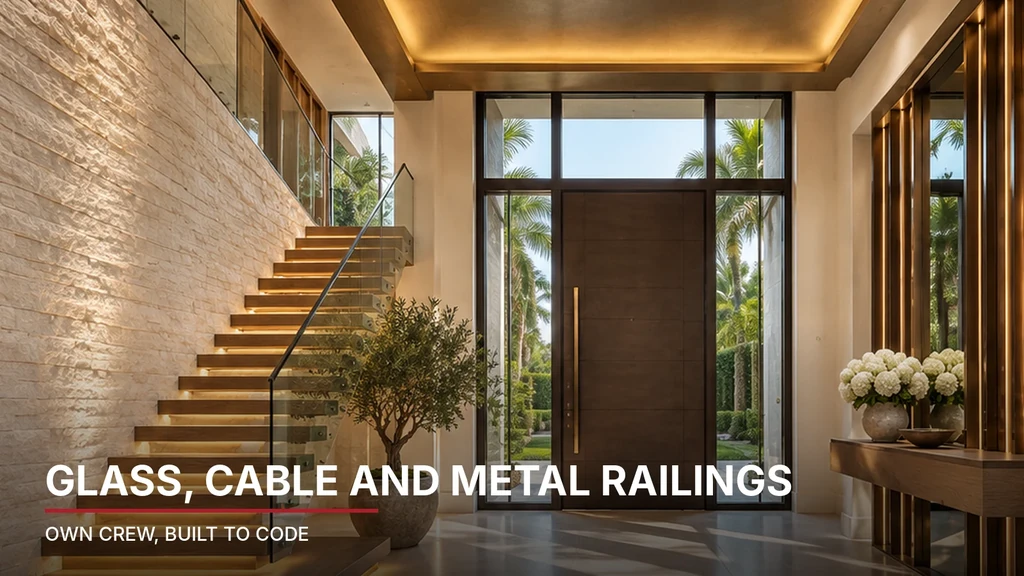
The stair is finished, the deck is built or the balcony has a view, and the railing is the last thing standing between you and the look you planned. You want glass so nothing blocks the view, or cable for a lighter line, or metal that will not rust by the pool, and you want it to pass inspection the first time.
Short answer: a railing is a guard that has to meet the code for height, strength and openings, and it is also one of the most visible design pieces in the house. The three main families are glass (frameless in a base shoe, or held by posts or standoffs), cable (stainless cables tensioned between posts) and metal (aluminum, stainless or steel pickets and panels). J. Perry & Sons installs glass, cable and metal railings with our own crew, on interior stairs, balconies, decks, terraces and pool areas, and we pull the permit when the work requires one.
We install railings for homeowners across Broward, Palm Beach and Miami-Dade, on their own or as part of a stair, deck or exterior project. J. Perry & Sons is a licensed and insured general contractor with 150+ projects completed.
Railing types we install
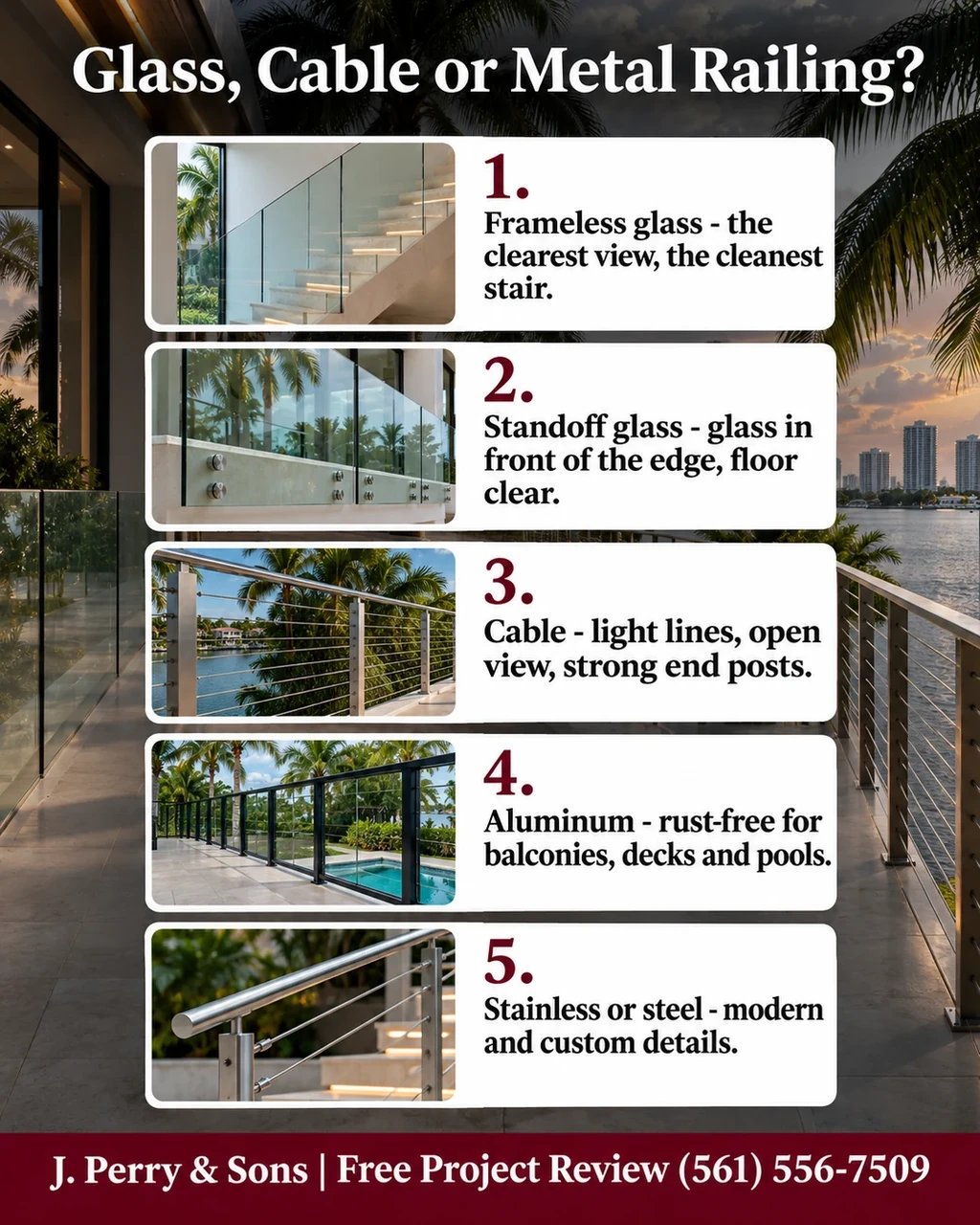
Frameless glass in a base shoe. Thick tempered or laminated glass panels are clamped in a continuous aluminum channel fixed to the floor, the slab edge or the stair stringer. Nothing but glass is visible above the floor, with an optional slim top cap. This is the cleanest look for a modern stair, a balcony with a view or a pool terrace.
Post-mounted glass. Glass panels held between metal posts with clamps. More frame, and often the practical choice where the floor or slab edge cannot take a base shoe.
Standoff glass. Glass panels fixed to the face of the slab edge or the stair with round standoff fittings, so the glass floats in front of the structure and the walking surface stays clear to the edge.
Cable railings. Stainless steel cables run horizontally (or vertically) between metal or wood posts, tensioned with fittings at the ends. They keep the view open with a light, modern line, and they are popular on decks and stairs.
Aluminum picket and panel railings. Powder-coated aluminum is light, does not rust, and handles salt air well. It is the common choice for exterior balconies, decks and pool areas.
Stainless steel railings. Brushed or polished stainless posts, rails and handrails, used alone or with glass or cable. The grade of stainless matters near salt water.
Steel and custom metal. Flat-bar, rod, plate and custom patterns for interior stairs and architectural designs. J. Perry & Sons fabricates and installs custom metal pieces, the same way we handle metal stairs.
Handrails. Wall-mounted and post-mounted handrails in wood, stainless or aluminum, including recessed handrails in a wall.
Next step: send a photo of a railing you like and a photo of where yours will go.

Where railings go: stairs, balconies, decks, pools
Interior stairs. Glass, steel rod and cable railings are the most requested on modern stairs. On a floating stair, frameless glass or slim rods keep the open look. On white oak stairs, wood and metal combinations are common.
Balconies and terraces. Glass for the view, or aluminum for durability. On balconies the slab edge, the anchoring and the waterproofing at each post are the critical details. If your balcony also needs concrete repair, see balcony repair.
Decks. Cable and aluminum railings on raised decks and stairs down to the yard. See composite decking and roof decks and terraces.
Pool areas and raised pool decks. Glass and aluminum near the pool, with hardware chosen for chlorine and salt. A pool barrier (the fence or enclosure that controls access to the pool) has its own requirements separate from a guard; tell us if your railing also has to serve as the pool barrier.
Pergolas, outdoor kitchens and patios. Railings at raised patios, steps and built-in seating. See pergolas.
Next step: tell us where the railing goes and how long the run is, and whether it is inside or outside.
How a railing is installed properly
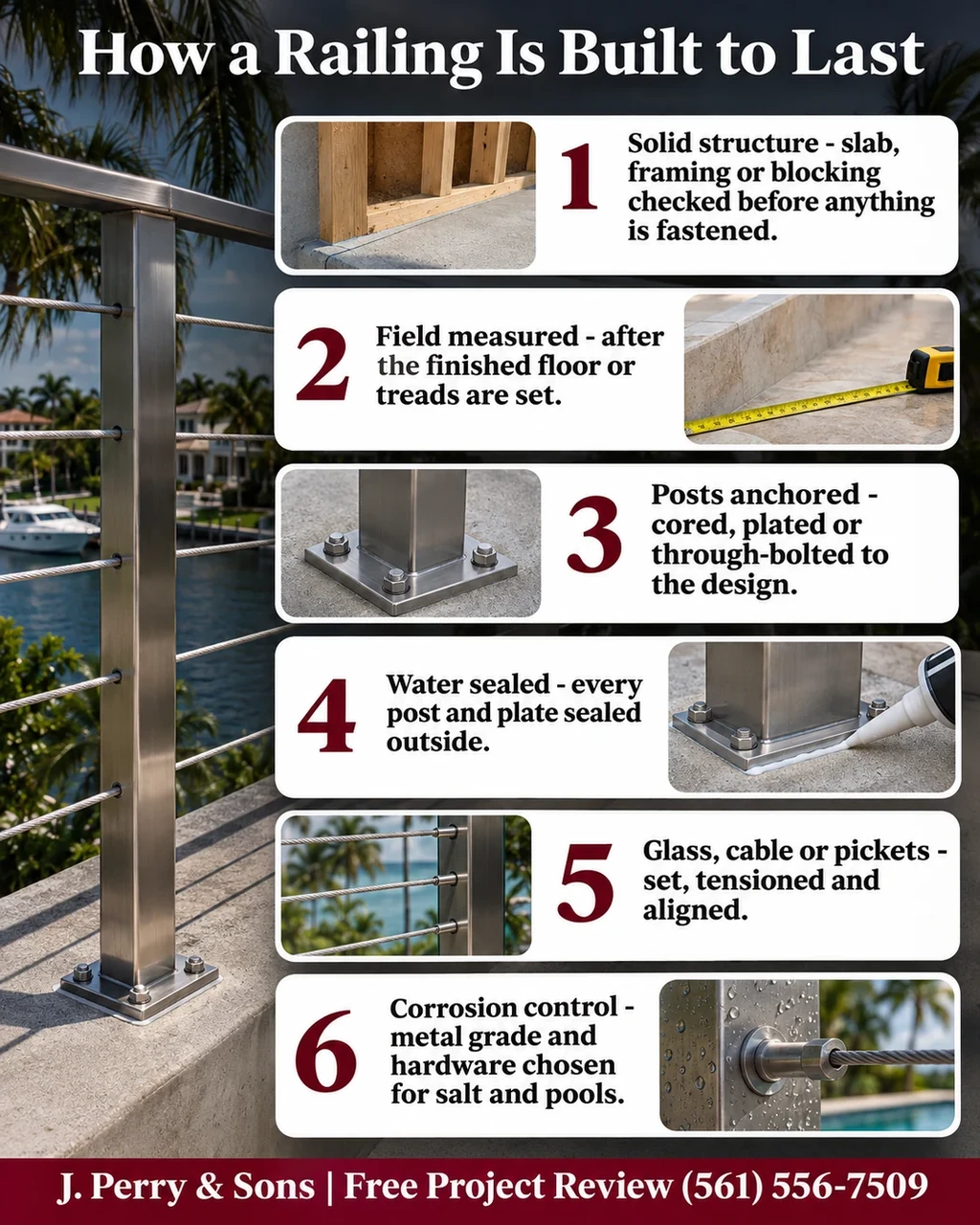
A railing that looks right but moves when you lean on it is a failure, even if it passed the eye test. These are the points that decide whether it is solid.
What it is fastened to. A guard is only as strong as what holds it. On a slab edge, posts are set in cored holes or on base plates with anchors; on a wood stair or deck, they are fastened through solid blocking or framing. If the structure behind the railing is weak, it is fixed first. Core drilling into concrete is part of our concrete cutting and core drilling work.
Layout and measurement. Glass panels and fabricated metal are made to measured sizes, so the stair, the landing and the slab edges are field-measured after the floor finish is set, not before. On stairs, the rake angle and the post spacing are taken from the finished treads.
Water at every post. Outside, every hole drilled into a slab or deck is a path for water. Posts are set with sealant or in sleeves designed to keep water out, and base plates are bedded and sealed. This is where many balcony leaks start.
Tension on cable railings. Cable has to be tensioned correctly and kept tight, and the end posts must be strong enough to resist that tension without bending. Intermediate supports keep the cables from spreading under load, because the code's opening limit applies to cable too.
Glass handling. Glass is ordered to size, protected on site and set in the shoe or clamps with the right gaskets or setting material. Edges are protected until the job is finished.
Finish and corrosion. Near salt air and pools, the metal grade, the powder coat and the fasteners decide how long a railing looks new. Dissimilar metals are separated so they do not corrode each other.
Next step: if the railing goes on a balcony or deck, send a photo of the edge where the posts will be fastened.
Code, permits and wind
Guard height and strength. The code sets the minimum guard height, the load a guard must resist and the size of openings in it, and it requires guards where a walking surface is a certain height above the floor or grade. Handrails on stairs have their own rules for height and grip. We build to those requirements and to any drawings from your architect or engineer.
Structural attachment. Where the attachment of a railing to a slab or a deck needs an engineer's design, for example on an upper-floor balcony or a raised terrace, we build to the engineer's details.
Glass. Glass in guards has to be the type and thickness the code and the product system require. We install systems that are tested for guard use.
Hurricane zone. Miami-Dade and Broward are in the High-Velocity Hurricane Zone; Palm Beach County is not. In the HVHZ, exterior railings and glass need the product approval the local building department requires. We confirm the product before ordering.
Condos and HOAs. Associations often control railing style and color on balconies and exteriors. We provide product data and a simple rendering for your board or architectural committee.
Permits. J. Perry & Sons pulls the permit when railing work requires one, and follows every city and county compliance requirement. See permits and compliance.
Next step: if you are in a condo or HOA, ask for the railing rules and send them with your photos.
Glass, cable or metal: how to choose
| Type | Best for | What to know |
|---|---|---|
| Frameless glass (base shoe) | Views, modern stairs, pool terraces | Needs a strong edge to mount the shoe; glass needs cleaning |
| Post-mounted or standoff glass | Balconies and stairs where a shoe will not fit | More visible hardware; standoffs keep the floor clear |
| Cable | Decks, stairs, open views | Needs strong end posts and periodic tension checks |
| Aluminum pickets or panels | Exterior balconies, decks, pools | Does not rust; color through powder coat |
| Stainless | Coastal homes, modern details | Grade matters near salt water |
| Steel rod or custom metal | Interior stairs, architectural designs | Custom fabrication; finish protects against rust |
Next step: pick two of these and we will bring samples of the hardware and finishes.
Outdoor glass railings that hold up to sun, salt and wind
An outdoor glass railing has a harder job than one on an interior stair. It has to carry the guard load, stand up to hurricane wind and keep looking good in full sun, salt air and pool splash. That is why we plan an outdoor glass railing as its own project, not a copy of an indoor one.
On balconies, terraces and rooftops, the system has to be rated for exterior guard use, and in Miami-Dade and Broward it has to be approved for the hurricane zone. Around the pool and near the ocean, the hardware finish and grade are picked for where the railing will live, not for how it looks in a catalog photo. When the view is the whole point, a frameless base-shoe system gives the cleanest line. When the slab edge or the design calls for posts, post-mounted or standoff glass keeps the view open, with the hardware as part of the look.
We also plan how the railing meets everything around it: the balcony edge and drip line, the deck or paver finish, the stucco below and any pergola posts nearby. Getting those details right keeps water out of the slab and rust stains off the walls.
After the project review, your written proposal lists the following scope and pricing: Outdoor glass railings. The price is based on the run length, the system type, the glass and how the railing attaches.
Call (561) 556-7509 or send us your project for a Free Project Review.
Replacing an old railing
Old aluminum or steel railings with corroded posts, wood railings that have rotted, or a picket railing that no longer suits the house are common in South Florida.
Remove. The old railing is removed and the post holes or plates are exposed.
Repair the edge. Corroded post pockets in concrete are cut out and rebuilt; rotted wood is replaced. This is the part owners do not see and the part that decides whether the new railing stays tight.
Install. The new railing is installed to the measured layout and sealed at every post.
Finish. Base covers, caps and touch-up, with the area cleaned.
On condo balconies where railing work is part of a building-wide concrete program, see balcony repair.
Next step: send a close photo of the base of one of your existing posts so we can see the condition.
Starting price
Railing pricing is based on the type, the length of the run, the number of posts, corners and stair sections, the glass type, the metal and finish, what the railing is fastened to and any edge repair. We do not post a single starting figure, because a short run of aluminum pickets and a frameless glass stair railing are very different scopes. Pricing is given in the itemized written proposal after your Free Project Review, with removal, edge repair, railing, glass and permit on separate lines.
Next step: send photos and the rough length of the run.
Railings by project type
- Interior stairs: stairs, floating stairs, metal stairs.
- Decks and terraces: composite decking, roof decks.
- Balconies: balcony repair when the concrete needs work too.
- Pool areas and patios: pool deck pavers.
- Whole exteriors: exterior renovation.
Licensed and insured. Certificate of insurance available on request.
Frequently asked questions
Do you install glass railings yourselves?
Yes. Glass, cable and metal railings are installed by our own crew. J. Perry & Sons fabricates and installs custom metal pieces with our own crew.
Are glass railings safe?
Yes, when the glass and the system are made for guard use and installed to the code and the product's tested details. The glass type, the base shoe or clamps and the anchoring are what make it safe.
Do cable railings meet code?
They can, when the cables are spaced, tensioned and supported so the openings stay within the code's limit, and the end posts are strong enough for the tension. We build cable railings to those requirements.
What is best near the ocean or a pool?
Powder-coated aluminum and glass hold up best. If you want stainless, the grade matters near salt water. Hardware and fasteners are chosen for the exposure, and dissimilar metals are kept apart.
Do I need a permit for a new railing?
Many railing projects need one, especially exterior guards and replacements on balconies and decks. J. Perry & Sons pulls the permit when it is required and handles the inspections.
Can a railing go on my existing balcony?
Usually, yes, after we check the slab edge where the posts will be fastened. If the concrete is damaged, it is repaired first so the new railing is anchored into sound material.
Do railings need product approval in South Florida?
In Miami-Dade and Broward, which are in the High-Velocity Hurricane Zone, exterior railings and glass need the product approval the building department requires. We confirm it before ordering.
Can a glass railing also be my pool fence?
Sometimes. A pool barrier has its own requirements, separate from a guard. Tell us if the railing needs to serve as a pool barrier and we will check it against those requirements before we price.
Does an outdoor glass railing need a top rail?
That is based on the system's rating and the code for its height and location. Some frameless glass systems are approved to stand without a top rail, which gives the cleanest view. Others need a cap rail to meet the guard rating, and stairs need a graspable handrail. Before anything is ordered, we show you which options carry the rating for your balcony, deck or pool area.
How do I keep an outdoor glass railing clean near the pool or ocean?
Rinse the glass and the hardware with fresh water to clear salt and pool splash, then clean the glass with a non-abrasive glass cleaner. Wipe the metal fittings too, because salt left on metal is what starts corrosion. Near the ocean, a regular freshwater rinse keeps the glass clear and the hardware looking new. We go over the care for your specific system when the job is complete.
Can you install glass railings on a rooftop terrace or a deck?
Yes, when the structure can take the anchors. On a rooftop, we check the slab and the waterproofing layer first so the new railing doesn't become a leak point. On a deck, we confirm the framing or fascia can carry the guard load. Where an engineer's design is needed, it goes into the permit package, and we pull the permit.