By John Perry
Do the edges of your big tiles not line up? Do some tiles sound hollow, or did a 24x48 crack a few months after it went in? Those are the classic large-format problems, and almost all of them come from the installation, not the tile. For large-format tile we use large-format mortars such as Mapei Ultraflex LFT, Laticrete 4-XLT or Laticrete 254 Platinum, Schluter DITRA uncoupling membrane over slabs with cracks, and Schluter profiles at edges and transitions.
Large-format tile is the look most South Florida homeowners want right now: big, calm surfaces with very few grout lines. It's also the least forgiving tile to install. Here's what it takes to do it right.
What counts as "large format"?
In the industry, any tile with at least one side 15 inches or longer is large format. In South Florida homes today that usually means:
- 24x48. The most popular size right now.
- 32x32 and 36x36. A square look with very few joints.
- 48x48 and 30x60. These read almost like a slab floor.
- Planks, 8x48 to 10x60. Wood-look porcelain.
- Panels and slabs, 60x120 cm and up to 48x110 inches. Used on walls, showers and exterior cladding.
The bigger the tile, the more the floor, the mortar and the crew matter.
The Owner's Guide to Tile, Floors and Stone
The technical detail behind tile that stays flat and bonded: substrate flatness, mortar coverage, movement joints, lippage, grout and how to compare tile quotes.
Why large tiles are harder to install
- They show every high and low spot. A small tile can follow a wavy floor. A 48-inch tile can't, so the edges end up at different heights (lippage).
- They aren't perfectly flat themselves. Long porcelain tiles have a slight factory bow, which is why we offset planks no more than one third of their length, never 50%.
- They're heavy. A 24x48 weighs 30–40 lbs, and panels need two to four people plus suction lifters.
- They need full support. Any hollow spot under a big tile becomes a crack when someone walks on it.
Call (561) 556-7509 or send us your project with photos, the city, approximate dimensions, and material selections.
The flatness rule

For tiles with any side 15 inches or longer, the industry standard calls for the floor to be flat within 1/8 inch over 10 feet, and 1/16 inch over 24 inches. Most South Florida slabs, especially in older homes, are not that flat. Getting them there is part of the job:
- Grinding humps and old mortar ridges
- Self-leveling underlayment in low areas, or across the whole floor when needed
- Patching pits and cracks
This prep is the step cheap quotes leave out, and the reason those floors end up with lippage. See floor leveling.
How we install large-format tile

- Measure the floor flatness with a straightedge and laser across the whole area.
- Flatten: grind and self-level until the floor meets the tolerance.
- Crack isolation membrane over slab cracks.
- Layout with a laser: balanced cuts, plank offsets of one third or less, and joints planned at doorways.
- LHT mortar. We use a large-and-heavy-tile mortar such as SikaTile-475 LHT Premium Set, mixed to spec. See our thinset guide.
- Comb and back-butter. Ridges go in one direction with a 1/2" or slant-notch trowel, and the back of each tile gets a thin layer of mortar.
- Set and walk it in. The tile is pushed across the ridges to collapse them, then beaten in. We lift tiles to check coverage: 95% in wet areas and outdoors.
- Leveling system. Red wedge-and-clip leveling hardware holds the edges flush while the mortar cures.
- Grout and movement joints, in the minimum joint width the tile maker specifies. Perimeter and field joints get flexible sealant.
Large format on walls, showers and exteriors
Walls bring their own challenges:
- Showers. Large tiles or panels over a waterproof membrane, a slope that works with the tile size on the floor, and careful planning around niches and valves.
- Feature and TV walls. Panels and slabs set with LHT mortar, often with mechanical support until the mortar cures.
- Exterior columns, walls and ceilings. Exterior-rated LHT mortar, full coverage, temporary supports, and movement joints for Florida heat and wind.
We recently installed 60x120 cm porcelain panels on the exterior columns, walls and ceiling beams of a waterfront home, set with LHT mortar and a red wedge leveling system. That's the kind of work that shows whether a crew can really handle large format.
Tools and crew: why large format needs more people
A professional large-format crew shows up with more than a tile saw:
- Suction cup lifters and handling frames for 24x48s and larger, so the tile doesn't flex and crack while it's carried and set.
- Rail cutters and wet saws long enough for the full tile length.
- Lasers for layout and flatness checks.
- Mixing stations so mortar is mixed in consistent batches.
- Leveling clips and wedges in the right quantity for the tile size.
- Two to four installers per tile for panels and slabs.
When a quote seems too low for 24x48 tile, ask how many people will be setting it and with what equipment.
Grout joints and grout for large tiles
- Joint width. Rectified large-format tiles usually go in with 1/16"–1/8" joints. We never go tighter than the manufacturer's minimum, because joints that are too tight leave no room for movement.
- Grout choice. A high-performance cement grout or a urethane grout in a color close to the tile makes the floor read as one surface.
- Movement joints. In large rooms, field joints every 20–25 feet indoors (closer outdoors and in sunlit areas), plus perimeter joints, filled with color-matched flexible sealant.
Large format in condos and over underlayment
Many condos require a sound-control underlayment under hard floors. Large-format tile over acoustic mats needs:
- a mat approved by the building and by the tile and mortar manufacturers
- a flat floor before the mat goes down, because the mat follows the slab
- the mortar system the mat manufacturer specifies
- careful planning at doors and transitions for the added height
See condo flooring rules.
Doors, transitions and baseboards
Big tiles plus leveling and underlayment can raise the floor. We plan for:
- trimming interior doors and checking front door clearance
- transitions to wood, carpet or other tile without trip edges
- baseboards removed and reinstalled, or a flush reglet detail for a modern look
- appliance heights under countertops, especially dishwashers
Large-format tile cost in South Florida (2026)
Installed starting prices. Final pricing is based on the floor condition, the tile and the scope, and is confirmed after we review your project.
| Scope | Installed, starting at |
|---|---|
| 24x48 floor | Starting at $30 per sq ft |
| 32x32, 48x48, 30x60 floor | Starting at $30 per sq ft |
| Wood-look planks 8x48+ | Starting at $20 per sq ft |
| Large-format shower walls | Starting at $30 per sq ft |
| Porcelain panels and slabs (walls) | priced per project |
The tile itself is extra. Large-format porcelain commonly starts at $30 per sq ft and more for premium lines.
How we schedule a large-format job
Large format isn't a fast install, and it shouldn't be. We don't publish standard durations, because every floor is based on what we measure on site. The schedule for your project is in your written proposal, confirmed after the project review. These are the things that decide it:
- Removal. Old tile, thick mortar beds or glued flooring underneath add steps before any new tile goes down.
- Flatness. Grinding high spots and pouring self-leveler where the floor is out of flat, with primer first and cure time before tile.
- The size and format. 24x48 planks, 48x48 squares and porcelain panels need more handling, more back-buttering and a bigger crew.
- Showers and walls. Waterproofing, a flood test where the shower floor calls for one, and support for wall panels while the mortar cures.
- Doors and transitions. Trimming doors, reglets or new baseboards, and transitions to other floors.
- Condo rules. Approved sound underlayment, work hours and elevator bookings.
Most of the time goes into prep and cure, not into setting the tile.
Problems we're called to fix on large-format floors
- Lippage. Edges at different heights, from a floor that wasn't flattened or no leveling system.
- Cracked tiles. Hollow spots from poor coverage or no back-buttering.
- Tiles lifting in summer. Joints too tight and no movement joints.
- Hollow sound across the floor. The mortar skinned over before the tiles were set, often on a hot slab.
When the problem is widespread, the honest fix is removal and a proper reinstall. We'll show you what we find before recommending anything.
Large-format trends in South Florida homes
What our clients are choosing right now:
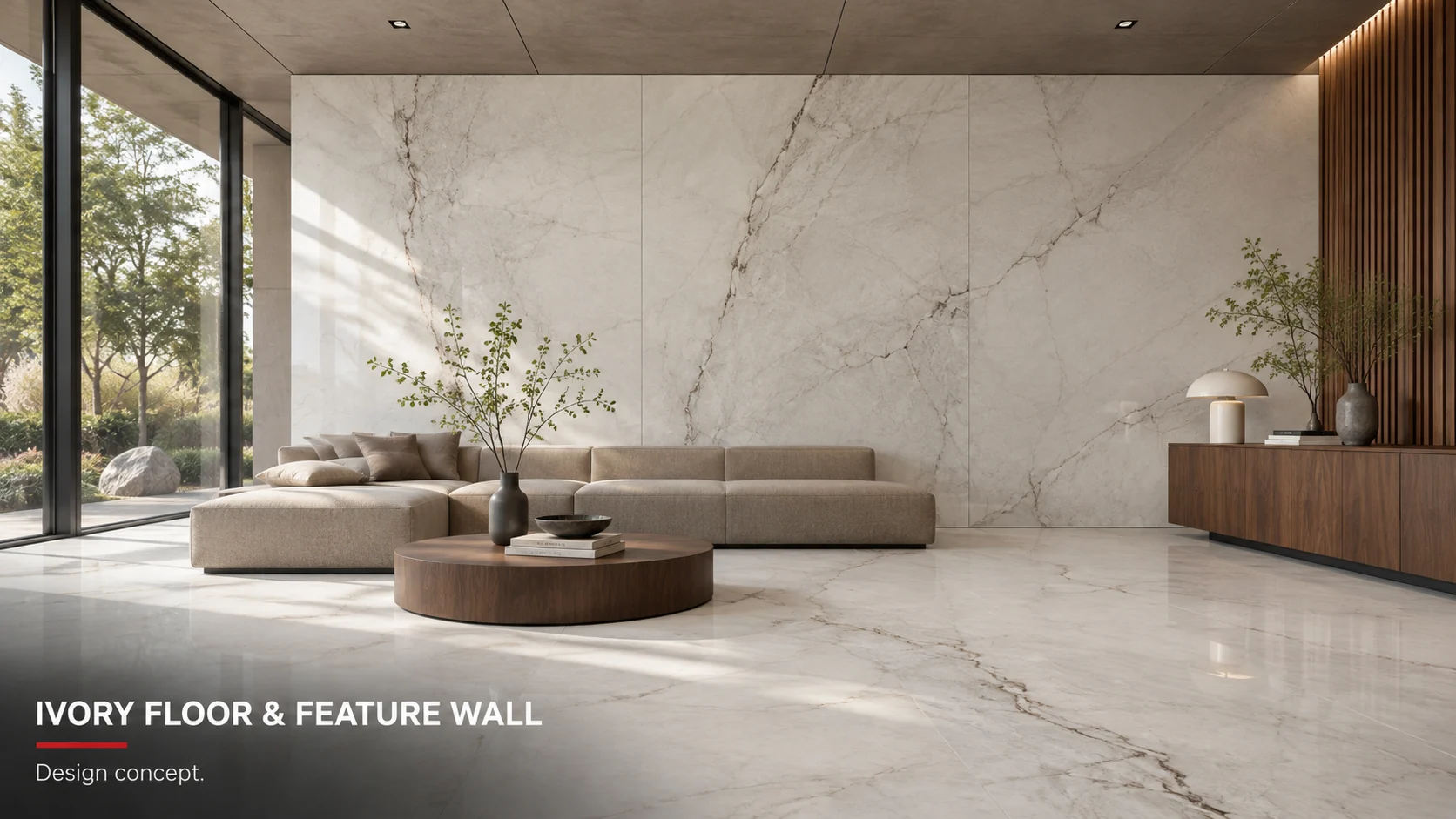
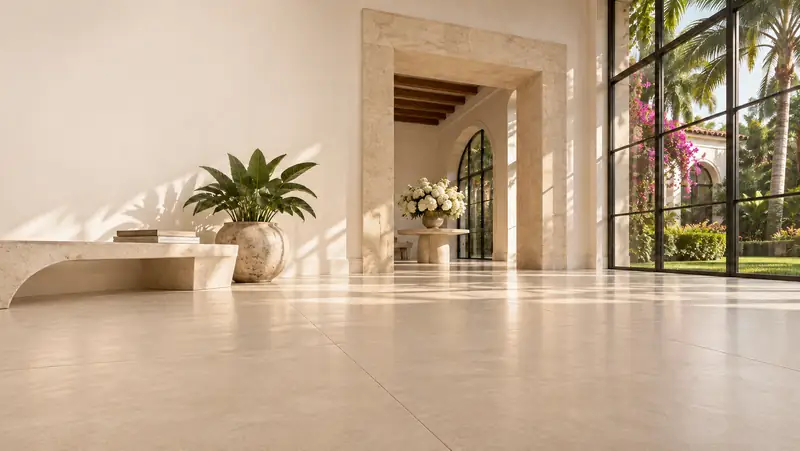
- Warm whites and soft beiges in 24x48 and 48x48, often matte, replacing the cooler grays of a few years ago.
- Travertine and limestone looks in porcelain. They give the natural-stone feel without the sealing and pitting.
- Bookmatched marble-look panels on feature walls, behind tubs and on TV walls.
- The same tile inside and out. Interior tile flowing to a matching outdoor porcelain on the patio for one continuous look through the sliding doors.
- Exterior cladding with large porcelain panels on columns, walls and soffits, replacing paint, stucco or wood that needs maintenance.
- Wide wood-look planks (10x60 and up) in bedrooms where clients want a wood look with zero water worries.
We bring samples to your home so you can see them in your own light.
Large format vs natural stone vs engineered wood
| Option | Look | Maintenance | Best for |
|---|---|---|---|
| Large-format porcelain | Modern, few joints | Very low | Whole first floors, outdoor continuity |
| Natural marble or travertine | Classic luxury, unique | Sealing, care with acids | Statement areas, luxury homes |
| Engineered white oak | Warm, natural | Moderate, avoid water | Bedrooms and living areas, where allowed |
Choosing the right large-format tile
- Rectified edges allow tighter joints and a cleaner look.
- Matte finishes hide lippage shadows and footprints better than polished.
- Check the bow. Ask for the manufacturer's warpage spec. Better tiles are flatter.
- Order 10–15% extra in one dye lot, for cuts and future repairs.
- Think about the route. A 48x110 slab has to fit through doors, elevators and stairwells.
Why clients trust us with large format
Large-format tile is where experience shows. Our crews set 24x48 floors, porcelain panels on walls and showers, and exterior cladding on columns and ceilings. We plan the layout before a single tile is cut, bring the saws and handling equipment large format needs, and check flatness and coverage throughout the job, not just at the end. J. Perry & Sons is a licensed Florida general contractor (CGC1540699) with 150+ completed projects, and our installations come with a workmanship warranty.
What to check on delivery day
Large tiles are expensive to replace, so we inspect every pallet before installation: the same shade and production lot on every box, no chipped corners, and any bow or warp checked against a straightedge before the tile goes on the floor.
Get a price for your large-format project
Send us your project and photos, or call (561) 556-7509. We'll check your floor's flatness on the first visit, so the price you get includes everything it takes to do the job right.
Related services: porcelain countertops · TV walls and accent walls
From large-format porcelain to natural stone, set right from the slab up.
Free project review · (561) 556-7509
FAQ
What size is considered large-format tile? Any tile with one side 15 inches or longer. In South Florida homes the most common sizes are 24x48, 32x32, 48x48 and wood-look planks.
Why does large-format tile need a leveling system? Large tiles show every small height difference at the joints. Leveling clips and wedges hold the edges flush while the mortar cures, so you don't feel or see lippage.
Do I need self-leveler for 24x48 tile? Often, yes. The floor needs to be flat within 1/8 inch over 10 feet. Many slabs need grinding or self-leveler in some areas to meet that.
How should 24x48 planks be offset? No more than one third of the tile length, never 50%, because of the slight factory bow in long porcelain tiles.
Can large-format tile be installed outside? Yes, with exterior-rated porcelain, exterior LHT mortar with near-full coverage, drainage, and movement joints.
Call (561) 556-7509 or send us your project with photos, the city, approximate dimensions, and material selections.
Share your vision for your South Florida home.
Free project review · (561) 556-7509