
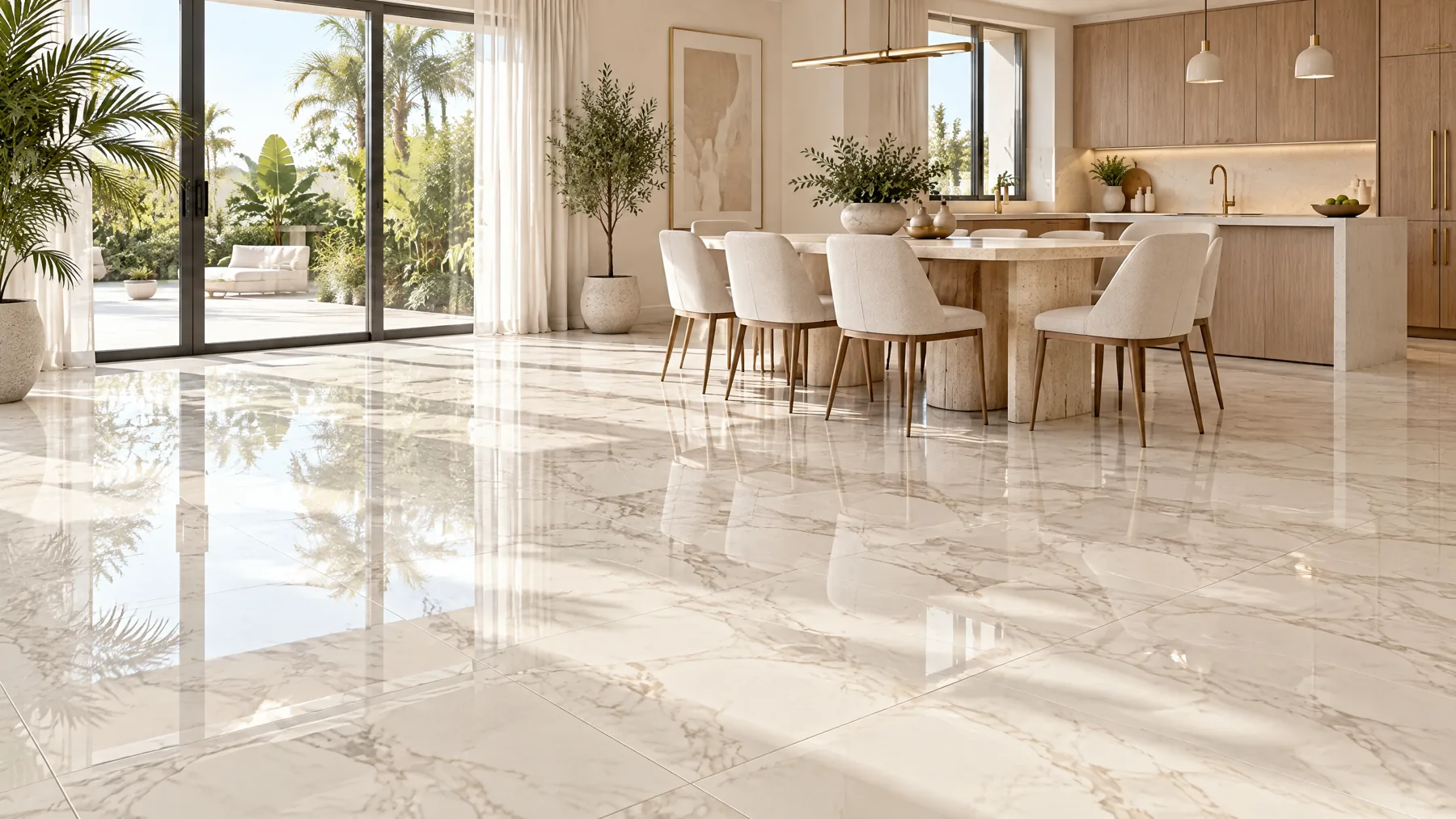
Why travertine still belongs in a luxury home
Travertine has been on the floors of fine homes for centuries, and it still has a look no manufactured tile copies well. Warm, quiet color, soft natural movement, and a surface that feels good under bare feet. In South Florida it suits Mediterranean homes, coastal homes and clean modern interiors alike; the finish you choose sets the style.
It is also a natural stone. It has pores and holes, it reacts to acids, and it needs a flat base and the right sealer. Most travertine floors we restore were not bad stone; they were set over an uneven slab, rarely sealed, or finished wrong for the room.
This guide is for homeowners and designers choosing a travertine floor: the finishes, filled versus unfilled, the common sizes including 18x18 and the French pattern, how we level the floor before stone, how to seal it in Florida humidity, and where travertine tile works indoors versus on a patio.
J. Perry & Sons supplies and installs travertine and other natural stone across Broward and Palm Beach. Send us your project with a few photos and the look you have in mind, and we will help you narrow down the right stone.
The four finishes: tumbled, honed, polished and brushed
The finish changes how travertine looks, how it feels and how it wears. It is the first choice to make.
| Finish | Look | Feel | Best for | Care notes |
|---|---|---|---|---|
| Tumbled | Rounded edges, aged, rustic | Textured, softer under foot | Mediterranean homes, patios, loggias | Hides wear and scratches well |
| Honed | Flat, matte, smooth | Smooth, not shiny | Living areas, kitchens, modern homes | Shows less wear than polished |
| Polished | Glossy, reflective, deep color | Very smooth | Formal rooms, foyers, low-traffic areas | Shows scratches and etching; slippery when wet |
| Brushed | Soft texture, slightly worn | Lightly textured | Transitional homes, covered outdoor areas | Good grip, forgiving look |
Tumbled travertine tile is tumbled with grit after cutting, which softens the edges and opens the surface. It gives the classic old-world look and is the most forgiving finish for active households and covered outdoor spaces.
Honed travertine is ground flat to a matte finish. It is the most popular choice in luxury interiors today, because it shows the stone's color without glare and holds up well in daily use.
Polished travertine is ground and buffed to a shine. It is beautiful in a foyer or formal living room, but it shows scratches, and acidic spills etch dull marks into the shine. Polished stone is also slippery when wet, so we do not recommend it for bathrooms or anywhere near the pool.
Filled vs unfilled travertine
Travertine forms with natural holes and voids. How those holes are treated matters as much as the finish.
Filled travertine has the holes filled at the factory, usually with a resin or cement filler close to the stone's color, and then honed or polished. The surface is smooth and easier to clean. This is what most interior floors use.
Unfilled travertine leaves the holes open. It has a rugged, natural look, often in tumbled stone. It is used mostly outdoors and in rustic interiors. The holes collect dirt indoors, and in a kitchen or bathroom that becomes a cleaning problem.
Some fillers loosen over time; reopened holes can be filled again on site. Our travertine restoration guide covers this.
Our general recommendation: filled and honed for living areas, kitchens and bathrooms; tumbled or unfilled for patios and covered outdoor spaces where the rustic look fits.
Sizes and patterns: 18x18, 24x24, French pattern and more
Travertine tile comes in a range of sizes, and the pattern you choose changes the whole room.
| Size or pattern | Typical use | Look |
|---|---|---|
| 12x12 | Smaller rooms, bathrooms, traditional homes | Classic, more grout lines |
| 16x16 | Mid-size rooms | Traditional, balanced |
| 18x18 | Living areas, open plans, older South Florida homes | Large square, fewer joints |
| 24x24 | Open-plan living, modern interiors | Clean, larger scale |
| 12x24 / 16x24 | Halls, modern interiors, wall areas | Linear, contemporary |
| French pattern (Versailles) | Foyers, great rooms, patios | Old-world, high-end |
Travertine 18x18 is one of the most common sizes in older South Florida homes, and it is still a strong choice for large open rooms. It gives a substantial square with fewer joints than 12x12. If you are matching or extending an existing 18x18 floor, we source the closest stone available and blend it at the transition, because natural stone from a new block will never match an older floor exactly.
24x24 and 12x24 suit modern interiors where you want a larger scale and a quieter floor. Long rectangular stone follows the same offset limits as large porcelain, so we lay it in a stack or a one-third offset.
French pattern, also called Versailles pattern, combines several rectangle and square sizes into a repeating set. It creates the hand-laid look of old European floors and is one of the most requested layouts in luxury homes. It takes more planning, more cutting and more care at the walls, so it is priced above a single-size floor. We lay out the pattern from the center of the room so it reads evenly at every wall and doorway.
Thickness. Most interior travertine tile is around half an inch thick. Outdoor pavers are thicker, which is part of why we treat patios differently below.
Leveling the floor with mortar before stone
A stone floor is only as flat as the base under it. Travertine is rigid. It cannot follow a dip in the slab, and it does not forgive high spots. When the base is uneven you get lippage, rocking tiles and, eventually, cracks.
Larger tiles need a flatter base. For tiles 15 inches or larger on any side, which includes 16x16, 18x18 and 24x24 travertine, the tile standards call for the substrate to be within 1/8 inch in 10 feet. Most South Florida slabs, new or old, need work to meet that.
Here is how we prepare the floor:
- Remove the old floor with our own crew, including old tile and thinset.
- Check the slab with a laser across the whole area.
- Grind high spots and fill low spots with mortar mix. Mortar is the right base for stone. It builds a bonded, solid bed that matches how stone wants to be set. Self-leveler is a product for vinyl floors, and we do not use it under stone.
- Treat cracks in the slab with a crack isolation membrane where needed, so a slab crack does not telegraph through the stone.
- Set the stone with full coverage, back-buttering each tile and checking coverage as we go. Hollow spots under travertine crack under furniture and impact.
In condos, most associations require a sound underlayment under hard floors on upper levels. We plan the underlayment, the transitions and the door clearances before the stone is ordered.
Sealing travertine in Florida humidity
Travertine is porous. Without a good sealer, it absorbs spills, cleaning water and the moisture that is always in the South Florida air. That is how stains, dark spots and dull areas start.
What sealing does. A penetrating sealer soaks into the stone's pores and slows down how fast liquids get in. It does not make the stone stain-proof, and it does not stop acid etching. Wine, lemon, vinegar and many household cleaners can still etch the surface, especially on polished stone.
Sealing travertine tiles the right way:
- Seal after installation, once the grout has cured and the floor is clean and dry.
- Use a penetrating sealer, not a topical coating that sits on the surface and wears unevenly. Topical coatings also trap moisture, which is a problem in humid climates.
- Test absorption with a few drops of water. If the water darkens the stone quickly, it is time to reseal.
- Reseal on a regular schedule based on traffic and exposure. Outdoor stone and floors near the pool need it more often.
- Clean with a pH-neutral stone cleaner. Acidic and harsh cleaners strip sealer and etch the surface.
For more detail, read our article on sealing natural stone in Florida humidity.
Indoor floors vs patios: where travertine tile works
Travertine works inside and outside, but not always in the same form.
Indoors. Filled and honed travertine tile is the standard for living areas, kitchens, hallways and bathrooms. In bathrooms, choose a honed or tumbled finish for grip, and seal carefully around the vanity and shower. We avoid polished travertine on bathroom floors.
Covered patios and loggias. Travertine patio tile works well under a roof, set on a sound slab with the right outdoor setting materials and movement joints. Tumbled and brushed finishes give better grip when wet.
Open patios and pool decks. In full sun and rain, we prefer thicker travertine pavers over thin tile. Travertine for outdoor patio areas has a big advantage in Florida: it stays cooler under bare feet than many other paving materials. Pavers are set on a proper base or bonded to a sound slab, and they handle heat, water and movement better than interior tile. Our travertine pavers page covers outdoor installations, and our guide to travertine vs marble vs porcelain pavers compares the options.
Indoor to outdoor flow. Many luxury homes run the same stone from the living room out to the patio. We can match the color and finish inside and out, using tile indoors and pavers or thicker stone outside, with the transition planned at the door.
What travertine flooring costs
Our published starting prices:
| Service | Starting price |
|---|---|
| Travertine patio pavers, new base (patio only) | Starting at $29 per sq ft |
| Travertine pool deck, tumbled, stone included | Starting at $38 per sq ft |
| Penetrating sealer after cure (exterior travertine, per visit) | Starting at $2 per sq ft |
| Interior travertine floor tile, supplied and installed | Priced in your written proposal after the project review |
| Floor leveling with mortar, demolition and pattern layout | Priced in your written proposal after the project review |
The final price is based on the stone grade, the finish, the size and pattern (French pattern takes more labor than a single size), the slab condition, the leveling required, and access at the property. It is set in an itemized written proposal after the project review. See our tile installation page for how we price stone and tile floors.
Why homeowners and designers choose us for stone floors
- We supply the travertine and set it ourselves, from demolition to sealing.
- We level every floor with mortar where stone is going down, never self-leveler.
- We bring samples to your home so you see the stone in your own light.
- We also restore, polish and replace existing travertine, so we can match and extend older floors.
- We pull all permits the work requires and follow every city, county and association requirement.
- J. Perry & Sons is a licensed Florida General Contractor (CGC1540699), licensed and insured, with more than 150 projects completed and a workmanship warranty.
Next step Call (561) 556-7509 or send us your project. Share photos of the rooms, the finish you like and whether the floor continues outside, and we will call you back personally to set up your Free Project Review.
Travertine flooring FAQ
Is travertine a good choice for floors in South Florida?
Yes, when it is filled, sealed and set on a flat base. It stays cool, suits many home styles and can be restored rather than replaced. It does need regular sealing in our humid climate.
What is the difference between filled and unfilled travertine?
Filled travertine has its natural holes filled at the factory and then honed or polished, for a smooth, easy-to-clean surface. Unfilled leaves the holes open for a rustic look and is used mostly outdoors.
Is 18x18 travertine still a good size?
Yes. It is one of the most common sizes in South Florida homes and works well in open rooms. For a more modern look, 24x24 and 12x24 are popular.
What is French pattern travertine?
A repeating layout of several square and rectangle sizes, also called Versailles pattern. It gives an old-world, hand-laid look and needs careful layout from the center of the room.
How often should travertine tiles be sealed?
It is based on traffic and exposure. Test with a few drops of water: if the stone darkens quickly, reseal. Outdoor stone and pool areas need it more often than interior floors.
Can I use travertine tile on my patio?
Under a roof, yes, with outdoor setting materials and a non-slip finish. For open patios and pool decks we recommend thicker travertine pavers, starting at $29 per sq ft for patios.
Does the floor need leveling before travertine?
Almost always. Stone tiles 15 inches and larger need a base within 1/8 inch in 10 feet. We laser-check the slab and correct it with mortar.
Guide
Request the guide: Large-Format Tile, Slab and Stone Floors: Finishes, Miters and Care
Call (561) 556-7509 or send us your project for a Free Project Review.