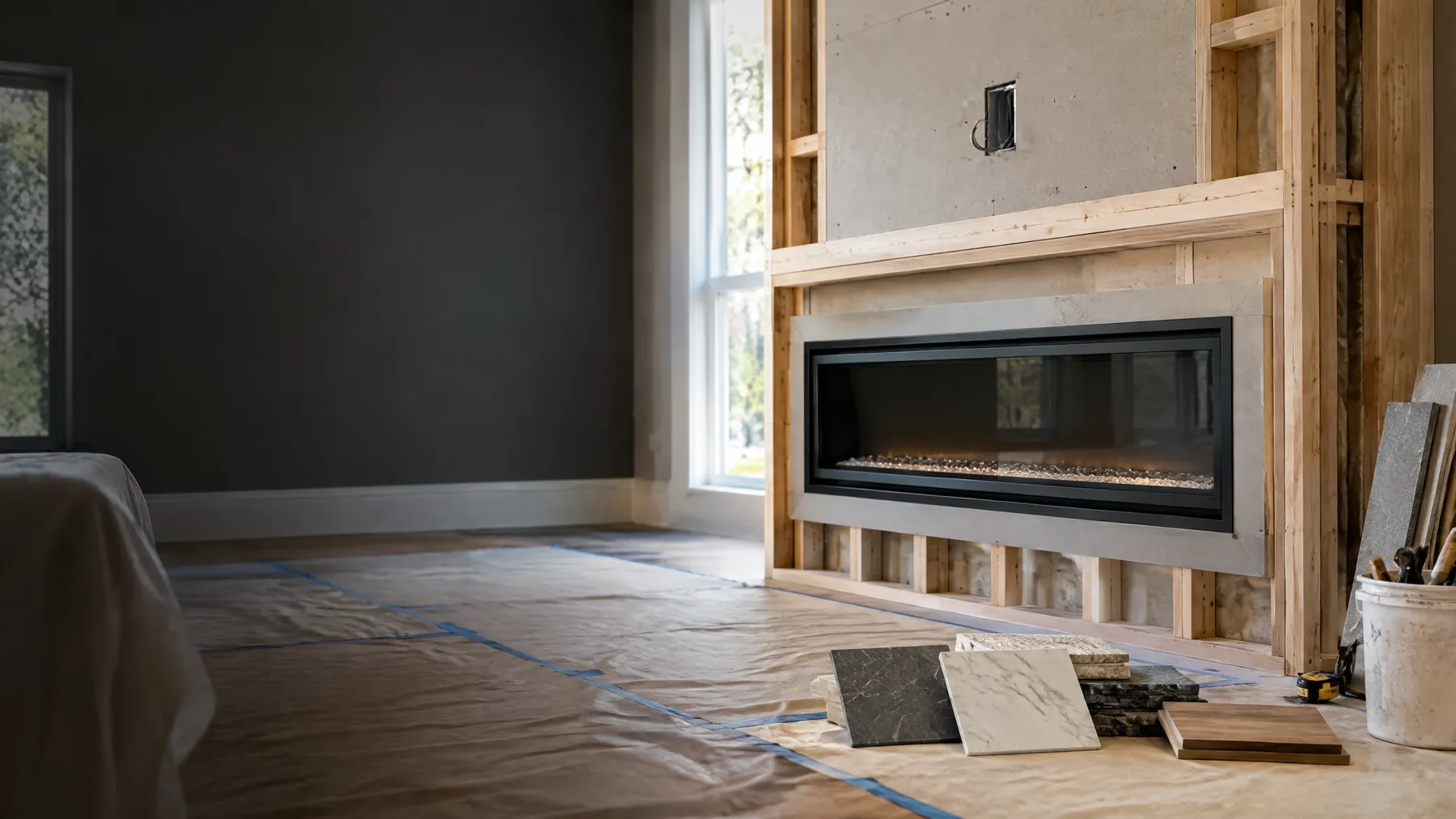
Refacing an existing fireplace with stone veneer, tile or a porcelain slab typically does not need a building permit in Broward or Palm Beach, because the firebox, venting and gas are untouched. Installing a new fireplace, adding a gas line, hard-wiring an electric insert, changing the venting or building a new chimney chase does. J. Perry & Sons fireplace installation handles both, and we pull the permit on every job that needs one. Here is where the line usually falls.
Fireplace work and permits: what typically applies
| Fireplace work | Permit typically required in Florida? | Sub-permits | Permit fee |
|---|---|---|---|
| Reface existing fireplace with stone, tile or porcelain slab | No (cosmetic finish over an existing, unchanged unit) | None | No permit fee |
| Replace mantel, add a hearth extension in stone | Usually no, unless it changes required clearances | None | No permit fee |
| Install a new electric fireplace, plug-in | No | None | No permit fee |
| Install a new electric fireplace, hard-wired on a new circuit | Yes, electrical | Electrical | Listed in the proposal |
| Install or replace a gas insert or gas log set | Yes, mechanical and gas | Gas, mechanical | Listed in the proposal |
| New gas line from the meter or propane tank | Yes | Gas (plumbing) | Listed in the proposal |
| New prefabricated (zero-clearance) fireplace with venting | Yes, building and mechanical | Mechanical, possibly electrical | Listed in the proposal |
| New chimney chase or exterior vent termination | Yes, building | Building; roofing if it penetrates the roof | Listed in the proposal |
| Outdoor fireplace, masonry or prefab | Yes in most cities | Building, gas if applicable | Listed in the proposal |
Each city sets its own fee schedule and some treat cosmetic work differently. Permit and engineering fees are separate and listed in the proposal. This is general guidance, not legal advice. Confirm with your city's permitting office or an attorney before starting.
Why refacing usually does not need a permit
A permit is triggered by work that affects structure, fire safety systems, electrical, plumbing, gas or mechanical. Refacing changes none of those. You are removing the old brick, tile or drywall face and installing a new finish over a cement backer board on the same framing, around the same firebox, with the same venting. The firebox and its listed clearances are not changed.
The one thing we check on every refacing job is clearance to combustibles. Prefab fireplaces come with a label inside the firebox stating the required distance from the opening to any combustible material, usually 6–12 inches on the sides and 12 inches or more above. Stone, tile and porcelain are non-combustible, so they can go right to the opening. A wood mantel cannot. If the new design moves a wood mantel or adds a wood beam closer than the label allows, it has to be redesigned, permit or not.
Free Project Review — call (561) 556-7509 or send us your project. Send a photo of the fireplace and the look you want, and we'll tell you whether it needs a permit and the starting price.
When a fireplace remodel does need a permit
Gas. Any new gas line, extension, insert or log set is a gas permit, with a pressure test and inspection. Gas work is done by licensed gas technicians, coordinated and permitted by J. Perry & Sons, with the project staying under J. Perry & Sons.
Hard-wired electric. A linear electric fireplace on its own 20-amp circuit is an electrical permit. A plug-in unit is not.
New fireplace. A new zero-clearance unit with a direct vent through the wall or roof is a building and mechanical permit. The inspector checks the unit's listing, the vent run, the clearances and the framing.
Chimney and venting changes. Moving a vent, adding a chase on the exterior or penetrating the roof is a building permit, usually with a roofing inspection.
Outdoor fireplaces. Most Broward and Palm Beach cities permit outdoor fireplaces and fire features, and some have setback rules from the property line and the house. HOA approval is required in almost every community.
Fireplace Permit Checklist for a New Fireplace
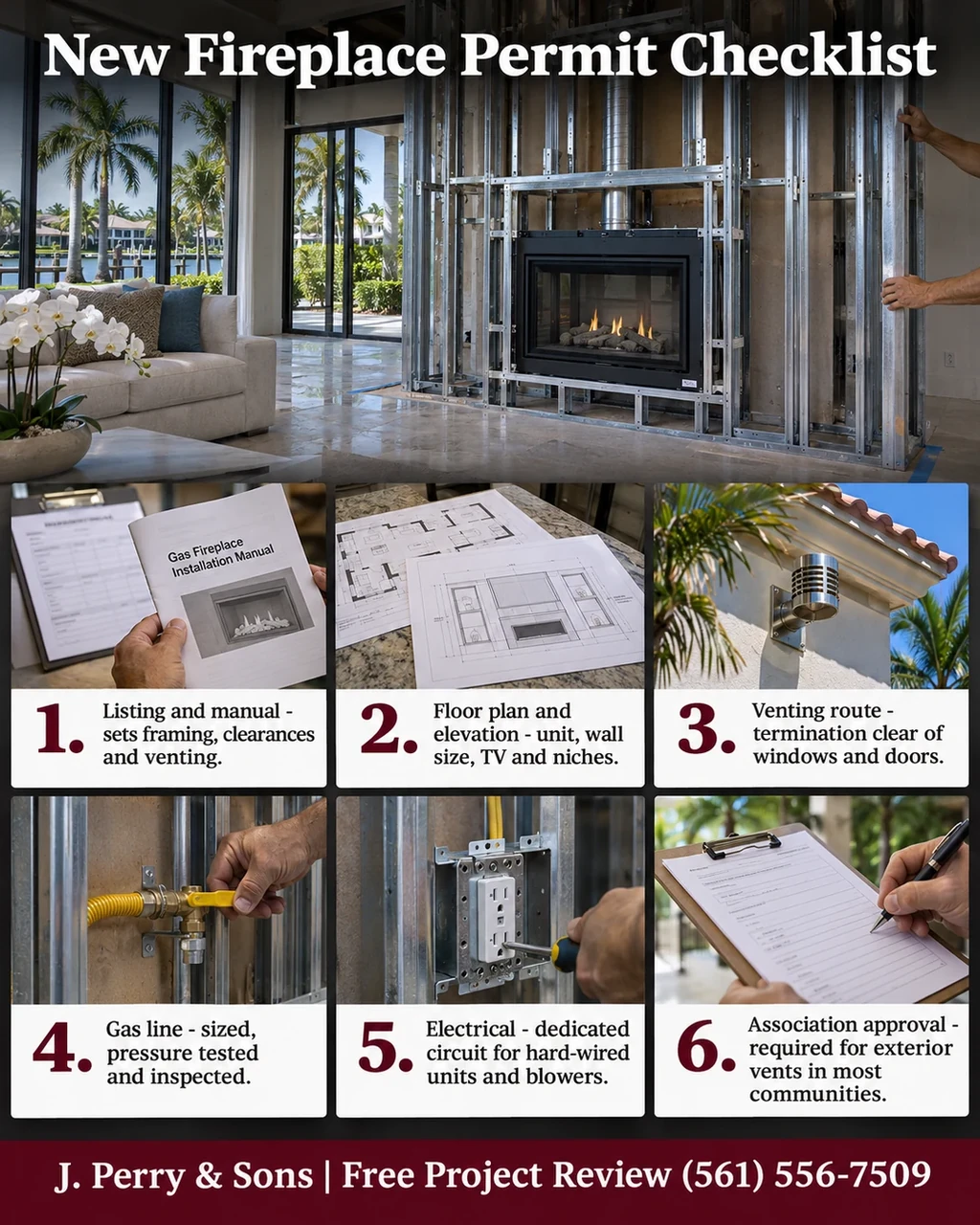
Adding a fireplace where there was none is the project most likely to need a full fireplace permit. The building department wants to see that the unit is listed, that it is installed to its manual and that the venting, gas and electrical meet the code. We prepare the package before we apply.
What goes into a new fireplace permit package: - The unit's listing and installation manual. The manual sets the framing size, clearances to combustibles, hearth requirements and the venting route. The inspector checks the installation against it. - Floor plan and wall elevation. Where the unit sits, the size of the chase or the wall, and where the TV, shelves or niches go. - Venting route. For a direct-vent gas unit, the route through the wall or roof and where the termination sits in relation to windows, doors and the property line. - Gas line. The line from the meter or tank, its size and the pressure test. Gas work is done by licensed gas technicians, coordinated and permitted by J. Perry & Sons, with the project staying under J. Perry & Sons. - Electrical. A dedicated circuit for a hard-wired electric unit or for a gas unit's blower and ignition, done by licensed electricians and licensed gas technicians, coordinated and permitted by J. Perry & Sons. - Framing. Wood or metal framing for the chase, built to the dimensions in the manual. Any opening cut into an exterior block wall is built to a licensed engineer's sealed drawings. - Association approval for a condo or HOA property, especially for any exterior vent termination.
Where projects go wrong. The common mistakes are a TV mounted too close above a unit that is not rated for it, a wood mantel inside the required clearance, and a vent termination placed under a window. Each one fails inspection, and each one is easy to plan around before the wall is built.
Our fireplace installation page explains how we build new fireplaces from the framing to the finish.
Next step: send us a photo of the wall and the unit you like, and we will tell you which permits it needs before you buy.
HOA and condo rules on fireplaces
Single-family HOAs rarely care about an interior refacing. Exterior work, including a new chimney chase or an outdoor fireplace, goes through architectural review.
Condos are different. Most high-rise buildings in Broward and Palm Beach do not allow any gas appliance in a unit and many prohibit wood-burning. Electric fireplaces are usually allowed. A refacing inside a condo unit still needs the building's contractor approval (license, insurance, scope) even if the city does not need a permit. We prepare that package.
Electric vs Gas: How the Choice Changes the Permit
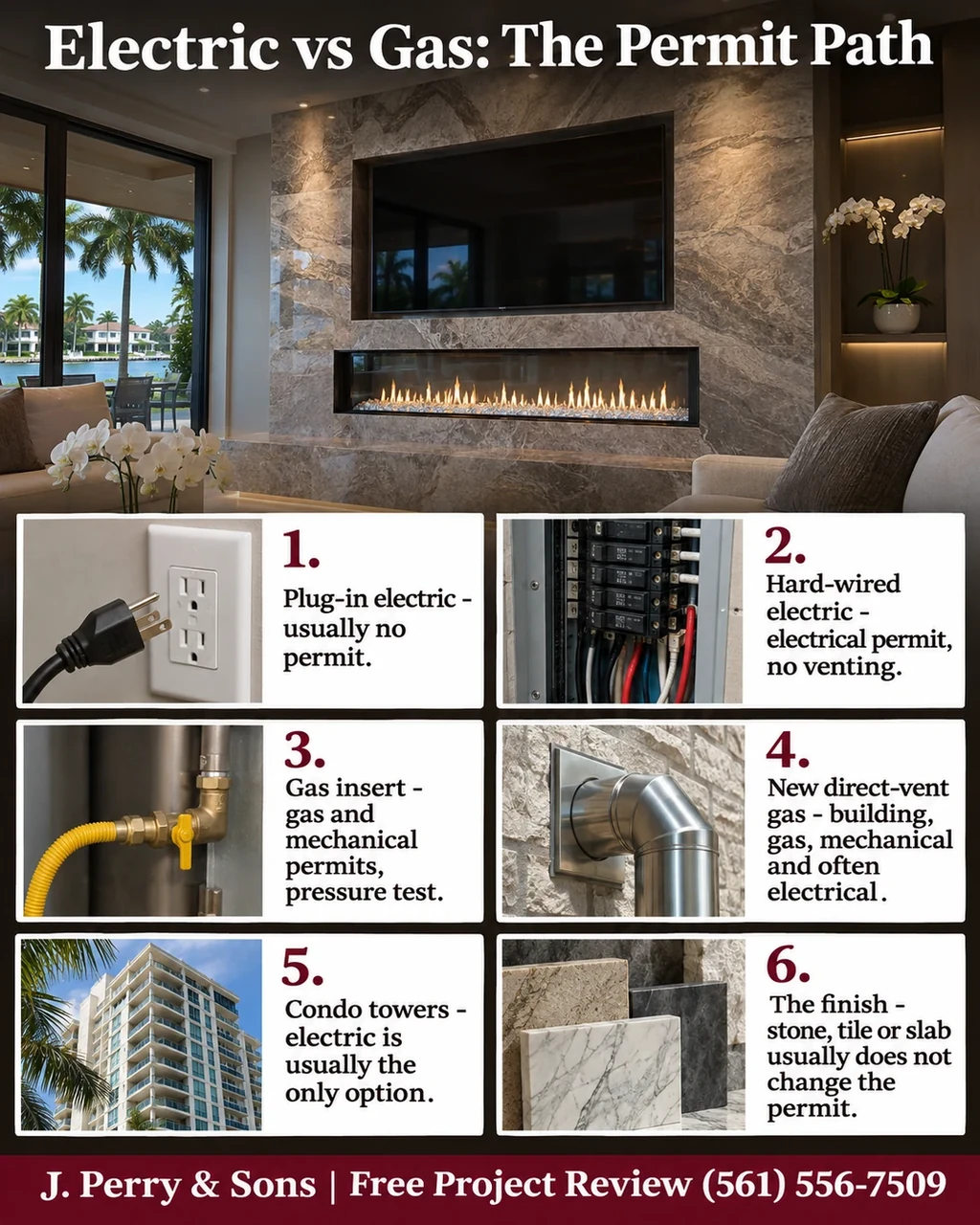
The type of fireplace you choose decides most of the permit work. Here is how electric and gas compare once the permit is part of the plan.
Plug-in electric. A unit that plugs into an existing outlet usually needs no permit. It is the simplest option, but it limits the size of the unit and where it can go.
Hard-wired electric. Most large linear electric fireplaces are hard-wired on their own circuit. That is an electrical permit, done by licensed electricians, coordinated and permitted by J. Perry & Sons. Electric units need no venting, so they work almost anywhere in a house and in most condo towers. Our guide to the linear electric fireplace wall shows how these walls are built.
Gas insert or log set in an existing fireplace. This needs a gas permit, a mechanical permit and a pressure test. The existing firebox and venting are checked for the new unit.
New direct-vent gas fireplace. This is the most involved permit: a building permit for the chase and the vent, a gas permit for the line, a mechanical permit for the unit and often an electrical permit for the blower. The vent termination has to meet the code's distances from windows, doors and air intakes. Our guide to gas fireplace insert cost covers the gas side in more detail.
Condo towers. Most high-rise buildings do not allow gas in the units, and many prohibit wood-burning. In a condo, an electric unit is usually the only option, and the association still reviews the electrical work.
What stays the same. Whether the unit is electric or gas, the finish around it, such as stone, tile or a porcelain slab, usually does not change the permit.
Next step: tell us whether your home has gas service and whether you are in a condo or a house, and we will tell you which units fit your permit path.
What a refacing job looks like
- Protect floors, remove the old face to the framing or block.
- Install cement backer board, taped and set in thinset.
- Set the stone veneer, tile or porcelain slab with a polymer-modified mortar rated for the material. Slabs go up on a mechanical and adhesive system.
- Install a non-combustible hearth if the design has one, and a mantel at the listed clearance.
- Grout or seal joints as the material requires.
Your schedule is set out in the written proposal after the site review. See our fireplace refacing cost guide for starting prices.
Building a Floor-to-Ceiling Stone Fireplace Wall
Many South Florida owners adding a fireplace want it to be the focal wall of the room. It is built in a clear sequence.
Floor-to-ceiling stone fireplace: Starting at $35,500. The final price is based on the unit, the wall size, the stone and the built-ins.
Framing. The wall is framed to the dimensions in the unit's manual. On a new feature wall, we often use metal framing, because steel studs stay straight in humid homes and are non-combustible around the firebox. The framing includes blocking for the TV mount, the mantel and any shelves.
The unit and the rough trades. The fireplace is set, the gas line or circuit is run by licensed electricians and licensed gas technicians, coordinated and permitted by J. Perry & Sons, and the rough inspections are passed before the wall is closed.
Backer. The wall is sheathed in cement backer board, with seams taped and set. This is the base the stone is bonded to.
Stone. After the project review, your written proposal lists the following scope and pricing: Natural stone veneer ( installed) is set with a mortar rated for the stone's weight. We install real natural stone only. For a smooth, modern face, a porcelain or stone slab is set with a mechanical and adhesive system. See our interior accent walls page for the stone options we install.
TV recess and niches. A recessed TV niche keeps the screen flush with the stone. The unit's manual tells us whether a TV can be mounted above it and how far up.
Mantel and hearth. A stone or concrete mantel can sit closer to the opening than wood. A wood beam mantel is placed at the clearance the manual requires.
Finish. Joints are pointed or grouted, the stone is sealed where the material needs it, and the final inspection closes the permit.
Next step: send us a photo of the fireplace wall you love and a photo of your room, and we will tell you how we would build it and the starting price.
South Florida specifics
Most fireplaces in Broward and Palm Beach homes are prefab zero-clearance units built in during construction, not masonry. That makes refacing simple and keeps the permit question off the table in most cases. On the coast, salt air corrodes exposed metal trim, so we use stainless or powder-coated hardware on outdoor units.
In hurricane season, exterior vent and outdoor fireplace work is planned around the weather. The order of work is set by the permit: the unit is chosen, the permits are issued, the rough gas, electrical and venting are inspected, then the wall is finished and the final inspection closes the permit. Your schedule is set out in the written proposal after the site review.
Outdoor Fireplaces and Fire Features: Permit Points
An outdoor fireplace is one of the most requested additions to a South Florida patio, and it is almost always a permitted project. It is a structure, it often has gas, and it sits near the house, the pool and the property line.
Footing and structure. A masonry outdoor fireplace is heavy. The concrete footing is poured with concrete specialists coordinated by J. Perry & Sons, and our crew builds the concrete block (CMU) structure and the natural stone finish, or a stucco or porcelain finish. The structure is built to the approved drawings.
Setbacks. Most cities set a distance from the property line, and some set a distance from the house, the pool and overhead structures. These are checked on the site plan.
Gas. A gas-fired outdoor fireplace or fire pit needs a gas permit and a pressure test, done by licensed gas technicians, coordinated and permitted by J. Perry & Sons, with the project staying under J. Perry & Sons.
Wind and weather. Outdoor units and their caps have to be suited to South Florida wind and salt air. On the coast, we use stainless or powder-coated metal trim.
Under a roof or pergola. A fireplace under a covered patio or a pergola has clearances to the roof and beams. The unit's manual and the code set them.
HOA approval. Most communities review the size, the height and the finish of an outdoor fireplace before the permit application.
For the full outdoor plan, including outdoor kitchens and fire features, see our outdoor living page.
Next step: send us a photo of your patio and a survey if you have one, and we will show you where an outdoor fireplace can go.
Fireplace installers by city
- Fireplace installation in Boca Raton
- Fireplace installation in Parkland
- Fireplace installation in Weston
- Fireplace installation in Fort Lauderdale
- Fireplace installation in Delray Beach
- Fireplace installation in Wellington
- Fireplace installation in Palm Beach Gardens
- Fireplace installation in Southwest Ranches
Free Project Review — call (561) 556-7509 or send us your project. Licensed Florida general contractor CGC1540699. Serving Broward, Palm Beach and Miami-Dade counties.
Fireplace permits in Florida — FAQ
Do I need a permit to put stone on my fireplace?
Typically no. Stone veneer, tile or porcelain slab over an existing, unchanged fireplace is a cosmetic finish. Clearances to a wood mantel still have to meet the unit's label. Confirm with your city.
Do I need a permit for an electric fireplace?
Plug-in units, no. A hard-wired unit on a new circuit needs an electrical permit, and the fee is listed in the proposal.
Do I need a permit for a gas fireplace insert in Florida?
Yes. Gas inserts, log sets and new gas lines require a gas and mechanical permit with a pressure test and inspection, and the fee is listed in the proposal.
Can I add a fireplace to a condo?
Usually electric only. Most Broward and Palm Beach condo buildings prohibit gas and wood-burning units. The building will still want the contractor's license and insurance for a refacing.
How do I get an exact price?
Call (561) 556-7509 or send photos and rough dimensions through our project form. After the site review and scope confirmation, you receive an itemized written proposal.
Do I need a fireplace permit to add a new fireplace in Florida?
In most cases, yes. A new fireplace usually needs a building permit for the chase and venting, plus gas, mechanical or electrical permits for the unit. A plug-in electric unit in an existing outlet is the main exception.
Can I mount a TV above a new fireplace?
Only if the unit's manual allows it. The manual sets how far above the opening a TV can go and whether a mantel or heat deflector is needed. We plan the TV niche from the manual before the wall is framed.
Do I need HOA approval for a fireplace in Florida?
For an interior refacing, usually not. For a new exterior vent, a chimney chase or an outdoor fireplace, almost always. In a condo, the association reviews any fireplace work in the unit.
Is a stone fireplace wall heavy enough to need special framing?
Natural stone adds real weight, so the wall is framed and sheathed for it, with cement backer board and blocking for the mantel and TV. On new walls we often use metal framing for straightness and fire resistance.
How are permit fees shown on your proposal?
Permit and engineering fees are separate and listed in the proposal, so you see them before you sign.