
The 50 percent rule in Florida renovation applies to buildings in a mapped special flood hazard area. When the cost of improving a building, or repairing it after damage, reaches half of the building's market value, the work is treated as a "substantial improvement" or "substantial damage," and the whole building may have to meet current flood requirements. Your local floodplain administrator decides what counts and how value is measured. This guide explains the idea in plain terms; see J. Perry & Sons permits and compliance for how we handle the paperwork.
How the 50 percent rule works, in general terms
The rule comes from the National Flood Insurance Program, which participating Florida cities and counties enforce through their own floodplain ordinances. The basic comparison is simple:
| Piece of the comparison | What it generally means | Who decides the details |
|---|---|---|
| Cost of the work | The full cost of the proposed improvement or repair, usually including labor and materials at fair market rates | Floodplain administrator reviews the cost estimate submitted with the permit |
| Value of the building | Market value of the structure itself, not the land | Community chooses which valuation sources it accepts, such as a property appraiser figure or an independent appraisal |
| The comparison | If cost reaches 50% of value, the project is "substantial" | Floodplain administrator makes the determination |
| Result if substantial | Building generally must be brought into compliance with current floodplain rules | Building department and floodplain office set the required measures |
Some communities in Florida also add up improvements over a period of years rather than looking at one permit at a time. Whether yours does, and for how long, is a question for your floodplain office. We don't give legal advice, and nothing here replaces that office's written determination.
The 50 Percent Rule in Florida: Substantial Improvement vs. Substantial Damage
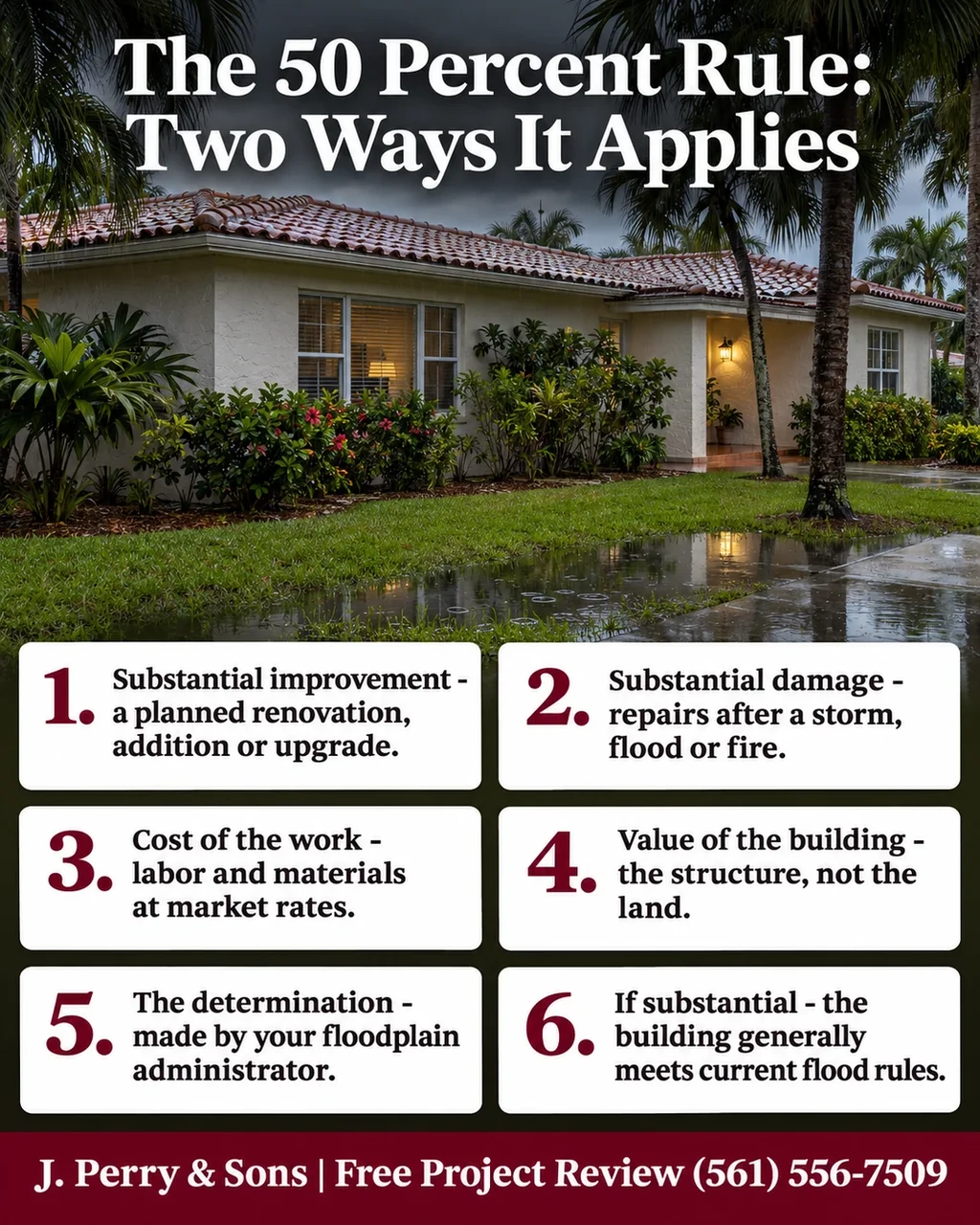
The 50 percent rule in Florida shows up in two situations, and owners often hear both terms without knowing the difference. Your floodplain administrator decides which one applies to your building and how it is measured. This is the general idea.
Substantial improvement. This is the planned-renovation side. You decide to remodel, add on or upgrade the house. The floodplain office compares the cost of that work with the market value of the structure. If the cost reaches half of that value, the project is a substantial improvement, and the building generally has to be brought up to current flood rules.
Substantial damage. This is the after-the-storm side. A hurricane, a flood or a fire damages the house. The floodplain office compares the cost to repair the building to its condition before the damage with its market value. If the repair cost reaches half, the building is substantially damaged, and the same compliance question follows.
Why the difference matters to you. - With an improvement, you control the scope and the timing, so you can plan around the rule before you sign anything. - With damage, the determination comes first, often while you are dealing with insurance and temporary repairs. - In both cases, the cost estimate submitted with the permit is the document the office reviews.
What it is not. The rule is not a ban on renovating. Many owners in flood zones renovate every year. The rule decides what standard the finished building must meet.
J. Perry & Sons pulls the permits on every project and prepares the cost documentation the building department asks for. Our permits and compliance page explains how we handle city and county requirements.
Next step: if your home is in a flood zone, ask your floodplain office for a pre-review before you finalize your renovation plans, and send us your wish list so the estimate is ready.
Why this matters before you plan a big remodel
A whole-house remodel in South Florida adds up fast: a kitchen, two bathrooms, new flooring throughout and impact windows can be a large share of what an older, smaller house is valued at for the structure alone. Owners of ranch homes built decades ago in low-lying parts of Broward, Palm Beach and Miami-Dade are the ones most likely to run into it.
If a project is found substantial, compliance often means raising the lowest floor or other flood-resistant measures, which can change the project from a remodel into something much bigger. Finding that out after demolition is the worst time.
Free Project Review — call (561) 556-7509 or send us your project. Send the address and your full remodel wish list, and we'll prepare an itemized budget you can bring to the floodplain office.
What the cost estimate is made of
When the work is in a flood zone, the building department usually asks for a detailed estimate with the permit. Ours breaks the job into lines so the reviewer can see the scope:
- Demolition and disposal of each area.
- Structural and envelope work, such as openings, windows and doors, stucco.
- Interior finishes: tile, flooring, drywall, paint, cabinets, countertops.
- Mechanical, electrical and plumbing done by licensed trades, coordinated by J. Perry & Sons.
- Contractor overhead and profit, which floodplain offices generally count as part of the cost of the work.
Floodplain offices often want items valued at market rates even if the owner is supplying material or doing work themselves. Ask how they treat owner-supplied material and owner labor before you submit. Some items, such as certain site work or detached structures, may be treated differently; your administrator decides.
Why an Itemized Proposal Matters for the Floodplain Review
When a renovation is in a flood zone, the cost estimate is not just a price for you. It is a document the floodplain office uses to make a determination. A vague estimate can lead to questions, a request for more detail or a determination based on the office's own cost figures.
What reviewers look for. - Every area of work listed separately: kitchen, each bathroom, flooring, windows and doors, exterior work - Labor and materials for each line, at market rates - Demolition and disposal shown, not left out - The electrical, plumbing and mechanical scopes, done by licensed trades, coordinated by J. Perry & Sons - Items the office may treat differently, listed on their own lines so the reviewer can see them
Owner-supplied material and labor. If you plan to buy fixtures yourself or do part of the work, ask the office how they count it. Many offices value it at market rates anyway, so it does not lower the total the way owners expect.
Changes during the job. If the scope grows after the permit is issued, the added cost may need to be reported. A change that pushes the project over the line after demolition is the hardest situation to fix. We price the full scope up front so that does not happen.
Why we itemize. Our written proposals are itemized by area and trade. That makes the floodplain review clearer and lets you see where the money goes if you need to adjust the scope. Our guide on why the contractor pulls the permits explains why this paperwork belongs with the licensed contractor.
Next step: send us your full renovation wish list, not just the first phase, and we will prepare an itemized proposal you can take to the floodplain office.
Questions to ask your floodplain administrator
- Is the property in a special flood hazard area on the current map, and which zone?
- Which valuation sources does the community accept for the building's market value?
- Does the community count improvements cumulatively, and over what period?
- Which items in our estimate are included or excluded from the cost?
- If the project is substantial, what compliance measures would apply to this building?
- Is an elevation certificate on file, and is a new one needed?
Bring the answers back to your contractor and, where needed, your architect or engineer.
When Compliance Means Raising the Floor or Adding On
If the floodplain office determines that a project is substantial, the building generally has to meet current flood rules. For many older homes on low ground, that means the lowest floor must be at or above the required elevation. This is where the project changes shape.
Raising the lowest floor. In some homes, a structure can be raised or the floor rebuilt higher. This is structural work. A licensed engineer designs it, and J. Perry & Sons builds to the sealed drawings. Engineering and permit fees are separate and listed in the proposal.
Rebuilding or replacing. For some owners, the cost of raising an older house is close to the cost of building new. That decision belongs with your architect, engineer and insurer, and we price the construction side so you can compare.
Additions. An addition to a house in a flood zone generally has to meet current flood rules on its own, even when the existing house does not change. A new master suite, a family room or a larger kitchen added on is built to the required elevation. Our home additions page explains how we build block additions to the engineer's drawings, under one permit.
The elevation certificate. Many of these decisions rest on the elevation certificate, a survey document that records the building's elevations. If one is not on file, a licensed surveyor prepares it.
Insurance. Flood insurance and the 50 percent rule are related but separate. A building brought into compliance may see its flood insurance change. Ask your agent before you decide.
For how permits work in the county where your home sits, see our Broward County renovation permits guide.
Next step: if your floodplain office has already given you a determination, send it to us with your plans, and we will tell you what the construction involves.
Ways owners approach a project near the line
These are general planning ideas, not advice on how to avoid a requirement:
- Phase the work, knowing that some communities count cumulative improvements, so phasing may not change the outcome.
- Prioritize what matters most: windows, roof and water protection first, finishes later.
- Get an independent appraisal if you believe the building's market value is higher than the source the office uses, and ask whether they'll accept it.
- Design for flood resistance even below the threshold: tile instead of wood on ground floors, cement board instead of paper-faced drywall in wet areas.
- Talk to your insurer. Flood insurance and the 50% rule are related but separate questions.
Flood-Resistant Materials That Make Sense on the Ground Floor
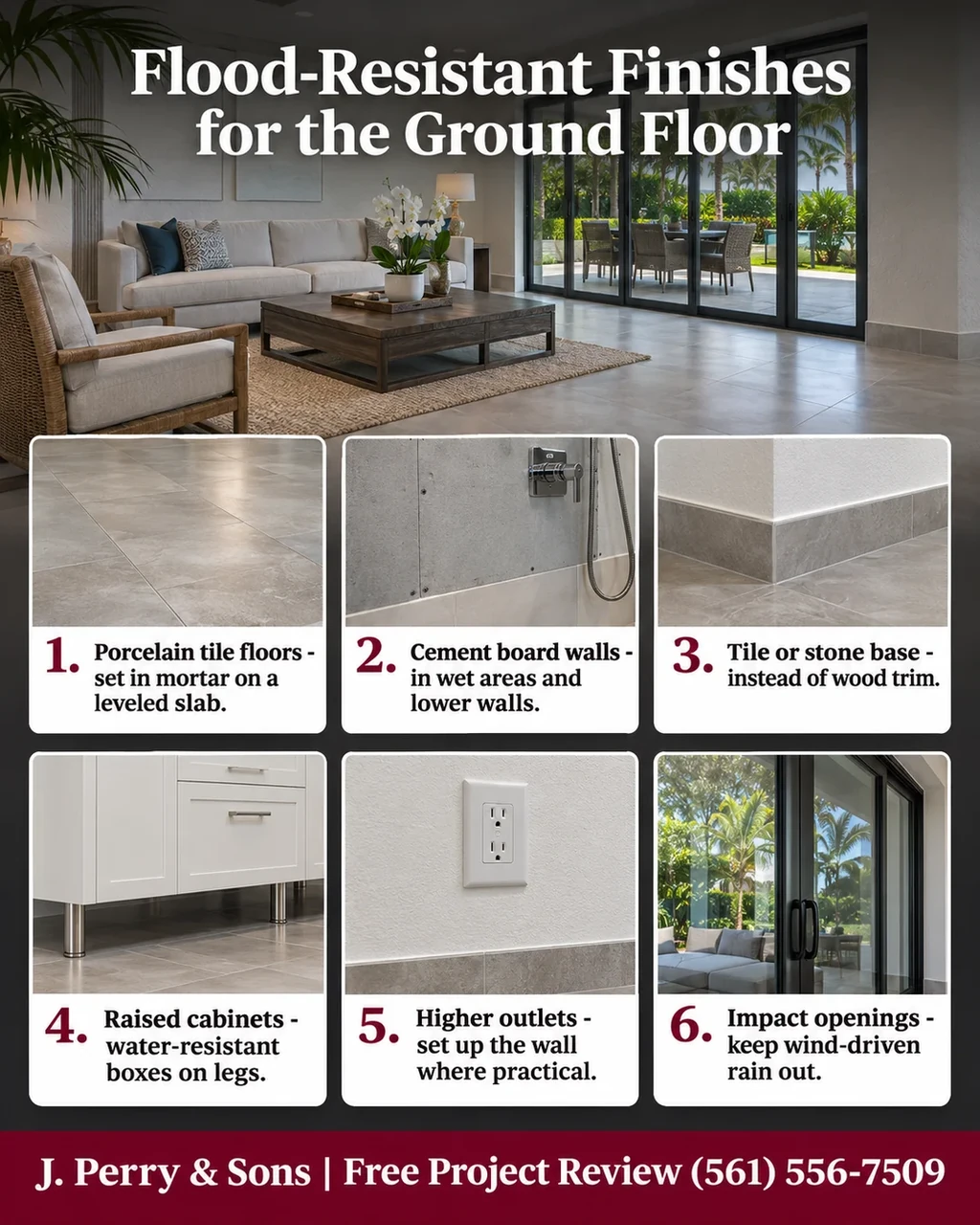
Whether or not your project crosses the line, choosing materials that tolerate water on the ground floor is good planning in South Florida. A home built with them recovers faster after a flood, with less to tear out.
Floors. Porcelain tile is the best ground-floor choice. It does not absorb water, it does not swell and it can be cleaned and kept after most floods. The slab is leveled with a sand-and-cement mortar mix before tile, and the tile is set in a full bed of mortar. Wood floors on the ground floor are the first thing removed after water comes in. Our residential tile page shows the options.
Walls. Cement board in wet areas and lower walls, and moisture-resistant board elsewhere, instead of paper-faced drywall. Block walls with stucco outside hold up far better than framed walls.
Baseboards and trim. Tile or stone base instead of wood or MDF, which swell and peel after a single wetting.
Cabinets. Cabinet boxes in water-resistant material, raised on legs where possible, so a small flood does not reach the boxes.
Electrical. Outlets and equipment set higher on the wall where practical, by licensed specialty contractors, coordinated by J. Perry & Sons.
Openings. Impact windows and doors keep wind-driven rain out during a storm. See our impact windows and doors services.
After a flood. Our guide to flooring after water damage in Florida explains what can be saved and what has to be replaced.
Next step: tell us which rooms are on the ground floor, and we will suggest flood-resistant finishes for each one at your Free Project Review.
Timeline when a project is in a flood zone
A flood-zone project adds steps before construction. The floodplain office gives a pre-review or determination, then the permit is reviewed by the building department with the floodplain office signing off. Construction follows the approved plans, and an elevation certificate or final flood documentation is completed at the end where it is required. Each community sets its own review process, so ask your floodplain office early. See Broward County renovation permits and Miami-Dade renovation permits for how permits work in each county. Your schedule is set out in the written proposal after the site review.
Renovation by city
Free Project Review — call (561) 556-7509 or send us your project. Licensed Florida general contractor CGC1540699. Serving Broward, Palm Beach and Miami-Dade counties.
Related services
50 percent rule — FAQ
What is the 50 percent rule in Florida?
In a mapped flood hazard area, if improvement or repair costs reach half of the building's market value, the work is considered substantial and the building generally has to meet current flood requirements.
Who decides whether my renovation is a substantial improvement?
Your community's floodplain administrator, usually within the building department. They decide what costs count and how the building's value is measured.
Does land value count in the 50 percent calculation?
Generally the comparison uses the value of the structure, not the land. Confirm which valuation source your community accepts.
Does the 50 percent rule apply after hurricane damage?
Yes, the same concept applies to repairs after damage, called substantial damage. The floodplain office makes that determination for each building.
How do I get an exact price?
Call (561) 556-7509 or send photos and rough dimensions through our project form. After the site review and scope confirmation, you receive an itemized written proposal.
Does the 50 percent rule apply to condos?
It can. The comparison is made for the building, and in a condo building the association and the floodplain office deal with it at the building level. Ask your association and the floodplain office how it applies to your unit's renovation.
Can I renovate one room at a time to stay under the rule?
Some communities add up improvements over a period of years, so phasing may not change the outcome. Ask your floodplain office whether it counts improvements cumulatively before you plan in phases.
Do new impact windows count toward the 50 percent rule?
Generally, improvements to the building count toward the cost, and windows and doors are part of the building. Your floodplain administrator decides which items are included.
Does an addition have to meet flood rules?
Generally, yes. An addition in a flood zone is built to current flood requirements, even when the rest of the house does not change. A licensed engineer designs it to the required elevation.
Will you prepare the cost estimate for the floodplain office?
Yes. Our written proposals are itemized by area and trade, which is the level of detail building departments usually ask for in a flood zone. J. Perry & Sons pulls the permit.