By John Perry, J. Perry & Sons — Florida CGC1540699
After the project review, your written proposal lists the following scope and pricing: In the epoxy grout vs cement grout question, epoxy costs more to install, is stain-proof and never needs sealing, and is the right choice for showers, kitchen floors and anything that sees grease or constant water. Cement grout is the standard on most floors and walls, easier to install and repair, and needs sealing. Urethane and premixed grouts sit in between. J. Perry & Sons tile installation picks the grout with the tile and the room, not as an afterthought.
Grout types compared
| Grout | Best for | Stain resistance | Sealing | Added cost over cement |
|---|---|---|---|---|
| Sanded cement grout | Floor joints 1/8" and wider | Low until sealed | Yes, every 1–2 years | baseline |
| Unsanded cement grout | Wall joints under 1/8", polished stone | Low until sealed | Yes | baseline |
| High-performance cement grout (polymer-modified) | Most floors and showers | Good | Recommended | small, often included |
| Urethane or premixed acrylic grout | Floors where color consistency matters | Good to very good | No | roughly starting at $2 per sq ft |
After the project review, your written proposal lists the following scope and pricing: New tile installation for standard porcelain floors and for shower walls with cement or high-performance grout included; the epoxy and urethane figures are added to those.
How each grout behaves after the job
Cement grout is Portland cement, sand (for sanded) and pigment. It is porous, so it absorbs water, soap, cooking oil and dirt unless sealed, and the sealer wears off. In a shower it stays damp longer and shows mildew first. It is also the easiest to repair: a section can be ground out and regrouted with the same product.
High-performance cement grout adds polymers that make it denser, more color-consistent and less prone to efflorescence. It is our default for most floors because it performs much closer to the specialty grouts while staying easy to work and repair.
Urethane and premixed grouts come ready to use from the bucket. Color is uniform from the first joint to the last, which matters on long runs of light-colored floor. They cure by air, so they set slowly in humid weather and need the joints clean and dry when applied.
Epoxy grout is a two- or three-part system that cures by chemical reaction into a hard, non-porous joint. Water, grease, wine and cleaning chemicals do not go in. It does not need sealing and keeps its color. The trade-off is installation: it has a short working time, sets hard on the tile face if not cleaned off right away, and takes a skilled crew.
Free Project Review — call (561) 556-7509 or send us your project. Send a photo of the area and the tile you picked. We review every project personally and follow up with you directly.
Call (561) 556-7509 or send us your project with photos, the city, approximate dimensions, and material selections.
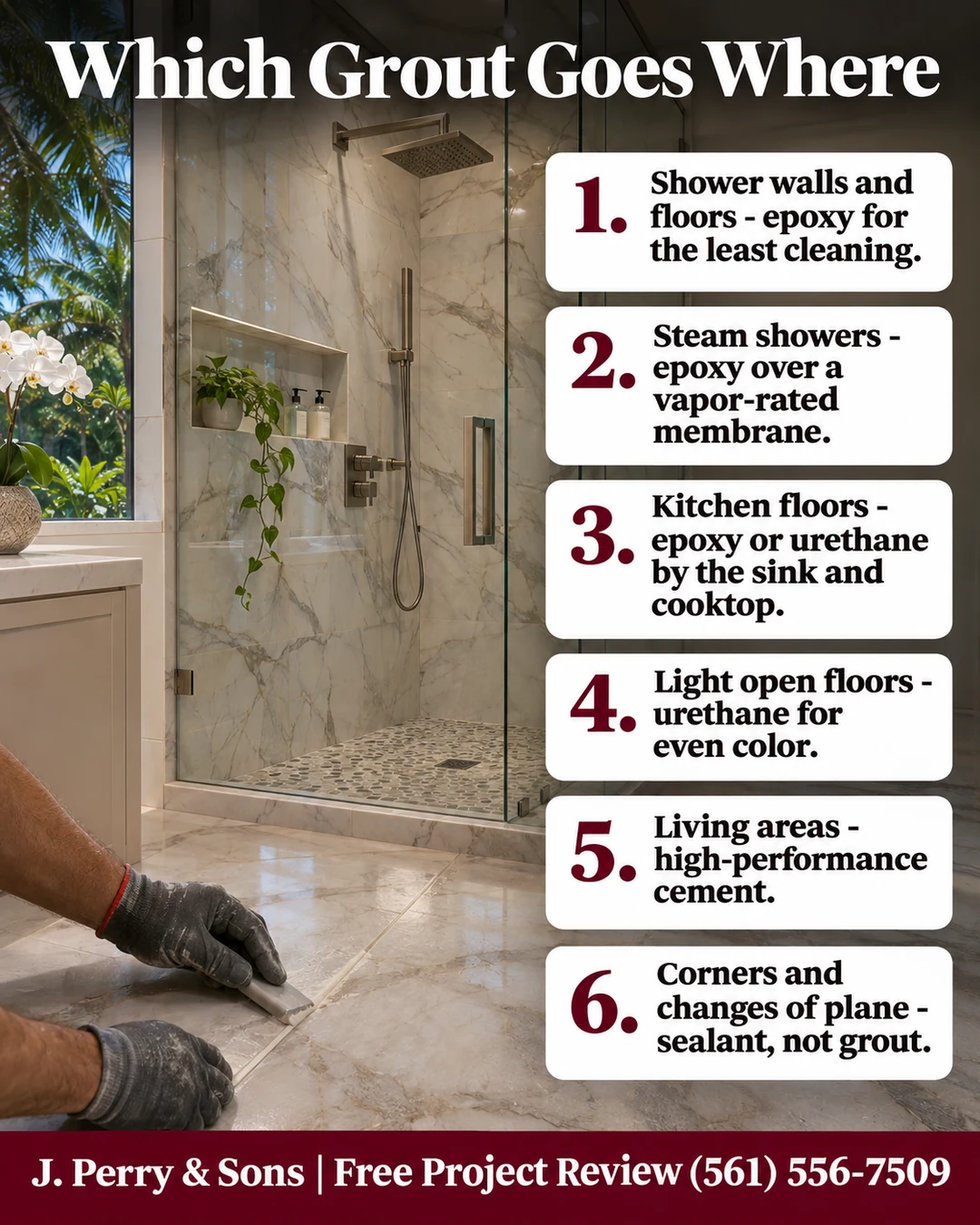
Where we specify each grout
- Shower walls and floors: high-performance cement as standard, epoxy on request and in any shower with natural stone mosaics on the floor or a steam unit.
- Kitchen floors: epoxy or urethane in front of the range and sink where oil and spills land.
- Living areas: high-performance cement or urethane with a large-format tile and tight joints.
- Backsplashes: unsanded or high-performance cement; epoxy behind a gas range if you want to wipe it like the tile.
- Commercial kitchens, restrooms and healthcare: epoxy, almost always, because of the cleaning chemicals used. See the restaurant kitchen quarry tile guide.
- Exterior and pool areas: cement or epoxy grouts rated for exterior use and UV.
Grout and stone: a caution
Some epoxy grouts can stain light, porous stone like white marble and limestone at the edges. We test on a spare tile first and seal the stone before grouting when the stone needs it. Unsanded grout is used on polished marble with tight joints because sanded grout can scratch the polish during cleanup.
Grout in South Florida conditions
Humidity is the main enemy. A cement grout joint in a shower that never fully dries between uses grows mildew in the pores, which is why so many shower regrouts here come back looking the same in a year when the grout is not changed. Epoxy solves that. A working exhaust fan vented outside, not into the attic, helps any grout.
Heat matters for exterior work. Epoxy has a shorter working time on a hot patio, so outdoor epoxy grouting is scheduled for the morning. Urethane grouts take longer to cure in high humidity, which can delay foot traffic by a day.
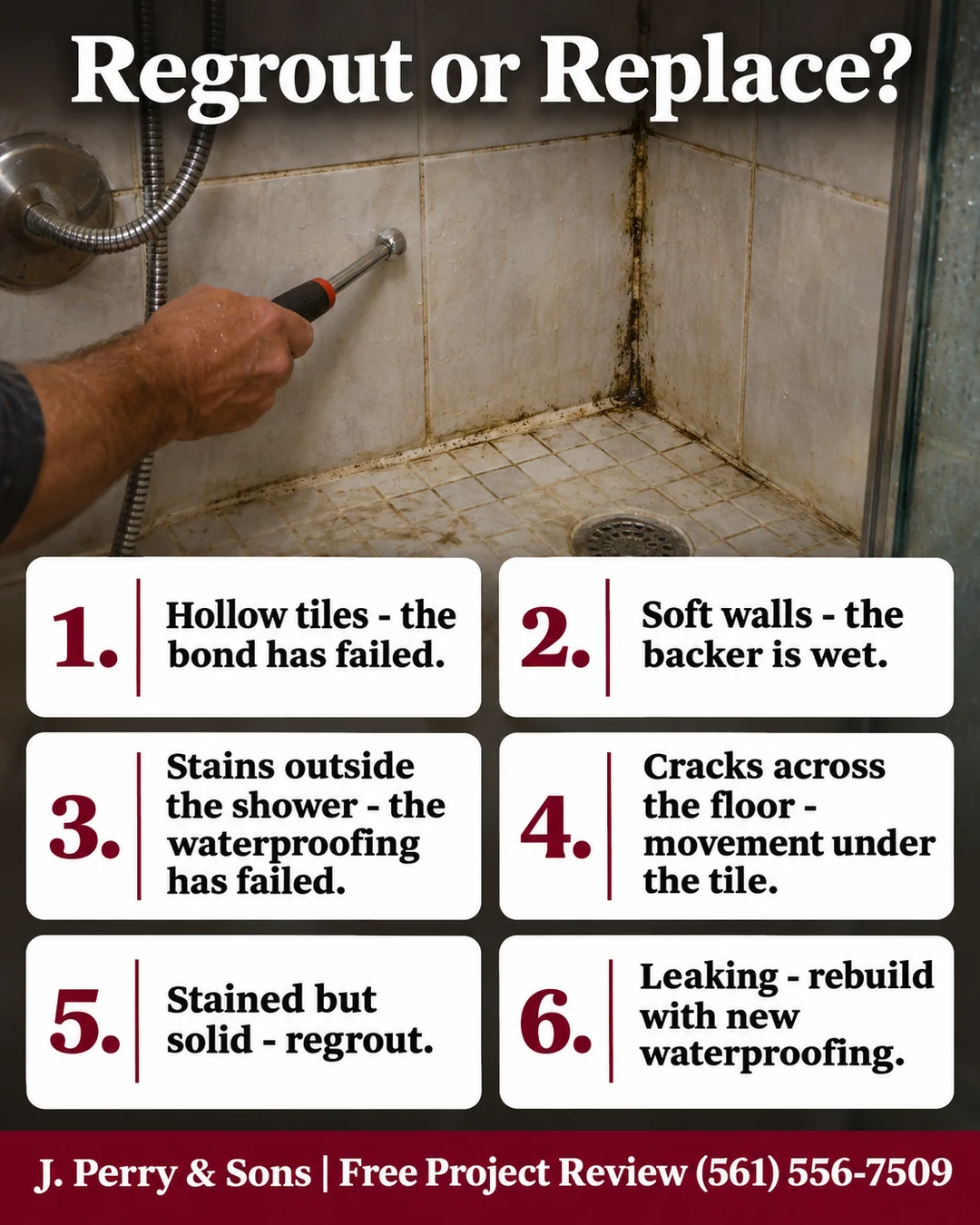
Slabs move slightly. No grout fixes a cracked slab. Movement joints at the perimeter and in large rooms are filled with silicone, not grout. When grout cracks in a line across a floor, the problem is under it. See cracked tile repair or replace.
Grout color, joint width and timeline
Joint width is set by the tile, not by taste: rectified porcelain can go to 1/16"–1/8", handmade tile needs wider joints. Gray and beige hide dirt better than white. epoxy cures enough for light foot traffic in about a day; cement grout cures for 72 hours before sealing. Timing is confirmed in your written proposal.
Tile and grout work by city
- Tile installation in Boca Raton
- Tile installation in Fort Lauderdale
- Tile installation in Weston
- Tile installation in Jupiter
- Tile installation in Davie
- Tile installation in Miami
- Tile installation in Wellington
Grout types — FAQ
Is epoxy grout worth it? In showers, kitchens and any floor that sees grease or constant water, yes. After the project review, your written proposal lists the following scope and pricing: It adds and removes sealing and most grout cleaning for the life of the floor.
Do you need to seal cement grout? Yes. A penetrating sealer after 72 hours of cure, then every 1–2 years. High-performance cement grouts still benefit from sealing in wet areas.
Can you put epoxy grout over old cement grout? No. The old grout is ground out to about two-thirds of the joint depth and the joint is cleaned before epoxy goes in. That is what an epoxy regrout includes.
What grout is best for a Florida shower? Epoxy for the lowest maintenance, or a high-performance cement grout that is sealed. Plain cement grout in a humid shower shows mildew quickly.
How do I get an exact price? Call (561) 556-7509 or send photos and rough dimensions through our project form. We review every project personally and follow up with you directly.
Free Project Review — call (561) 556-7509 or send us your project. Licensed Florida general contractor CGC1540699. Serving Broward, Palm Beach and Miami-Dade counties.
Call (561) 556-7509 or send us your project with photos, the city, approximate dimensions, and material selections.
Explore our owner's guides before you choose your materials and finishes.
Free project review · (561) 556-7509
Share your vision for your South Florida home.
Free project review · (561) 556-7509