By John Perry
Porcelain is the floor most South Florida homeowners end up choosing, and for good reason. It handles humidity, sand, pets, pool water and the occasional flood better than anything else at its price. But "porcelain" covers a huge range of products, from a Starting at $20 tile at the big-box store to a 48x110 slab that takes four people to set. Picking the right one, and installing it the right way on a Florida slab, is what decides whether your floor looks perfect in ten years or starts popping in two.
This guide explains the types of porcelain, the sizes and finishes, how a professional installation is done, and what it costs in 2026.
Is porcelain the right tile for your project?
For most South Florida homes, yes. Porcelain is fired at a higher temperature than ceramic and absorbs less than 0.5% water, which is what makes it the standard for:
- Living areas and kitchens. It is hard, stain-resistant and does not mind sand or pets.
- Showers and bathrooms. It does not soak up water, so it works on walls, floors and benches.
- Patios and pool decks. Outdoor-rated porcelain stays cooler than many stones, does not need sealing and has slip-resistant finishes.
- Condos. It works over the sound-control underlayment most associations require.
When we recommend something else: if you want the look and feel of real stone and accept the maintenance, we install marble and travertine. If you want warmth underfoot in bedrooms, engineered white oak is a good option.
The types of porcelain (and why it matters)
| Type | What it is | Best for | Watch out for |
|---|---|---|---|
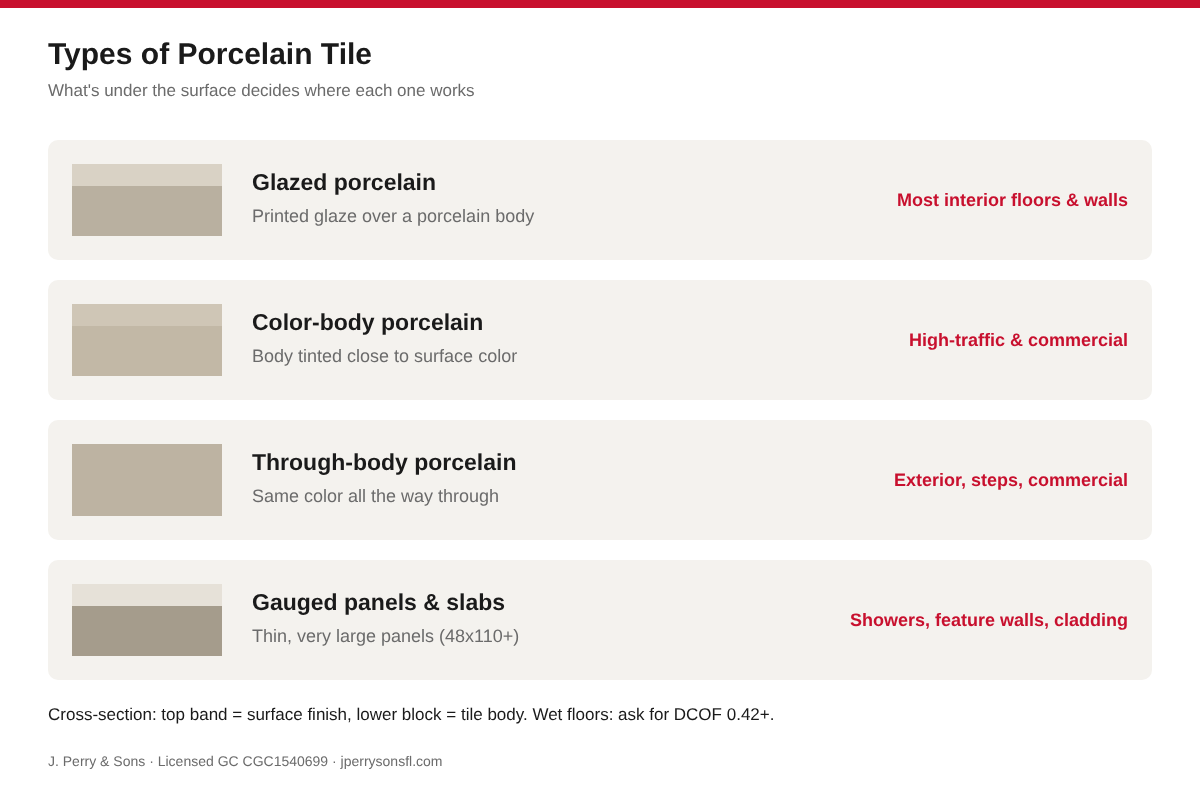
| Glazed porcelain | A porcelain body with a printed glaze on top. This is where the marble, wood and concrete looks come from. | Most interior floors and walls | A deep chip shows the body color underneath |
| Color-body porcelain | The body is tinted close to the surface color | High-traffic floors, commercial | Costs a little more |
| Through-body (full-body) porcelain | Same color and pattern all the way through | Commercial, exterior, steps and edges | Fewer design options |
| Gauged porcelain panels and slabs | Thin, very large panels (for example 48x110 and up) | Feature walls, showers with no grout lines, countertops, exterior cladding | Needs a specialist crew and special handling |
Finishes: polished (shiny, can be slippery when wet), matte or honed (the most popular right now), and textured or anti-slip for showers, patios and pool decks. For any floor that gets wet, ask for the tile's DCOF rating. We look for 0.42 or higher.
Call (561) 556-7509 or send us your project with photos, the city, approximate dimensions, and material selections.
Sizes: from 12x24 to slabs
Bigger tiles mean fewer grout lines and a more modern look, but they demand a flatter floor and more skill:
- 12x24 and 24x24. The standard. Forgiving, and good for most rooms.
- 24x48. The current favorite in South Florida homes. It needs a floor flat within 1/8" over 10 feet, plus full mortar coverage.
- 32x32, 48x48 and 30x60. These read almost like a slab floor. The substrate prep is critical.
- Wood-look planks (8x48 and up). The warmth of wood without water worries. They need a tight offset pattern so they don't warp.
- Panels (60x120 cm and larger, slabs). Used on walls, showers and exterior cladding. They are set with large-and-heavy-tile mortar and a leveling system.
How we install porcelain on a Florida slab
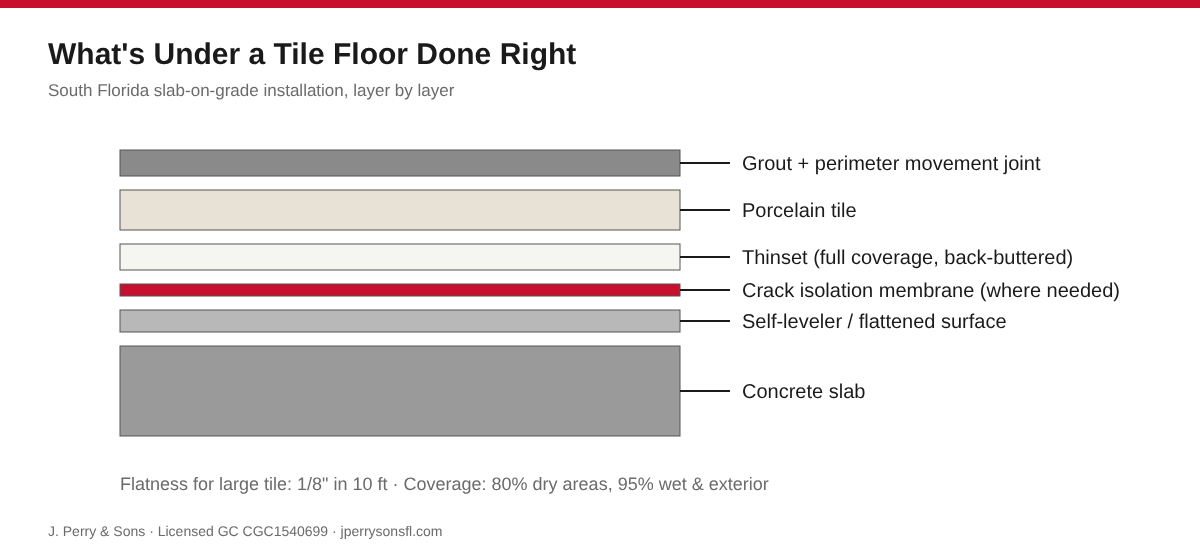
- Check the slab. We check flatness with a straightedge and laser, look for cracks, and test moisture. Most South Florida floors are concrete slabs on grade, so this matters.
- Fix the floor first. High spots get ground down. Low spots get self-leveler. If a floor is out of flat, the tile edges will never line up (lippage), no matter how good the installer is.
- Crack isolation membrane where needed. If the slab has cracks, a membrane goes down first so the cracks don't come up through your new tile.
- Layout. We snap lines with a laser, center the room on the main view, and plan cuts so no thin slivers land at doorways.
- The right mortar. For large porcelain we use a large-and-heavy-tile (LHT) mortar such as SikaTile-475 LHT Premium Set. On every large tile we comb it out with the right trowel and back-butter the tile. See our thinset and mortar guide.
- Full coverage. We pull up a tile now and then to check coverage: at least 80% indoors, and 95% in showers and outdoors. Hollow spots are what make tiles crack or pop later.
- Leveling system. Clips and wedges hold the edges flush while the mortar cures.
- Grout and movement joints. We grout once the mortar has set. At the perimeter and in large rooms we leave soft joints with flexible sealant so the floor can move with Florida heat.
- Clean, seal where needed, and walkthrough.
For large-format tile we use large-format mortars such as Mapei Ultraflex LFT, Laticrete 4-XLT or Laticrete 254 Platinum, Schluter DITRA uncoupling membrane over slabs with cracks, and Schluter profiles at edges and transitions.
Indoor vs outdoor porcelain
Outdoor porcelain in Florida deals with sun, heat, rain and salt air. For patios, pool decks and exterior walls we use:
- outdoor-rated, frost-proof porcelain with an anti-slip finish
- exterior-rated mortar, with full coverage so no water gets trapped under the tile
- slope away from the house and proper drainage
- for exterior wall cladding, panels set with LHT mortar, mechanical support while it cures, and movement joints
More in our exterior wall tile guide.
Porcelain tile installation cost in South Florida (2026)
These are installed starting prices. The final price is based on the condition of the floor, access, the tile you choose and the full scope. We confirm it after we see the project.
| Scope | Installed, starting at |
|---|---|
| Standard porcelain floor, 12x24 or 18x18 | Starting at $20 per sq ft |
| Wood-look plank, 8x48 | Starting at $20 per sq ft |
| 24x48 and larger | Starting at $30 per sq ft |
| Remove existing tile | Starting at $20 per sq ft |
For full breakdowns see porcelain tile installation cost and the tile installation cost guide.
Common porcelain problems we get called to fix
- Tiles cracking or sounding hollow. Not enough mortar coverage, or a crack in the slab with no membrane.
- Uneven edges (lippage). The floor wasn't flattened, or there was no leveling system on large tiles.
- Tiles popping up ("tenting"). No movement joints, so the floor had nowhere to expand in the heat.
- Slippery shower or patio. A polished tile in a wet area.
If you're seeing any of these, we can tell you whether it's a repair or a replacement. Call us.
Choosing porcelain room by room
The right tile for the kitchen isn't always the right tile for the shower or the patio. Here's how we usually guide clients:
- Living areas and open floor plans. Large format (24x48 or bigger) in a matte or soft-polished finish. Fewer grout lines make the space look bigger and calmer. We run the same tile through the whole first floor whenever we can, so there are no transitions at doorways.
- Kitchens. A matte finish hides water spots and footprints better than polished. Color-body porcelain is a smart upgrade here, because a dropped pan won't reveal a different color underneath.
- Bathroom floors. A textured or matte finish with a good wet-slip rating. Smaller tiles or a mosaic in the shower floor give more grip and follow the slope to the drain better.
- Shower walls. Large panels or 24x48 tiles mean fewer grout lines to clean. Porcelain slabs can cover a whole wall with almost no joints at all.
- Patios, pool decks and entries. Outdoor-rated, anti-slip porcelain, often 2 cm thick pavers for pool decks. They stay cooler than many natural stones and don't need sealing.
- Condos. A tile that works over the sound-control underlayment your association requires. We handle the board approval paperwork.
Grout: the part you see every day
Grout is small, but it's what you clean and look at for years. With porcelain you have three main options:
| Grout type | Pros | Cons | Where we use it |
|---|---|---|---|
| Cement grout (sanded or unsanded) | Lowest cost, easy to repair | Needs sealing, can stain | Budget-conscious dry areas |
| High-performance cement grout | Better color consistency, less staining | Still benefits from sealing | Most floors |
| Urethane or epoxy grout | Stain-proof, no sealing, very durable | Costs more, epoxy needs skilled installers | Showers, kitchens, white or light grout |
Rectified porcelain (precisely cut edges) lets us use tighter joints, usually 1/16" to 1/8". We'll always follow the minimum joint the tile manufacturer specifies. A joint that's too tight is one of the reasons tiles pop up in the heat.
Keeping your porcelain looking new
Porcelain is low maintenance, but not zero maintenance:
- Sweep or vacuum sand often. Sand is what dulls finishes over time.
- Mop with a pH-neutral cleaner. Skip vinegar and bleach on the grout.
- Reseal cement grout every 1–2 years, or choose a grout that doesn't need sealing.
- Use felt pads under furniture, especially on polished tile.
- Outdoors, rinse salt and pool chemicals off the surface regularly.
How to compare tile quotes
Two quotes for "porcelain installation" can be very far apart, and the cheaper one usually skips steps you can't see. When you compare, ask each contractor:
- Is floor flattening or self-leveling included, or is it an extra?
- Which mortar will you use, and will you back-butter large tiles?
- Do you use a leveling system on large format?
- Is a crack isolation membrane included where the slab is cracked?
- Where will you put movement joints?
- Is removal and disposal of the old floor included?
- Do you pull the permit when one is needed, and are you licensed and insured?
At J. Perry & Sons every one of these is written into the proposal, so you know exactly what you're paying for.
Porcelain outdoors
Porcelain also works outside on lanais and patios when it's rated for exterior use, has a textured or slip-resistant finish, and is installed with exterior-rated mortar, proper slope and movement joints at the perimeter.
Ready to plan your porcelain floor?
Send us your project with a few photos and rough measurements, or call (561) 556-7509. We bring samples to your home, check your slab, and give you a written price after the visit.
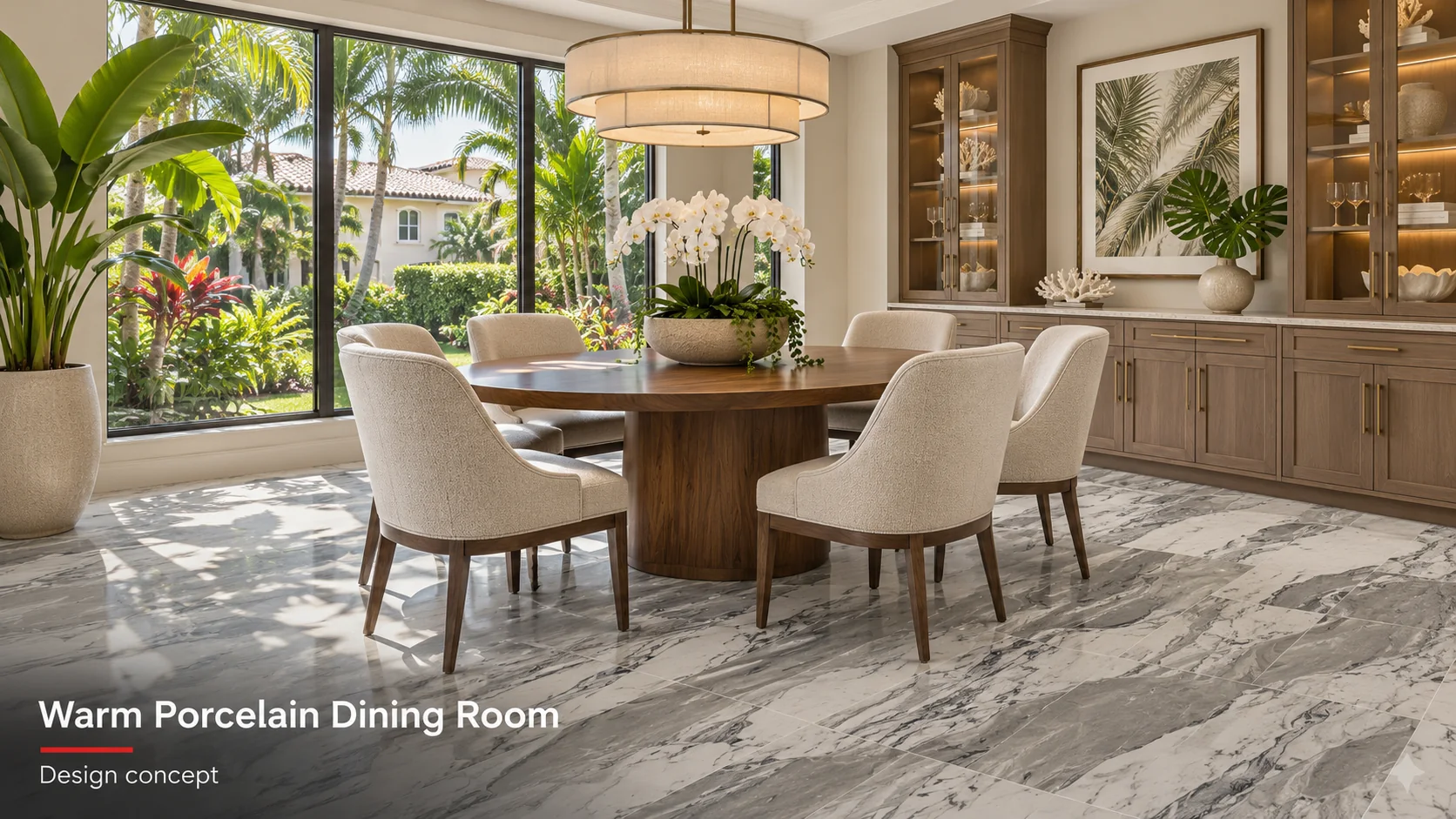
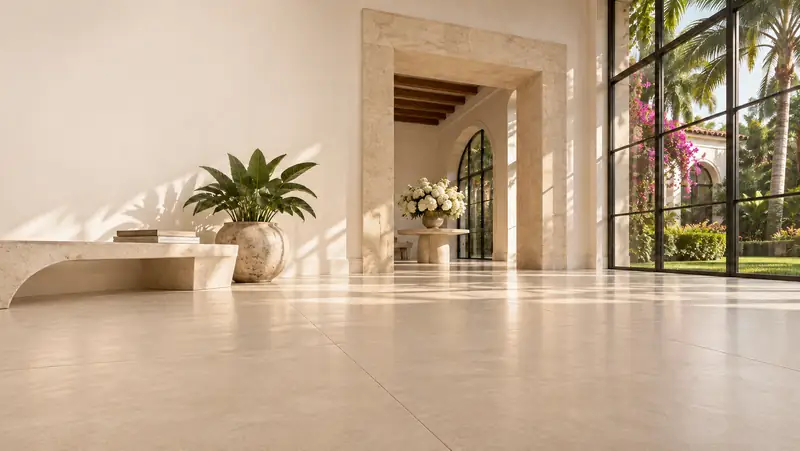
Want your floor to look like this? Plan your new floors
The Owner's Guide to Tile, Floors and Stone
How to choose the right floor, what makes it last, what to ask any contractor and how to care for it.
From large-format porcelain to natural stone, set right from the slab up.
Free project review · (561) 556-7509
FAQ
What is the difference between porcelain and ceramic tile? Porcelain is made from denser clay fired at a higher temperature, so it absorbs less than 0.5% water. That makes it harder, more stain-resistant and suitable for showers and outdoor areas. Ceramic is softer and mainly used on interior walls.
What size porcelain tile is most popular in South Florida right now? 24x48 is the most requested size in homes right now, along with wood-look planks. Larger panels and slabs are growing for showers and feature walls.
Does porcelain tile need to be sealed? The tile itself does not. Cement grout benefits from a sealer, or you can choose a urethane or epoxy grout that doesn't need sealing.
Can porcelain be installed over existing tile? Sometimes, if the old tile is solidly bonded, flat and the extra height works at doors and appliances. In most South Florida homes we recommend removing the old tile so we can check and fix the slab.
How long does a porcelain floor installation take? Every project is different. Your schedule is written into the proposal once we've seen the space and confirmed the scope.
Call (561) 556-7509 or send us your project with photos, the city, approximate dimensions, and material selections.
Share your vision for your South Florida home.
Free project review · (561) 556-7509