
A Florida renovation contract should include, at minimum, the contractor's license number, a written scope of work, a fixed price or clear unit prices, a payment schedule tied to progress, who pulls the permit, how change orders are handled, a start date and duration, and the lien-law notice the state requires on residential contracts over a set amount. At J. Perry & Sons, a licensed renovation contractor in Broward, Palm Beach and Miami-Dade, every contract we sign has those items. Here is what each one should say.
The 12 items a renovation contract should include
| # | Item | What it should say | Why it matters |
|---|---|---|---|
| 1 | Contractor name and license | Legal business name, Florida license number (CGC, CBC, CRC or trade license) | Lets you verify the license covers the work |
| 2 | Scope of work | Each room, each surface, materials, thicknesses, what is excluded | Most disputes are about something that was never written down |
| 3 | Price | Fixed total, or unit prices with estimated quantities | Prevents the "it ended up more" conversation |
| 4 | Payment terms | Each amount and when it is due, in writing | No surprises |
| 5 | Permits | Who pulls them, under whose license, fees at cost or included | See our permit guide; the contractor should pull them |
| 6 | Schedule | Start date, working days, what pauses the clock | Sets expectations before demo starts |
| 7 | Change orders | Written, signed, priced before the extra work begins | Protects both sides |
| 8 | Owner-supplied materials | Who orders, overage required, what happens if material is late or short | Tile and stone jobs vary with this |
| 9 | Lien-law notice | The Florida statutory warning text on residential contracts above the state threshold | Required by state law on most residential jobs |
| 10 | Insurance | General liability and workers' comp or exemption, with certificate on request | Verifies who is covered on your property |
| 11 | Warranty | Workmanship warranty terms and what is excluded (owner-supplied material, abuse, water from other sources) | Defines what you can call about later |
| 12 | Cancellation | Cancellation terms, and what is non-refundable after materials are ordered | Fair to both parties |
This is general guidance based on how we write our own contracts, not legal advice. For the specific statutory language and thresholds, confirm with the Florida DBPR or an attorney.
Renovation Contract Red Flags in Florida

Most renovation problems can be seen in the contract before the first wall comes down. If you see any of these, stop and ask questions before you sign.
No license number, or the wrong license. The contract should carry the contractor's Florida license number, and that license should cover the work. A handyman or a trade license does not cover a kitchen or a structural change. Our guide on how to verify a Florida contractor license shows how to check it on the state site.
You are asked to pull the permit. If a contractor asks you to pull the permit as an owner-builder, you take on the legal responsibility for the work. A licensed contractor should pull it under their own license. Our article on why your contractor should pull the permit explains what is at stake.
A one-line scope. "Remodel bathroom" is not a scope. If the contract does not list each surface, each material and what is excluded, the price is not really fixed.
Allowances that are too low. A low allowance for tile, fixtures or cabinets makes a bid look cheaper and comes back later as an extra.
No certificate of insurance. You should be able to get a certificate of insurance before work starts. If the contractor will not provide one, do not let them on your property.
Pressure to sign today. A real contractor gives you time to read the contract and ask questions.
Cash only. A contractor who will only take cash, or asks for payment to a personal name, is a warning sign.
Next step: if you already have a contract in hand, send it to us with your project photos, and we will tell you what a full scope for your project should list.
Scope of work: the part that prevents arguments
"Install tile in master bath" is not a scope. "Demo existing floor and shower tile to slab and studs; install sheet waterproofing membrane and sloped pan, flood test; install 24x48 porcelain on floor and walls to 8 ft, 1/16" grout joint, offset not to exceed 33%; one recessed niche 12x24; epoxy grout; silicone at all changes of plane" is a scope.
If plumbing fixtures, electrical, glass doors, painting or drywall patching are by others, the contract should say so.
Free Project Review — call (561) 556-7509 or send us your project. Send photos and a description of the project, and we'll tell you the scope and the starting price.
Allowances, Selections and Exclusions in a Home Renovation Contract
After the scope, the next most common source of disputes is the difference between what was priced and what was chosen. A good home renovation contract handles this in three ways.
Firm selections. The best contract names the actual product: the tile series, size and finish, the slab, the faucet model, the cabinet line and door style. When the product is named, the price is real.
Allowances. When a selection is not made yet, the contract sets an allowance, a dollar amount for that item. Ask how each allowance was set and whether it matches the level of finish you want. If you choose something above the allowance, the difference is a change order.
Exclusions. Every contract should list what is not included. Common exclusions are appliances, furniture moving, painting of untouched rooms, work by the association and anything behind the walls that cannot be seen before demolition.
Who supplies the materials. J. Perry & Sons supplies all materials from preferred brands we work with, so the tile, setting materials and fixtures are ordered, checked and stored by us. If another contractor asks you to supply material, the contract should say so clearly.
Samples before you sign. We bring samples of the main finishes before the proposal, so selections can be firm when you sign. Once you sign the proposal, a simple rendering is included; detailed design by our in-house designer is billed separately. See our renderings and samples page.
Next step: make a list of the finishes you have already chosen, and we will build the scope around them.
Payment schedule: what is normal in South Florida
The contract lists each payment and when it is due.
Owner-supplied materials: write it down
On some tile, stone and paver jobs the homeowner buys the material. J. Perry & Sons supplies all materials on our projects, but if a contractor asks you to supply it, the contract should say who orders it, that it must be on site before the start date, how much overage is required (10–15% in one dye lot for tile, 15–20% for natural stone and patterns), and that the contractor is not responsible for breakage, shortage, color variation or delays from material that is not there.
Permits, lien notice and the Notice of Commencement
The contract should name who pulls the permit: the contractor, under their license, with fees at cost. For residential jobs over the state threshold, Florida requires a lien-law warning in the contract, and the owner typically records a Notice of Commencement before work starts. Our Notice of Commencement guide covers the steps; confirm the current amounts with your county clerk.
Engineering, Permit Fees and Hidden Conditions
Two parts of a renovation contract are often left vague: the work done by other licensed professionals, and what happens when the walls are opened. Both should be written down.
Engineering. When a wall is removed, an opening is cut in block or a beam is added, a licensed engineer designs the work and seals the drawings. The contractor builds to those drawings. J. Perry & Sons is not an engineer; we work with licensed engineers and build to their sealed drawings. See our load-bearing wall removal page for how that work is handled.
Fees listed separately. Engineering and permit fees are separate from the construction price and are listed in the proposal, so you can see exactly what they are.
Licensed trades. Plumbing, electrical and gas work is done by licensed contractors. On our projects, that work is done by licensed trades, coordinated by J. Perry & Sons.
Hidden conditions. No one can see inside a wall or under a tile floor before demolition. The contract should say how hidden conditions are handled: rotted framing, a leaking drain, a slab that needs leveling, termite damage or mold. The best contracts give unit prices for the common ones, so the cost of a surprise is known in advance.
Inspections. The contract should say who schedules inspections and who meets the inspector. Our permits and compliance page explains how we handle every inspection on our projects.
Next step: if your project includes a structural change, send us the plans or photos, and we will tell you what the engineer will need.
Change orders: priced before the work, not after
Every renovation has a surprise: a drain in the wrong place, a slab that needs leveling. The contract should say that extra work is priced in writing and signed by both parties before it is done, and that the schedule adjusts accordingly.
Warranty: what to expect
A workmanship warranty is standard. It should say what it covers (loose tile, failed grout, leaks at the installer's waterproofing) and what it does not (owner-supplied material defects, settling, water from plumbing by others). Manufacturer warranties on materials pass through separately.
South Florida specifics worth a line in the contract
- Condo and HOA approvals: who prepares the package; start date contingent on approval.
- Hurricane season: a named-storm closure delays the job with no penalty to either side.
- Slab conditions: floor leveling beyond a stated tolerance is a change order, priced per square foot.
- Working hours: many condos limit work to weekdays, 9 to 5.
Condo Renovation Contracts: The Extra Lines You Need
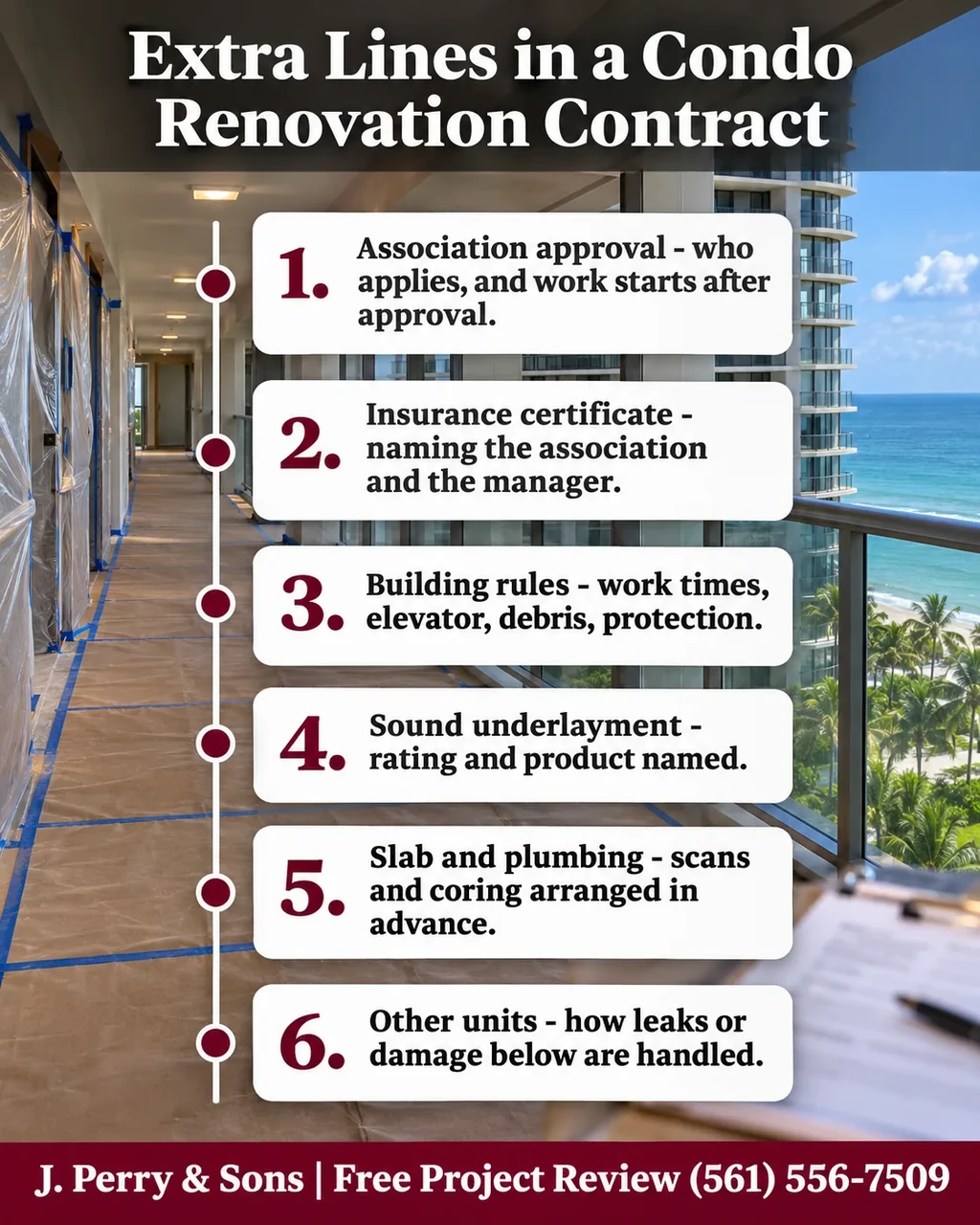
A condo renovation has a third party in the contract that a house does not: the association. A contract for a condo unit should reflect the building's rules, or the job will stop at the front desk.
Association approval. The contract should say who prepares the application, that work starts after approval, and what happens if the association asks for changes.
Certificate of insurance. Most buildings want a certificate naming the association and the management company before work starts.
Building rules. Work times, elevator reservations, loading dock use, parking, debris removal and protection of common areas should be part of the scope, not a surprise.
Sound rules for hard floors. Many associations require a sound-rated underlayment under tile and stone. The contract should name the rating and the product. Our condo flooring page explains how we build floors to association rules.
Plumbing and slab work. Moving a drain or coring the slab often needs the association's engineer or a slab scan. The contract should say who arranges it.
Damage to other units. The contract should say how a leak or damage to the unit below is handled. Our crews also repair the ceiling of the unit below after a leak, including replacing damaged framing.
Our condo renovation rules checklist lists what buildings usually ask for.
Next step: send us your association's renovation rules with your project, and we will write the scope to match them.
How long it takes to get a contract from us
Our process follows a set order. We review your photos or visit the site, confirm the scope with you and prepare a written proposal with the scope, the materials and the price. Once you approve the proposal, we issue the contract, and once it is signed we start the permit and, for condos, the association package. Your schedule is set out in the written proposal after the site review.
Renovation contractors by city
Free Project Review — call (561) 556-7509 or send us your project. Licensed Florida general contractor CGC1540699. Serving Broward, Palm Beach and Miami-Dade counties.
Florida renovation contract — FAQ
Does a renovation contract have to be in writing in Florida?
Yes. Florida requires written contracts with specific lien-law language on most residential jobs above a state threshold, and a written scope is what protects both sides. Confirm the current threshold with the DBPR or an attorney.
Should the contract include the contractor's license number?
Yes. Florida requires licensed contractors to show their license number on contracts and advertising. Look it up on the DBPR site before you sign.
What if I supply the tile or stone myself?
Normal, and the contract should say so: who orders, how much overage, that material must be on site before the start date, and that the installer is not responsible for shortage, breakage or color variation in owner-supplied material.
How do I get an exact price?
Call (561) 556-7509 or send photos and rough dimensions through our project form. After the site review and scope confirmation, you receive an itemized written proposal.
Should a renovation contract list every material?
Yes, as far as possible. The tile, slab, cabinets and fixtures should be named by product. Where a choice is not made yet, the contract should give an allowance and say how differences are handled.
What is an allowance in a renovation contract?
An allowance is a dollar amount set aside for an item you have not chosen yet, such as tile or a faucet. If you choose something that costs more, the difference is added by a signed change order.
Is engineering included in the renovation price?
Not usually. Engineering and permit fees are separate and listed in the proposal. The engineer designs and seals the drawings, and J. Perry & Sons builds to them.
What should a condo renovation contract include?
Everything a house contract has, plus the association approval, the certificate of insurance, the building's work rules, sound underlayment requirements and how damage to other units is handled.
Can I cancel a renovation contract after signing?
The cancellation terms should be written in the contract. Read them before you sign, and ask what happens once materials have been ordered or fabricated.