By John Perry
Stone veneer is one of the fastest ways to give a South Florida home a high-end look: a stacked-stone entry wall, coral stone columns, a limestone fireplace, or a full exterior elevation clad in natural stone. Done right, it lasts as long as the house. Done wrong, it cracks, stains, traps water behind it or falls off the wall.
The difference is almost never the stone. It's the wall preparation, the mortar, the water management and the details at the bottom, the top and every edge. Stone veneer in South Florida starts at $47 per sq ft installed. This guide explains the materials, how the wall is built, what affects the price and how we install it.
The three main types
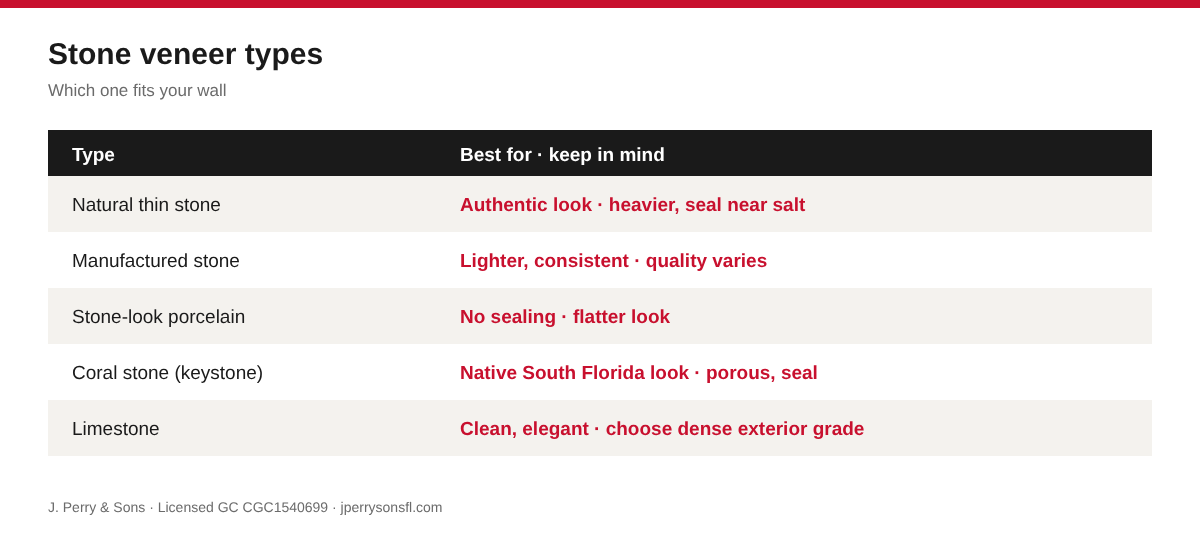
| Type | What it is | Pros | Keep in mind |
|---|---|---|---|
| Natural thin stone | Real stone sawn to about 3/4"–1½" thick | Authentic color and texture; ages naturally | Heavier; needs sealing near salt |
| Manufactured stone | Cast concrete made to look like stone | Lighter; consistent; wide color range | Color is on the surface; quality varies |
| Stone-look porcelain | Porcelain panels with stone texture | No sealing; doesn't absorb water | Flatter look than real stone |
Popular South Florida stones:
- Coral stone (keystone): native look, warm color, porous texture; seal near the coast.
- Limestone: clean, light and elegant; great for modern and Mediterranean homes.
- Stacked ledgestone: layered strips in grays, tans and whites for feature walls.
- Travertine: warm tones that match travertine pool decks.
- Quartzite and slate ledgers: dramatic texture for fireplaces and accent walls.
Why we build with natural stone
Every stone veneer wall we build uses real, quarried stone: limestone, coral stone, quartzite, travertine, slate and fieldstone, cut thin enough to set on a wall. Our clients choose it because it ages the way a fine home should.
Color goes all the way through. Natural stone is the same color inside as on its face. A chip or a cut edge looks like stone, not like a coating. In the South Florida sun, the color holds instead of fading.
Every wall is one of a kind. No two pieces from a quarry are the same. A natural stone wall has variation in tone, texture and veining that can't be repeated, which is why architects and designers specify it for entries, fireplaces and facades on high-end homes.
It can be cleaned, sealed and restored. Natural stone can be washed, re-sealed and even honed over the years. Salt air, rain and pool splash are handled with the right sealer, and a damaged piece can be replaced with stone from the same source.
It works inside and out. Thin-cut natural stone stays light enough for interior walls and upper walls on a facade. Full-bed stone is used at the base of exterior walls and on columns, with the support and ties that its weight needs.
It adds value buyers recognize. Natural stone signals quality to the people who buy luxury homes and to the appraisers who value them.
Tell us where the stone will go and what style the home is, and we'll bring natural stone samples to your Free Project Review.
The Owner's Guide to Stucco, Stone Veneer and Exterior Walls
The technical detail behind stone veneer that stays on the wall: wall preparation, lath and scratch coats, weather barriers, flashing, sealing and how to compare stone veneer quotes.
Prices (2026)
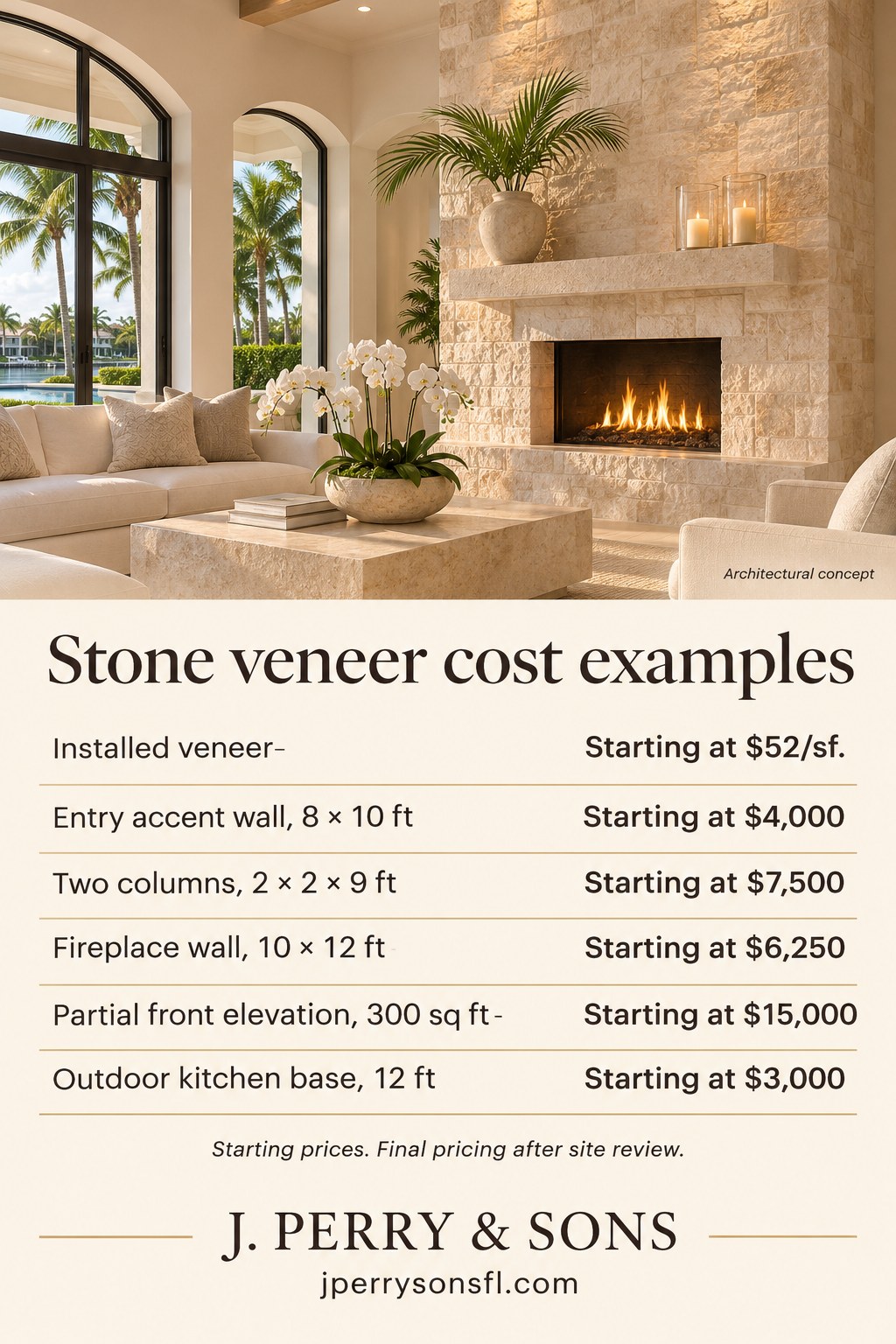
Stone veneer starts at $47 per sq ft installed, based on the stone, wall condition, height, access, corners, openings, caps and finish details.
| Example | Approximate area | Starting price |
|---|
Caps, sills, corner pieces, lath and scratch coat over painted walls, scaffolding for tall walls and stucco repairs around the stone are listed as their own lines. J. Perry & Sons starting prices; final pricing is confirmed after we see the wall.
Call (561) 556-7509 or send us your project with photos, the city, approximate dimensions, and material selections.
How a veneer wall is built
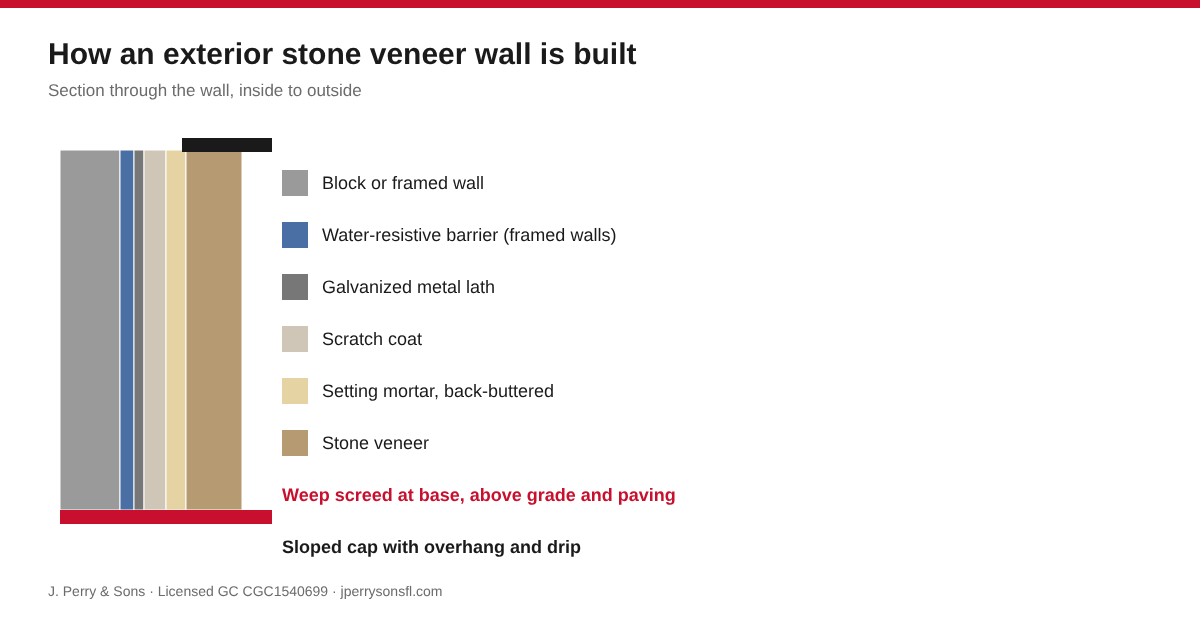
The system is based on the wall behind:
Over clean, unpainted concrete block (CMU)
- Clean the block; stone can bond directly with a polymer-modified veneer mortar.
Over painted block or existing stucco
- Paint and coatings stop mortar from bonding. We remove them or install metal lath mechanically fastened to the block, then a scratch coat.
Over wood or metal framing
- Two layers of water-resistive barrier, galvanized metal lath fastened into the framing, a scratch coat, then the stone. A weep screed at the bottom lets water out.
Common details:
- Weep screed at the base, kept above grade and above paving, so water behind the stone can drain.
- Back-buttering: mortar on the back of each stone plus the wall, for full contact.
- Joints: grouted with a grout bag and tooled, or dry-stack with tight joints.
- Caps and sills: sloped stone or precast caps on top of columns and walls, so water runs off.
- Flashing at windows, doors and where the stone meets roofs or stucco.
- Sealer: breathable penetrating sealer on natural stone, especially near salt water.
How we install stone veneer
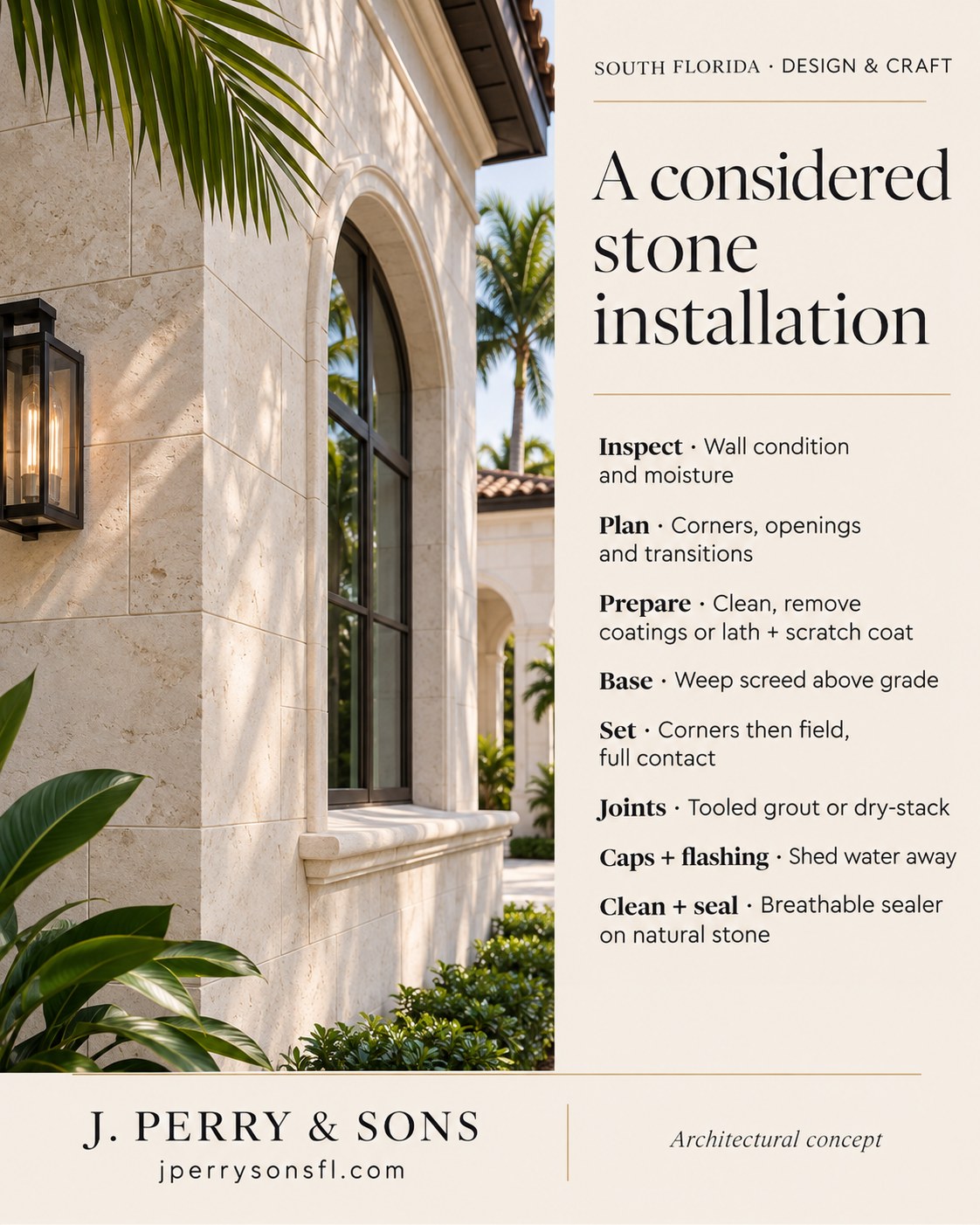
- Inspect the wall: block, stucco, paint, framing, cracks and moisture.
- Plan the layout: corners, openings, caps, transitions and where cuts land.
- Prepare: clean, remove coatings or install lath and a scratch coat.
- Set the base: weep screed or base course above grade.
- Install corners first, then the field, keeping courses level or random as the style requires.
- Mortar: back-butter every stone; full contact, no hollow spots.
- Joints: grout and tool, or dry-stack with tight fit.
- Caps, sills and flashing.
- Clean mortar off the face as we go.
- Seal natural stone once cured.
Interior or exterior?
| Interior (fireplace, accent wall) | Exterior (front, columns, walls) | |
|---|---|---|
| Water | Minimal | Rain, sprinklers, humidity |
| System | Over cement board or block | Lath, scratch coat, weep screed, flashing |
| Stone choice | Natural stone; lighter thin-cut natural stone for upper walls | Durable stone; sealed near salt |
| Permits | Fireplace work may need one | Wall cladding often needs a permit |
Interior stone walls: drywall, TV mounts and light
Inside the house, a natural stone wall is usually the focal point of the room: behind the TV, around a fireplace, on an entry wall, or behind a bar. Inside, the risk isn't water. It's a wall that wasn't built to hold the stone, or a finished wall that looks flat or dark once the lights are on. See our interior stone accent walls service.
What goes behind the stone. Stone isn't glued directly onto drywall. The paper face of drywall can't carry the weight, and stone set that way eventually lets go. We fasten metal lath through the drywall into the studs and apply a scratch coat, or we replace that section with cement board, then set each stone in veneer mortar. On block walls, we prepare the surface and set the stone directly.
Plan the TV and anything mounted on the wall first. A TV, floating shelf or sconce on a stone wall needs solid blocking in the framing and its wiring run before the stone goes on. Drilling through finished stone to find a stud is how walls get damaged. We mark every mount location and conduit on the layout before the lath goes up.
Light it from the side. Stone texture shows when light grazes across it from above or the side, using a linear fixture or recessed lights set close to the wall. Front lighting flattens it. Deep, dark stone also absorbs light, so in a room with one window we usually recommend a lighter stone with shallower relief.
Seal where it gets used. Kitchen and bar walls, and anything near a cooktop, get a penetrating sealer so grease and wine wipe off the stone instead of soaking in.
Send us a photo of the wall and how the room is lit, and we'll recommend the stone and the build at your Free Project Review.
Where stone veneer works best
<!-- COMBINED_ADDON_SECTION -->Natural stone veneer fireplaces
The fireplace wall is the most requested stone veneer project we build. It's the one wall in the room everyone looks at, and in South Florida it's often more about the design than the fire: a linear electric unit in a living room, a gas fireplace in a family room, or an outdoor fireplace on the lanai.
Plan the fireplace before the stone. The unit's installation manual sets the clearances from the opening to the stone, the mantel and the TV. Gas units need their venting and gas line in place. Gas work is done by licensed gas contractors, and electrical by licensed electricians, coordinated by J. Perry & Sons. We confirm the unit model before we lay out the wall, because clearances differ from one model to the next.
Non-combustible backing. Around the firebox, the stone goes on cement board or a block surface with lath and a scratch coat, not on framing alone.
Mantel and hearth. A floating wood mantel needs steel brackets or blocking set before the stone goes up. A stone mantel or a raised hearth is planned as part of the layout so the courses line up with it.
TV above the fireplace. The mount, power and cable conduit are placed before the stone, and the TV height is checked against the mantel and the viewing distance.
Stone choice. A clean ledgestone in a light color suits a modern linear fireplace. Coral stone and limestone suit Mediterranean and coastal homes. We bring samples and set a few stones dry so you can see the pattern at full size.
Send us a photo of the wall, the fireplace model if you have one, and any designer drawings. We'll plan the wall once, before the first stone is set.
For budgeting, read our guide to stone fireplace surround cost.
For budgeting, read our guide to stone fireplace surround cost.
Coral stone and natural stone cladding on South Florida homes
Coral stone is the stone most South Florida owners ask for by name. It is the porous, warm-toned limestone you see on older Mediterranean and Key West style homes, and it is still one of the best choices for an exterior here because it looks right next to stucco, palms and water. Natural stone cladding in general, whether coral, limestone or ledgestone, behaves differently outside than inside, and a good stone veneer contractor plans for that.
Coral stone. Cut coral comes in sawn panels for walls and columns, and in thicker pieces for caps, sills and steps. It is porous, so it is sealed with a breathable penetrating sealer, never a film that traps moisture. Near the ocean, salt and wind wear the face faster, and resealing comes around sooner. Our coral stone page shows the finishes and sizes.
Limestone and ledgestone. Limestone gives a smoother, more formal face. Natural ledgestone is the layered look most people mean by "stacked stone" and suits entry walls, entrance columns and garden walls.
Full exterior cladding. When the stone runs across a whole elevation, the wall behind matters more than the stone. Block gets cleaned or lathed and scratch-coated; framed walls get a water-resistive barrier and lath first; the base gets a weep screed above grade and above the paving. Windows, doors and roof lines get flashing, and the stone has to tie into the stucco cleanly. See exterior house stone veneer, and if the stucco around the stone needs work, our stucco crews handle it in the same scope.
Site walls. Coral and limestone are also common on retaining walls and seat walls, where the stone face sits close to soil and irrigation and needs drainage behind it.
When you search for stone veneer installers near you, ask who sets the stone. At J. Perry & Sons, our own stone masons do the prep, set the stone, cut the caps and seal it, and we pull the permit when the cladding needs one. Natural stone veneer starts at $47 per sq ft installed.
Next step: Send us a photo of the elevation or wall and the stone you like, and we'll tell you how we'd build it and the starting price.
- entry walls and front door surrounds
- columns and gate pillars
- fireplaces, indoors and outdoors
- outdoor kitchen islands
- garden walls and seat walls
- feature walls in living rooms and lanais
- full or partial front elevations
- commercial entries and signage walls
See entrance columns and gate pillars and exterior stone cladding.
Permits and HOAs
Exterior stone cladding, columns and site walls often need a building permit, and most HOAs require approval of the stone, color and drawings. Fireplace surrounds may need a permit when the firebox or gas changes. J. Perry & Sons pulls the permits and prepares the HOA package.
How we schedule a stone veneer project
We don't publish standard durations, because every veneer job is based on things we can only measure on site. The schedule for your project is in your written proposal, confirmed after the project review. These are the things that decide it:
- Where the stone goes. An interior accent or fireplace wall, a pair of entrance columns, part of a front elevation or the full exterior.
- The wall behind it. Block, stucco or framed walls each need their own prep, and on framed walls the water-resistive barrier and lath go on first.
- The stone you choose. Natural stone and thin natural panels set differently, and caps or sills may be cut to order.
- Repairs first. Cracked stucco, failed flashing or damaged framing is fixed before stone goes on.
- Approvals. HOA review where it applies, and a permit when the scope needs one.
- Weather. Exterior work is best in the dry season. Mortar needs dry weather to cure properly.
Mistakes we fix most often
- stone set over painted stucco without lath; it pops off
- no weep screed, so water is trapped behind the stone
- stone run down into the soil or mulch
- flat caps that hold water
- mortar smeared on the face and left to harden
- unsealed soft stone near salt water
Grouted joints vs dry-stack
Grouted (mortared) joints
- stones set with a visible mortar joint, usually 3/8"–1/2"
- joints filled with a grout bag and tooled to a raked, flush or brushed finish
- forgiving of irregular stone shapes
- traditional look for fieldstone, coral stone and rustic styles
Dry-stack
- stones fitted tight with little or no visible joint
- clean, modern look, popular with ledgestone and limestone panels
- requires careful cutting and fitting; more labor per square foot
- mortar is behind the stone, not visible on the face
The choice changes the look and the labor, so we decide it with you before pricing.
Ledger panels or individual stones: two ways to lay natural stone
Natural stone veneer comes in two forms, and they produce different walls.
Ledger panels. Ledgestone is often sold as natural stone strips bonded into panels, commonly about 6 inches tall and 24 inches long, with stepped ends that lock into the next panel. The wall is set from the bottom up, staggering joints so no seam lines up with the one below. Matching L-shaped corner pieces wrap outside corners so the stone looks full-depth. Panels give a tight, linear, contemporary look. They suit TV walls, modern fireplaces and clean exterior elevations. They also need a flat, plumb wall, because any bow in the wall shows along the long horizontal lines.
Individual stones. Coral stone, fieldstone, limestone ashlar and random thin-cut pieces are laid one at a time. The installer chooses each stone for size, color and shape, balancing large and small pieces across the wall, and cutting and fitting at corners and openings. This is the traditional, hand-built look for Mediterranean, Old Florida and estate homes. It takes more skill and more time on the wall, and the result comes down to the mason's eye.
Neither is better. They suit different houses. We bring samples of both, and on larger walls we lay out a mockup panel so you can approve the pattern, joint size and color blend before the full wall is set.
Tell us the style of your home, or send your designer's inspiration photos, and we'll recommend which approach fits.
Mortar and setting materials
- Polymer-modified veneer mortar formulated for adhered stone, mixed to the manufacturer's instructions
- Type S mortar for scratch coats over lath where specified
- Back-buttering every stone for full contact, no voids
- Exterior-rated materials on every outdoor wall
- Cure time before sealing, based on the product and the weather. Timing is confirmed in your written proposal.
Hollow spots behind the stone are where water collects and pieces eventually loosen, so full contact matters more than any brand.
Corners, returns and openings
What makes stone look real is how it handles edges:
- Corner pieces with two finished faces on every outside corner
- Returns where the stone wraps into a window or door opening
- Sills and headers at windows in stone or precast
- Clean terminations at inside corners or trim, never mid-wall
- Transitions to stucco with a trim or a clean, sealed edge
Care and maintenance
- rinse dirt and salt with low-pressure water; never blast with a high-pressure tip
- keep irrigation off the wall
- reseal natural stone every 3–5 years, sooner near the coast
- repair any open joints or loose pieces early
- trim plants that hold moisture against the stone
A typical project
A common South Florida project: a 1990s stucco home with a plain entry.
- Remove paint from the entry wall area or install lath and a scratch coat.
- Weep screed above the front walk.
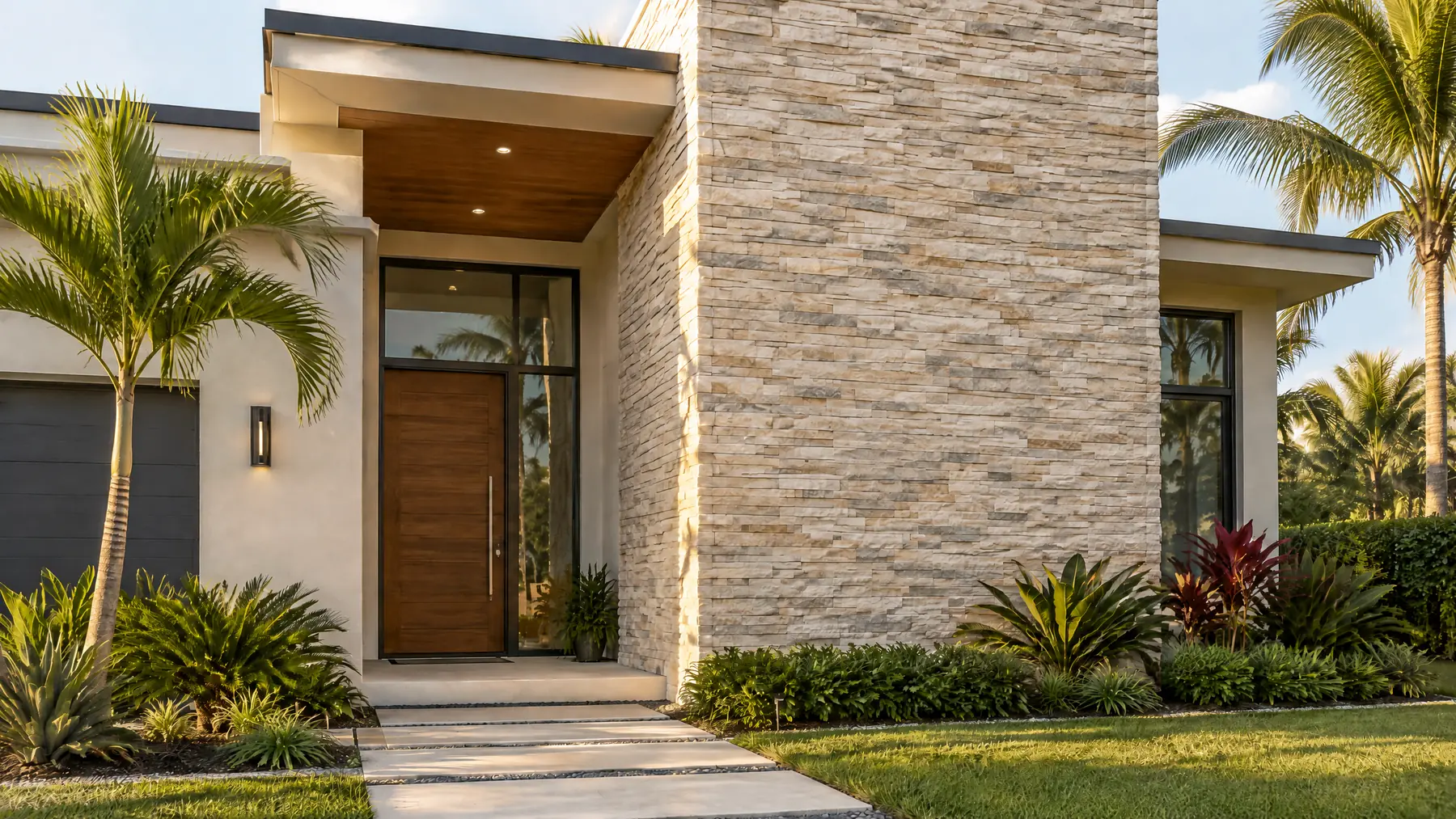
- Limestone ledgestone dry-stack on the entry wall, wrapping both outside corners.
- Stone wrap on the two porch columns with sloped limestone caps.
- Breathable sealer once cured.
- Repaint the stucco in a warm white to complement the stone.
Why a licensed GC
Exterior stone often runs alongside stucco, paint, windows, electrical for lights and permits. As a licensed Florida general contractor, J. Perry & Sons pulls the permits, prepares the HOA package, coordinates any licensed electrical work and takes responsibility for the whole job, with the wall prep, stone, caps and sealing written into one scope.
What to send us first
- photos of the wall from a distance and close-up
- rough dimensions, including height
- whether the wall is painted, stucco, block or framed
- photos of stone you like
- HOA guidelines if you have them
Commercial stone veneer
We also install stone veneer for businesses, HOAs and general contractors: entry monuments, signage walls, building bases, clubhouse fireplaces and amenity areas. Commercial work follows the architect's specification and the manufacturer's tested system, with submittals, mockups and inspections as the project requires.
Living with the project
Exterior stone work means saw cutting and some dust near the work area. We protect windows, doors, landscaping and walkways, clean daily and keep the entry usable. Interior fireplace walls are sealed off from the rest of the room with plastic barriers.
Choosing stone colors
Stone looks different in samples than on a full wall. To choose well:
- look at samples outside in morning and afternoon light
- hold them next to the roof, windows and paint colors
- see a larger mockup or a finished project when possible
- remember that natural stone varies from piece to piece; that variation is part of the look
- order all stone for the project at once so the color stays consistent
Sealers can slightly deepen the color of natural stone, so test the sealer on a sample first.
Order a few extra pieces of stone, including corners, and keep them with the sealer name for future repairs.
Get a price
Send photos of the wall, rough dimensions and the stone you like, or call (561) 556-7509. We'll inspect the wall, bring samples and send a written estimate with prep, stone, caps and sealing as separate lines. J. Perry & Sons is a licensed Florida general contractor (CGC1540699) with 150+ completed projects and a workmanship warranty.
Related services: exterior cladding · outdoor fireplaces
Why South Florida owners choose J. Perry & Sons
- A licensed Florida general contractor (CGC1540699) with 150+ completed projects and a workmanship warranty.
- Built over the right wall system, with flashing and a weather barrier.
- Our own stone masons.
- HOA documents prepared for your application.
- Daily updates with photos, and we call you before every decision.
Want your front to look like this? Design your front entrance
How we work
- Project Review. We look at the house with you and talk about the walls, the columns and the look you want.
- Proposal. A clear scope and a starting price, everything written down.
- Private Showroom Appointment. Choose the stone, the color and the pattern with us, with sample boards on your wall. You can add our designer for a full design plan; design time is billed separately.
- Installation. Wall preparation, stone installation, caps and trims, sealing and a final walkthrough, with daily updates.
Away for the season?
Hand us your front project and come back to it finished. You get photos and a short update every day, and we call you before every decision. Keys, deliveries, inspections and cleanup are handled. How renovating while you're away works →
Many of our clients prefer that their homes stay private, so most of our work isn't online. When we meet at your project, we'll show you work similar to yours. See private clients.
Working with an architect or designer? We take over and manage the whole project with them. See architects, engineers and designers.
Natural and coral stone veneer for façades, columns and feature walls.
Free project review · (561) 556-7509
FAQ
How much does stone veneer cost in South Florida? Stone veneer starts at $47 per sq ft installed, based on the stone, wall condition, height, corners, caps and access.
Is natural stone or manufactured stone better? J. Perry & Sons installs natural stone veneer only. Natural thin stone has authentic color, ages well and holds up to South Florida sun and salt; manufactured stone is cast concrete with color on the surface.
Can stone veneer go over stucco? Yes, but painted or coated stucco needs to be removed or covered with metal lath and a scratch coat so the mortar can bond.
Does stone veneer need to be sealed? Natural stone, especially coral stone and limestone near salt water, should get a breathable penetrating sealer. Porcelain doesn't need sealing.
Do I need a permit for exterior stone veneer? Often yes, for exterior cladding, columns and site walls. HOAs usually require approval too. We handle both.
How long does stone veneer installation take? Every project is different. Your schedule is written into the proposal once we've seen the space and confirmed the scope.
Is coral stone good for exterior walls in South Florida?
Yes. Coral stone is native to the region, holds up to sun and rain, and stays cooler than many other stones. It is porous, so it needs a breathable penetrating sealer and stainless fasteners near the coast. Natural stone veneer starts at $47 per sq ft installed. See coral stone.
Can you clad the whole front of my house in natural stone?
Yes. A full elevation is built over the right wall system: lath and scratch coat or bonded prep over block, a water-resistive barrier on framed walls, a weep screed above grade, and flashing at every window, door and roof line. Exterior cladding usually needs a permit and HOA approval; we handle both. See exterior house stone veneer.
Who installs the stone, your crew or a trade contractor?
Our own stone masons. They prepare the wall, set the stone, cut caps and sills and seal it, and J. Perry & Sons pulls the permit when one is needed. Licensed and insured. Certificate of insurance available on request.
Can stone veneer go straight onto drywall?
No. Drywall can't carry the weight of stone, and stone glued to drywall eventually comes loose. For an interior wall, we fasten metal lath through the drywall into the studs and apply a scratch coat, or replace that section with cement board, then set the stone in veneer mortar. On concrete block walls, the stone goes on the prepared block. We confirm the wall type during your Free Project Review.
Can I mount a TV on a natural stone wall?
Yes, if it's planned before the stone goes on. We add solid blocking in the framing where the TV mount will be, run power and an in-wall conduit for cables, and mark the location on the layout. The mount then fastens through the stone into that blocking. Electrical work is done by licensed electricians and coordinated by J. Perry & Sons. Adding a TV to a finished stone wall later is much harder.
How heavy is natural stone veneer, and can my wall hold it?
Thin natural stone is sawn to keep the weight down, so a properly prepared block wall or a framed wall with lath and a scratch coat can carry it. The building code limits how heavy adhered veneer can be. Thick, full-bed stone is past that limit and is installed with ties and support at the base instead of mortar alone. Where that's needed, engineering is by a licensed engineer, and we build to the drawings.
Will my condo association allow a stone accent wall?
Most do, with approval first. Associations usually ask for a description of the work, the materials, the contractor's license, and a certificate of insurance naming the association, since the work involves fasteners into the building and a heavier finish. J. Perry & Sons is a licensed Florida general contractor, CGC1540699. We prepare the paperwork the association asks for, and we can provide proof of insurance on request.
Can natural stone veneer go around a gas or electric fireplace?
Yes. The stone is set on a non-combustible backing, and the fireplace maker's clearances to the opening are followed exactly. With many electric units, the stone can come right to the trim. We plan the mantel, the hearth and any TV mount before the stone goes up, so nothing has to be cut out later. Gas lines are run by licensed gas contractors, coordinated by J. Perry & Sons.
Why choose natural stone veneer for a luxury home?
Natural stone is quarried, so the color runs all the way through each piece and holds up in the Florida sun. It weathers the way stone should and can be cleaned and re-sealed for decades. Each wall has a variation that can't be copied, which is why designers specify it for fireplaces, entries and facades on high-end homes.
What makes a stone veneer wall look custom?
Three things: blending stone from several crates as the wall goes up so colors don't band; tight, consistent joints or a clean dry-stack; and finished corners and returns at windows and openings. On larger walls, we lay out the first rows dry and walk you through the blend before the wall is set, so you approve the look first.
Call (561) 556-7509 or send us your project with photos, the city, approximate dimensions, and material selections.
Share your vision for your South Florida home.
Free project review · (561) 556-7509