
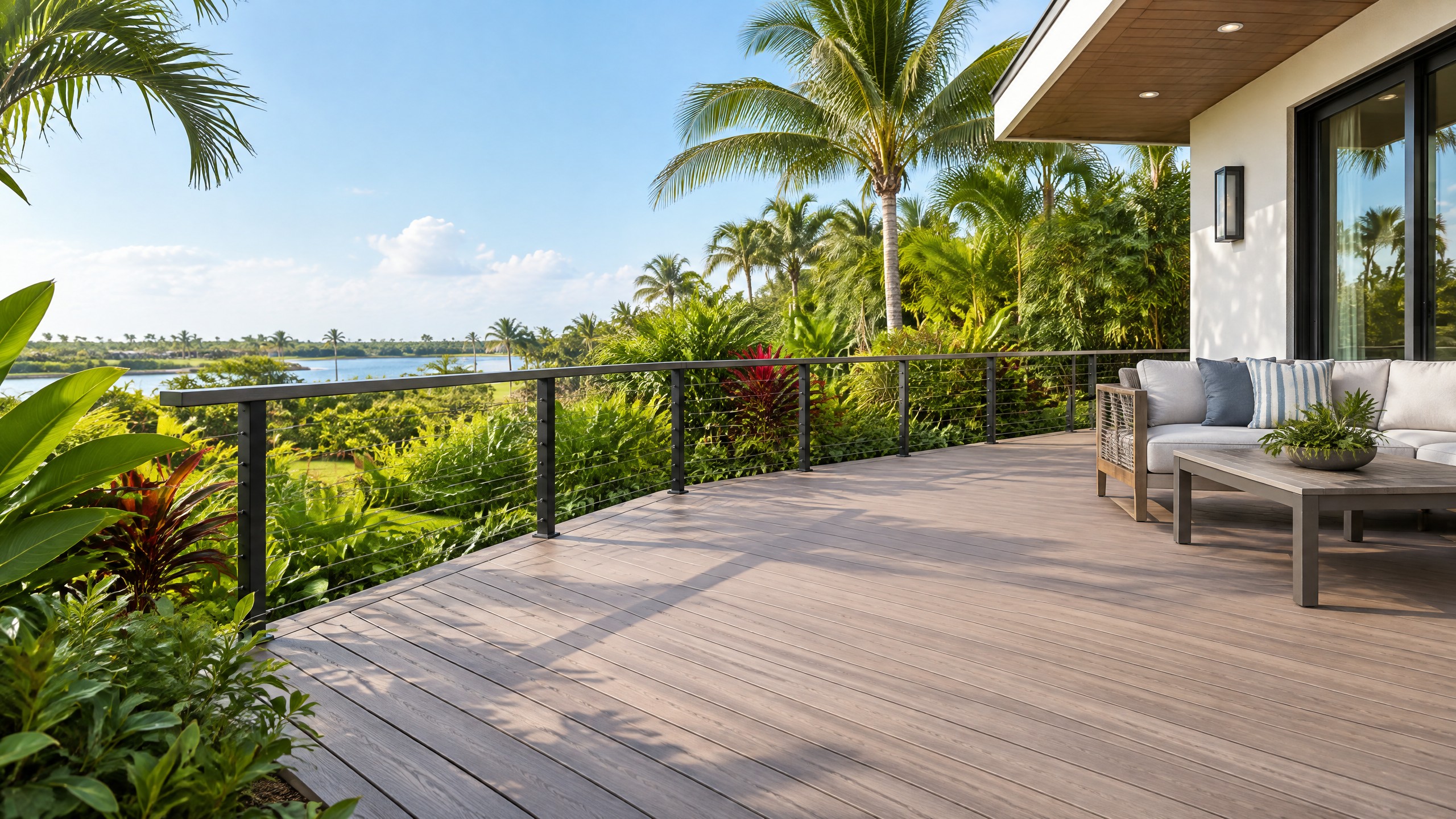
The brand question is the right question, asked a little early
You have narrowed it down. You want composite, not wood, because you are done sanding and staining. Now you have four names on the table: Trex, TimberTech, Fiberon and Deckorators.
Here is what we tell homeowners, builders and designers across Broward and Palm Beach: all four make good capped composite decking, and all four can give you a deck that looks great for a long time in Florida. The brand matters. But in our climate, the color you pick, the board core, the fasteners and the frame underneath matter just as much, and those are the parts that most brand comparisons skip.
J. Perry & Sons installs Trex, TimberTech, Fiberon and Deckorators decking. We do not represent any of them and we do not push one. This guide walks through how the four compare for sun, heat, salt air and pools, what really changes the result, and how the final choice gets made.
If you already have a deck in mind, send us your project and we will bring samples of each brand to your yard.
What all four have in common
Before the differences, the common ground. All four brands make capped boards: a core wrapped in a protective polymer shell that resists stains, fading, mold and moisture far better than the uncapped composite boards sold years ago. In South Florida we install capped boards only. Uncapped composite soaks up water at the surface and grows mildew in our humidity.
All four also offer:
- Several product lines at different price points, from entry collections to premium lines with deeper wood-grain patterns and color blends.
- Grooved-edge boards for hidden fasteners and square-edge boards for borders, stairs and fascia.
- Matching fascia and, in most cases, railing.
- Published installation instructions with joist spacing, gap and ventilation requirements that the manufacturer's warranty is tied to.
How the four brands compare, in plain terms
We keep this to what is widely documented about each brand. We do not quote brand prices, specs or warranty terms here; those change, and the manufacturer's own literature is the place to confirm them for the exact line you choose.
| Brand | What it is known for | Board cores offered | Railing to match | Good fit when |
|---|---|---|---|---|
| Trex | The most recognized composite brand; capped composite in several lines, with Trex Transcend as its premium line | Capped composite | Yes, Trex railing systems | You want the name most buyers know, and a wide color range |
| TimberTech | Capped composite plus capped PVC boards under the same brand | Capped composite and capped PVC | Yes, TimberTech railing systems | You want the option of a PVC core for a pool or a very wet spot |
| Fiberon | Capped composite in a range of wood-grain looks and colors | Capped composite | Yes | You want a broad set of looks and finishes to compare |
| Deckorators | Composite decking plus an extensive range of railing, balusters and post caps | Composite | Yes, a large railing and accessory range | Railing and trim details matter as much as the floor |
A few honest observations from installing all four:
Color and grain are where most clients decide. A board that looks warm brown indoors can read gray or red in your sun.
The core is the biggest technical difference. Composite boards mix wood fiber and plastic in the core. PVC boards are solid plastic with no wood fiber, so the board itself does not absorb water. For most South Florida decks a capped composite performs very well. For a pool surround that is constantly wet, a deck over a slab with little air below, or a spot that sees standing water, a PVC core is worth comparing. Among these four, TimberTech is the brand most clients come to for that PVC option.
The railing often tips the decision. If you want the railing, posts, caps and boards to read as one design, pick the brand whose railing you like, then choose boards from the same family.
Board heat: the South Florida question nobody can avoid
Every deck surface gets hot in direct Florida sun, and composite is no exception. Clients ask us which brand runs coolest. The honest answer is that color affects heat more than brand.
- Darker boards get hotter. Deep browns, charcoals and dark grays absorb more sun. On a west-facing deck with no shade, a dark board can be uncomfortable barefoot.
- Lighter boards stay cooler. Light grays, driftwood and sand tones are noticeably more comfortable underfoot.
- Some lines are marketed for lower heat. Several manufacturers offer boards with technology meant to reduce surface heat in certain colors. If cool-to-the-touch performance matters to you, ask us for the manufacturer's published heat data on the specific colors you are comparing, and compare those numbers, not marketing words.
- Shade changes everything. A pergola, a shade sail or a covered section over part of the deck does more for comfort than any board choice. See our pergolas page.
Salt air and pools
South Florida decks face two chemical exposures that inland decks do not: salt in the air near the coast and on the water, and chlorine or salt water from the pool.
The boards handle salt well. A capped board is not damaged by salt air the way metal is. What salt attacks is everything metal under and around the deck: fasteners, joist hangers, post bases, screws and railing hardware.
Hardware is where coastal decks fail. Near the ocean or the Intracoastal, we use stainless steel fasteners and connectors suited to salt exposure, and coated hardware rated for the location elsewhere. A beautiful board held down by a rusting screw stains around the head and eventually lets go.
Pools add wet feet and chemicals. Around a pool, a textured surface gives better grip than a smooth one, lighter colors keep feet cooler, and a PVC core is worth comparing for areas that stay wet. Where the deck meets the pool coping, the transition needs to be planned so water drains away and the board ends are supported. Our pool deck pavers page covers stone and paver options if you want to mix materials around the water.
Hidden fasteners: Trex Hideaway and the others
Most of our clients want a clean deck surface with no screw heads. That comes from hidden fasteners: clips that sit in a groove along the board edge and screw into the joist below.
Each brand has its own hidden fastener system designed for its own grooved boards. Trex Hideaway is Trex's hidden clip system, and it is one of the most searched deck terms for a reason: it is what most Trex decks are held down with. TimberTech, Fiberon and Deckorators each have their own clip systems for their boards.
Why it matters to use the matching clip:
- The gap is built into the clip. Composite expands and contracts with temperature. The clip sets the side gap the manufacturer requires, so boards do not push against each other in summer heat or open up too wide in a cool snap.
- The warranty usually expects it. Manufacturers specify which fasteners go with their boards.
Hidden clips are not used everywhere. Square-edge boards on picture-frame borders, stair treads and fascia are face-fastened with color-matched screws or plugs, placed in a neat, consistent line.
The frame underneath: where decks really succeed or fail
The best board on the market will not save a weak frame. Most deck problems we are called to fix come down to the structure, not the surface.
Joist spacing
Every brand publishes a maximum joist spacing for its boards. Tighter spacing is required for diagonal and herringbone layouts, for stairs, and often for commercial loads. A frame built at the wrong spacing gives you boards that bounce or sag between joists. We frame to the manufacturer's spacing for the exact board and layout you choose.
Framing material
| Frame | Where it fits | Notes |
|---|---|---|
| Pressure-treated lumber | Most residential decks at grade or slightly raised | Ground-contact rated where needed, joist tape on top of joists, coated or stainless hardware |
| Aluminum framing | Coastal sites, pool areas, roof decks, wherever rot or termites are a concern | Will not rot, light, works with low profiles |
| Steel framing | Longer spans and some elevated or commercial decks | Designed for the load and protected for the location |
See our deck installation page for the full range of deck types, including roof decks.
Ventilation and drainage
Composite needs air under it. Low decks and decks over concrete slabs need a minimum clearance and a path for air and water, or the boards stay damp underneath and move more than they should. Over a slab, we install sleepers or pedestals and make sure water drains off the slab rather than pooling under the deck.
What a composite deck costs in South Florida
Our current starting prices, installed, with material supplied by J. Perry & Sons:
| Deck type | Starting price |
|---|---|
| Composite deck boards on a new pressure-treated frame, hidden fasteners | Starting at $100 per sq ft |
| Composite decking over an existing sound slab | Starting at $88 per sq ft |
| PVC (cellular) deck boards on treated or aluminum framing | Starting at $95 per sq ft |
| Pool deck surround in composite or PVC, with coping transition | Starting at $95 per sq ft |
The final price is based on the brand and product line, the frame type, the deck height, the railing, the stairs and access at your property, and it is set in your written proposal after the project review. Our composite decking page covers pricing in more detail.
How the choice gets made: the project review
We do not ask you to pick a brand from a website. The choice is made in the project review, at your property, with the real conditions in front of us.
- We look at the site. Sun direction, shade, pool, distance to salt water, the slab or soil, the height off grade and how water drains.
- We narrow the options. Based on those conditions, we recommend a board core (composite or PVC), a color range that suits the heat on your deck, and the frame type.
- We bring samples. Boards from more than one brand, set in your sun next to your house and pool, so you choose with your own eyes and hands.
- We match the railing. We show railing that pairs with your boards, including glass and cable from our railings work.
- We write it down. Your proposal names the brand, the line, the color, the fasteners and the frame, line by line.
Once the proposal is signed, a simple rendering of the deck is included so you can confirm the layout and color. More detailed design by our in-house designer is a separate service.
For builders, designers and architects
We install to your specification and check it against the site and the manufacturer's instructions before boards are ordered. We pull every permit the work requires and follow city and county requirements. J. Perry & Sons is a licensed Florida General Contractor (CGC1540699), licensed and insured, with more than 150 projects completed, backed by a workmanship warranty.
Next step Call (561) 556-7509 or Send us your project. Share a few photos of the yard, the brand or color you are considering and any plans you have, and we will call you back personally to set up your Free Project Review.
Composite decking brands FAQ
Is Trex better than TimberTech?
Neither is better across the board. Both make quality capped decking. Trex is the most recognized composite brand, and TimberTech offers capped PVC boards as well as composite. The right choice is based on your color, heat, pool and salt exposure, and the railing you want, and we compare both with samples at your home.
Which composite decking is best for Florida?
Any capped board from these four brands can perform well in Florida when it is installed correctly. Choose a lighter color for heat, consider a PVC core for constantly wet pool areas, and use stainless hardware near salt water. The frame and installation matter as much as the brand.
Does composite decking get too hot in Florida sun?
All decking gets hot in direct sun, and darker colors get hotter. Lighter colors and shade make the biggest difference. Ask for the manufacturer's published heat data on the colors you like, and test samples in your own yard.
What is Trex Hideaway?
Trex Hideaway is Trex's hidden fastener system. The clips sit in the groove of the board edge, hold the board to the joist and set the side gap, so the surface has no visible screws. We use each brand's own hidden fastener system on its boards.
Do you install all four brands?
Yes. J. Perry & Sons installs Trex, TimberTech, Fiberon and Deckorators decking and railing, and we supply the boards, framing and hardware. We do not push one brand.
How much does a composite deck cost in South Florida?
Composite decks start at $100 per sq ft on a new frame and $88 per sq ft over a sound concrete slab. Priced in your written proposal after the project review. The final price is based on the brand, frame, height and access, and it is set after the project review.
Can composite decking go around a pool?
Yes. We build composite and PVC pool deck surrounds with a planned transition to the coping. A textured, lighter board is best for grip and heat. Pool deck surrounds in composite or PVC start at $95 per sq ft.
Guide
Request the guide: Decks and Docks for Sun and Salt
Call (561) 556-7509 or send us your project for a Free Project Review.