
"The inspector said there is moisture behind the stucco on two walls. The report lists the readings, but nobody has told me what actually happens next, who does it, or what the wall will look like afterward."
If you are holding a moisture report or a contractor's warning, this page explains what remediation is, what gets opened up, what gets rebuilt, and where J. Perry & Sons fits.
Short answer: stucco remediation means removing the stucco and damaged material behind it, correcting the way water got in, installing new flashing and sealants, and rebuilding the wall in lath, coats, finish and paint to match the rest of the house. J. Perry & Sons is a licensed and insured general contractor. J. Perry & Sons does moisture and window water testing before the work starts. On condo and HOA buildings, we build to the engineer's report.
We repair and rebuild stucco across Broward, Palm Beach and Miami-Dade. J. Perry & Sons pulls the permits and keeps the project under its management.
What stucco remediation is (and what it is not)
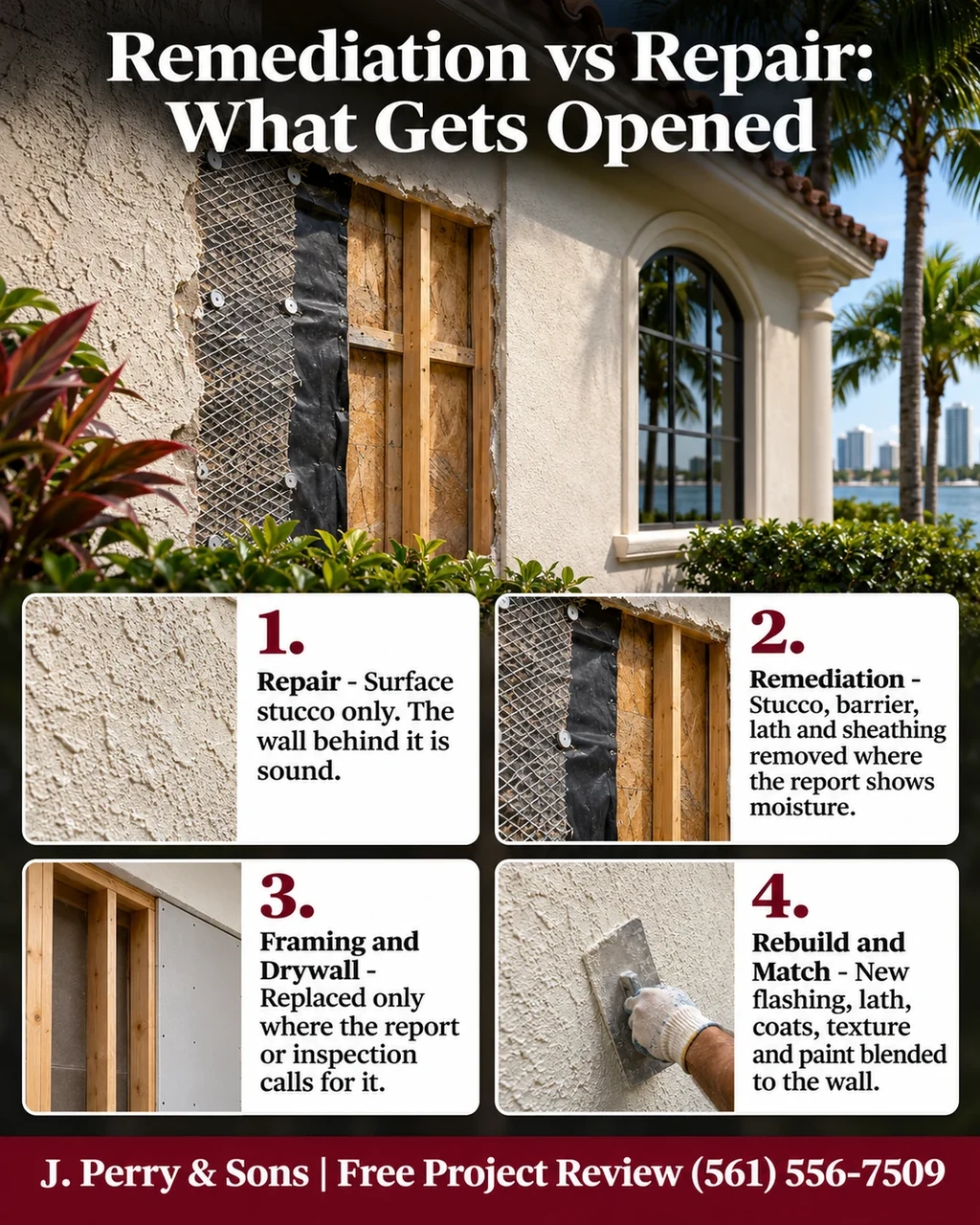
Remediation is a different job from repair, even though people use the words interchangeably.
Repair fixes surface damage that stays on the surface: a crack, a small spalled patch or a stain. The wall behind it is sound, so the failed stucco is cut out, the coats are rebuilt and the texture is matched. Our stucco repair page covers that work, which starts at $1,500.
Remediation deals with water that has already gotten behind the stucco and into the layers beneath: the paper or barrier, the lath, the sheathing and, where the report requires it, other wall materials. Wet material is removed, not covered. The entry point is found and corrected, and then the wall is rebuilt in the scope set by the report, drawings and permit.
Remediation is not a coat of paint, a bead of caulk or a sealer sprayed on top. Those approaches can hide the problem while trapped moisture keeps working behind them.
It is also not a diagnosis. We do the moisture readings and window water testing. Structural opinions and engineering reports come from the engineer, and we build to the permitted drawings. We do not present ourselves as engineers and do not issue diagnostic reports. We open the wall where the report directs, remove damaged material within the approved scope and rebuild it to the report and drawings.

Signs you may need remediation
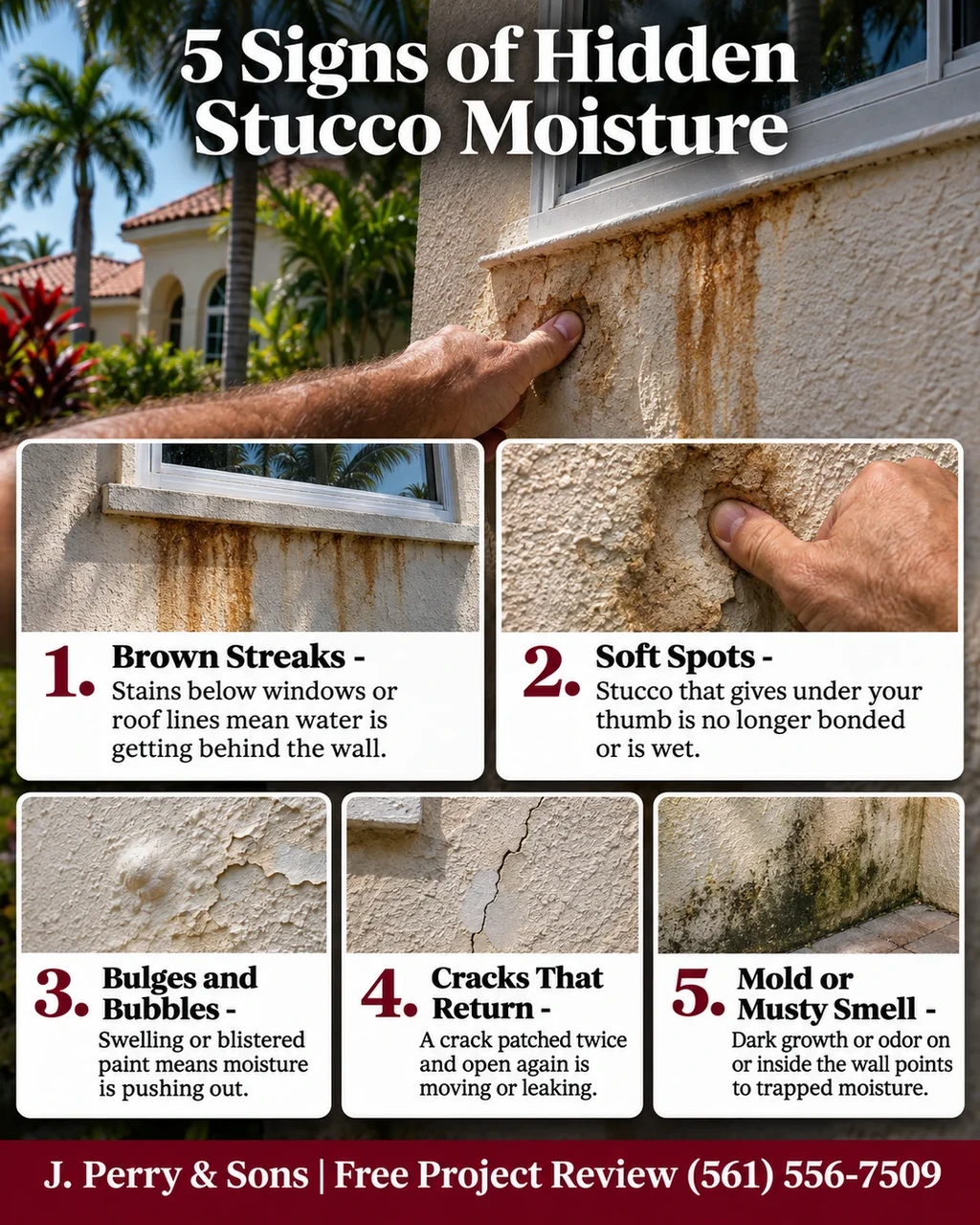
Water behind stucco often shows up in small ways before anything fails.
- Stains. Brown or gray streaks below windows, at roof lines or at the base of a wall.
- Soft or spongy spots. Stucco that gives under thumb pressure or feels cool and damp.
- Bulging or bubbling. The surface swells away from the wall, or paint blisters in the same place.
- Cracks that return. A crack patched twice and open again, especially at window corners.
- Mold or a musty smell. Dark growth on the wall or an odor inside a room that shares the wall.
- Interior signs. Peeling paint on interior drywall, warped baseboards, stains on the ceiling or marks around window trim.
- Rot behind the wall. Soft trim, damaged window frames or material that deteriorates when the wall is opened.
Any one of these can have a simple cause, and several together point to a wall that needs to be opened. We will not guess. When the signs add up, your inspector should confirm what is wet before anyone cuts into the wall.
Photograph each sign close up and from a few feet back, then send the photos with the inspection report before anyone paints over the area.
Our scope: open, remove, flash, rebuild and finish
Once the report identifies the affected areas, the scope is written line by line in an itemized proposal. The work follows a sequence.
- Protect and open. Landscaping, windows and floors are protected. Stucco is removed in the area marked on the report and around it as needed to find sound material.
- Remove damaged material. Wet or degraded barrier, lath, sheathing and any other materials identified in the approved scope are removed. Material that stays wet is not simply left in place.
- Correct the entry point. The source of the water is addressed first: window and door flashing, sill details, roof-to-wall transitions, penetrations and sealant joints.
- Rebuild the wall. New weather barrier, flashing and lath go in, followed by the stucco coats. Each coat cures according to the material requirement before the next one goes on.
- Finish and match. Texture is matched to the existing wall and blended at the edges so the work does not read as a patch from the driveway.
- Paint. The rebuilt area is painted and blended to the elevation. Our residential painting team keeps the stucco and paint scope coordinated.
- Permit and inspection. J. Perry & Sons pulls the permit, schedules the inspections the city requires and keeps the project file.
When your engineer or the building department requires a particular flashing detail, drainage layer or fastening schedule, the work follows those details. We do not substitute our own design.
Testing and diagnosis come from your inspector
This is the part of remediation that people most often mix up, so it is worth being direct.
Who tests? J. Perry & Sons does the moisture and window water testing. On condo and HOA buildings, the engineer's report sets the repair scope. That professional maps where the stucco is wet, evaluates how far the damage reaches and identifies the likely source. The report is the document the construction scope is based on.
What we do. We open the wall as the report directs. If the opened area reveals conditions outside the written scope, work pauses while the condition is photographed and a written change is provided before continuing. If something appears unrelated to stucco, we tell you and suggest that your inspector review it.
What we do not do. We do not issue moisture diagnoses, state that a wall is structurally sound or unsound, or guarantee that no moisture exists in areas that were not opened. Those are findings for the people qualified to make them.
If you do not have a report yet, we can explain what type of inspector or moisture specialist to contact before you spend money on the wrong trade.
Windows, doors and roof lines: where water gets in
Moisture rarely enters through the middle of a stucco wall. It commonly enters where another building element meets the stucco.
- Windows and doors. Perimeter sealant can dry and split, or sill and head flashing may be missing or incorrectly installed. Our window and door perimeter caulking page describes how those joints are renewed.
- Roof lines and roof-to-wall transitions. Flashing must lead water out over the stucco. Missing kick-out flashing can send rain into the wall.
- Penetrations. Hose bibs, lights, vents, dryer exhausts and electrical boxes need sealed edges.
- The base of the wall. Soil, mulch or pavers built up against the stucco, or a sprinkler spraying the wall, can keep it wet.
- Cracks and failed paint. Open cracks let water in directly.
- EIFS edges. On synthetic stucco, water at terminations and penetrations can enter the foam. See our page on EIFS and high-build stucco, because the remediation method differs from cement stucco.
A wall rebuilt without correcting the entry point can become wet again. That is why entry-point correction comes before the new stucco in the scope.
Wall materials, framing and interior finishes
The inspection report and permitted drawings identify which layers need to be opened and what replacement work is required. If the project includes sheathing, framing or interior drywall, those items are listed separately in the written proposal and handled in accordance with the applicable plans, permit and licensed trade requirements. Ask us to show each item as its own line so you can see exactly what the report requires.
Matching the finish and paint
A rebuilt section is successful only when it belongs on the house. That takes planning from the first day.
Texture. We identify the finish—sand float, Santa Barbara, skip trowel, dash or smooth—and build a sample on site. New stucco is blended at the edges rather than stopped on a hard line.
Color. New stucco cures at a different shade than weathered paint. Rather than leave a visible patch, the paint is taken to a natural break such as a corner, band, window line or full elevation. Painting a whole elevation costs more than painting a patch, but it can be the version that looks right.
Smooth conversion. If you are already rebuilding a wall and want a modern look, it may be the time to discuss a smooth stucco finish, with the change shown and quoted as part of the work.
Bigger scope. When damage affects most walls, we explain full-house stucco, because rebuilding every wall under one scope can be more sensible than a series of patches.
Permits, license and insurance proof
Remediation touches the building envelope, so it should be permitted and inspected. J. Perry & Sons pulls the permits and keeps the project under its management. Roofing, waterproofing, electrical and other specialty work that we do not self-perform is handled through the licensed contractor for that trade.
Licensed and insured. Certificate of insurance available on request. The written proposal is itemized so you can compare the scope line by line, and we work with your inspector and engineer to build to their details.
Starting price for stucco remediation
Remediation is priced after the project review because the scope is set by the inspection report and the size of the opening. Stucco repair is the entry point and starts at $1,500. Remediation of a wall with moisture behind it is a larger scope; the final number is based on the areas identified in the report, access, materials replaced and the finish to match. It is confirmed in your itemized written proposal, and the price in your signed proposal is the one that applies.
Stucco guides
Frequently asked questions
How much does stucco remediation cost?
It is more than a stucco repair, which starts at $1,500, because layers behind the stucco are removed and replaced. The price is based on the area opened, what is found behind it, the flashing and sealant work, the finish to match and the paint. We confirm it in an itemized written proposal after the project review.
What is the difference between remediation and repair?
Repair fixes damage that stays in the stucco surface. Remediation removes stucco and the wet or damaged layers behind it, corrects the entry point and rebuilds the wall. Our stucco repair page covers the first, and this page covers the second.
Who tests for moisture?
J. Perry & Sons does moisture and window water testing to find where the water is getting in. We are not the engineer and don't issue engineering reports. On condo and HOA buildings, we build to the engineer's report and the permitted drawings.
Will insurance cover it?
That is based on your policy and on the cause of the damage. Some policies cover sudden water damage and not gradual leaks. Ask your insurer, and we will provide an itemized written proposal and photos for your claim.
Do you rebuild the framing too?
The inspection report and permitted drawings determine whether framing, sheathing or interior drywall work is included. Each required item is identified in the written proposal and handled in accordance with the applicable plans and licensed trade requirements.
Will the new stucco match the rest of the house?
That is the goal of every job. We match the texture with an on-site sample, blend the edges and paint to a natural break or the full elevation so the repair does not show.
Should I paint over the stain until the inspector comes?
No. Paint hides what the inspector needs to see and can trap moisture. Take photos and leave the wall as it is.