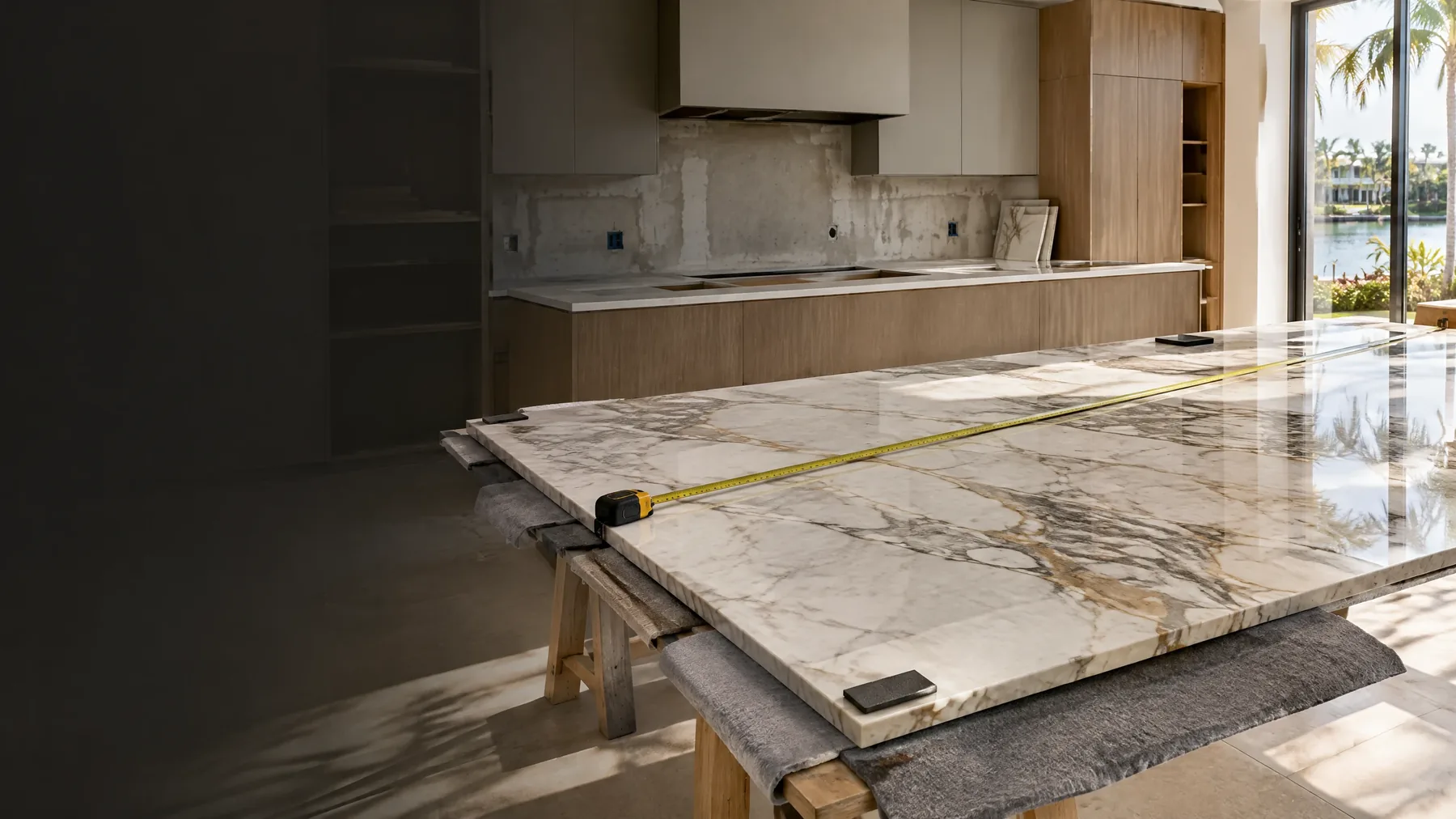
"We love our cabinets, we just hate the counters. If we replace only the tops, what's the process, and how much of it do we actually have to live through?"
Good news first: of all the work you can do in a kitchen, a countertop replacement is the least disruptive. Most of the process happens away from your house, in the slab yard and the fabrication shop. The part that happens in your kitchen is short and contained, and the kitchen stays usable for almost all of it.
What makes a countertop replacement smooth is not speed at installation. It is the order of the steps before it: the right slab, a kitchen that is truly ready for the template, the sink and faucet on site, and the backsplash decided. This guide walks through that order as our stone slab installation crews run it, and the same process applies to unit turnovers under our commercial countertops and slabs service. Timing is confirmed in your written proposal. By then your slab is chosen and its availability is known, so the schedule fits your real kitchen.
Licensed and insured. Certificate of insurance available on request.
Countertop replacement at a glance
| Step | Who | What you decide |
|---|---|---|
| Free Project Review and measure | J. Perry & Sons | Material type, edge, backsplash approach |
| Written estimate | J. Perry & Sons | We review every project personally and follow up with you directly. |
| Slab selection | You, with us or your designer | The exact slab, finish and edge profile |
| Readiness check | You and J. Perry & Sons | Sink, faucet, cooktop and range on site or confirmed |
| Template | Our templater | Seam locations, overhangs, faucet hole positions |
| Fabrication | Stone shop | Slab layout on veined material, if you want to approve it |
| Removal and installation | Install crew | Nothing new; the decisions are made |
| Plumbing reconnect and sealing | Plumber we coordinate; our crew | Care routine for your stone |
Step 1: Free Project Review and measure
At the first visit we measure the runs, the island and any vanity tops you want included, and we check the cabinets. Keeping old cabinets is often the best value if the boxes are solid, but they must be level and structurally sound to carry stone. We shim small differences in level; larger problems mean the cabinet base needs work first, and we will tell you before you order a slab.
We also look at what comes off: laminate, tile tops, old granite or quartz, and what sits on top of them. Tile backsplashes often break when old tops come out, so we discuss that now, not at installation.
We review every project personally and follow up with you directly.
Step 2: Choosing your material
Most of our clients choose between four materials:
- Quartz. Engineered, consistent color, no sealing required, strong stain resistance. The most predictable choice for a busy kitchen.
- Quartzite. Natural stone, very hard, with the movement and depth of marble. Needs sealing and careful slab selection.
- Marble. The classic luxury surface. Softer and more reactive to acids, so it etches; many owners accept that patina as part of its character.
- Porcelain slab. Thin, very stain- and heat-resistant, and suited to book-matched looks and full-height backsplashes. It requires a fabricator experienced with porcelain.
Our guide Choosing Your Countertop: Quartz, Quartzite, Marble and Porcelain compares them for South Florida kitchens; ask us for it at the project review.
Choosing Your Countertop: Quartz, Quartzite, Marble and Porcelain
How quartz, quartzite, marble and porcelain compare for South Florida kitchens.
Step 3: Slab selection
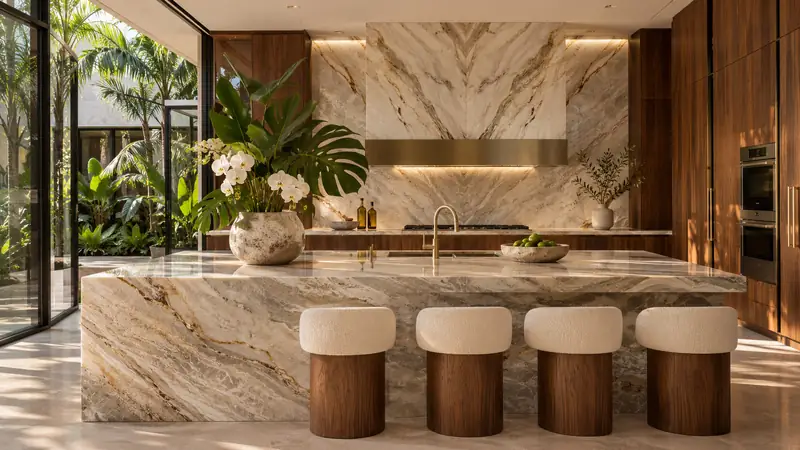
For quartz, you can often choose from samples, since the pattern is consistent. For quartzite, marble and veined quartz, you should see the actual slab. We go to the yard with you or your designer, and you choose the exact slab that will be cut for your kitchen. On veined stone, this is also the moment to think about where the dramatic movement should land: on the island, behind the range, or on a full-height backsplash.
What you decide here: the slab, the finish (polished, honed or leathered) and the edge profile.
Common quartz colors are usually in stock in South Florida yards. Specific veined quartz, exotic quartzite and some porcelain slabs may need to be ordered, and that lead time is part of your schedule.
Step 4: Getting the kitchen ready for the template
Templating a kitchen that isn't ready is the most common cause of a second trip and a delay. Before the template:
- Cabinets set and level. New cabinets fully installed and anchored; existing cabinets checked and corrected.
- Sink on site. Undermount sinks are templated from the actual sink, not the spec sheet.
- Faucet chosen. Hole count and spacing are drilled at the shop.
- Cooktop or range specs confirmed. Slide-in ranges and cooktops need exact cut dimensions.
- Backsplash decided. A full-height slab backsplash changes where seams go and how the slab is used.
- Appliances in position, or their exact dimensions confirmed, so overhangs and clearances are right.
Step 5: The template
Our templater measures the installed cabinets digitally or with physical templates, marks the sink and cooktop cutouts, faucet holes and overhangs, and confirms seam locations with you. Islands longer than a standard slab may need a seam or a jumbo slab; we show you where a seam would fall and how it will look so there are no surprises.
What you decide here: seam locations, overhang depth at the island seating, and faucet and soap dispenser positions.
Step 6: Fabrication
The shop cuts the slab, shapes the edge, cuts and polishes the sink and cooktop openings, drills the faucet holes and polishes every exposed face. On veined stone, the shop can lay the template pieces over the slab and show you the layout before the saw cuts, so you approve which part of the slab goes where.
This is the stage you don't see, and it is where most of the process happens. Your kitchen is fully usable in the meantime.
Step 7: Removal and installation
This is the only stage that takes over your kitchen, and it follows a set order:
- Protection. Floors and cabinet faces covered, path to the door cleared.
- Disconnect. Water shut off, faucet and disposal disconnected; the cooktop is disconnected by the trade that installed it.
- Removal. Old tops are cut loose and carried out. Laminate comes off in pieces; old granite and quartz come out in sections and leave with us.
- Cabinet check. Cabinet tops cleaned, shimmed and checked for level again.
- Dry fit. Each piece is set to confirm fit before adhesive goes down.
- Set and seam. Tops are bonded, seams joined with color-matched epoxy and pulled level with seam setters.
- Sink mount. The undermount sink is epoxied and clipped, then sealed.
- Cleanup. Seams polished, surfaces cleaned, area vacuumed.
Step 8: Plumbing reconnect and sealing
The plumber reconnects the faucet, drain and disposal once the sink adhesive has set. Natural stone such as quartzite and marble is sealed, and the sealer cures before the surface goes into everyday use. Quartz and porcelain don't need sealing. We go over care with you: what cleaners to use, what to avoid on marble, and how to protect the surface from heat.
If the backsplash is being replaced or repaired, it follows the countertops, because tile and slab backsplashes sit on the finished top. Our kitchen backsplash cost guide covers the options.
What can stretch the process
Slab availability. A specific veined quartz, an exotic quartzite or a particular porcelain may need to be ordered.
A kitchen that isn't ready at the template. A missing sink or an undecided faucet means a second template visit.
Seams and jumbo slabs. Long islands may need a jumbo slab, which needs more people and a clear carry path into the house.
The old backsplash. Tile backsplashes often crack when old tops come out. Plan on a new backsplash or a matching repair.
Condo logistics. High-rise buildings require elevator reservations and a certificate of insurance, and every slab piece must fit the freight elevator. We arrange all of this before installation.
Hurricane season. Shops and deliveries back up after a storm. If you're planning a fall installation, select and template early.
Doing the countertops as part of a bigger remodel
If cabinets are being replaced, countertops come after the cabinets are installed and leveled, and before the backsplash and final paint. The full kitchen sequence, with demolition, rough-ins and inspections, is covered in kitchen remodel timeline in Florida. Keeping your cabinets and replacing only the tops is often the best value if the boxes are solid; see cabinet refacing vs replacement.
Bathroom vanity tops
Vanity tops follow the same sequence on a smaller scale: measure, choose the stone (often a remnant or a piece from the kitchen slab), template from the real vanity and sink, fabricate, install, reconnect. Doing vanity tops alongside a kitchen is efficient because the same slab selection, template visit and installation can cover both. It is also the easiest way to carry one stone through the house, so the primary bath and the kitchen read as one design. Powder rooms are a good place for a more dramatic stone, since the top is small and the room is seen by every guest.
For designers
The decisions that shape a countertop job are slab selection, seam placement and backsplash approach. We meet you at the yard, share the template layout for approval on veined stone, and coordinate with your backsplash and lighting plan so the stone reads the way you designed it.
Countertop installation by city
Book a residential template through J. Perry & Sons stone slab installation. For multiple units, see commercial countertops and slabs.
Quartzite, marble and porcelain slabs, templated and installed with care.
Free project review · (561) 556-7509
Quartz countertop installation — FAQ
Can I use my kitchen during a countertop replacement?
Yes, for almost all of it. Fabrication happens at the shop. The kitchen is out of service only during removal and installation, and until the sink adhesive sets and the plumbing is reconnected.
Do I need to remove my backsplash?
Not always, but tile backsplashes often crack when the old tops come out. Plan on a repair or a new backsplash, which goes in after the countertops.
Do I have to choose the actual slab?
For quartz, samples are usually enough. For quartzite, marble and veined quartz, we recommend choosing the exact slab at the yard, with us or your designer.
What must be ready before the template?
Cabinets level and anchored, the undermount sink on site, the faucet chosen, cooktop or range specs confirmed, and the backsplash approach decided.
Does quartz need to be sealed?
No. Quartz and porcelain don't need sealing. Quartzite and marble are sealed, and the sealer cures before everyday use.