Hardwood flooring is one of the most sought-after features in a South Florida home — but it's also one of the most commonly misinstalled. South Florida's humidity creates unique challenges for wood flooring that require careful material selection and installation technique. Here's the complete guide.
Solid Hardwood vs. Engineered Hardwood in South Florida
The most important decision in wood flooring for South Florida is choosing between solid hardwood and engineered hardwood. The difference matters enormously in this climate.
- Solid hardwood (3/4 inch solid wood): Expands and contracts significantly with humidity changes. South Florida's humidity swings — from 40% in air-conditioned interiors to 90%+ during summer — cause solid hardwood to gap, cup, and buckle. Only appropriate in well-controlled interior spaces away from moisture. Can be refinished multiple times.
- Engineered hardwood (real wood veneer over plywood core): The plywood core is dimensionally stable — it doesn't expand and contract like solid wood. Handles South Florida humidity significantly better. Available in the same wood species and finishes as solid hardwood. Can be refinished one to three times, based on the thickness of the wear layer.
- Our recommendation: Engineered hardwood for virtually all South Florida applications. The performance difference in this climate is significant.
The Owner's Guide to Tile, Floors and Stone
How to choose the right floor, what makes it last, what to ask any contractor and how to care for it.
+ Free one-page checklist: Before You Order Your Tile
Glue-Down, Floating or Nail-Down: Installing Wood Over a Florida Slab
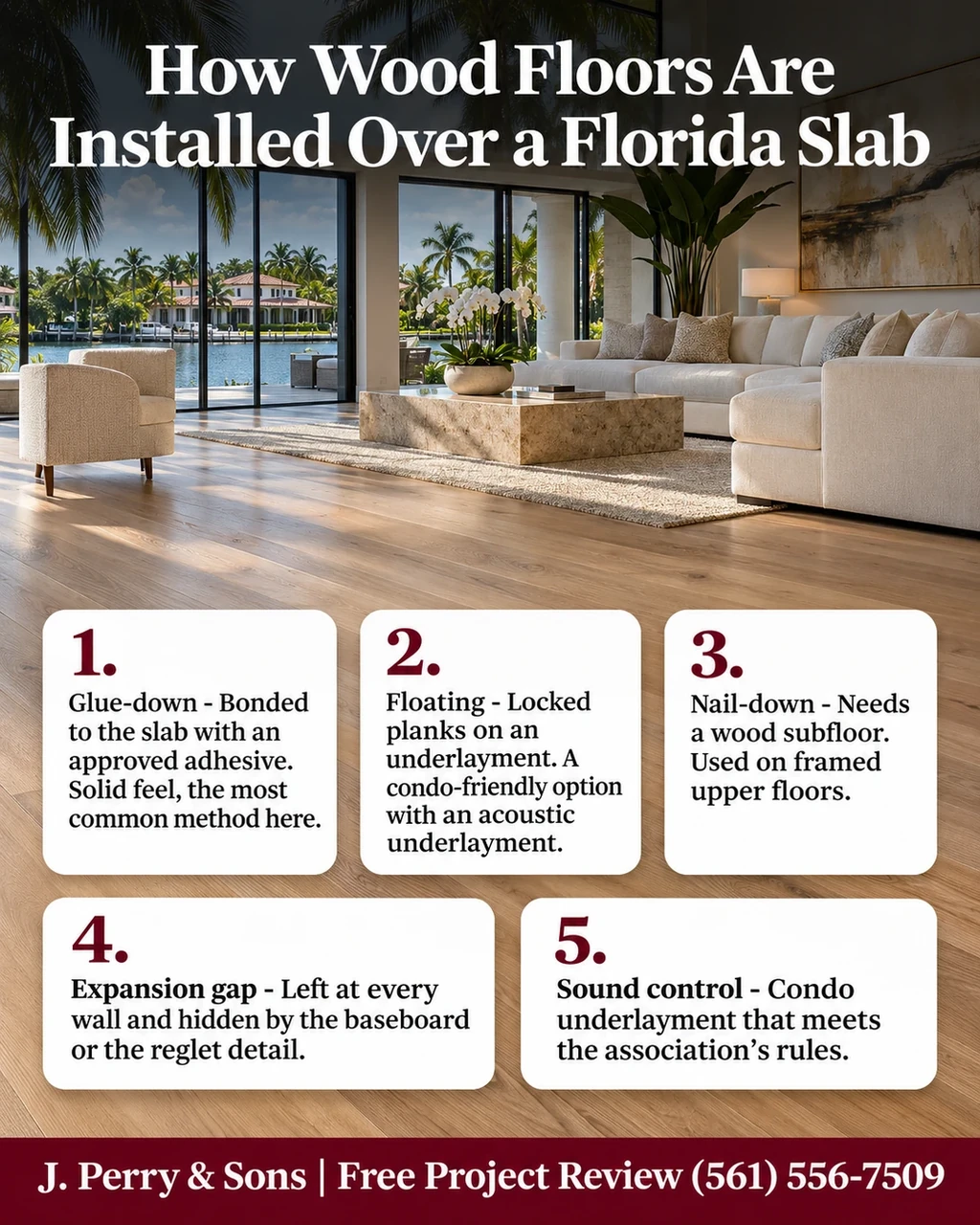
Almost every home and condo in South Florida sits on concrete. That one fact decides how a wood floor is installed, and it is where most wood floor problems start.
Glue-down. The plank is bonded directly to the slab with a flooring adhesive. This is the most common method for engineered wood here, because it gives a solid feel underfoot, no hollow sound and no bounce. Many of the adhesives used over slabs are urethane products that also act as a moisture-control layer, so one product bonds the floor and limits slab moisture. The adhesive has to be the one the flooring company approves for that plank, applied with the trowel it specifies, so the floor is fully bonded.
Floating. The planks lock together and rest on an underlayment, with no adhesive to the slab. Floating floors are faster to remove later and can work well over a slab that has a moisture-control underlayment. They feel slightly softer and can sound more hollow than a glue-down floor. In condos, a floating floor over an approved acoustic underlayment is one way to meet the association's sound rules.
Nail-down. Nailing needs a wood subfloor, which most South Florida homes do not have on the ground floor. It applies on upper floors framed in wood, or where a plywood subfloor is installed over the slab first.
The expansion gap. Wood moves with humidity, so every installation leaves a gap at the walls and at fixed objects such as cabinets and columns. Baseboards normally hide it. On walls finished with a reglet and no baseboard, the gap is planned into the wall detail before the drywall is finished. See our flush baseboard and reglet work.
Condos. Most associations require a sound-control underlayment under wood and written approval before work starts. Our guide to condo flooring rules explains what boards usually ask for.
Next step: tell us whether your home is on a slab or a framed floor, and whether it is a condo, and we will tell you which method fits.
Best Wood Species for South Florida
- White Oak: The most popular hardwood species in South Florida luxury homes in 2026. Wide planks (5–7 inches), wire-brushed texture, and natural or gray stain finishes. Stable, beautiful, and works well as engineered hardwood.
- European Oak: Similar to white oak but with a slightly different grain pattern. Popular in contemporary South Florida homes.
- Hickory: The hardest domestic hardwood — extremely durable and resistant to denting. Popular in high-traffic areas.
- Walnut: Rich, dark brown color — dramatic and luxurious. More expensive than oak. Popular in master bedrooms and studies.
- Brazilian Cherry (Jatoba): Extremely hard, reddish-brown color. Traditional South Florida choice, still found in many established homes.
Reading an Engineered Wood Spec: Wear Layer, Core, Width and Finish
Two engineered floors can look the same in the showroom and perform very differently in your house. These are the four parts of the spec that matter most.
Wear layer. The wear layer is the real hardwood on top. Its thickness decides how many times the floor can be sanded and refinished in the future. A thin wear layer can be lightly screened and recoated; a thick one can be fully sanded more than once. If you plan to live in the house for a long time, the wear layer is worth paying for.
Core. Under the wear layer is the core, the part that keeps the plank stable. Multi-ply hardwood or plywood cores, with layers cross-laid against each other, resist humidity swings well. The core is the reason engineered wood works in this climate where solid wood struggles.
Width and length. Wide, long planks are the look most owners want, and they show off white oak grain beautifully. Wider boards also move more across their width, so a wide-plank floor needs a stable core, a well-prepared slab and full adhesive coverage.
Finish. Most engineered floors arrive prefinished from the factory, with a hard coating that goes on more evenly than a site finish. Oil finishes give a natural, matte look and can be spot-repaired, but they need periodic maintenance. A wire-brushed surface hides small scratches and sand better than a smooth one, which matters near pool doors and in homes with dogs.
Edges. A micro-bevel at the plank edges hides small height differences between boards. A square edge gives a seamless look but needs a very flat slab.
We bring samples to your home so you can see the species, width and finish in your own light. See renderings and samples.
Next step: pick two or three samples you like and we will compare their wear layer, core and finish with you side by side.
Hardwood Flooring Cost in South Florida (2026)
- Engineered hardwood installation (standard): Starting at $12 per sq ft installed
- After the project review, your written proposal lists the following scope and pricing: Engineered hardwood installation (wide plank, premium): installed.
- Solid hardwood installation: Starting at $18 per sq ft installed
- After the project review, your written proposal lists the following scope and pricing: Hardwood floor refinishing (existing floor).
- After the project review, your written proposal lists the following scope and pricing: Hardwood floor repair (boards only): per area.
- After the project review, your written proposal lists the following scope and pricing: Stair nosing installation (per step).
Moisture Testing, Acclimation and Humidity Control
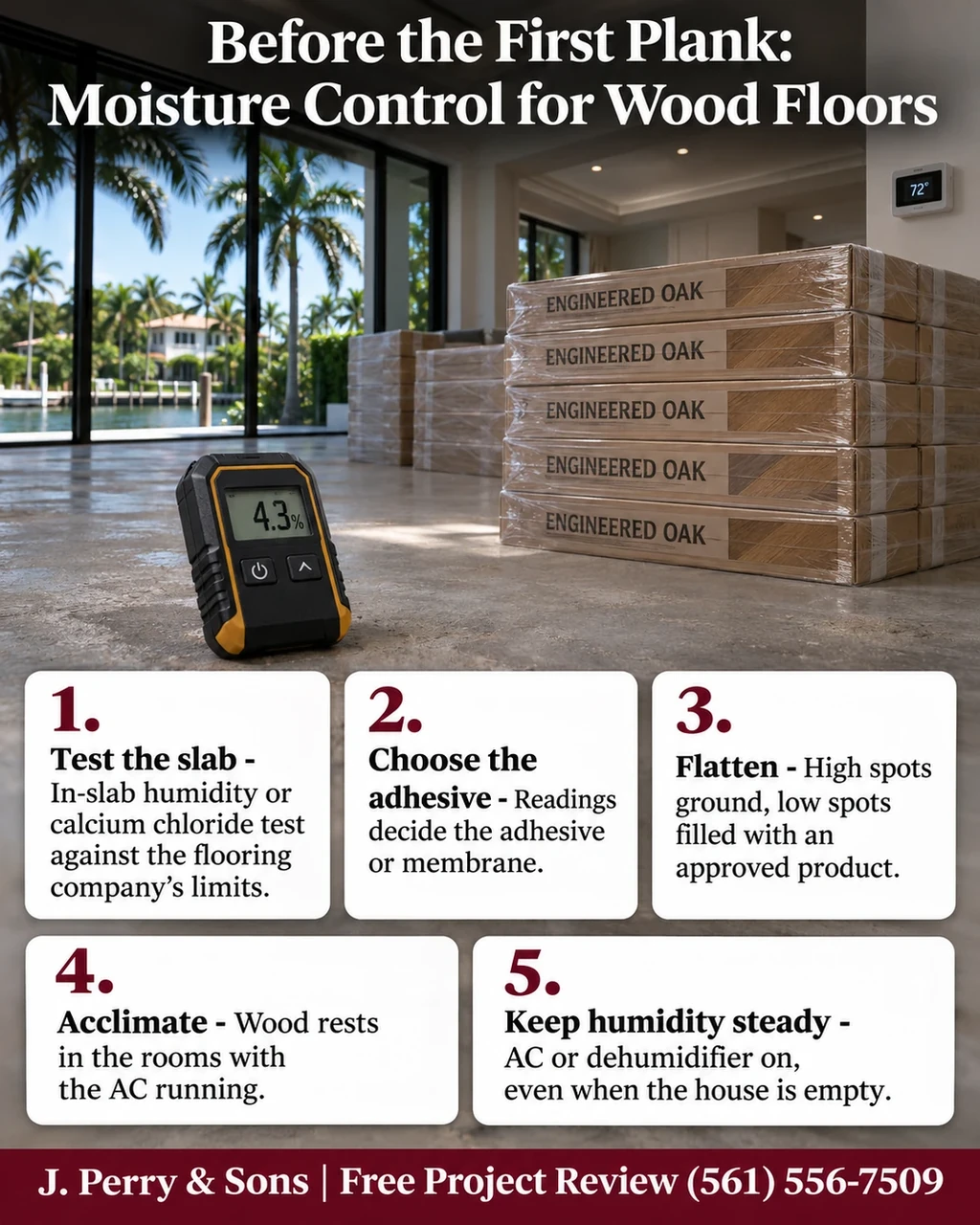
A wood floor in South Florida is only as good as the moisture control around it. These checks happen before the first plank goes down.
Testing the slab. Concrete releases moisture for its whole life, and a slab on grade here keeps getting it from below. The slab is tested against the limits set by the flooring company and the adhesive maker, using an in-slab relative humidity probe (ASTM F2170) or a calcium chloride test (ASTM F1869). The readings decide the adhesive or membrane. Skipping the test is how floors cup.
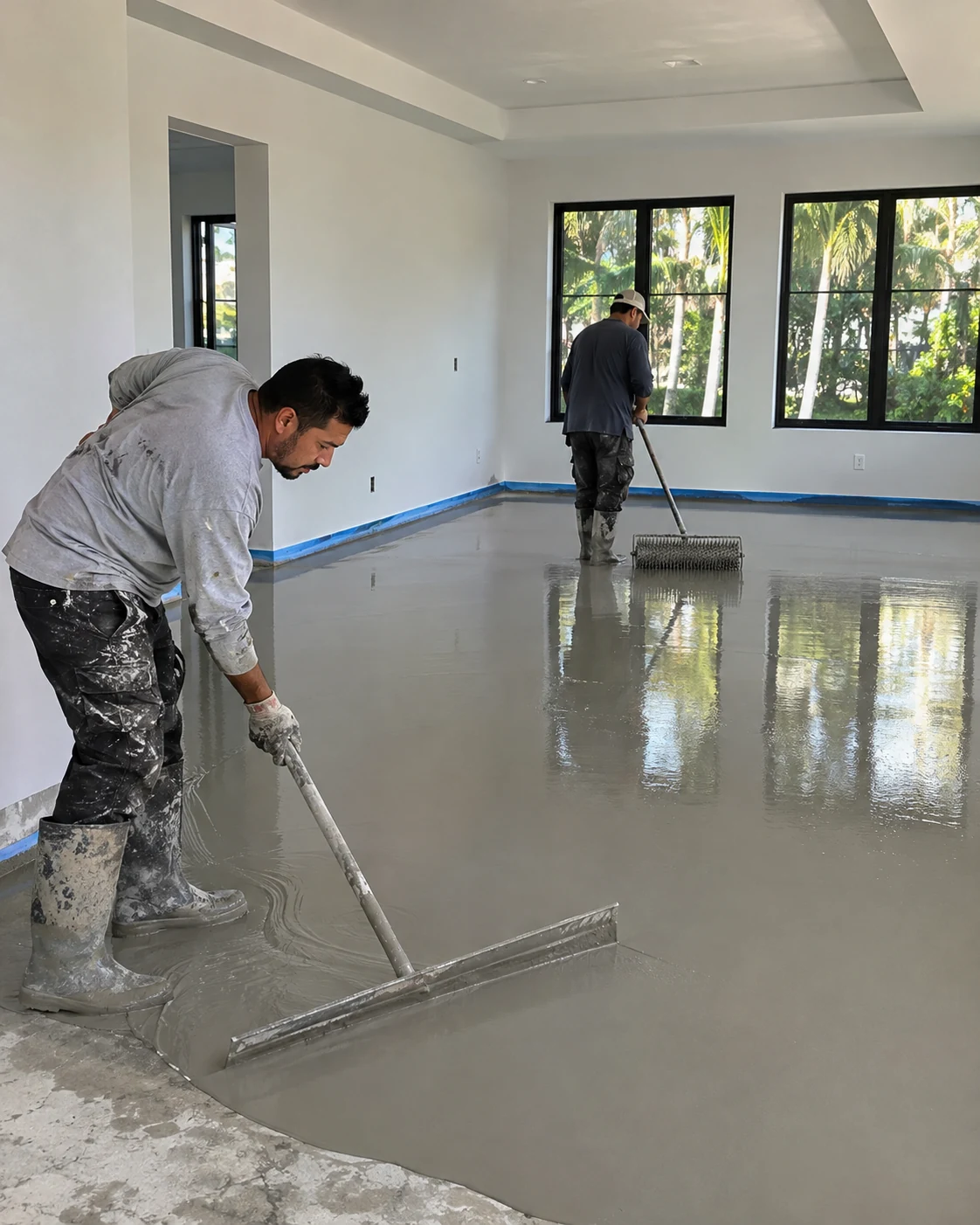
Flattening the slab. Wood needs a flat slab to bond fully. High spots are ground down, and low spots are filled with a patching or leveling product that the adhesive maker approves for use under wood. The flatness tolerance comes from the flooring company's installation instructions. Our floor leveling service covers this step.
Acclimation. The wood is delivered to the house and kept in the rooms where it will be installed, with the air conditioning running at normal living conditions, for the acclimation period the flooring company sets. Wood stored in a hot garage or installed before the AC is running absorbs moisture and moves after installation.
Living with it. After installation, the indoor humidity should stay within the range the flooring company lists. For seasonal homes, that means leaving the air conditioning or a dehumidifier running while you are away. A house closed up through the summer with the AC off is the fastest way to ruin a wood floor.
After a leak or flood. Wet wood rarely recovers on a slab. Our guide to flooring after water damage explains what can be saved.
More on this topic in our guide to engineered hardwood and Florida humidity.
Next step: if you are planning wood in a seasonal home, tell us how the house is cooled while you are away, and we will tell you what the floor needs.
Where Wood Meets Tile, Stairs and Wet Rooms
The details at the edges are what make a wood floor look finished.
Wood next to tile. Tile and wood are rarely the same height. The transition is planned so the two finished surfaces meet flush or close to it, using a flush reducer, a stone or wood threshold, or a slight build-up under the lower floor. It is planned before either floor is installed.
Kitchens. Engineered wood can run through a kitchen when the owner accepts the care it needs at the sink and dishwasher. Many owners choose tile in the kitchen and wood in the living areas instead.
Bathrooms and laundry. In bathrooms and laundry rooms we install porcelain, which handles the humidity.
Stairs. A wood floor that ends at a worn, mismatched stair looks unfinished. Stair treads in white oak matched to the floor, with matching nosings and risers, tie the two levels together. If you are replacing an old stair finish, see our guide on converting stairs to wood or tile.
Next step: send us a photo of every place your new wood floor will meet another floor or a stair, and we will tell you how we would finish each one.
FAQ
Is engineered hardwood real wood?
Yes. The top layer is real hardwood, such as white oak or walnut, bonded to a stable multi-layer core. You see and feel real wood, and the core is what keeps the plank from cupping and gapping in South Florida humidity.
Can engineered hardwood be glued directly to a concrete slab?
Yes, and it is the most common installation here. The slab is tested for moisture, flattened, and the plank is bonded with the adhesive the flooring company approves, often a urethane adhesive that also limits moisture from the slab.
Can I put wood floors in a condo?
Usually yes, with association approval and a sound-control underlayment that meets the building's rules. The board's requirements are reviewed before the material is ordered, so the floor you choose can actually be installed.
How do I keep a wood floor from cupping in Florida?
Keep the air conditioning running and indoor humidity in the range the flooring company sets, including when the house is empty. Wipe up water quickly, use mats at pool and patio doors, and never wet-mop wood. Most cupping comes from moisture, either from the slab or from the air.
Do you supply the wood flooring?
Yes. J. Perry & Sons supplies the flooring, adhesive and underlayment from the preferred brands we work with, ordered from one lot with an overage for future repairs. We bring samples to your home before you decide.
Porcelain, wood or stone, chosen for the way you live and installed on a flat, sound base.
Free project review · (561) 556-7509